
Field of Barrows” and the Chönyi Bardo
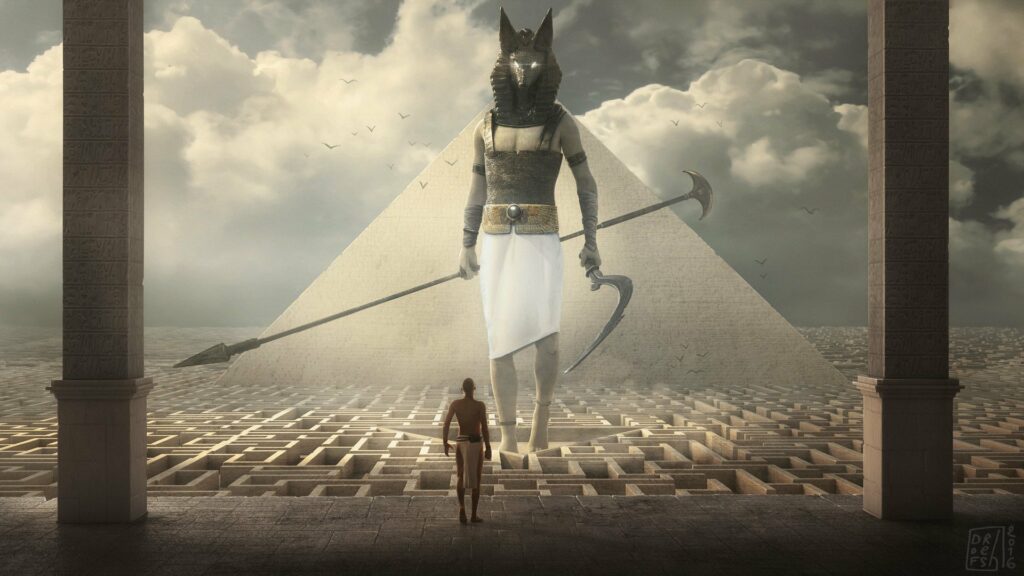
Posthumous journey of the mind through the Interval is the path of “change of host,” reaping the fruits and taking stock.
The exhaustion of the possibilities of one conductor leads the mind not only to a new support, but also to its reconfiguration, the destruction of internal connections, and the freeing of possibilities for new ones to arise. Therefore the experience of the intermediate state is not just a “transition,” it is a global restructuring of the stream of consciousness, which, of course, includes extremely unstable phases when the “old” connections and anchors are no longer relevant, while the new ones have not yet formed.
Accordingly, in this restructuring three phases are clearly distinguished:
- “destruction,” that is — dying (known as “Chikhai bardo” or “Fire of Sunset”), consisting in the exit of the mind from connection with the outdated guide,
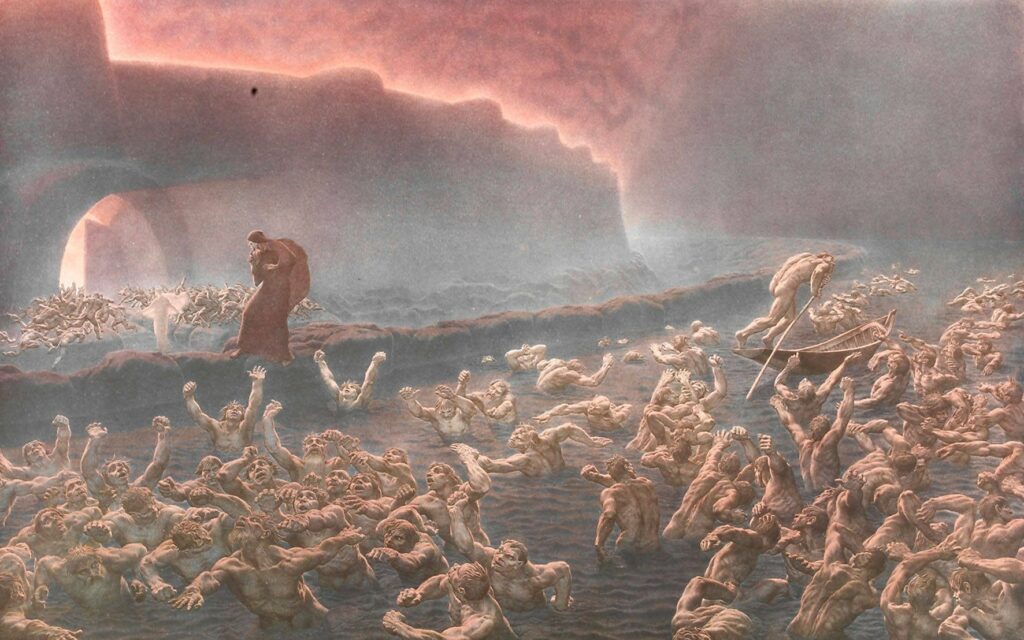
- “instability,” that is — the search for current needs, opportunities, and impulses that will serve as the basis for the further destiny of the mind — its rebirth or liberation. This stage, known as “Chönyi bardo” or “Path of Hills,” involves analyzing the current state of the flow of mind, the manifestation of its driving forces and motives, and ends with a “Judgment” or “Decision” about the next path;
- “new emergence,” that is — emergence onto the next level of existence, which may mean a return to the Cycle, fixation in one of the “blessed” states, or complete liberation. This stage is called “Sidpa bardo” or “the Path of waters,” since the mind no longer “walks,” but is carried by the stream of destiny.
It is clear that the most responsible stage of this wandering is the stage of analysis, since, on the one hand, it is aimed at extracting as much as possible the “lessons,” the “dry residue” of the preceding incarnation, and on the other hand, it has the maximum possibilities for the mind’s breaking out of conditioned cycles.
This stage implies a “complete audit” of the mind, and is described
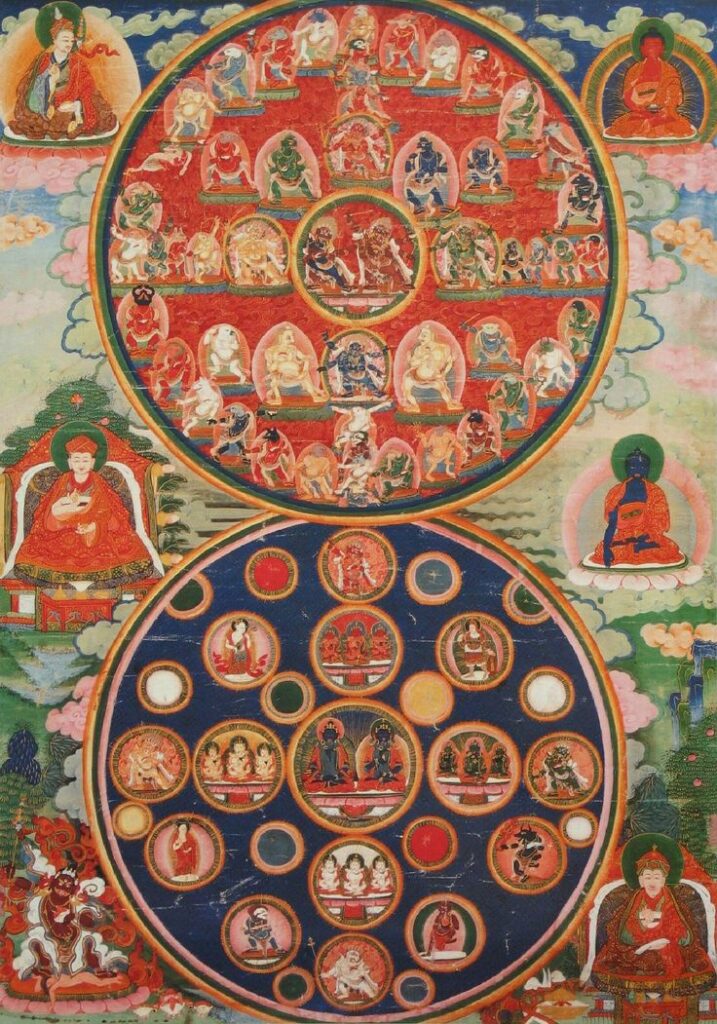
- by Tibetans — as “the Vision of Shitro,” that is — the entire set of affirming (“peaceful”) and acting (“wrathful”) activities that constitute the cosmos, or the “mandala” of mind;
- by Egyptians — as “the Field of Hills,” that is — an “ascent” to a number of “peaks” and a “survey” from them of the whole Interval (Duat).
It is clear that these descriptions differ only in perspective and cultural context and boil down to the same process — the successive interaction of the perceiving focus of mind with its “foundations” — acting and causal forces.
Since the mind of a Western person is usually less self-reflective than is characteristic of the Buddhist tradition, the “posthumous visions” of most such people are more like the descriptions in the “Book of خروج” than the context of “Bardo thodol,” that is, they include an element of a “hike,” a “movement” through the Space of the Interval.
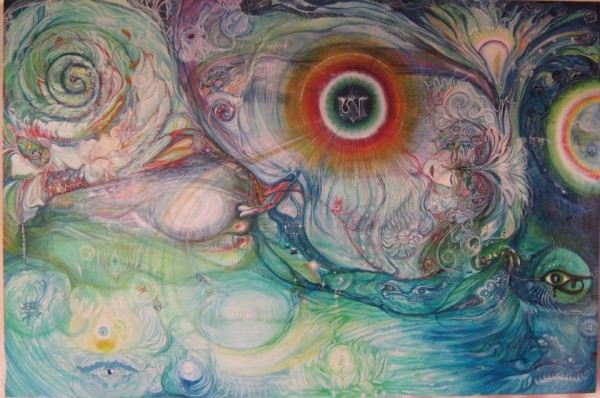
We have already noted that the Egyptian system describes this “wandering” as two separate quests — “journey of ka,” that is — “the path of the persona” (or, in terms of modern esotericism — the Journey in the posthumous body) and “journey of ba,” that is — “the path of the soul” (or the Path of the Mental body), subordinated, respectively, to the “Osirian” and “solar” scenarios and described in the corpora of the “Books of Exit” and the “Books of the Barque.” The outcome of these quests should be the “reunification” of the active and essential components of the flow of mind, and — either their integration and liberation, or the emergence to the next stage of development.
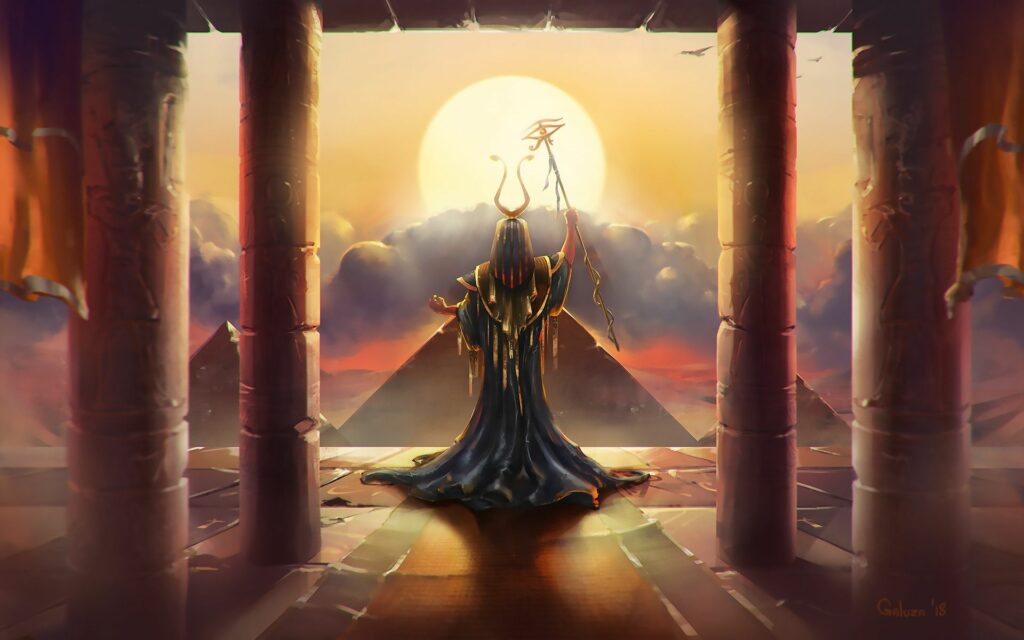
Since the “Path of the Barque” occurs in a domain usually inaccessible to the perceiving part of mind, it proceeds as a “background” journey, engaging the higher levels and actors of the psychocosmos and not much dependent on personal effort, and only periodically “shining through” into the “Osirian” plane through a number of “Arit,” “windows” into the higher reality.
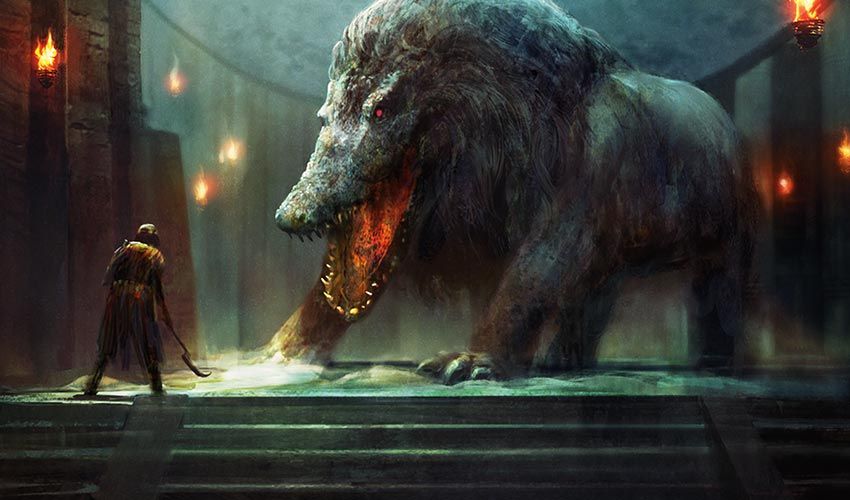
The main task of the “path of ka” is “attaining purity,” that is — finding all the “bugs” allowed during life and their “exhaustion,” that is — disconnecting from the sources of “Hu energy,” personal power — libido.
We have already mentioned that the Osirian myth describes, as one of the important moments, the “dismemberment” of the body of the God of Life (as well as his “loss” of independent reproductivity), which reflects the fact well known from the experience of every being — of the mind’s fragmentation. At the level of ka, fourteen main “parts,” modes, are found, which are symbolized by fourteen Fields (Sehet) or Regions (Aats) of the Duat, and, on the personal posthumous path — by fourteen Peaks. Note that in the Tibetan tradition Chönyi bardo also includes fourteen visions occurring in the first days after the dead person’s awareness of their death.

The “ascent” to each of the peaks is contact with the corresponding “part of Osiris’ body,” or, in other words — with the corresponding basic Matrix of mind. The sequence of these contacts can be traced both in the images of the “Books of Exit” (as well as the “Coffin Texts”) and in the tradition of Bardo thodol. The “Peaceful” and “Wrathful” deities, the Guardians and Judges of the Duat (and Shitro), are the forces that were active in the course of life, served as the foundations and drivers of its flow, and interaction with them on the “peaks” or in the “days” is the identification and analysis of the reactions of mind and the forms of manifestation of these basic forces in the past life. In other words, when the mind, for example, ascends the Hill of baboons or sees Buddha Amitabha, it explores the degree to which it found and manifested its desires, and, for example, the Hill of Shesmu or the Vision of Tramen makes it possible to identify the degree and form of influence of the “animal” component of a being.
Thus, passing through the “Field of Hills” is a key component of the posthumous state, in which the “fate of ka” is decided — the flow of vitality passing through this being and constituting its foundation. Correct contact with each of its stages, “peaks,” can help, at minimum, to achieve the “purification of ka,” and, “at best,” to catch a glimmer of ba, integrate with it and thus — find liberation.
Wow En, how good you are! I lost track of you for 10 years and now I’ve met you again, and you already manage to describe in one short article the experience and research of a lifetime!!)))