
Fear of the Heart
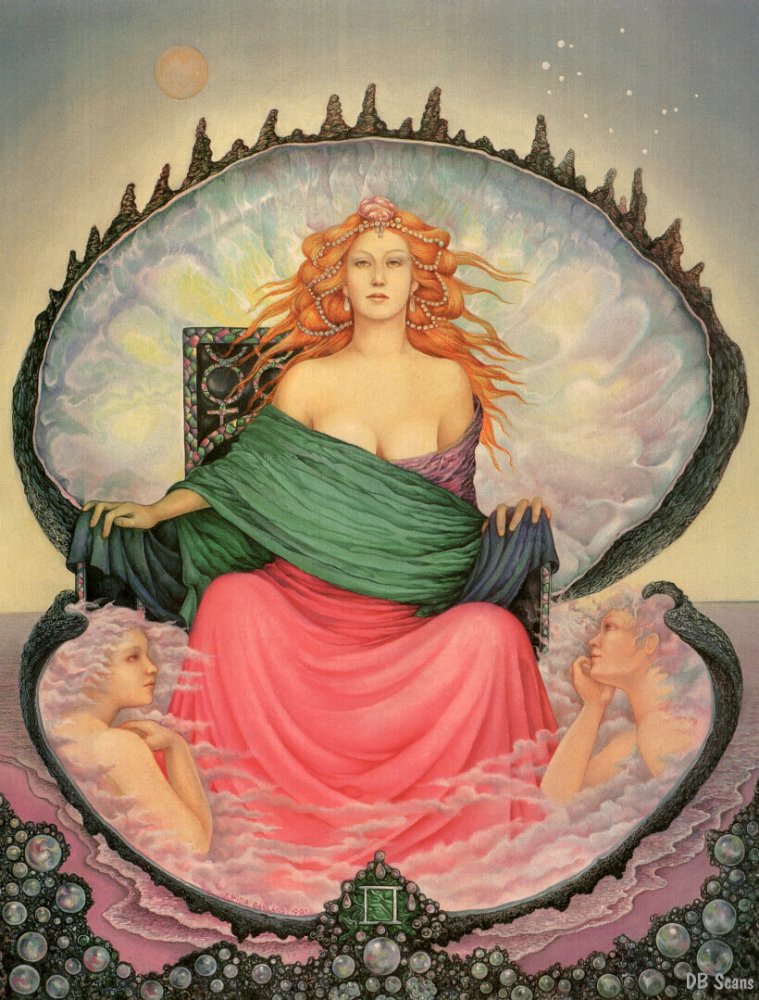
Although the driving force behind any achievement is always desire, one of the most difficult tasks a Magus faces is generating and directing desires.
And paradoxically, for the Magus who so ardently pursues realization and emphasizes will, the inability to “reach” his own desires can become an insurmountable obstacle.
Desire is born when the Waters of the primordial Dark Ocean are stirred into movement by the Primary Fire, and it is in that mutual attraction that the possibility of any manifestation lies.
The problem is that, on the one hand, the Magus strives for maximal self-identity — that is, differentiation of himself from the primordial unity of the world — yet, on the other hand, the principle of desire belongs precisely to that One nature of the Great Mother. Thus the Magus who seeks freedom and independence cannot move toward his aim because he cannot generate the impulse required for it.
This problem is especially acute for the “innate” Magi — those who, across a number of lives, have sought to use Magic as a system of liberation to transcend the conditioned world. Such travelers often become rigid, joyless people with cold hearts, trapped precisely by their own self-destructive rigidity in seeking freedom. They think that feelings make them “weaker,” that feelings force them to lose their “independence,” which, of course, undermines them, since you cannot achieve freedom by suppressing nature. A frequent reason for suppressing the realm of feeling is also the fear of pain that arises when feelings reach a dead end. Both motives — the fear of “unfreedom” and the dread of pain — are clearly serious barriers that must be overcome. And the inability to go beyond one’s limits turns the striving for freedom into a new slavery.
Until the Magus stops fearing his heart, until he allows it to come alive and tremble with joy (and with pain), his movement will lack the intensity needed to overcome the world’s pull toward mutual consumption and to pass beyond it.
The apparent “unfreedom” of feelings is balanced by the sense of a supremely free pleromic unity, and the pain of a “shattered” heart is the cost of growth.
We have said more than once that a successful Magus is a passionate being who achieves dynamic harmony precisely in the turmoil of his living heart.
The Magus laughs when he has much power and weeps when he lacks it; the Magus is overflowing with love and compassion, and it is precisely such an existence that makes the Magus a victor.
It is obvious that it is crucial not to fall into the many traps that abound in this area — into emotional traps, whims, and caprice — yet the Magus’s iron discipline must become his reliable protection in this current.
The razor’s edge he must walk lies precisely between the abyss of Dionysus and the abyss of Apollo — between the madness of ecstasy or trance, and the sterility of cold reason.
Therefore, the Magus who seeks effective existence must overcome his fears — including the fear of a heart filled with life; he must awaken it just as he must awaken his intelligence, develop it just as he must develop his will, and then, in the triune unity of his Psychocosmos, he will have a chance to attain the supreme gift of the Absolute — Freedom.
… And you will be as gods, knowing good and evil.
To achieve the Freedom of the Absolute means to become God. Not in the ordinary sense – an object of worship, no. But in the great ability to create – to create oneself and worlds, to acquire and give, to feel the contact of worlds and their interpenetration and mutual preservation.
‘Here is happiness, here are the rights!’ (ASP)
Thus, the temptation is precisely this ability – and for an ordinary person an illusion: the apple has been bitten, but neither freedom, nor magic, nor even immortality (or post-mortem existence) results.
The mysterious facets of being are filled, perhaps most of all, with emotions – they’re the most energy-consuming element. Even will and reason draw their energetic potential from feeling.
The more I read, the more confused I get. Everything is essentially clear, but a thousand and one more questions arise in pursuit. How can I control emotions? As far as I can judge from other articles, suppression is a sure path to failure. I even saw a woman who, suppressing her emotions and keeping everything inside, lost her appetite and fell ill with anorexia until she set them free. I understand that the answer to most questions lies in control and discipline; it’s all simple, but how difficult it is.
The heart is alive – you can hear it… 🙂
But the nature of Desire is open to debate! 😉
“Fear of the Heart”… Your ability to voice and touch upon such deep matters has always captivated me… 😉
Not long ago, I realized that I had been running away from my heart all my life. So many turbulent, boiling years have passed, and now I see that all of them were essentially a flight from myself… Because it’s really scary)))
And this is not a fear of feelings, emotions, experiences, or suffering and pain. Because there has been, and continues to be, more than enough of all this))))
I realized that the Fear of the Heart is something much deeper. It’s a fear of one’s own … suchness, naive and in some sense formless. And it was only when I finally accepted my heart for what it is that I saw that it is the fear of one’s true nature, which the Daoists call “true mind,” Tibetans call “rigpa,” and Buddhists call “Buddha nature”…
The heart is like a hurricane, a mad typhoon, a raging whirlwind. And in this never-ending whirlwind spin all the passions of the world – all its pain, all its love, anger, fears, desires, and so on and so forth…
And we are constantly engrossed in this whirlwind, but if we venture into the deepest depths of our heart, there, at the very center of this unquenchable cyclone, we will suddenly discover… complete calm, absolute Silence! This is that universal Silence, residing in absolute Peace and absolute Devotion to all that exists, all-pervasive and overflowing to the very edges…
…Shanti! 😉
Of course, it is the heart that is the place where individuality finds its manifestation. And this manifestation is precisely in the unique way of generating chains of incarnations – analogies, associations, perceptions, creations, which is unique only to this Monad.
Byarka, for an ordinary person – the Beatitudes, and unconscious Sovoboda-Happiness.
+Almost insane…+
.
Passion weaves a pattern from feelings, igniting a fire
Manifesting as a flash of light, in the heart of a strange poet…
.
Not expecting anything, quietly playing in life,
Weaving meaning on the go, the child writes a verse for himself.
Revising, digesting, eternally recalling something
And plays on the go, alone with himself in his Game.
.
Burning the excess within, improving the feeling of life
Flying into the world of self, catching light within while burning
Releasing links, roots, sending currents through the veins of the day
Reviving the moment with fire, giving a compliment to the lady…
.
He plays with “nothing” in strands, dancing Life
Sewing patches on grievances, so joy is not spilled…
If only to grasp the essence of movement, to spin the Game within
With a bright thought of guidance, to burn the glitter of illusions…
.
I came here to play and I don’t need to be disturbed,
Life flows and I live in It, when I sleep I fly in It,
And feeding only on a moment, desiring only one now,
When I snuggle up to you again, through you I will dissolve in It…
“Innate” magicians find it harder because the scarcity of resources available to a person searching for a way to freedom is more obvious to them. But the “locking of the heart in prison” is something that a magician experiences and subsequently discards, because there is no efficiency in restraining one’s nature, (as practice shows):)
For an average person, I would reduce the above to the necessity of self-affirmation, i.e., getting rid of disbelief in oneself, the tendency to imitate, and bias. A magician is a creator of that part of the Unified Reality that is contained within him potentially, which he must reflect in the process of evolution. But the main thing that can happen is the acquisition of one’s own Self, without which only imitation is possible. At a certain stage of the path, this manifests as the proclamation of oneself as the ‘navel’ of the universe and absolute atheism, as a detachment from Unity. There is no other way to independent creativity, after which follows a return to Unity through self-awareness as part of It and subsequently transitioning to the feeling of being both Whole and part of It…
There is another facet, or side, as you prefer, to this question.
It’s one thing to fear opening one’s heart, but an even bigger problem is that there is no one to accept love.
What may exist in the heart of a magician may be so strong and huge that it scares or cannot be accommodated by another.
This is a much bigger problem than being afraid to open your heart and allow yourself to love 😉
I agree with the information written by Enmerkar. However, after reading the comments, I want to add that an open heart is unconditional acceptance; it is without thought, it simply radiates love and strength, if you will, and the presence of another who can “contain” it as mentioned, is unnecessary! This is a representation of your mind, a system of perception built on conclusions. Feelings and emotions are like living beings; they are separate from consciousness just like thoughts are. This is where the true path of a mage with an open heart begins; then you realize that black cannot exist without white, that a person is the axis of rotation of these forces and the forces of materialization, you could say the value of the Cosmos. Yet, at the same time, all processes are one: black and white cannot exist separately, and a person, possessing magnetic abilities, must act from the position: what is outside is also inside!
I thank everyone and Enmerkar for the impetus towards understanding and awareness!
Isn’t desire the driving force behind any achievement? It seems that, if you look into the essence, at the core of everything, it is primarily Interest, the interest of knowledge, while desire is secondary and arises when the interest is not so easy to satisfy, when obstacles arise in its path. Obviously, this is to make the process of cognition more interesting and, so to speak, to stretch the pleasure. In general, from this position, it is also interesting and useful to consider these phenomena.