Magic and Fear
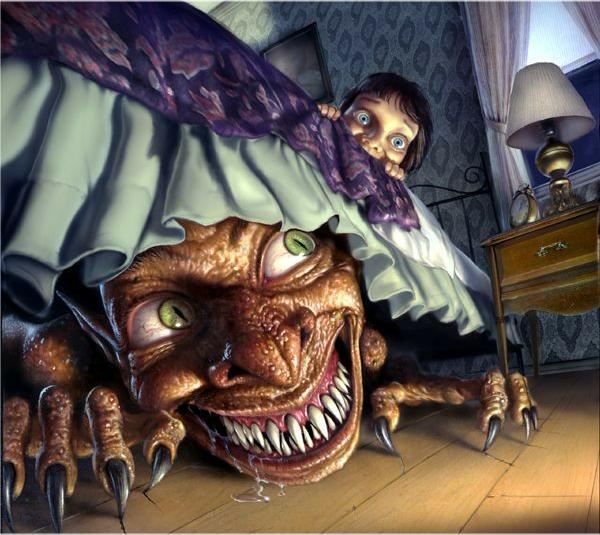
We recently discussed that standing at the threshold of Magic is a powerful guardian — fear — which, wearing many masks, blocks the way to Power. We discuss the role Fear plays after crossing that threshold.
Fear is always an acquired, “learned” phenomenon. Moreover, one can “learn” to fear almost any object, literally anything. A person is born without fear: a very small child is not afraid to touch fire, to fall from heights, and the like. Fear is induced by the environment; a child begins to fear what they haven’t encountered themselves but which provokes fear or even terror in other children (Baba Yaga, Babay, etc.) or adults (for example, fear of snakes, mice, spiders, and so on). In addition, as one grows older a person withdraws into their own world, and those interactions that were natural for a child begin to seem frightening to an adult because they disrupt the adult’s coherent worldview. As a result, in adulthood a person is literally riddled with fears.
On the one hand, it is no secret that many come to Magic out of cowardice. Often, when a person lacks the courage to strike their offender, they begin, in a corner, affectedly, to whisper spells in order to take revenge from the shadows with impunity. However, as one progresses it turns out that the likelihood of suffering retaliation in magical operations is no less than in a street fight. Therefore such a person faces a choice — either to continue sitting timidly in the corner, trying to evade retribution while constantly fearing and expecting it, or to step out into the open and accept responsibility for their life and actions — in whatever form that responsibility may take — in the form of victory and reward or of defeat and a retaliatory blow.
At this stage many of those for whom Magic was a way of self-assertion abandon this Way, returning to their miserable existence. Others overcome their fear and become from frightened rabbits into Warriors and Hunters of Power.
Another group of Magi from the outset do not turn to Magic for support or a means of fulfilling their secret desires, but understand that Magic is their innate Way. As Arbatel puts it, Arbatel,
“A Magus is a person for whom such a Way was destined even in the mother’s womb.”
For this category of Magi there is no question whether to practice Magic; yet this does not mean they are immune to fear.
Clearly, fear is above all a reaction to the unknown, and Magic is a world full of the uncharted, where every step is shrouded in uncertainty. Therefore fear is common for the Magus. Over time, however, the Magus, without ceasing to feel fear, nevertheless learns to control it and stops yielding to it.
For the Magus it is crucial to cultivate a sense of mystery and a spirit of adventure (in a positive sense). Understanding that the World is founded on Mystery, nothing can be said with complete certainty, “the world cannot be fully reduced to intellect,” the Magus stands face to face with the unknown, and therefore with the source of fear.
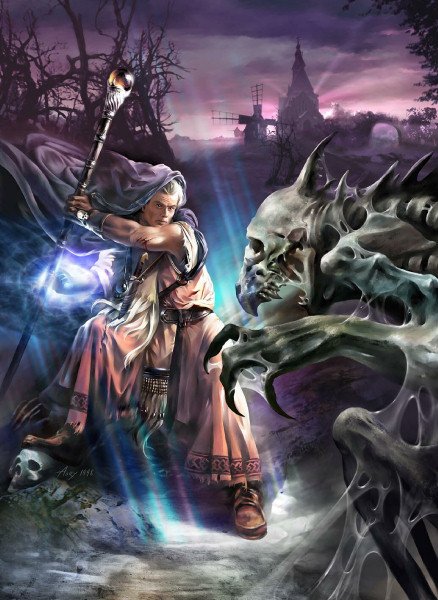
At the same time, it is dangerous to ignore fear or to bury it in the unconscious. I know a real example where a hidden fear cost a Magus his life. One Magus advanced far in elemental magic and learned many elemental spells. His successes were quite significant. Yet one day he was found dead within a ritual circle, and in investigating the cause of death it turned out that he had choked on a pear. No one knows how the pear entered the circle, especially since he disliked pears. And he disliked them for one reason — because their flesh contained small gritty particles. It goes without saying that the ritual during which he died was an evocation of Earth Elementals. Unaware of his conflict with Earth and entering into contact with that principle, he paid with his life. This story is a classic, but it clearly illustrates the danger of unrecognized conflicts and small details in Magic.
Thus, for the Magus it is very important not to “fight” fear, since such a struggle often pushes fear into the subconscious; rather, one should acknowledge fear as a natural reaction, face it, and — without pretending it’s not scary — nevertheless strive to maintain clearheaded judgment and move steadily toward one’s goal.
Surprisingly well-thought-out article. A person consists of stereotypes instilled in them from childhood of social and personal control. Elementals, in my opinion, are in constant conflict, both with each other and particularly against humanity. Therefore, who controls whom in a magical ritual, is still a question. And as the author rightly noted, in any such action, it’s very important (as in the movie ‘Charmed’) to see the target, not to notice the obstacles, and to believe in oneself.
I am not surprised at all that the article is thoughtful :), as they are all very good and absolutely unique in every way.
I am completely new to the internet; I just started making my blog, but I have enough life experience. When I read ‘Magic and Fear,’ I saw what I had recently remembered and written about: my first experience calling spirits and the horror I experienced. Indeed, fear is a barrier, as I ran home in a hurry without finishing the call. But those sensations evoked such a strong interest in magic in me that neither fear nor anything else could stop me. I really liked your blog! I have not read everything yet, but I will manage it before your return from the mountains. Respectfully, Elena.
Very interesting reasoning. One could also say that fear can be different depending on the object. One can fear death, the unknown, and one can also fear losing independence – by trying to subjugate certain forces/entities – one ends up being subordinated. One can also lose clarity of thought.
“If one day you decide to know yourself, you will have to choose the path of a warrior. You will know the dark sides of your spirit, and if you have enough strength to overcome your fears, you will know who you really are.”
Originally fear serves as a protection function. We fear what threatens our safety. At some point fear itself becomes a threat to our development. It would be good to have such an indicator – when fear is a shield, and when it is a toothy monster.
Perhaps it is still so: fear itself is an indicator that somewhere we are weak, that we do not understand, do not accept, cannot feel and experience.
Fear is a barrier on the path to Power, created from our own strength, separated from us. Therefore, it is worth knowing your fears and returning the strength contained in them.