
Dark Gods
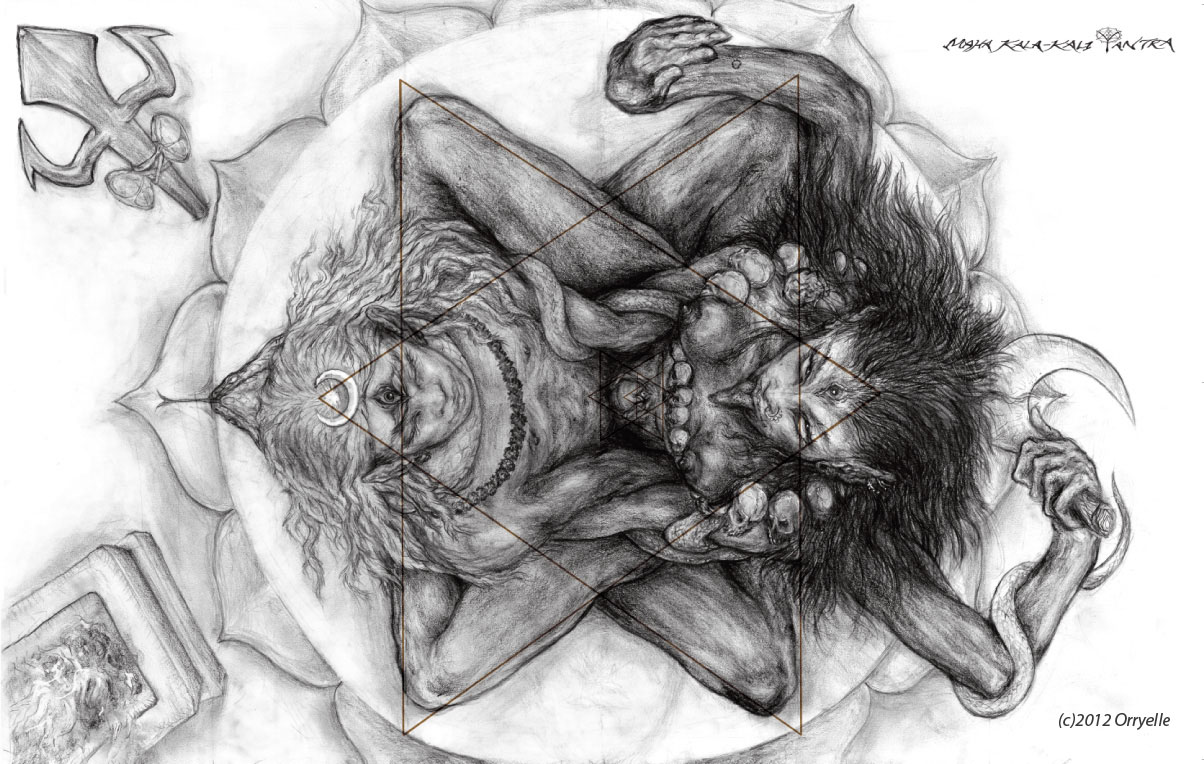
The magical myth that describes the cosmos as the result of the interaction of mind and environment presents the world as a totality of creative currents arising in the result of that interaction.
At the same time, each creative power, each stream of mind that creates and transforms being, can be considered from two fundamental perspectives: from the standpoint of its “source” and from within the stream itself.
When regarded as the result of the activity of some source, any creative current is seen as a manifestation of creative will, and that source is described as a creative principle — a god.
When viewed “from within,” a stream of creative energy is described as a vortex, the inner nature of which is personified as the so-called “ministering” being.
Note that gods are rather conventionally called “free” beings in the sense that, acting as the source of a current, they are in a certain sense “free” — to generate or not generate that current. It is clear that this “freedom” is highly relative, since in reality the god has no choice — to create or not to create; creation is his very nature, and so he can be called “free” only with a large degree of idealization. At the same time, once a current has been created, when it is regarded as an actual reality, its “inner” forces belong entirely to the nature of that current, and are therefore also conventionally called “ministering” spirits; lacking free choice, their existence is conditioned and limited by that current.
Since any movement is the consequence of a difference of potentials, is — duality, it is clear that any active force, and therefore any current, is binary: it includes both the “direct” — creative, constitutive — and its paired “reactive” “inverse,” destructive. Accordingly, any current, whether a differential creative act or the Great Current of the universal process, has two “sources” — creative and destructive — which are manifestations of the same principle. Therefore, each god is described as manifesting in “beneficent” and “wrathful” guises. Likewise, within the current itself one can distinguish a “descending,” supporting component and an “ascending,” destabilizing one — an angel and a Demon, respectively.
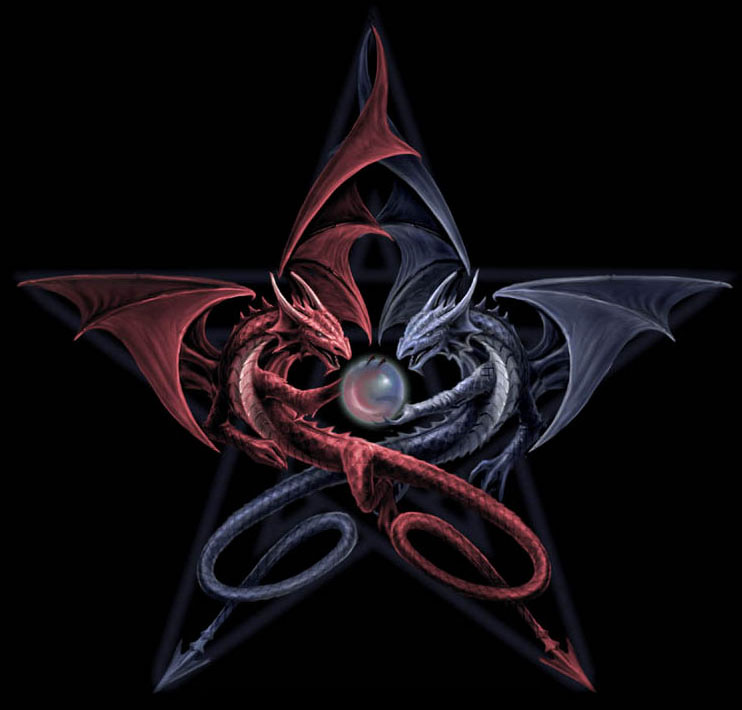
Just as angels and Demons, in their opposition, generate tension within the current; beneficent and wrathful gods set in motion the cycle of movement itself.
In this regard, for some currents the ‘dominant’ force is creative, and for others — the force of destruction, and so some gods are better known for their “light” side, while others are more characteristically “wrathful” in their mode of action.
It is clear that for the human mind interaction with such destructive forces can be unpleasant and dangerous; nevertheless, it is very important to understand that without destruction creation is impossible, and therefore ignoring destructive forces — whether in the form of active currents (Demons, Grey Spirits, etc.) or as sources (dark gods) — deprives the cosmic picture of completeness and vitality.
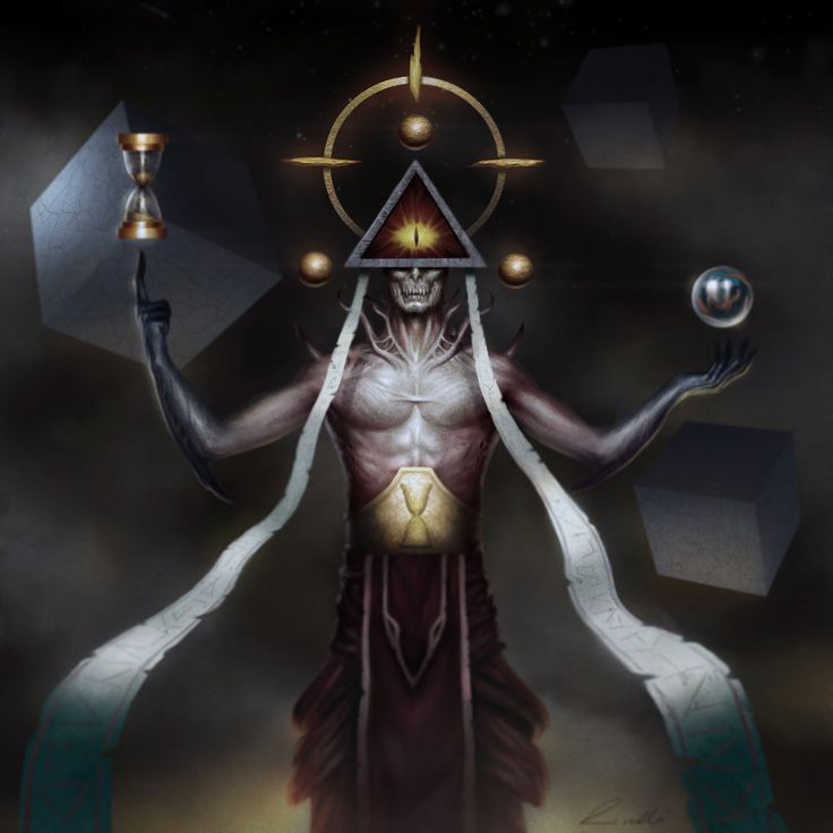
Dark gods are dangerous and destructive; yet this is part of their appeal: their activity adds freedom by clearing space occupied by worn-out and constraining structures and concepts. Therefore, the activity of dark forces is absolutely necessary; without them the world would calcify, trapped in imperfect forms, losing mobility and vitality. Sometimes destruction is the only path to creation when without it a system begins to self-limit.
Nevertheless, an infatuation with destruction likewise leads to a halt in movement, depriving the current of structure and direction for creative action.
For a Magus, it is very important not to fall into extremes — losing oneself in creation or fixating on destruction, while also not getting stuck in neutrality. The Way to full realization lies not by negation, not in ignoring any of the manifestations of the world-current, not in artificially distancing oneself from its forces and energies, but in integrating them with harmonious awareness.
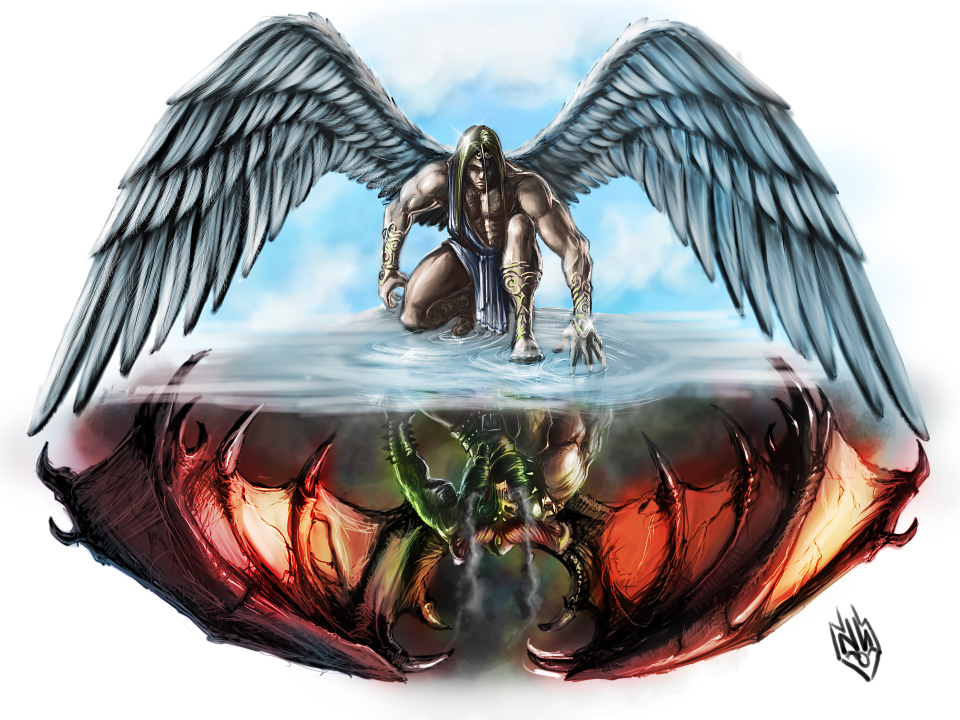
This binary situation can lead to endless cyclicality. Either you destroy what has been created or you create for destruction. A neutral position is beautiful in theory, but in practice, the personal position of the participant is created from an initial point (only it can be neutral) and how they as a creation have gone through internal and external influences. And the overall universal equilibrium, in my opinion, depends on the general compensatory actions of the participants in the process of creation. If you wish, balance as a constant of infinity is a utopia. Changing the places of the terms of a sum does not change it. In this lies the most interesting aspect that the terms are constantly changing places in the infinite process…
Good day.
A complex topic to understand. My question is about Dark Matter. Kali or Ishtar can still be digested and perceived. Let it be as wild, primitive, but specifically CREATIVE impulse. Embodiment of war and carnal passion, for we are not speaking about the vector of the impulse. This is the very ability to fight and win, regardless of the goals and needs.
In one cult novel, Ishtar is presented as the spirit of possession and equated with gold. But thanks to your works, it becomes clear that evil does not hide in the nature of this power itself. That there exists a superstructure, a shell darkening the “impulse” – this distortion you call Lilith. Sometimes in your works, you refer to the works of the sinister Thelema. For example, one of the activists of this teaching calls himself the Knight of Lilith and writes that she is the ideal. In your myth, the axis is the concept that “all is possible but not all is permitted”, that there is some formative principle, Logos, or fate, providence, in my understanding a certain stencil, channel of flow and perhaps an ideal.
You also defined 3 models of development:
Vector model: Movement in the flow, implementation.
Buddha’s model: the path of the mystic, monasticism, dissolution.
Lucifer’s model: rarely mentioned. A rebellion against the formative principle, Anti-Logos in your words. Isolation. And while breaking the taboo is so tempting and romantic, you have brought a clear understanding of the value of such freedom. Outside the flow, force can only be taken. This is the path of the predator.
But returning to Thelema, the epithets stand out: mother of abominations, great whore. Perhaps there is a hidden meaning here, and I am incapable of understanding these allegories? Or is it much simpler!? If a person writes that he is a knight of Lilith, this simply means that he is a true adept of absolute evil. And if they say “abomination”, perhaps they mean abomination? Of course one could refer to the fact that absolute evil does not exist, but this clearly contradicts your views regarding parasitism. Also, to what extent are you a legacy of Crowley, and perhaps you could explain such a contradictory figure as Babalon.
Hello!
First of all, I want to note that the Line in which my training took place belongs to a somewhat different Tradition than Thelema, which is why some terminological and ideological discrepancies between the Myths are natural. Nevertheless, I do not consider Thelema “sinister” in any way and understand its undeniable value for those whose spirit it resonates with.
Regarding the Dark Goddess, this topic has already been widely addressed in this blog:
https://enmerkar.com/en/way/two-faces-of-the-mother-of-worlds
https://enmerkar.com/en/way/the-spirit-of-possession
https://enmerkar.com/en/way/mother-of-fate
https://enmerkar.com/en/myth/mother-of-monsters
https://enmerkar.com/en/observations/exiles-of-love-lilith-and-homosexuality
https://enmerkar.com/en/way/mara
https://enmerkar.com/en/way/lilith-and-lucifer
Nevertheless, in the context of this discussion, I find it necessary to note a few points.
Just as the principle of any god is that of the father, creating the impulse for manifestation, movement or realization, the principle of any goddess is that of the mother, creating the possibility, gravity, substrate for this realization.
Accordingly, the “good” fatherly principle – is the impulse of creative movement; the “angry” fatherly principle – is active transformation, destruction, and liberation.
Analogously, the “good” motherly principle is that of generation, that is – shaping creative potentials, granting them “specificity”, formality, reality in the most general sense; the “dark” motherly principle is that of absorption, dissolution, disintegration.
In this regard, it is clear that the Dark Goddess is the “mouth” of all rivers of creation, the abyss into which they flow, which “pulls” them into its all-consuming womb (from which the White Goddess then gives birth to all that exists). Similarly, the Mother of Demons, Lilith, is the essence of this all-consuming stream, its real filling, the foundation of disintegrating forces.
Can such absolute destruction be considered absolute evil? In itself – yes. In the global sense – no, since behind every destruction follows creation, and after Lilith, Eve must come, giving birth to her children.
The point is to really fit this into one person. Perhaps later, after, it might be possible to create some other world with different rules. However, seeing the trend, that may not be desired, and may not happen at all. Thus, dealing with the questions of rectification and expulsion, in a global sense, seems ineffective.
Hello Enmerkar. Thank you. Your involvement and concern are genuine generosity.
Now there is a partial understanding of the architecture of the tree. Binah of the Good father represents the Dark mother. Adam is burdened by Lilith, not Eve at all. Tension arises from the difference of potentials. It is logical to assume that direct contact with the Good is detrimental. The benevolent mother is something like a provider. The abyss is amorphous; the Good, according to your words, is the form itself, the specificity. Such a model ensures the purity of energies and prevents scattering.
But is this model applicable in its mirrored reflection? It turns out that the Dark father is drawn to the Good mother instead? It seems that in this case, direct contact is also detrimental. The provider for the Dark father, ensuring access to the object of desire, becomes the Dark mother. This also allows achieving purity of energy. But how does this look in practice? Earlier I couldn’t fathom those words of yours:
“My benefactor was a fierce man. He used the feeling of rage to accumulate power.”
Perhaps the key lies in the divine nature of rage. The model here would be: rage is drawn from the depths of the dark god, directed into the abyss? It’s too difficult to understand. And the main question: in the doctrine of the myth you described, the fundamental idea is the mortal importance of the vector path. But the system rests on the formative principle; is that not so? And after all, the very nature of rage contradicts the form. There is perhaps a catch somewhere.
The Tree of Klippot is “fallen”, and therefore “inverted” in relation to the Tree of Sefirot – such that its top is Lilith (in the klippah of Nahhemoth), and its bottom is Lucifer (in the klippah of Taumiel). This is precisely why Lilith is referred to as the Mother of Demons, since she stands at the head of the demonic pseudo-hierarchy, and it is precisely through her that contact with the demonic worlds is established with the sephirotic ones.
Regarding “rage”, “anger” – there is nothing dark in them themselves, and they can be vectorized if directed at sweeping away a specific barrier, rather than destroying in general.
The text expresses a complex set of beliefs regarding the concepts of the Tree of Life and the Tree of Death (Klipot) in various philosophical and religious traditions. Here’s the translation:
“It is usually interpreted that the Tree of Life and the Tree of Death (Klipot) balance each other. But in my opinion, it is just a parasite that has latched on. Could the Tree of Life not exist without it? Secondly, in other interpretations, the Klipot are depicted parallel to the Tree of Life, not below it; which is correct? Thirdly, the concept of Klipot is actually relatively recent; it came with the rise of Zoroastrianism, where the priests placed a strong emphasis on the theme of Evil—Evil came into the world. Among the Pagans (Slavs), Chernobog and Belobog (the swastikas clockwise and counterclockwise) were ‘equal’; both were treated with respect and reverence, and no one was excluded.
I also think that Klipot is a purely Western worldview product, and I would call it ‘the shadow of the Logos.’ Rational Logos, the daylight consciousness, completely excluded Darkness from itself, resulting in increased internal contradictions (since any sun/Logos originates from Darkness), leading to a struggle against Darkness (Tehom), which then shifted into ‘Darkness’ (Klipot). What do you think about this?
If for a pagan, Evil is a violation of balance, a sharpening of duality, then for a Zoroastrian and later a Christian, what is Evil? Here, duality is overly polarized. What is the formula of evil, and what does Ahura Mazda fight against? It’s clear that it’s against Ahriman, but what is the logic?”
This text raises various philosophical inquiries regarding duality, the nature of good and evil, and the evolution of these concepts across different cultures and belief systems.
I remember a time when I drew strength from anger. When I had to work for forty hours straight, without breaks. In such cases, nothing helps – neither duty nor responsibility nor understanding, but anger helps. It’s hard to rationalize, but easy to feel. I think one can say – Don Juan’s benefactor drew strength from the feeling natural to him. And there is no point in dividing into good and evil. Just experience the feeling. Your Feeling.
There is a principle – fight or flee.
The strength is not in the anger itself. Anger is the emotional experience of the desire to survive. It is a kind of coloring for designation. Due to stress, it is colored negatively. The most basic (the first contour is sometimes called and other descriptions).
There is no dark. This is a descriptive scheme to somehow operate with it. There is only following and flowing along a certain vector of higher intention.
Contraction – black hole, ordering-destruction-archiving. Expansion – supernova or initial passage and flight of the primordial in the dark field).
There is also an upper motor – for instance, fasting for 40 days. For some, a day of fasting is worse than death, while others find joy in life for all 40 days.
Yes, sometimes unwholesome gods
Offer a contract on the road,
They say: “Your life will be sweet,
If you become mine without reservation.
Do you understand, this is so important,
In this terrifying world of despair,
Where violence and pain are in every syllable
The dark gods will protect you.
All that is needed – is a little humility
And fulfillment of the contract,
And then, whenever you want, my sweet,
You will run away from the gods without looking back.”
…………………………….
And under the flag of countless bloody sacrifices
Magicians embark on their work,
And on their faces, under makeup and paint
Those gods reveal their masks.
Dear Enmerkar, what do you think about the so-called Ancient Gods, the first Powers – incarnations of Chaos? Their primary goal is destruction.
The main reason for anger, in my opinion, is the inability and unwillingness to perceive others (the surroundings) as they are. It is very important and difficult to rethink one’s actions and behavior, experimenting with emotions and realizing that our behavior is one aspect of the forced.
But there are other aspects.
Anger is resistance and the refusal to accept the futility and absurdity of Existence. In a magician who sees further and deeper, the impulses of anger are almost absent; he is internally extremely balanced and consistent. In general, anger is often confused with rage. They are not the same. Rage is a result, a manifestation of the irritation within the inner psychic cosmos. At least one of the reasons.
Evil is the violation of the rules that we set ourselves.