
Baldr Must Die
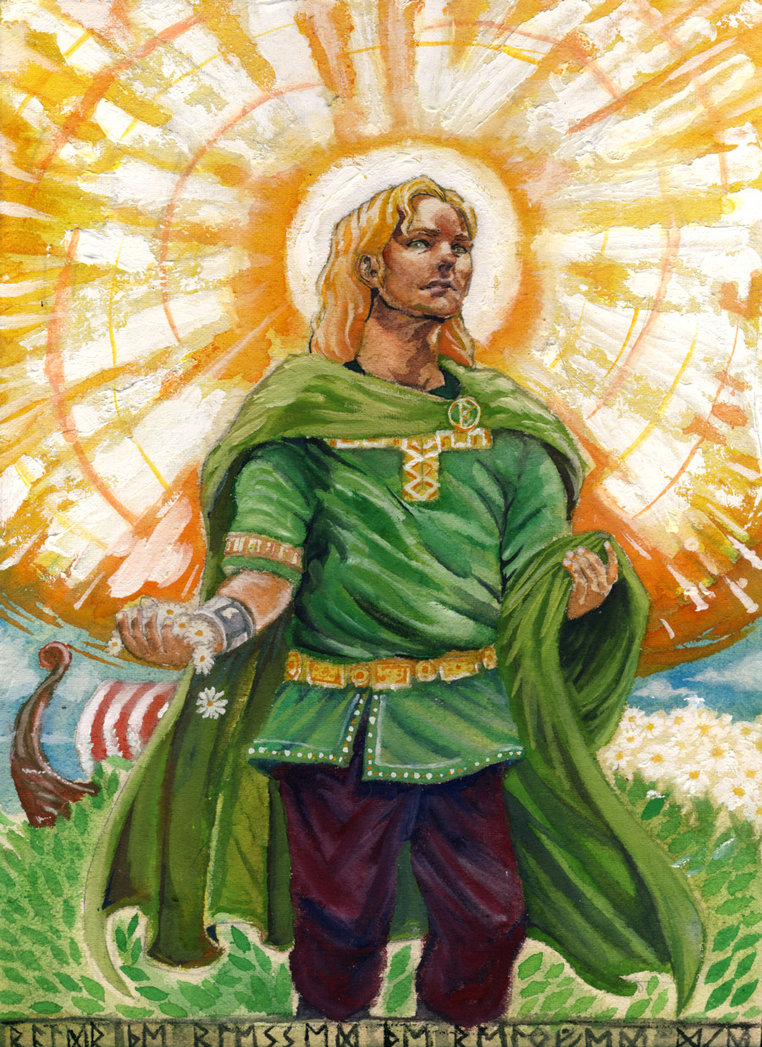
The archetypal mythic motif of the “death of the fair god”, which in the Norse system finds expression in the figure of the tragic fate of Baldr, is exceptionally important and multilayered.
This myth is usually interpreted as an account of seasonality — both natural and psychological — and that layer of meaning is, of course, quite significant.
Nevertheless, for the magus, another level of meaning in this semantic matrix is important — the level that describes the development of the mind itself, the «initiatory» level.
If one regards the principal images of the myth not merely as separate figures but as manifestations of a single, though multi-layered, mind, one can understand that the course of events described in this story is characteristic of any mind in the process of formation and development.
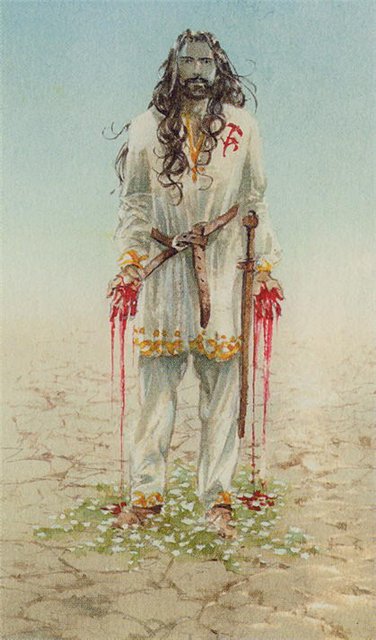
Baldr is the «diurnal» mind, finding harmony in “simple things”, content with everything, though deprived of the capacity for creativity: «none of his decrees will come to pass». This is the level of mind that is most readily attained. «Positive thinking», «inner perfection» and other similar clichés of the mind are very characteristic of the state when a person first becomes aware of the mere possibility of development, of the value of manifestation and of the original (potential) harmony of the cosmos. We have repeatedly noted that such a mind usually acts very simply: it tends to ignore the disharmonious or inconvenient elements of that cosmos (it builds “halls of harmony”):
It is called Breidablik.
There Baldr for himself
built halls;
on that land
no evil
has been done since of old.(“The Vision of Gylfi”)
And this stability, this “positive thinking”, is actively sustained by a subconscious desire for safety: the firmness of Baldr’s position is secured by his mother — Frigg — who exacts from all objects and beings an oath not to harm the “fair god”. In other words, such an artificial system, such a false harmony, requires external protection; there must be a force that supports and fortifies it, because by itself it is nonviable (and Baldr himself senses this instability — he sees “ominous dreams”). However, so long as Frigg does not relax her overbearing vigilance, everything appears beautiful.
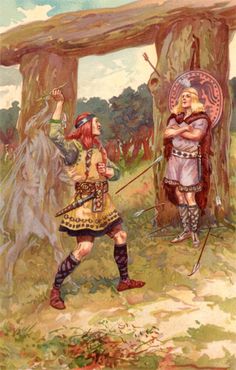
All ways of development know many such “Baldrs”, who have locked themselves in their “Breidabliks” and from there proclaim universal harmony and love. Such a mind lacks tension, lacks movement, yet is full of theatricality (“to ‘honor’ Baldr — that is to cast a spear at him and be sure it will not harm him”).
However, it is not so difficult to prove the artificiality of that “harmony”: Frigg willingly tells Loki that the reason for Baldr’s invulnerability lies in the “oath”, which not all creatures swore; anyone can slay Baldr:
«thin and long,
fair on the field,
the sprig of mistletoe,
it, deadly…»(“The Prophecy of the Völva”)
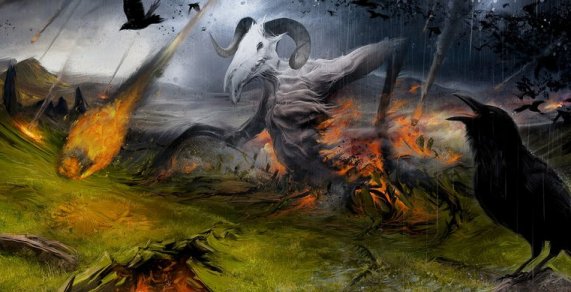
It is striking that the strength and invulnerability of the “fair god” proves insufficient to withstand an honest attack even by the “slender sprig.”
And it is not surprising that the mind, sensing the hopelessness of that condition, seeks a way out, and that exit turns out to be highly traumatic.
To continue developing, to move forward, the mind must activate within itself the power of destruction: Loki (this very striving to overcome) must make Hodr (blind aggression) kill Baldr. It is worth noting that minds in which Baldr is active — those very “self-satisfied ‘enlightened'” types — usually do their utmost to suppress Hodr, the aggression which, as they understand, could destroy their beatific existence.
As soon as a person stops desperately sustaining within himself the limiting notion of primitive “harmony”, as soon as he looks honestly at the situation — he undergoes a “crisis” and a “tragedy”: Baldr dies.
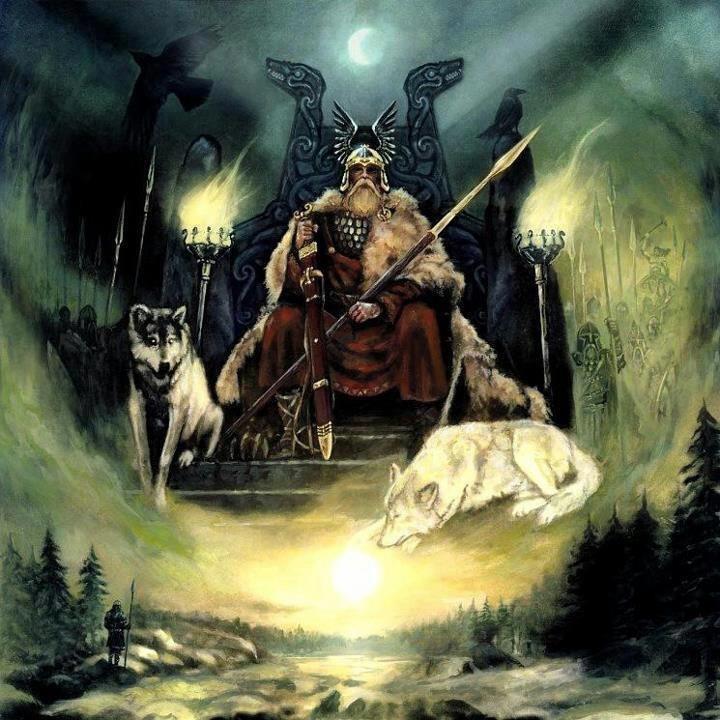
Of course, the mind does not accept this; it wants to regain its “positive outlook”, its “lost paradise”, it wants to make the whole world “mourn” its loss, but the Guardian of the mind, the power of development (in this case — Loki in the guise of Tökk, in Near Eastern myth the “Angel with the turning sword”) prevents this.
Only when the mind finds within itself the resolve to step beyond that artificial “happiness” it has built for itself can it continue to develop. Trapped in enlightenment, actively ignoring the disharmonious elements and imitating what is still only potential, it condemns itself to an eternal “standing on the ting”, where the only amusement is watching as spears are cast at you.
And it is no accident that Odin, as the higher part of the mind, knowing Baldr’s tragic fate, does nothing to save him; he only whispers something into Baldr’s ear at the funeral pyre (seeing his own rebirth in the already-past Hel, which has already found support in the “lord” after Ragnarök).
Baldr must die. The mind must find the strength within itself to abandon the habit of closing itself behind the walls of illusory harmony; it must stand face to face with itself and with the world (as the external reflection of itself), and find balance not by ignoring but by integrating all opposites, all binaries, thereby attaining freedom that needs no protection by “oaths” or fortress walls.
Thank you; in fact, this is a very important, albeit quite painful realization. It is difficult to admit to oneself that the cozy little island one has built over many years of training is merely an illusion, a fortress behind which one is simply hiding from the outside world. I often think – what is it that I dislike so much about all these singers of universal happiness. And now I understand – they are hiding from themselves. They conceal themselves from themselves. And as long as their anima, their Frigg, protects their souls – they feel secure. But how much rage and hatred begins to pour out of them as soon as circumstances press upon them. Let’s not hide behind sin – I notice this in myself too, that all understanding vanishes somewhere when circumstances align unfavorably. Thank you once again. I will destroy my fortress. The main thing in this is not to get carried away with destruction 🙂
You rightly noted that it is very important not to get carried away with “destruction” just as it is important not to get carried away with ignoring problems. As usual, any extremes rob effectiveness. But for a magician, it is important to walk the razor’s edge between these two chasms, not ignoring what he still cannot integrate but not destroying what is necessary for the completeness of the picture. If Baldur were not needed at all, he would not have been born in consciousness. It is very important to combine in balance Odin and Loki, Baldur and Höðr, all potentials of consciousness, all its capabilities. We should not cherish and revere our limitations; however, we also should not uproot the seeds of that which can sprout into fruitful fruits.
But “Baldur must die.” Dying a little bit is as impossible as giving birth a little.
Absolutely correct. But Baldur must die, not all nine worlds. What must be destroyed – must be destroyed. What must be built – must be built. What is important is only that having begun destruction, one must stop in time, and having started to build, one must carry it through to the end.
The whole problem lies in the fact that there are forces that protect the righteous and forces that punish the destroyers. Naturally, both are imperfect. Transition to destruction requires receiving the patronage of the forces supporting the destroyers. Otherwise, the smallest deviation from goodness can bring a blow that you won’t be able to withstand. Such a person, who allowed himself to release inner urges, will look at others who create thousand times more destructive things, but continue to thrive, with misunderstanding as to how they are intact after this. At the same time, to understand the forces of patronage over destroyers and go to them means becoming a destroyer, but then receiving everything in full from those forces if one wishes to harmonize again. In the end, this is an unsolvable problem.
In my opinion, the variety of stages of consciousness development is such (regarding this myth) that one can give birth a little or be born and not die fully, and this can happen simultaneously within one person.
The matrix of the myth of Baldur has several lines and layers. Two of them are interpreted in this article.
The third layer of the myth – the line of predestination – the line of prophecies and fate. The basic absolute well-being of Baldur is interrupted by his own ominous dreams, of which he, as a deity, is unable to control. In Baldur’s dreams, the primary shadow matrix of his own intentions towards himself is formed – very ominous.
The entire subsequent myth states that a magician must always remember, even in a dream – HIS INTENTIONS FULFILL. The ability to manage dreams and, especially, the endings of dreams, from strength and balance – is one of the stages of the development of the strength of consciousness. It is important to remember that the dream is YOUR DREAM, and you can do EVERYTHING in it to change it.
Next, the line of the possibility of Baldur’s dream shadow INTENTION TO PERISH is reinforced by the prophecy of the Völva. The fabric of the energy probability, reinforced through MONOVARIANT prophecy by the power of the Norns, is solidified. The Völva asked “Should I speak more? Or is that enough?” Nobody asked about alternatives and release, which crystallized the prophecy.
The intention of Frigg to save her son comes into conflict with her son’s own shadow intention. THE INTENTIONS OF THE MAGICIAN ABOUT THEMSELVES ARE USUALLY STRONGER THAN THE INTENTIONS REGARDING OTHER MAGICIANS AND THE WHOLE WORLD, therefore, if everything is not right in life – look for YOUR SHADOW INTENTION.
Frigg’s intention merely postpones the denouement. Baldur’s own bravado at the thing, where spears are thrown at him, continues to attract the manifestation of his own unconscious intention from dreams to self-destruction. Baldur elevates the frequency of self-destructive practice up to 100% probability of fulfilling his intention to die.
Loki is merely an instrument of Baldur, in which he invokes the feeling of envy – the energy potential for realizing his intentions from the dreamlike (shadow and unconscious) reality.
The prophecy fulfills, as the balance of forces that led to the death of Baldur was formed by his own intention and action. No one can escape the fate that they have prescribed for themselves if they do not attain the STRENGTH OF AWARENESS and do not kill the SHADOW INTENTION, thus diverting the energy of death to the shadow intention, thereby preserving the balance of energies.
The fourth layer of the myth – the world of necromancy. The energy of death was generated by grace and idleness, which do not allow for development. The apparent perfection laid down a cycle of stagnation and, as a result, a primary death of DEVELOPMENT. When the purpose of existence – the development of the STRENGTH OF AWARENESS – died, Baldur was still alive. But a living body does not always signify the preservation of life in higher bodies. The place where Baldur lived was so bright that the worldly balance forced a shadow to appear INSIDE the light. The death of the intention to DEVELOP THE STRENGTH OF AWARENESS leads to the awareness of the completeness of THE PATH. The awareness of the completeness of THE PATH is equivalent to the intention to COMPLETE it, that is, to DIE.
In this state, it is the mistletoe that kills Baldur, which in various traditions acts as a symbol of life. The one who intends to die cannot perceive life in its manifestations. Life will not give a vow to be a EMPTY ILLUSION and not to inflict harm. Life is REAL, and THE PRACTICE OF LIFE develops the strength of awareness through a series of WAVES and obstacles. It is not surprising that in this state Baldur sequentially left, following the current of the energy of death.
In this regard, it is noteworthy that the necromantic rituals undertaken to preserve Baldur’s life – Odin’s journey to Hel and reviving Baldur – Hermod’s journey to Hel do not yield a positive result. Baldur is in Hel at an honorable place, well-deserved. Death cannot be reversed by necromancy. The shadow remains a shadow even in Hel, although it can provide its patronage and prosperity in the form of Draupnir. The dead – from the dead with magical properties can return alive, while the spirit remains a spirit until Ragnarök – the next cycle of the spiral.
Wonderfully written. Doctor, tell me, where else could I read your reflections?
The fire of Enmerkar’s magic periodically sparks inspiration within me. My words of power regarding the relationship between my current magical practices and what Enmerkar has written can only be read in the comments on this site.
Doctor! I really respect your comments. But I have questions: 1) why do you believe that a dream is only your dream?
2) what prospects could there be for Baldur?
1. I believe that a dream is only my dream because, as a magician, I can manage any of my own dreams and dream realities, changing them to a favorable direction for myself and the universe.
2. Baldur had the prospect of dying.
Nevertheless, – Mors Certa, Hora Incerta (Death is predetermined, the hour is not predetermined). He died of weakness, hence died physically. Those who die because of weakness end up in Hel.
He could have died from Strength, breaking the chains of the illusion of his own perfection by REALIZING THE DOMINANT OF DEVELOPMENT and stepping onto the Path. His body would have remained alive, but the beautiful and illusory perfect Baldur, as depicted in the myth, would have disappeared (spiritually died), undergoing an initiation and becoming a Warrior of Strength.
Regarding Baldr, I will still write my opinion. I believe that the story with Baldr goes back to the construction of the walls of Asgard when the contract with the giant was violated. Therefore, in Baldr’s case, Loki was not the ‘force of development’ but the ‘force of retribution.’ Thus, Baldr finds himself in Hel. But in the end, according to the text, Ragnarok will come, all involved in the deception will perish, and Baldr will reside in Gimle, indicating his eternal nature.
What is the problem of the impossibility of changing a dream, even in full awareness? There is some difference between being able to change a lucid dream and when one completely cannot, not even a little. Who establishes such limitations?
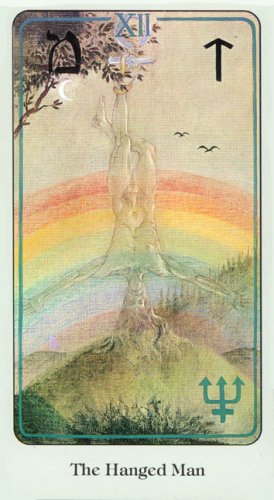
If according to the myth, the only limitation is Frigg, part of the unconscious, namely the aspect of the Mother, who does not want changes and wants her “child to remain a child”; the Hanged Man hangs upside down. She makes him invulnerable, essentially immortal, thinking she preserves life, but this is an illusion, as walking in circles, “stagnation” is worse than death (a series of reincarnations “life-death” is life). A rather amusing paradox is that one unconscious saves another figure of the unconscious, and more precisely, the Shadow (Loki) of the Consciousness (Odin), that is, the masculine principle.
Thus a limitation can also be imposed by a higher consciousness if it leads to development.
That is, theoretically being in such a place to change the ‘dream’ it is necessary to activate the masculine component of the ‘subconscious’?
Strange that I can see my hands and know that I am dreaming, but I cannot change anything with simple intent. That is, is the energy of intent not full? Is there a lack of the masculine component?
crackjack, when I used the word ‘dream,’ I meant the illusion, the dream of the mind (which ‘gives birth to monsters’) related to life as a whole. It was said concerning En Merkar’s myth.
The Doctor has his own myth, in which I also trace the work with the unconscious area of the psyche. You can work with it, both through dreaming, since the boundary in such moments is very thin (for dreamers, a very good option), and also with the help of active imagination without entering into sleep (the method I use). Such work when entering into a liminal state is directed inward (with the internal elements of the psychocosmos, with recorded programs (images)).
But in a liminal state, you can also go beyond the boundaries of a person’s psychocosmos to the boundaries (planes, worlds) of the universe’s cosmos.
It’s hard to say what your case is, what exactly you are working with.
Regarding the subconscious, based on my method, I can say that there is a certain algorithm for working with programs (images), and if a program exists but cannot be hacked, you need to find the missing element through analysis, select, find the hack code.
As for lucid dreaming and the external world, for example, the astral due to its density is very poorly susceptible to influence. They can block with restraining elements (entities) so that you don’t do something silly, but most often they leave a clear warning. In such matters, it is better to learn to listen to oneself, but specifically I cannot tell you anything.
I use different things, but the question was about lucid dreams.
I am not in those sectors of magical worlds, so I am not in this and not in that myth. Although I perceive the terminology with difficulty). The question is – why does intention not always manifest in lucid dreams? For some it happens quickly and immediately, for others it is completely independent of me.
I am looking for the plane of the plane before the plane of intentions where the focus of attention is formed.
The key is changing one’s state in terms of all fullness; I will try. The game – look and get involved in the process is interesting, but now there is a new game – manifest by changing the space of the game. For which I thank you.
I asked the runes about what was originally laid down in this myth – what is the meaning of Baldur’s death. The runes Odal and Hagalaz fell – the destruction of the unshakeable ideal. For what purpose: Inguz. It resonates with what was said in your article.
Perhaps yes, it is better to do it yourself, carefully, with your own scalpel than to wait until the moment ripens, and outside surgeons arrive and chop haphazardly..
At a certain stage, such an illusion is simply necessary. To shield oneself from external influences that could hinder laying the foundation of one’s world perception. Once it is laid down, one can also recognize that not everything is good.
A couple of months ago, I had a certain glitch that related to this topic. A note remained in the files; I remember I even wanted to develop it into poetry, but the next day I forgot about this storyline. Moreover, back then it seemed that killing Baldur within myself was very, very bad) Here’s how it looked; I’ll copy:
“Help resist
the blind man
killing the sacred Baldur within me.
Lilith knows who should be above – the earth or the sky.”
So this article caught my attention, and I wanted to figure it out, hence I turned to the runes.
Baldur can be compared to the Fool of the Tarot. He also does not see the abyss at his feet and apparently will not fall from there – for him there is no “underfoot” (his head is thrown back). To become a Magician, one must fall – 1 arcana. And survive in the process.
In my opinion, the situation with Baldur merely symbolizes a stage of evolution. Refusing “fools always win” we attain more awareness, and thus freedom, but also more problems.
I will slightly deviate from this theme with my appeal to more experienced individuals regarding the period of the “dark night of the soul”. One can even draw a parallel here with the death of Baldur, relating it to the first stage of this period of transformation when he “dies” for the outer world, which seemed favorable to him, and descends into the “underworlds” of the inner. Partly the question is the continuation of the myth; what next? Doctor, you touched on the topic of “the dead will be dead (although they may seem alive) until Ragnarök – the death of the gods, as something inevitable. After all, it turns out that the destruction can no longer be stopped, regardless of how you balance? The destruction of the inner world built on old foundations has already begun. Perhaps you could suggest what to read about this from a practical standpoint, mostly about emotions, states, and tracking.
I would be grateful.
Milita, the Doctor touched upon other topics…………………………. If only “Baldur” had listened to the Doctor’s advice and changed the ending of his dream in advance, then perhaps……………….. In the pre-dawn hour, when everyone was still sleeping, a person in a cloak with a hood and a backpack would have emerged from Breidablik. He was no longer called “Baldur” and was no longer a god. He was Nobody… or…. (name of your choosing). And….. he went into the Unknown, forsaking his high status and severing old ties. And… maybe he perished around the first turn, or perhaps, gazing at the world with wide-open eyes, learning from the world and applying New Knowledge in his life – he lived to a ripe old age…
Perhaps, Tavita Shaut, it was indeed so 🙂 :
The word and STRENGTH – the hazy veil of perfection,
The fog Baldur filled the gods’ gaze with, completely obedient,
All the more beautiful was the magic of light,
He led all the gods into the ILLUSORY WORLD OF DREAMS.
There were no flowers in the world as white and beautiful,
Those that could compare with the beauty of illusions.
He cast it upon all, the swift and indifferent,
The fog of power brought all the AEs into a united union.
Each saw their image in him – perfectly beautiful,
Here everyone united, the young and the old,
Each with different characters and tastes,
Only Baldur, in their opinion, was the most beautiful of all.
Baldur perfected the fog – full of illusion,
There are no vices in Breidablik, no evil,
Only no illusory sentence is fulfilled,
And otherwise, the AEs enjoy as if they have fallen into childhood.
Stepping aside and putting his phantom as a target,
Baldur amused himself with naivety and perfection,
Adjusting the line of flight of the spear with illusion,
Through the illusion (real), he observed the happiness of the AEs.
What becomes mundane is eventually tiresome,
It was very desirable to go beyond, into the Dimension of Paths,
There are no problems here, just the phantom sewn with mistletoe,
The shadow walks into Hel, having gone through the burial.
Morning dawned, the traveler left Asgard,
He was no longer a god, became MORE THAN A GOD ON THE PATH,
Left behind nine worlds, drew the illusory threshold,
And in real dimensions, a ROAD lay above it.
Tavita Shaut, but alas, this is already another myth, and also the phrase “if only” implies past time, and one does not cry about the past. Baldur is who he is and what is happening with him is what should happen specifically to Baldur (does something need to be completed?). There is also the question whether it is possible to change Baldur? I will answer – yes, if Baldur realizes what he wants from him in the myth (however, the myth is designed to lead to changes – the question is, which ones?). However, for Baldur to realize the myth, he lacks something (which is the entire history), and this something does not fall from the sky like heavenly manna. As Baldur begins to realize his “blindness” and supposed invulnerability, the only question on the path becomes “how not to break more wood and not get involved in a new myth while seeking the key to passing the old one”, as Baldur will have to go through everything with his own feet in any case, the only question is in certain marks (information that can become a thread of the search) from those who have already passed this path to track “yes, I am not lost, I am going where I need to go, which means this will lead to the desired end of the story.” This is from the perspective of my Baldur))
I am not asking for concrete guidance, merely information that might contain the key in your feeling, who knows perhaps something will click)
Here is the magical search) Since one of the keys has been found, but after the request was written here, I will finish my myth about Baldur; perhaps it will help someone analyze what is happening. Parapsychology and the Tarot arcana came to help. My problem – the Moon arcana, which is also known as the “dark night of the soul” and is dangerous as others have a beginning and an end, but this card is a closed circle (although there are other dangers). I think En Merkar did not cite the illustration of the Hanged Man in vain, while the Moon represents a dream, the illusion of the XII Arcana. Why did this happen? I can assume that it is about the head of the hanged man – on the classical Waite there is a halo, and as one person said when entering this arcana, despite the distressing position of the Hanged Man before his eyes, that person felt the most uneasy about feeling the gaze upon him, no matter where he went (such a feature sometimes occurs with icons =)). The Hanged Man has awareness and Divine presence; he consciously made his choice to be a “victim”, BUT is the next stage a consequence of violation or a necessary stage of passing “Baldur” – that is the question? But one can say that the Hanged Man hung himself and fell into sleep (illusion) of the XVIII arcana, where, by the way, there is no acting human figure. So, Doctor, the illusion here is indeed a stone of stumbling, which takes precedence)
In the context of the dark night of the soul, Baldur corresponds to the High Priestess. This is Gimel – the path of Keter – Tiphareth. Baldur – the Sun (Tiphareth) passes through the abyss into the realm of Pluto (Keter)). Thanks to Loki.
Then it is better to say that the “dark night” corresponds to the World of Klippot (World of Demons – casting back), the entrance to which opens through Da’at. And as a result, it may turn into quite a long “dark night” from the cycle of rises and falls if Tiphareth is not clean enough, not to mention that to truly reach Keter, one must pass through the levels of body, soul, and spirit three times.
Thus, a very dark night.
Da’at is a completely unmanifested sephira. The next step.
Klipot – the husk of the universe. Enmerkar has a good article on this topic https://enmerkar.com/en/myth/qliphoth-the-husk-of-the-cosmos
The fact that Da’at is located on the path of Gimel on the Tree of Life diagram is conditional, as it is marked with a dotted line and is somewhere in the abyss. There is no time there, so ‘long’ does not exist, as well as short. The dark night of the soul is when long-buried moments emerge from the subconscious, usually not very pleasant. This happens before another expansion of consciousness occurs. When accepted, identified, integrated into one’s world – then it is affirmed, expanded. But if you throw it back into the dark closet again, then wandering in the shadows is ‘quite long.’ This is the Moon. The 18th arcana, although it bears an analogous name, corresponds only to Pisces. Milita, this is just my opinion; it is interesting to communicate with you.
Overall, a cool blog. Respect to Enmerkar.
I often find exactly what I need here and when I need it.
Klipot is devastatingly frightening for those who have become involved in ‘positive development,’ i.e., for those people who cultivate qualities, abilities, and strength while only moving within the Tree of Life and ignoring ‘negative development,’ which involves cleansing, as you wrote, ‘accepted, identified, integrated into one’s world’ (such an unpleasant task for those with a positive outlook to delve into their own dirt, i.e., they think they are cleansing without touching it, shielding themselves from it, they are simply ignoring it, and it just accumulates and accumulates…). As a result, they distort their inner world, leading to destructive influences. ‘Some enter the world of the dead, while others enter hell’ – both are ‘below.’
However, En Merkar wrote about all this; such a ‘Baldr,’ reaching Tiferet (which gathers the forces and abilities of the other lower Sephiroth) really shines like the sun. But as soon as he steps over the abyss and looks into the eyes of the Demon of the Abyss, his experience will be ‘eaten,’ as this is an illusion, ’empty experience,’ such a ‘Baldr’ will return to his broken trough (from which, by the way, he never left). But he will sincerely believe that it was the misfortunes that fell on his head that led to the loss of strength, not empty experience per se.
I am not a Kabbalist)) But I know how carefully words and their meanings are treated there, excluding distortions (‘everything has already been said before them,’ so they do not try to reinvent the wheel twice). And there are quite deep layers of Knowledge, especially regarding the invisible and contradictory sephira, which are as real and concrete as ever))
It can be said that initiated Kabbalists understand the weaknesses of the world well, but however, ‘not all of us are Kabbalists, but everyone has their own Abyss’… and I would like to add by habit from psychology ‘…and a collective one’ ))
As for the Arcana, the Moon (the silver thread) – yes, this is the High Priestess II – the central pillar (truth – Isis – the Great Mother, the thread that runs between the Fool and the Magician (implying the pouring of one’s blood into the cup of Babylon – fulfilling true purpose).
While the Arcana XVIII – signifies the ‘Terrible’ Mother, the Dark one – a lunar eclipse, with all the resulting consequences. And if the II arcana is truth, then XVIII is illusion. And as one person said, ‘The death arcana does not necessarily mean death, just as the moon does not necessarily mean the Moon’ )) So in this I agree with you.
Perhaps Ragnarök became possible with Baldur’s death. When the world-consciousness loses a stabilizing element, its development necessarily gets started. The equilibrium is disturbed.
It is noteworthy that Baldur did not go into complete oblivion; he did not die. He lives in Hel and serves as a kind of “pole of attraction” for the vector of power.
The paradox of the modern world is that one must work hard to earn money and do nothing.
I believe that once an accomplished part of the myth occurs, it then always happens. Of course, in that “always”, it is accomplished for the specific consciousness at the current moment. If Baldur died, then in thousands of daily realizations, the energy may move in this way. This plot gets realized. Perhaps the metaphor would suit, like a deck of cards, face down, which gradually opens up along the path. They transition from potential to real. And I think that this is reflected in every action and word of a person, and simply in their presence. I might say that everything becomes more real. I respect myths as examples of optimal energy distribution, also perhaps as something that is referred to as Authority in this blog. I read the comments and thought, this is quite a significant experience, to die for the first time, for you can hardly grasp onto anything, and with each individual being, any movement of consciousness occurs totally. Like on a big screen, with complete realism. I thought it’s good that there is a myth; sometimes, it might help. Although most of the time, one realizes that it was, already later.
I just noticed this. What a true myth) The phrase about the jug that spills what it is filled with is often socially circulated. The death and further development of Baldr in this regard is an inverse plot. It concerns one’s own vulnerability, genuine, without any defenses.
Oh Frigg. It is unjust to see her only as a mother, caring for her offspring. She foresees destinies no worse than the Norns and knows that Baldr is doomed. Without hope, she acts for his salvation, without despair or fuss—something not everyone is capable of. She does what she must. And suddenly, there is a strange carelessness with mistletoe and a conversation about it with whom? With Loki. The reader is pleased to realize that the great Frigg has overlooked something, and he gladly seizes the version presented to him. But in reality, Frigg, as the higher part of consciousness, a prophetic spirit, leads Baldr to transformation in a mathematically precise and flawless manner, taking the shortest and most elegant path, one that excludes chance, deviations, and failures. And for Odin, only tormenting Rind remains, preparing the world for existence after Baldr, even though he is still alive. The fact that Baldr returns the ring signifies: Baldr is not the future Odin. He is the future Baldr, and he does not need what is foreign to him.
Enmerkar writes: “cannot withstand an honest attack even from a ‘subtle escape’.” Subtle things are often more dangerous than obvious and large ones.
And another thing. The image of the wanderer has accumulated too much romanticism, as if the wanderer is somehow a higher being, above gods, and so on, while in most cases, the wanderer is simply escaping from boring responsibilities. It is unworthy of Baldr to take the damp path of the wanderer, for he has the chance to win outright, while also bringing Nanna and Höð with him.
This is one of my favorite articles. Thank you, dear Enmerkar.