
Dissatisfaction as a Driving Motive

It is perfectly clear that the driving force behind any development, indeed behind any movement of the mind, is the feeling of dissatisfaction with its current state — the sense that a more harmonious, more comfortable condition is possible, a state of greater equilibrium.
On closer inspection it is easy to see that the source of this dissatisfaction is the limitations of existence — the mind feels discomfort when it runs up against any constraints or restrictions on its activity.
As mentioned, this sense of limitation is subjectively experienced as an unpleasant state, and in response the mind can either try to “come to terms with it,” even deriving a kind of masochistic pleasure from suffering, or try to change the situation so that the number of limitations, and therefore the suffering, is reduced — and this is the basis of development.

In order to establish a direction of development, Myth introduces the ideas of a source and a Way of development as a method for overcoming the mind’s limitations.
It is evident that absolute absence of limitations is possible only for an absolutely homogeneous, infinite and boundless substance, devoid of properties of both being and non-being. Myth calls such a state the Great Spirit (the Absolute, Brahman). There are different approaches to understanding this absolute category — one may take it as a final absolute Reality or as an intellectual abstraction — but in any case it is the basis for reflections on liberation from limitation.
Thus the primal ground of reality is conceived as a universal category completely free of limitations, which in turn implies the absence of any manifestations or forms. It sets the “zero” of the coordinate system against which subsequent reasoning is arranged. Again, it makes no difference whether we regard the Great Spirit as some supra-real reality or as an abstract concept; this does not change the fact that in its purity it has nothing to do with what we call reality as a world of forms, and therefore of limits. This absolute reality is at the same time utterly unreal, since it lacks any heterogeneity, any limitations or motion. It also lacks any qualities, any constraints, and equally lacks their opposites.
To describe the transition of this absolute category into actual reality the notion of “differentiation” is used: the transition to “creation,” to “being,” begins with the emergence of the first duality: God/world, Father/Mother, Transcendent/Immanent faces, Being/mind, and so on. One can suppose this once “happened,” or treat it as a category of cognition; in any case, being as we understand it begins with absolute division. From the standpoint of our topic this absolute separation turns out to be also an absolute suffering, expressed in the language of Myth as the “sacrifice” underlying the cosmos: the sacrifice of Purusha, Ymir, Mitra, Osiris, Christ.
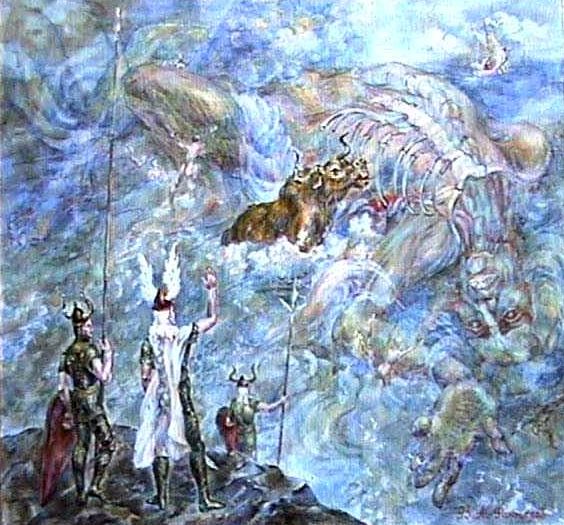
The next step is the fragmentation of homogeneous mind into differentiated aspects — individual acts of self-knowledge of the original reality. Only by moving beyond that integral unity can the Great Spirit acquire a reality, and it acquires that reality in what we call the manifested worlds. One can say that as soon as the Great Spirit moves from its absolute integral unity to self-knowledge in the totality of its aspects, it experiences an “absolute limitation,” which is the absolute source of dissatisfaction, and the whole subsequent process is directed toward the restoration of unity and, accordingly, toward the cessation of suffering due to limitation. And again — it does not matter whether we think Myth describes an actual historical process or is a matter of epistemology — the fact remains: the more developed the mind becomes, the more keenly it feels its limitation, and limitation as such.
Although it is obvious that the sense of separateness is one of the most significant factors slowing development, it is striking how many beings cling precisely to that sensation. It turns out that in the mind of any being two contradictory impulses coexist: the impulse to preserve one’s separateness and the impulse to overcome one’s limitations. To resolve this contradiction, Myth introduces the concept of “individuality” as a unique mode of perception inherent to a given mind; the uniqueness of this mode does not imply separateness, since each mind is regarded as a “point of view,” a particular way reality looks at itself.
To avoid the suffering that arises from the sense of limitation and separateness, the developing mind can either try to ignore the “relativity” of limitation, theoretically regarding the cosmos from the “original” position of Absolute undivided reality, or try to reduce suffering as an overall phenomenon by promoting the development of the mind.

The mind can either simply declare: “I am God,” “Atman is Brahman,” and close its eyes to the world’s diversity. The question that remains open in that case concerns precisely the original “suffering” of divided reality.
In fact, any advanced mind faces this dilemma: what to do about the suffering of all beings? One can smile and assert that their suffering is merely an “illusion,” a mistake that does not concern me, or one can attempt to act with compassion. The more the mind senses its inseparability from the fullness of the world, the less separateness remains within it, and the more acutely it perceives the world’s collective suffering. If at the initial stages the motive is to reduce personal dissatisfaction with one’s limitation, as development proceeds this aim becomes increasingly global, and one’s own development turns into an instrument of world-change — the being understands that by reducing its own limitation, by increasing its self-realization, it contributes to the reduction of suffering in the world at large.
The stream of a Magus’s realizations, the growth of his power and authority, constitutes development only when accompanied by the harmonization of his surrounding space, by the spread and propagation of harmony. However successful a Magus may appear, whatever the brilliance of his achievements, the criterion of the effectiveness of his Way is precisely his ability to increase harmony around him, his capacity to structure and order both spaces — macrocosm and psychocosm.
Hello. Is it possible to develop without harmonizing everything around while having bright realizations? After all, development does not happen without destruction; hardly anyone has a high amount of power without having destroyed their being, filtering it. If that’s the case, the developing one reaches the deep motives and removes the trash, which naturally reflects harmoniously on everything. Perhaps it implies a case where a person has power without understanding deep motives and individuality and uses it while already being destructive?
Development is always accompanied by the growth of barracks, the energy of harmony: https://en.enmerkar.com/myth/energiya-masterstva. However, not everything that seems like development is necessarily so. Not every increase in realization capabilities is development; not every deepening of understanding is development. Development is that growth of awareness that is accompanied by the growth of harmony, both within consciousness and around the being.
“Is it possible to develop without harmonizing everything around while having bright realizations?”
We need to understand what this “everything” is. One cannot harmonize everything, especially not everyone. One’s own “everything” can and should be gradually harmonized, but the other’s cannot be forced. You can offer someone help, hints, but you can’t coerce. I tried within the limits of my knowledge – but it didn’t work! Now I work with it more carefully.