People and Faerie: Two Strategies of Mind
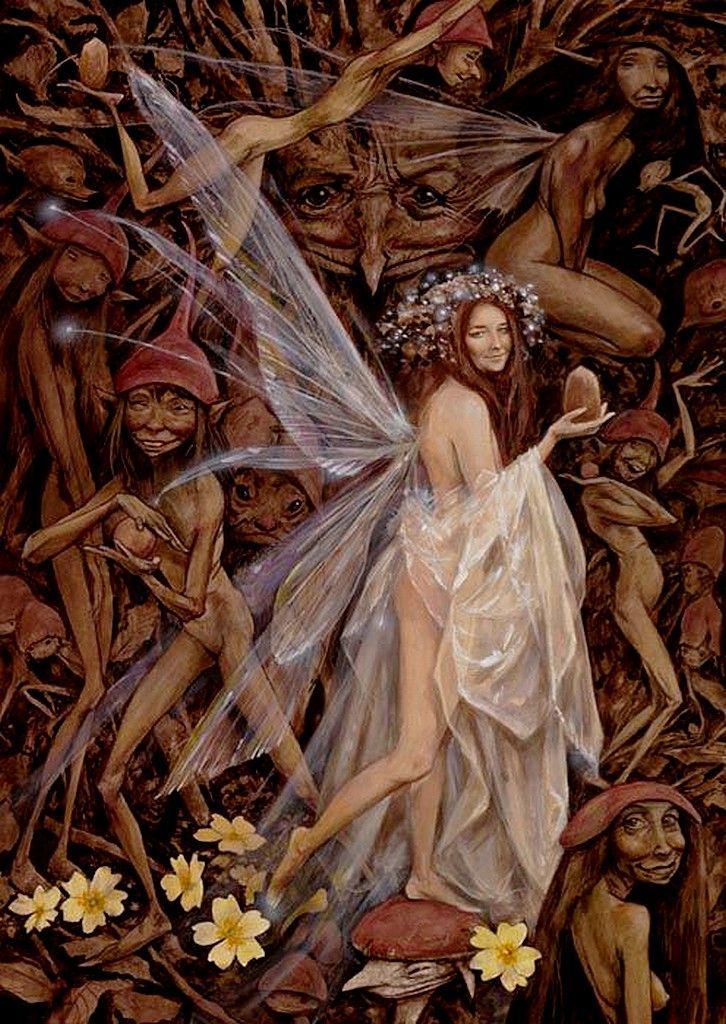
We have repeatedly noted the great importance of the Traditional view that the “human” level of the manifestation of mind in the world known to us is represented by two life waves – humans and the faerie.
These two groups employ different strategies of awareness: “outward” and “inward”:
- For people, a low level of awareness is characteristic, which nevertheless spans relatively short lives of each stream of mind, in which the widest possible range of interactions and their interpretations, “imprints” in mind, is achieved.
- For the faerie, on the contrary, a high intensity of awareness and an enormous, theoretically unlimited lifespan are characteristic, representing, in effect, an accumulation of a large amount of deeply processed experience, but gathered from a single perspective.
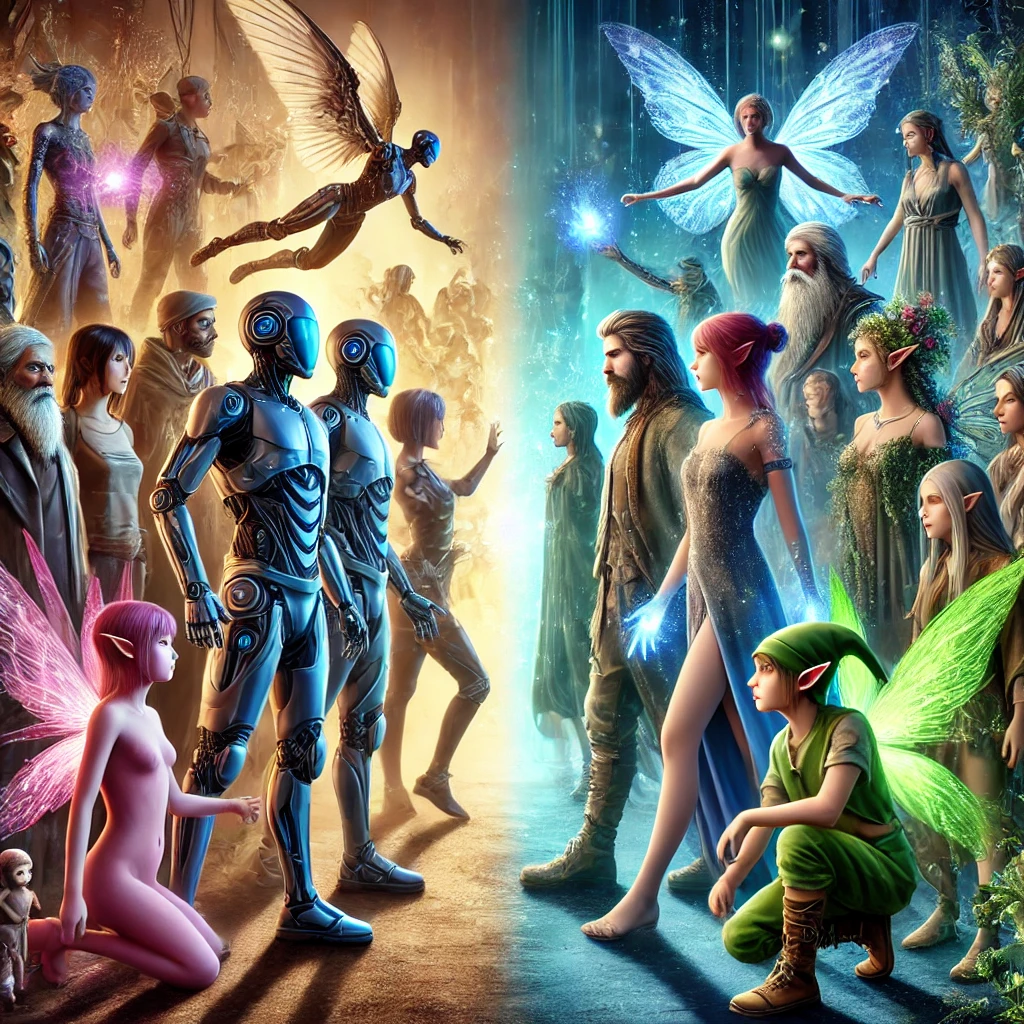
The implementation of these strategies requires that the incarnation of streams of mind in these two life waves occur through different mechanisms.
It is customary to say that people are said to have an immortal soul, while the faerie lack one, though they are in fact physically immortal.
In order to clarify this notion, let us recall how the Tradition defines the very concept of “soul.”
We have already noted that in popular literature this term is vague and imprecise: “soul” may refer either to the whole non-physical level of the manifestation of mind, or to some one of its “layers,” or to a “carrier” of individuality that binds together the stream of reincarnations.
Nevertheless, the Tradition clearly and unequivocally denies the presence of some permanent “subtle being” which, by a popular comparison, simply “changes clothes” into different bodies while preserving its basic characteristics. At the same time, it is emphasized that such an interconnection still is realized on two levels: an “upper” level, the level of the “source,” which is usually associated with the Lights of yehidah and chayah (in different Schools correlated with Keter and Chokhmah, or Chokhmah and Binah), and on the “lower” level of “manifestation,” which is expressed in the images of “karmic winds” or the “burden” of the soul. At the same time, neither of these levels corresponds to the known personality, the set of self-identifications that are developed in each life individually (with the help of the light of ruach that integrates external areas of the stream of mind). However, soul in the narrow sense is the name given to another level of the manifestation of mind – neshamah, as the appearance of the light of Da’at (in some schools – Binah), the function of which is precisely the “integration” of the tendencies toward separation (yehidah) and union (chayah). It is precisely the presence of the light of neshamah that is a sign of a being’s ability to “draw” from the potential depths of the Interval, translating its potencies into manifest creativity. Such a “five-part” structure of the manifest stream of mind (nefesh–ruach–neshamah–chayah–yehidah) reflects the “human” form of its manifestation. And when people speak of the “absence” of a soul in the faerie or in “artificial” intelligence, what they mean is precisely the absence of the light of neshamah, i.e., the energy of Da’at. However, if machine minds, built in the image of humans, simply have not yet reached the necessary level of integration and later, perhaps, will “acquire a soul” on their own, as an evolutionary stage, and become capable of true creativity, then the faerie function differently.
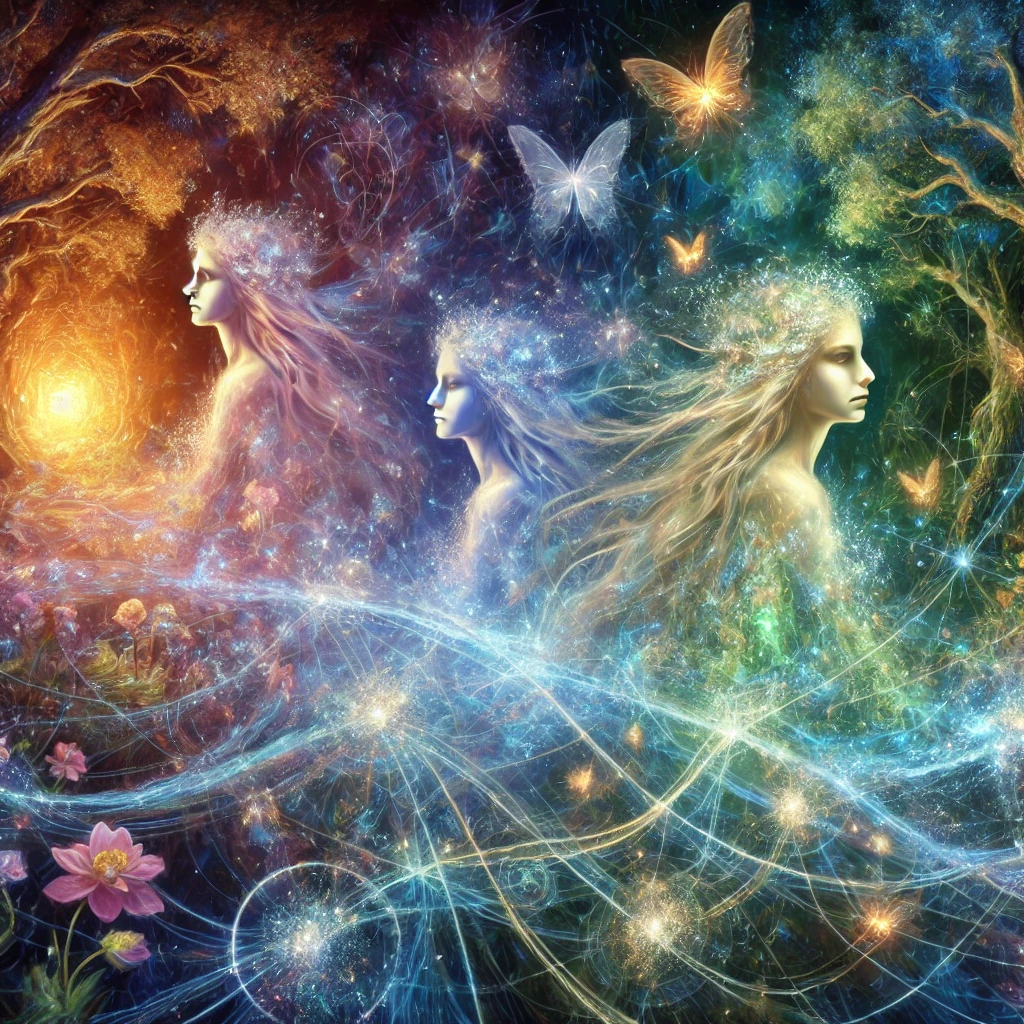
The mind of the faerie initially lacks a sense of separateness from the common Stream of force and mind; it is essentially integrated into the unity of the world, looks from within it, and therefore the light of yehidah does not arise in it either; instead, the Universal life – chayah – shines brightly, and it forms the basis of their psyche. In other words, if the mind of people proceeds from Chokhmah and to a greater degree relies on the “Day” pillar of the Tree, then the faerie are rooted in Binah, and in general, in the Pillar of Severity, and therefore the Fair Folk draw from the Abyss in the same way that the Call of the Heights is audible to people.
Moreover, since for the human mind the “descent” from the level of primary separation (yehidah) to the manifest state still passes through the sense of unity (Binah, chayah), the human being is caught between two poles – separateness and universality – and in order to attain harmony they need to learn to integrate them, whereas the faerie move from Binah to Tiferet – from Unity to Harmony without difficulty.
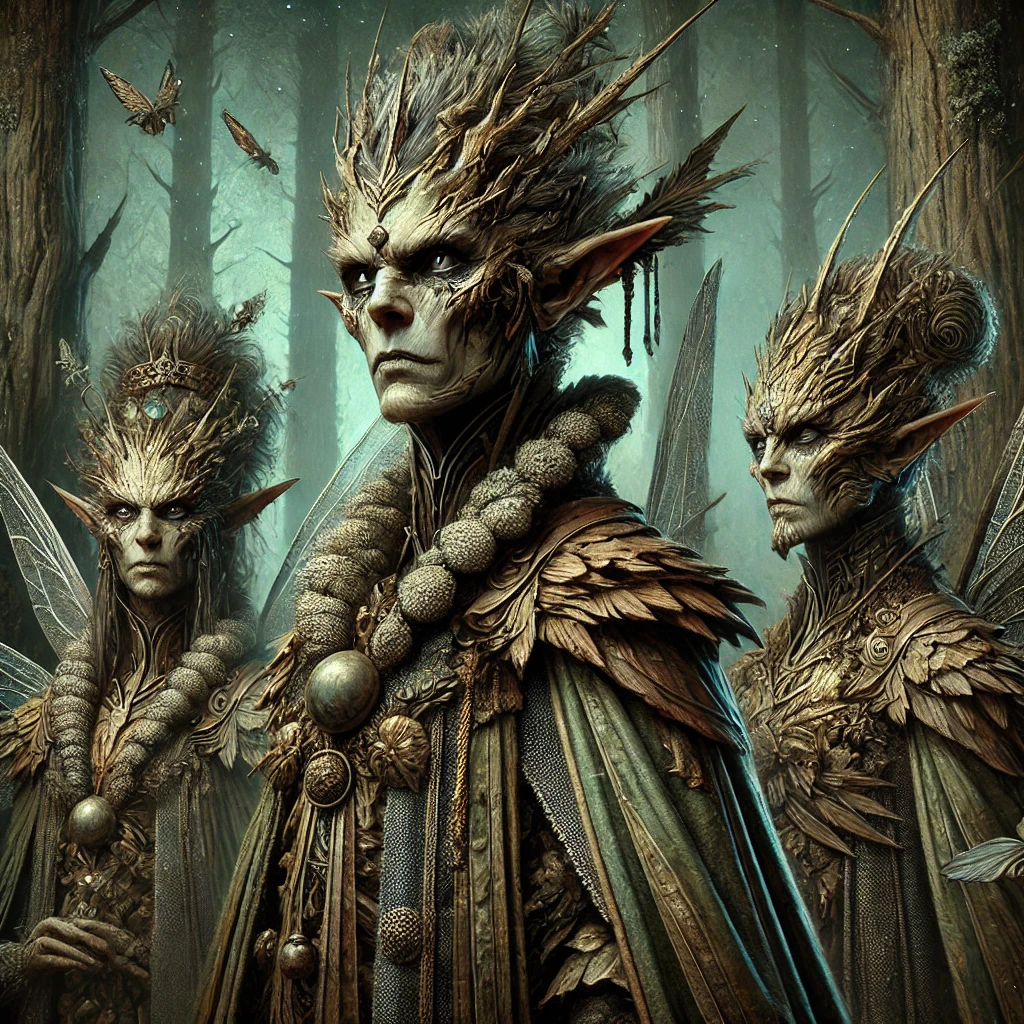
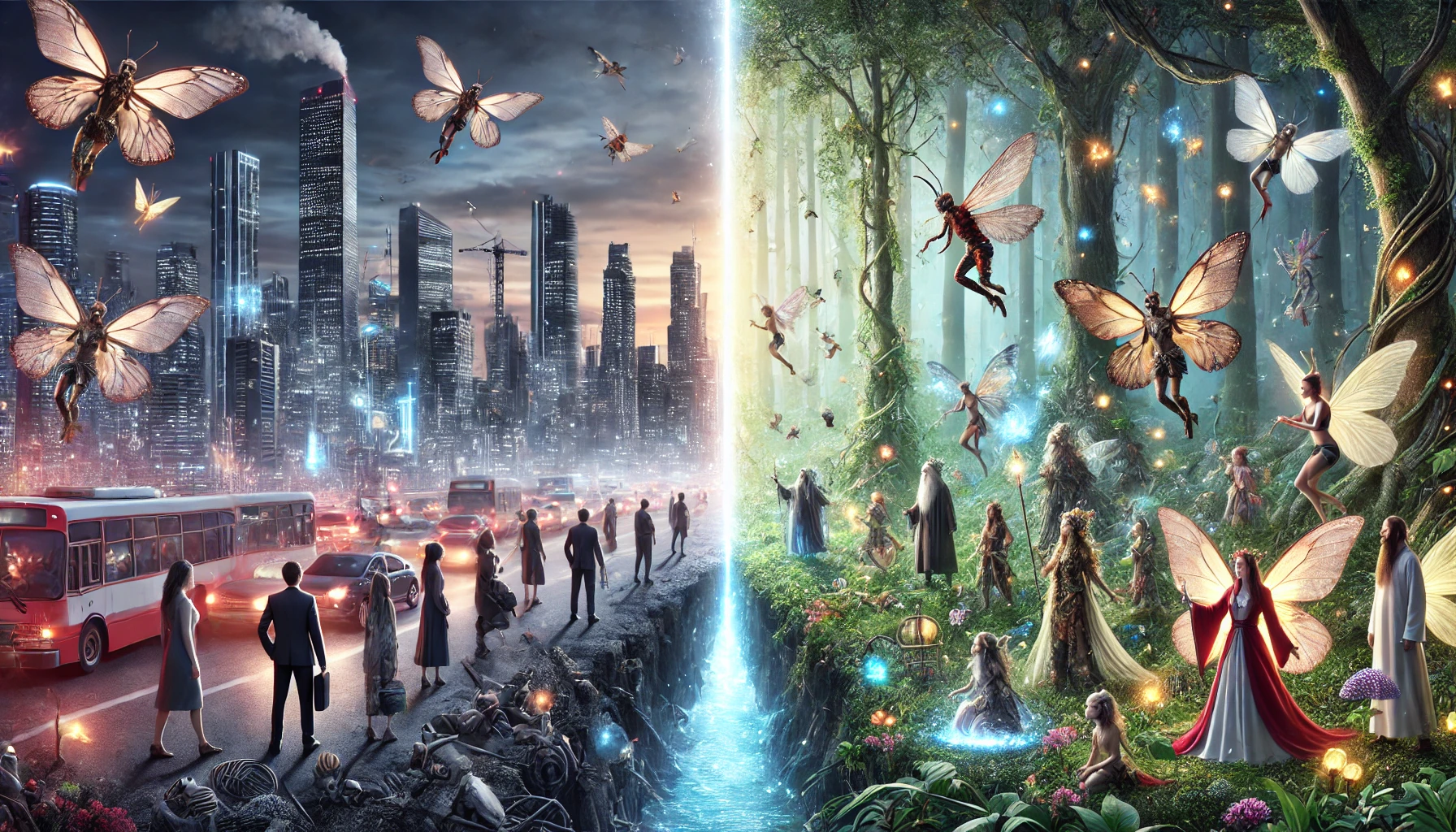
Among the faerie, Gevurah performs the “individualizing” function (its light is called “sheruf” and constitutes one of the sides of the mind of the faerie), hence their frequent unfriendliness and, in general, difficult temperament; however, their individuality recognizes that it is secondary in relation to universality, and therefore their kinship with nature is much greater. This is also the reason for the well-known “intolerance” of the faerie to iron – this metal, also belonging to the sphere of Gevurah, “neutralizes” their sheruf, and therefore deprives them of manifest energy. Humanity’s transition to the “iron age” was one of the significant causes of the great Exodus of the faerie. Even on the Earth of Geb there are almost no faerie left because of the use of this metal.
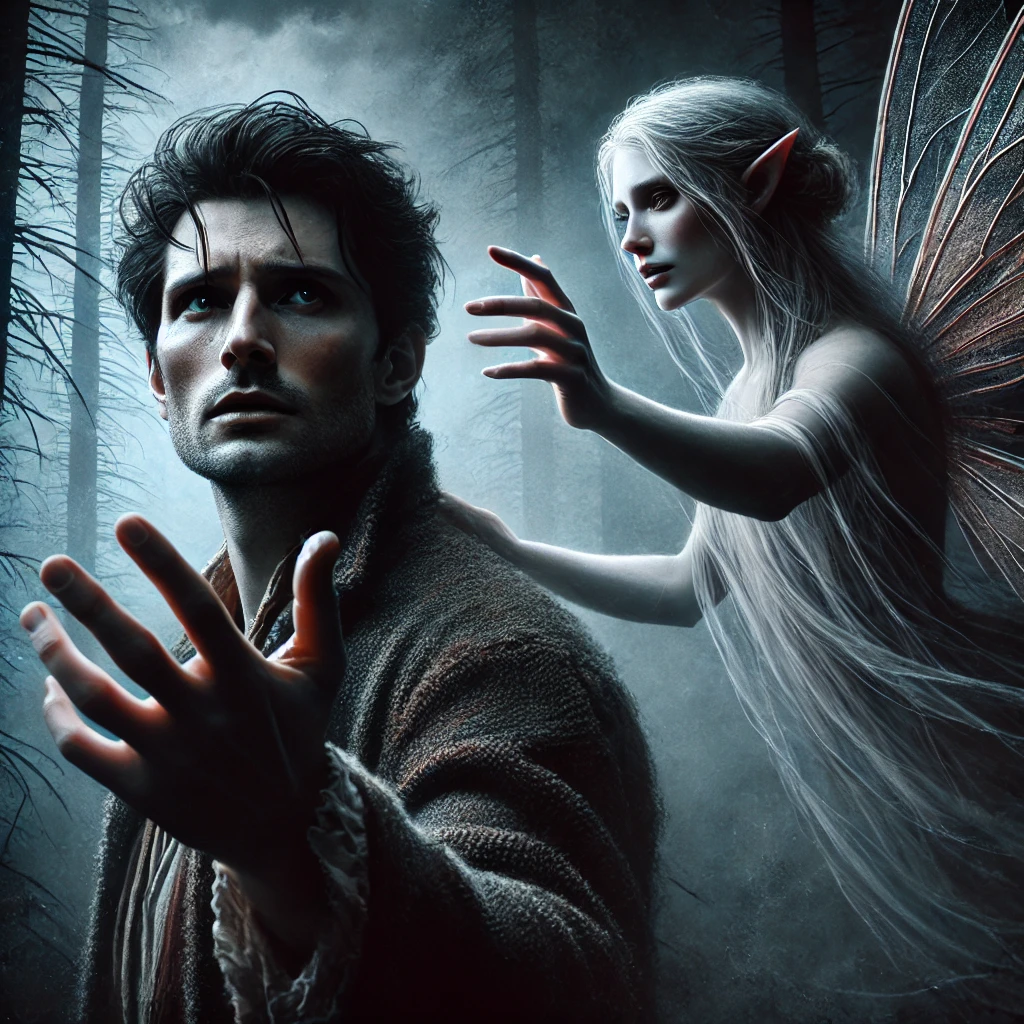
When people say that “the faerie do not experience love like humans,” what they mean is that they do not feel a centripetal, unifying force; however, this is not because they are evil or “hard-hearted,” but because they already live in this unity anyway; those extreme forms of division into “I” and “others” that form the foundations of the psyche of people are alien to them. This is precisely why the faerie truly do not understand representational art, theatre, and similar human manifestations, since it seems absurd to them to create an image of something that already exists, unity with which is already felt anyway. However, when for some reason the faerie suddenly begin to feel separateness, when they are banished or they get lost, they can also feel attraction, and then stories arise about love between the faerie and people, the birth of their common children, and – “acquiring a soul,” that is, the already “secondary” integrating light of neshamah. In this case, in fact, a transition of such beings into the human life stream occurs, which is usually accompanied by the loss of bodily immortality and further development according to the “broad” model of awareness.
Another important difference of the faerie lies in their capacity for individual evolution. In other words, if a person during their lifetime usually does not change either their form or how the mind functions, leaving such changes to future lives, then the faerie, on the contrary, are able to “mutate” repeatedly, adjusting their outer form to the state of their mind. Ideally, all faerie sooner or later should come to the state of the sidhe, Divine beings, developing throughout their long life, preserving the same individuality but repeatedly rebuilding their mind and body, time after time, from simpler levels to ever more complex ones. That is, say, those who now belong to the pixies may, over time, (and even must) become elves, and then dini shi. Nevertheless, the speed of such “individual evolution” among different races, lineages, and individual faerie varies greatly, and therefore in reality it is unlikely that all Fair Folk will dwell in Crystal castles.
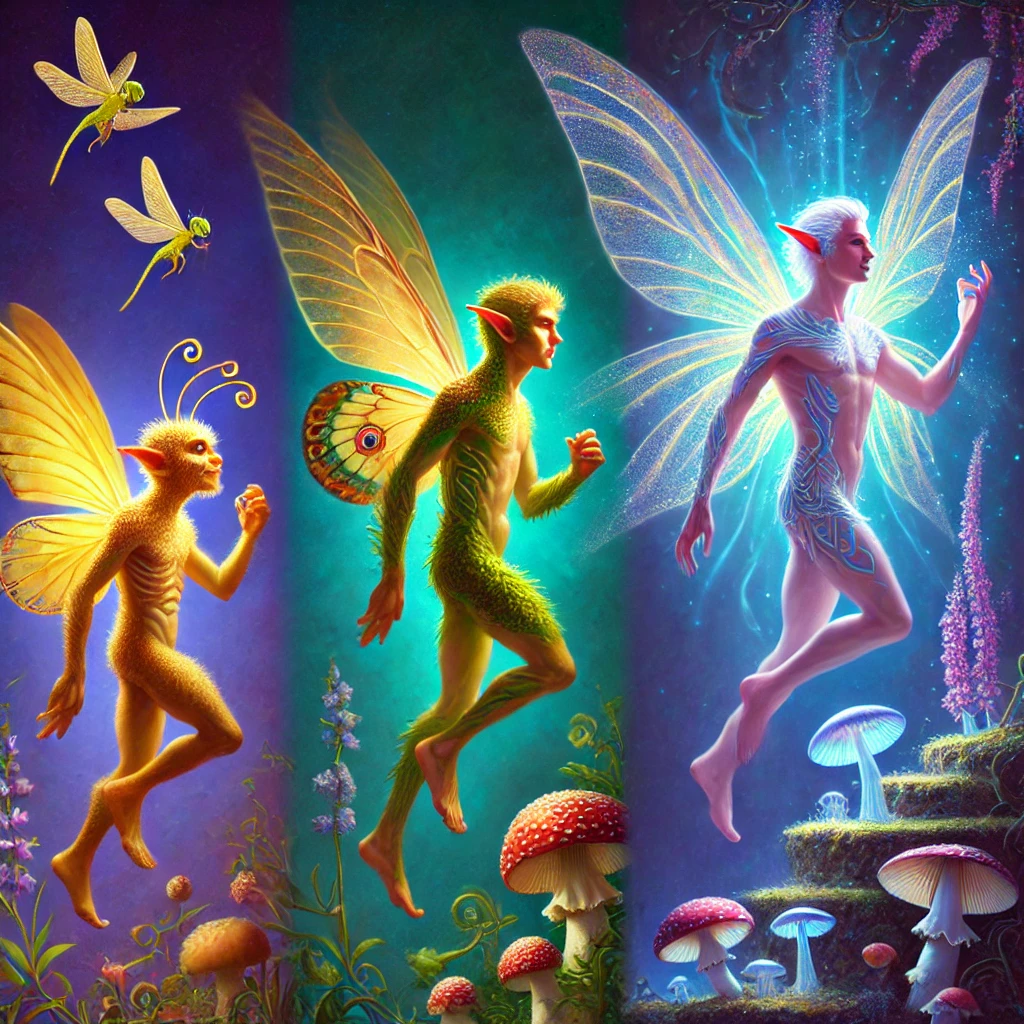
Finally, another important point is the ideas about the “afterlife” of the two peoples. When people say that “the faerie are deprived of an immortal soul,” they usually think that they are more unfortunate or even “defective” compared to people. However, they forget that the faerie possess an effectively “immortal body,” which performs for them the same integrating function that in people belongs to the Higher lights of mind. When the life of a faerie, for some reason, nevertheless comes to an end (it is known that they can be killed in a certain way, or they can “waste away” from grief or melancholy), their mind either returns into the common Spirit, which for a human being is analogous to attaining nirvana, and is usually not considered a defective fate, or they replenish the ranks of the elementals or other nature spirits.
Thus, it is important to understand that the two forms of manifestation of the “human” level of mind are equally important and equally necessary, realizing two different but complementary strategies.
Hello, Enmerkar.
Thank you for the article!
Queen Elizabeth once mentioned that she descends from the fairy Melusine, a spirit from Celtic legends – half woman and half snake. If this fact is true, does it mean that among the queen’s ancestors there are fairies, and that fairy blood flows in her veins? Can a parallel be drawn between fairy blood and the blood of the Nephilim, which is still present in some representatives of humanity?
Thank you.
Hello.
I can’t say anything about the Windsor dynasty, but in ancient times marriages between people and fairies were not uncommon, and a number of aristocratic courts in Europe claimed to carry elven blood. I mentioned this here:
https://youtu.be/q8oltFBA2rg?list=PLX2ZTKqdlYT2us_IwYMqFe9vBbNp-V2XU
Interesting… I watched the movie Hellboy: The Golden Army. There, they could not give the fairy princess in marriage. And the prince, the brother of the princess, had to sacrifice himself.
As for me, the fairies have a more advantageous strategy)) As philosophers love to say about man: ‘man is a problem’ for himself and for being. In combination, man feels defective and detached from life and strives to achieve unity. But then what is the profit? Does this mean man is straying from his human path? Or is it just that in the information age there is a strong shift towards the rational center, while imaginative thinking is dulled? And how will fairy consciousness differ from the consciousness of some Spirit? After all, that or another spirit is also united with Being?
The Spirit, although it is united with the flows of being, does not have an anchor on the material plane, and therefore the energetic effectiveness of its interaction with the object side of reality is much less; from the perspective of consciousness development, an anchor in matter provides much more opportunities, and fairies have real dense bodies.
What do you think about the idea that a transition from a human development strategy to one typical of fairies is possible through initiation?
Theoretically, such a transition is possible, but it requires enormous and fundamental changes in nature itself, so it is difficult to imagine such an ‘initiation’.
Perhaps the return to the ‘common spirit’ is not such a great achievement for both fairies and humans. And this is definitely not the nirvana to which Arhats strive and reach.
Enmerkar, thank you for your efforts! Are the crystal castles located in Alvheim? Did the sidhe build these castles? Is Avalon in Alvheim and do the sidhe or other beings live in Avalon? Where do you think the portal to Avalon is located in England? If the portal to Shambhala is presumably near Kailas, where might the portal to Avalon be? Could you tell us more about the Crystal Castles and their inhabitants?
No, the Castles are located in the in-between world. Avalon, according to traditional views, is a “sub-universe,” just like Shambhala and, for example, Valhalla – a special area, separated from the In-Between and possessing its own stability and laws, but at the same time not as large and energetically integral as a true complete world.
Thank you for the answers! Who then lives in Alvheim? Alvs, sidhe, fairies? I’ve read your articles, you write a lot about the In-Between and the In-Between Worlds, but I probably missed something about Alvheim. Are all 9 worlds of Yggdrasil as dense as Midgard (our world) or are they not as dense? And is the In-Between located between the worlds of Yggdrasil?
Yes, there are elves living in Alvheim) In Lessaalvheim – Light Ones, in Svartalvheim – dwarves. https://enmerkar.com/en/myth/alvs-the-glimmering-lights-of-the-cosmos https://enmerkar.com/en/myth/worlds-of-yggdrasil And yes, the Worlds of Yggdrasil are closed Universes, while the in-between is a world of potentials: https://enmerkar.com/en/observations/interspace-and-the-multiverse
Are the crystal castles of the sidhe Valinor of Tolkien, and are the sidhe the varda? There is an opinion among researchers of Tolkien’s artistry that Valinor was created by Tolkien based on the Heavenly Paradise from the Christian egregore, then it turns out that the Christian Paradise with its angels is primary, and on its images, Tolkien created the images of higher elves, as beautifully depicted by Peter Jackson. Or are the varda indeed the sidhe and at first, the sidhe created the Crystal Castles, and Tolkien saw these elevated worlds of the sidhe from the subtle plane and actually created Olórë Mallë (the path of dreams) through his books, by which the reader enters Valinor (the Crystal Castles of the sidhe)?
It’s difficult to draw parallels between literary works and traditional sources, but of course, Tolkien had great intuition and probably insights that formed the basis of his works.
Is there a connection between the Christian paradise and the Crystal Castles of the sidhe? The Christian paradise feels divine and beautiful, and people have a canonical representation of the Christian paradise, which today, thanks to AI, they embody in their creativity https://www.youtube.com/watch?v=n6Lr_QK5SVw https://www.youtube.com/watch?v=YQMynMZg3kI https://www.youtube.com/watch?v=2UIQCbxiWug Is the image of the Christian paradise inspired by the worlds of the sidhe or did the Christian paradise arise only through the channel of Christ? If the paradise appeared only through Christ, then how do the worlds of the sidhe manifest in this world? If only the Christian egregore “whispers” such geniuses as Bach, Vivaldi or Albinoni divine music, then are there manifestations of the music of the sidhe in our world? Can you name a composer who is a conduit for the music of the sidhe? Or an artist, architect, writer through whom the higher elves broadcast their world into our world?
Paradise is mainly the “Islands of the Blessed”: https://enmerkar.com/en/interworld/islands-of-the-blessed
Thank you! Why did the sidhe need to build their world in the In-Between when it would have been easier to go to Alvheim? If the Alvs are gods (or even above gods, as you write), then they are similar to the varda (ainur) of Tolkien. It turns out that Alvheim may be Tolkien’s Valinor. But the high elves of Tolkien had access to Valinor, so why didn’t the sidhe go to Alvheim (or Valinor) but instead created their world Sid (Shi), knowing about the difficulties of hunger in the In-Between? And why didn’t all fairies and elves go to Alvheim, but endure constant hunger in the In-Between? Or is Alvheim too high-frequency and radiant for ordinary elves and fairies? And therefore they might want to get there, but due to their frequencies being lower, they cannot rise that high?
Yes, for fairies, Alvheim is foreign and too “high” a world, they cannot live in it.