
Islands of the Blessed

One of the most important, yet contradictory, realms of the so-called Interworld is the Islands of the Blessed (the ether level BAG), where joy, faith, and trust become the “foundational structures of existence.” Here a silence is possible in which fear is already exhausted, although fullness has not yet reached pleromic timelessness; peace reigns here that does not compel action, yet does not dissolve the individual form.
BAG is an ether of the Interworld, generated by the Aeon Makariotes (Blessedness); for many postmortem travelers it becomes a sustaining haven, a place of rest and solace along the way.

The birth of this space is linked to a turning-point event in the world’s paleohistory. During the so-called “Second Battle of Mag Tuired” (about 65 million years ago), the world first encountered the death of embodied faerie.
It was the decisive clash of the Tuatha Dé Danann with the Fomorians for control over the flows of matter and energy and the direction of the evolution of matter preparing to receive a new wave of mind. The Fomorians, who had emerged from the Interworld, into which they had been driven back in earlier ages, and who were creating gigantic beings in the world, learned to burn the bodies of the sídhe with demonic fire. The Tuatha Dé Danann, relying on the support of the alves, Vanir, Aesir, and the craftsmanship of the svartálfar (through their students — kobolds, goblins, forgoes, leprechauns, and others), gathered an alliance of light forces and steered evolution back toward creativity. When the scales had already tipped in their favor, the Fomorians deployed the “Eye of Balor” — three strikes of “heavenly fire.” In mytho-historical terms, this is the Cretaceous–Paleogene catastrophe, the death of ancient ecosystems, and the end of the dominion of the dinosaurs.
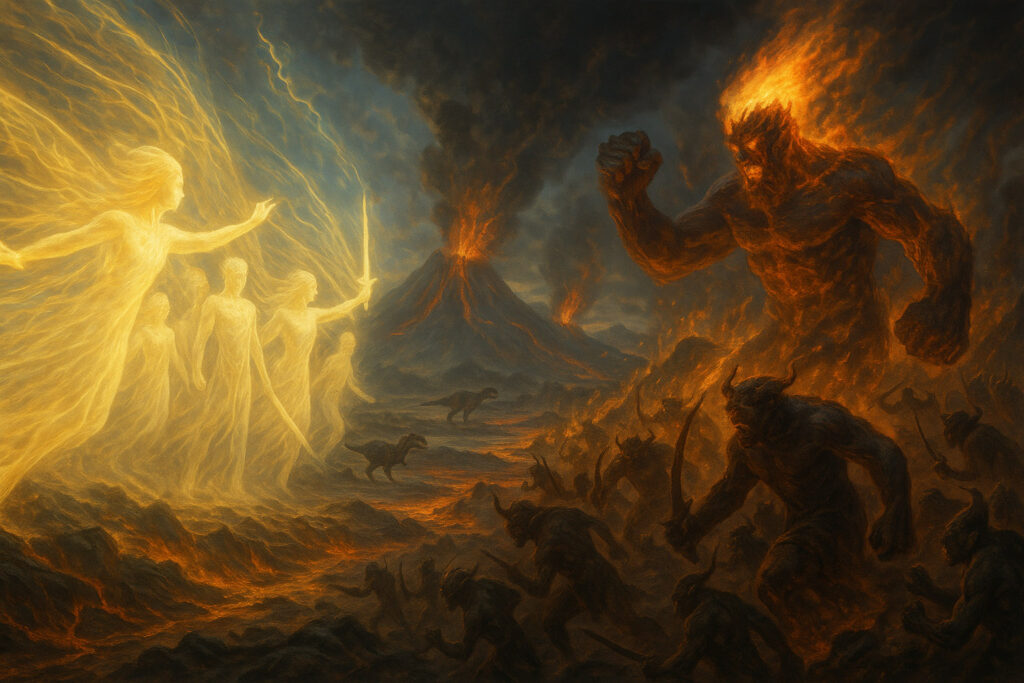
The elves, the bright gods of information — immortal and incorporeal by their nature — were not destroyed completely in this battle; but the Fomorians expelled them from the dense world and “banished” them into the Interworld or cast them back into Álfheimr. The faerie, however, who by the epoch of the Tuatha Dé Danann already possessed stable supports of mind, experienced firsthand the reverse side of shaped existence: their “bodies” — condensed, materialized light — became vulnerable to destruction. Their essence did not die, but it was deprived of support and became a wanderer in the Interworld.
To accept the new reality and ease the path through the Interworld of the exiled elves and the “killed” faerie, the Bright alves rebuilt one of the ethers of the Interworld — BAG — turning it from a boundless light expanse into an archipelago of mercy that sustains the mind. Thus began the history of the Islands of the Blessed.
Before the war, the space of BAG was a “surface”: a lofty, impersonal light ocean — the manifestation of the Aeon of Blessedness. In the first Epochs, only a few entered here — contemplatives among the elves, a few Vanir and Aesir in meditation and dreams. The threshold was guarded by a warden, a complex guardian being, the “angel” of BAG. Only those in whom faith ceased to be an effort and became part of nature could enter. The rest, BAG gently kept out, preserving its pristine purity.
However, the War changed everything. The Bright alves gave the ether’s surface an “island” architecture as a set of individual subspaces, subworlds, where each being finds an environment fully consonant with it. Since then, each Island arises at the moment an elementer enters — an unembodied being that has completed its cycle of embodiment in a state of inner harmony. The landscape of each Island is a direct continuation of its inner state, a kind of “High House,” fully dependent on its inhabitant. Luminous hills, crystalline pools, transparent meadows of glowing grass — everything grows and flows in unison with the inhabitant’s peace. This was the first experience of individual “paradisal lands” among the faerie — not eternal, but sufficient for the pain of battles, losses, and exiles to dissolve in soft light.
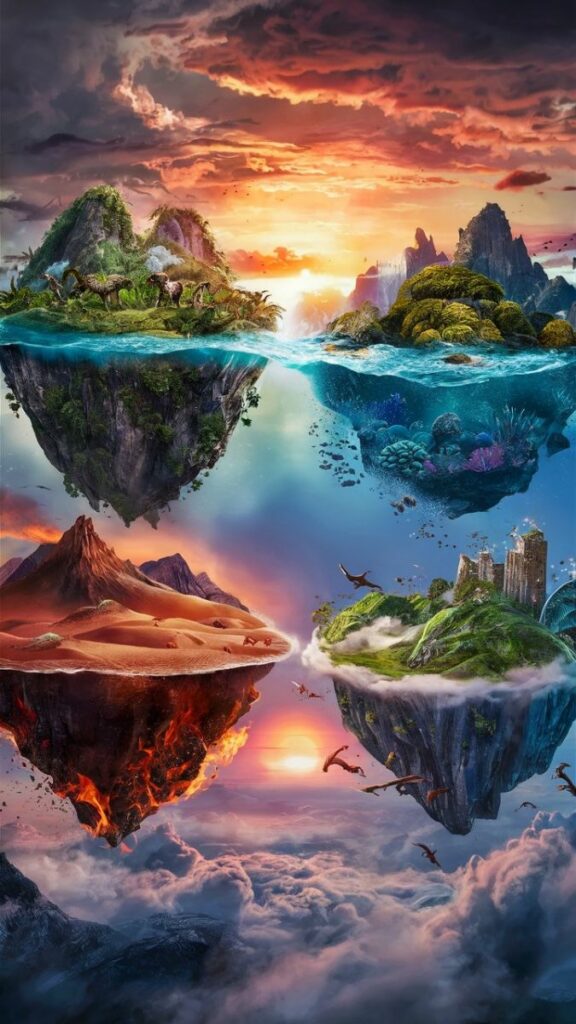
The architecture of BAG is nourished by the same energies as the Castles of the sídhe: by the currents of the Elemental Cities, which extend through this ether as well. At the same time, the main “matter” of BAG is the energy of trust; the “material” of the islands is fidelity that has become light.
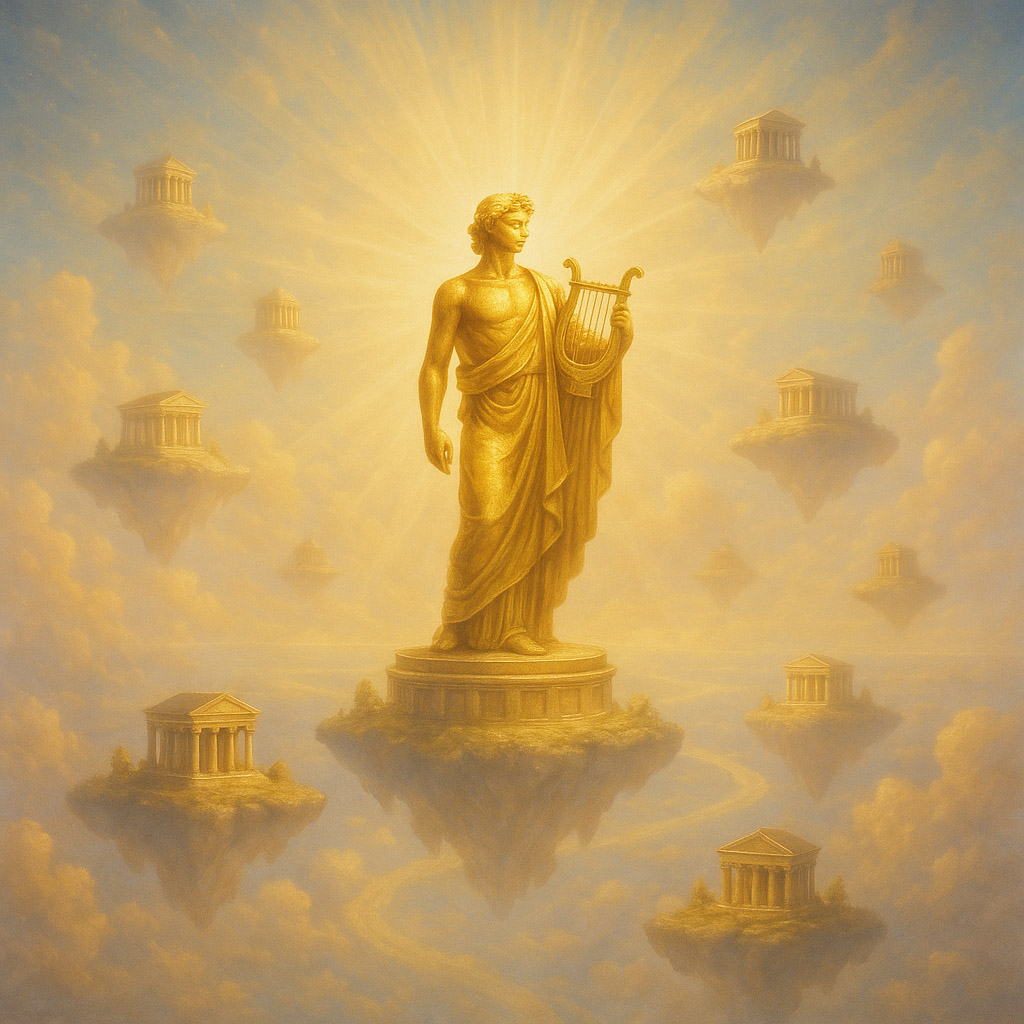
Gradually, many such subspaces formed into a semblance of a planetary system — an archipelago at the center of which a great sphere took shape, a “planet-sanctuary.” Here abides an aeonic deity of this level, the Solar Kithared, whose music later myths conveyed in the image of Apollo. His influence is manifested in maintaining the harmony of spaces; his music unites the islands into a common choral mode, preventing chaos of the Interworld from disrupting peace and blessedness.
BAG is not an ultimate heaven; it is a lofty, but intermediate haven: there is no fear here, but form is still preserved; there is peace, but not yet absolute fullness, and blessedness is not yet Enlightenment.
In this peace, elementers gain clarity and strength, living through their pure blessedness; however, sooner or later a moment comes when the island becomes confining for the mind dwelling on it. Then the inhabitant sets out again: either to a new birth, or beyond the Interworld, to where Pleroma removes all limitations. In this sense, the “eternity” of BAG is only a sweet dream within a state; by its nature it belongs to the space of transitions, and therefore inevitably has an end as well.
An essential feature of BAG is its barely perceptible “note of loneliness.” Each “island” is a direct continuation of a specific stream of mind, and therefore each inhabitant finds themself in their own perfect heaven, suitable only for them. This, of course, brings healing wholeness, yet also isolation: here it is impossible to meet another in the fullness of their being. Communication can only be indirect, mediated by light and music, while immediate closeness is impossible or severely limited. Therefore, through the sensation of the Islands’ peace there always sounds a barely perceptible note of bitterness: joy can be deep, but it is not shared, and therefore is not perfect.
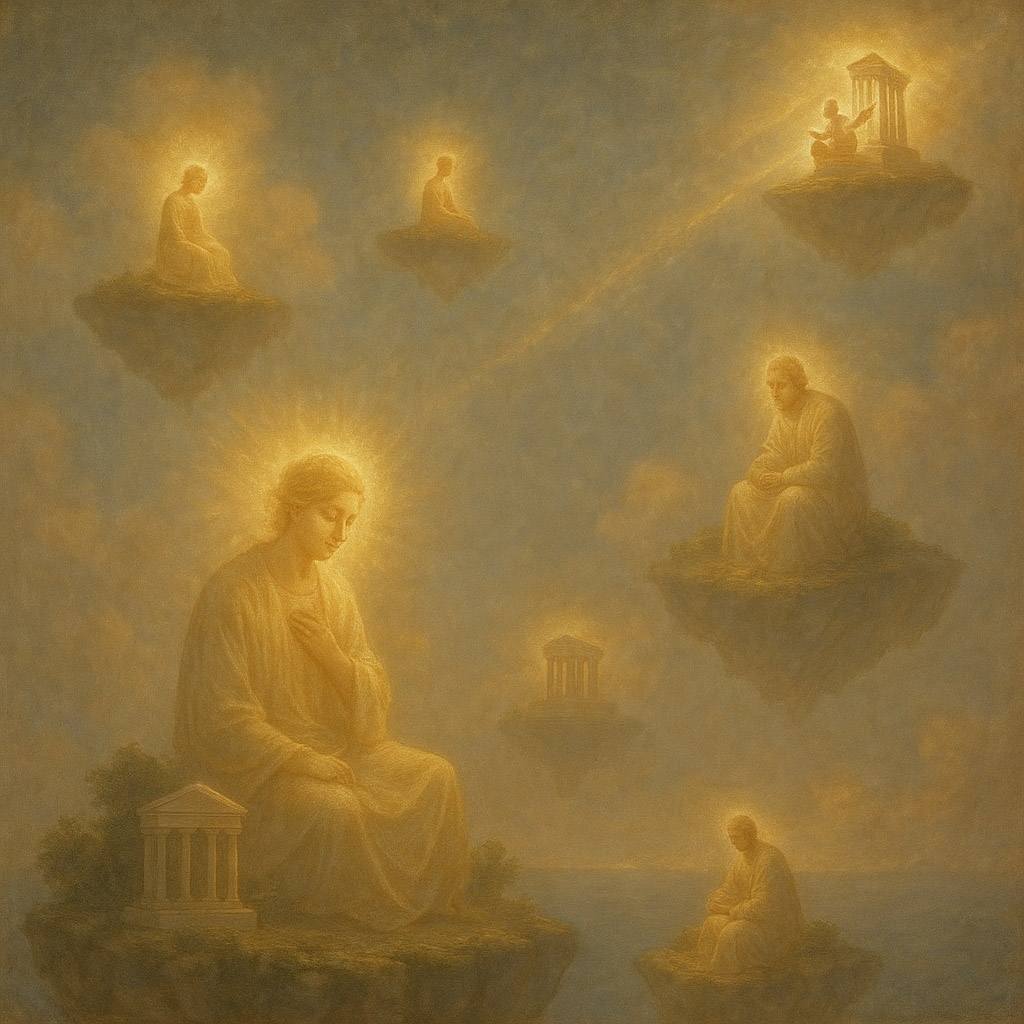
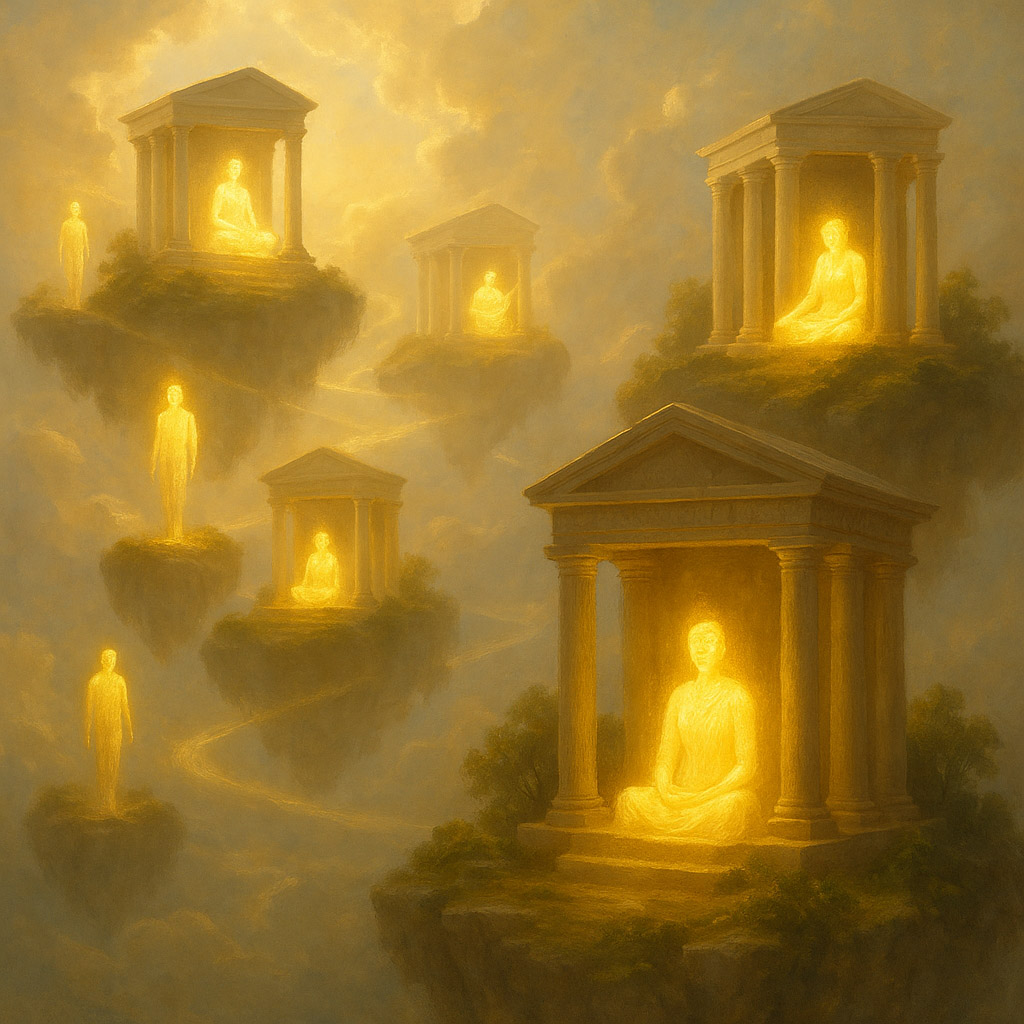
The Bright alves softened this flaw by building special “Temples” on the central sphere — light-bearing structures that arise when many souls simultaneously reach toward unity. In the radiance of these “Temples,” the inhabitants of BAG can gather briefly: share experiences, sing as a single choir, strengthen their participation in the Higher — yet still then return to their islands, albeit somewhat clearer and more filled. However, these “gatherings” are always brief: the support of personal form draws one back, and BAG thus remains a space of “cold” blessedness rather than loving union.
Over the course of epochs, the Islands of the Blessed became a common space not only for gods, elves, and faerie. The space created as a merciful haven for those “killed by light” turned out to be accessible to the dead from many worlds.
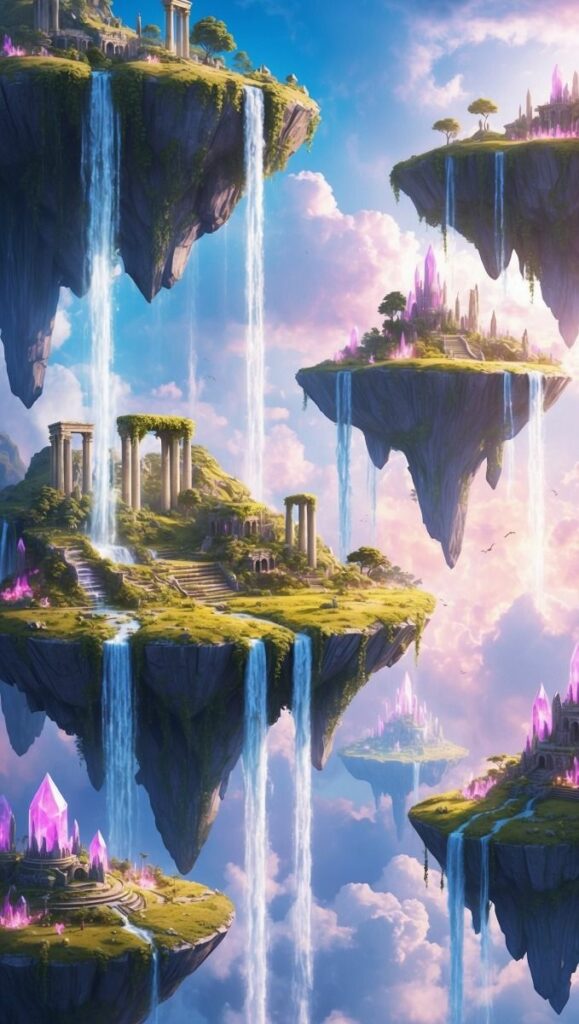
Today, the main inhabitants of BAG are elementers who have completed disembodiment in states of faith and self-realization. Religious practitioners often arrive here, and from our world as well — especially Buddhists, inclined to see in BAG the Pure Land of the bodhisattva of wisdom — Manjushri. And indeed, the form of the space — pure, clear, musical — evokes such associations. However, strictly speaking, Buddhakshetras, like other pleromic “lands,” lie outside the Interworld’s ethers, although their images do arise from its potential fabric. And therefore BAG is only a distant “echo” of the Pure Lands in the ether of Blessedness: lofty and good, but still an intermediate space.
For a visionary, this ether most often appears as a boundless light ocean with softly outlined territories — “mini-planets,” where material boundaries are scarcely felt. The light here is warm, soft; it does not come from outside, but radiates from the beings themselves — as the radiance of Makariotes that has become nature. Each “planet” arises in response to the entry of the corresponding elementer and exists as long as the inhabitant needs its peace. Between the “planets” flow light, luminous currents, allowing them at times to draw closer and part; in the center is the music of the Kithared, holding the tuning so that neither loneliness nor encounter destroys the overall harmony.
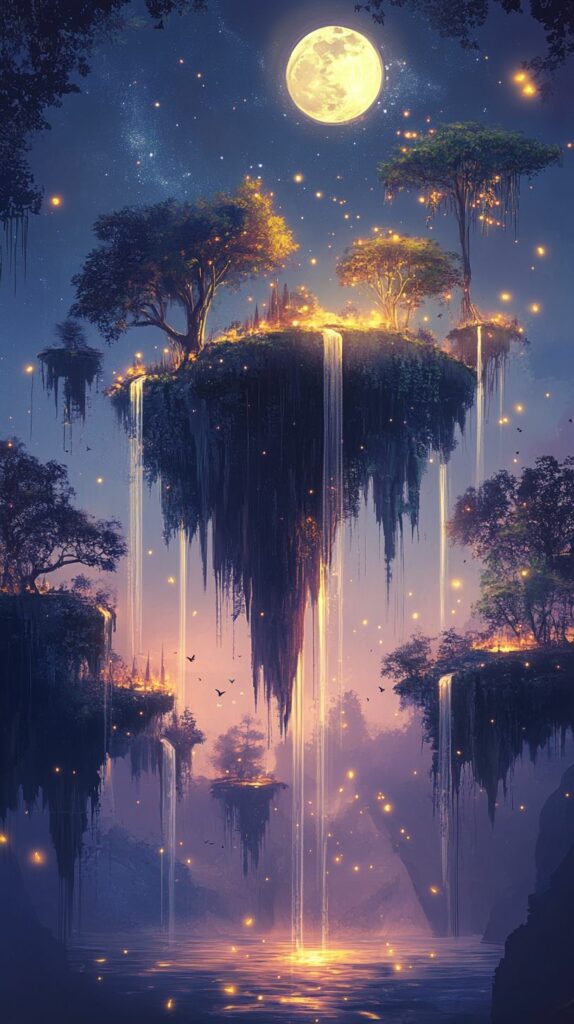
Thus BAG turned into the “Islands of blessedness”: here faith sustains, joy flows; here nothing constrains activity except one’s own nature; this is the “Place of the free road,” as the ancient Egyptians called the spaces of BAG.
But it is precisely this freedom that reminds one of the larger goal: BAG is only a place of rest; it is still far from the end of the journey, not its goal. It restores breath to the mind, cleanses traces of pain, gathers the energy of merit into light — and by this prepares movement onward.
Various myths describe these spaces as the Elysian Fields, Annwn, Eden, partly as the Field of Reeds: reflections of one and the same image — a refuge of light that arose as a response to the birth of death among immortals.

The victory of the sídhe over the Fomorians was hard-won; its greatest price was the appearance of the very idea of death among those who knew only the free flow of light. But along with this price there arose the consoling knowledge that beyond the destroyed form there exists a shore where one can wait out the storms of the Interworld, restore clarity, and hear the music that joins scattered feelings, thoughts, and impressions into a single order.
It was precisely this experience that made the faerie closer to humans: they foreshadowed much that would become both a trial and a blessing. The Islands of the Blessed are testimony that peace is possible, but without full enlightenment it is not final. These bright shores exist so that one may leave them again — freer, purer, and more ready for the Way to complete freedom and perfect Unity.
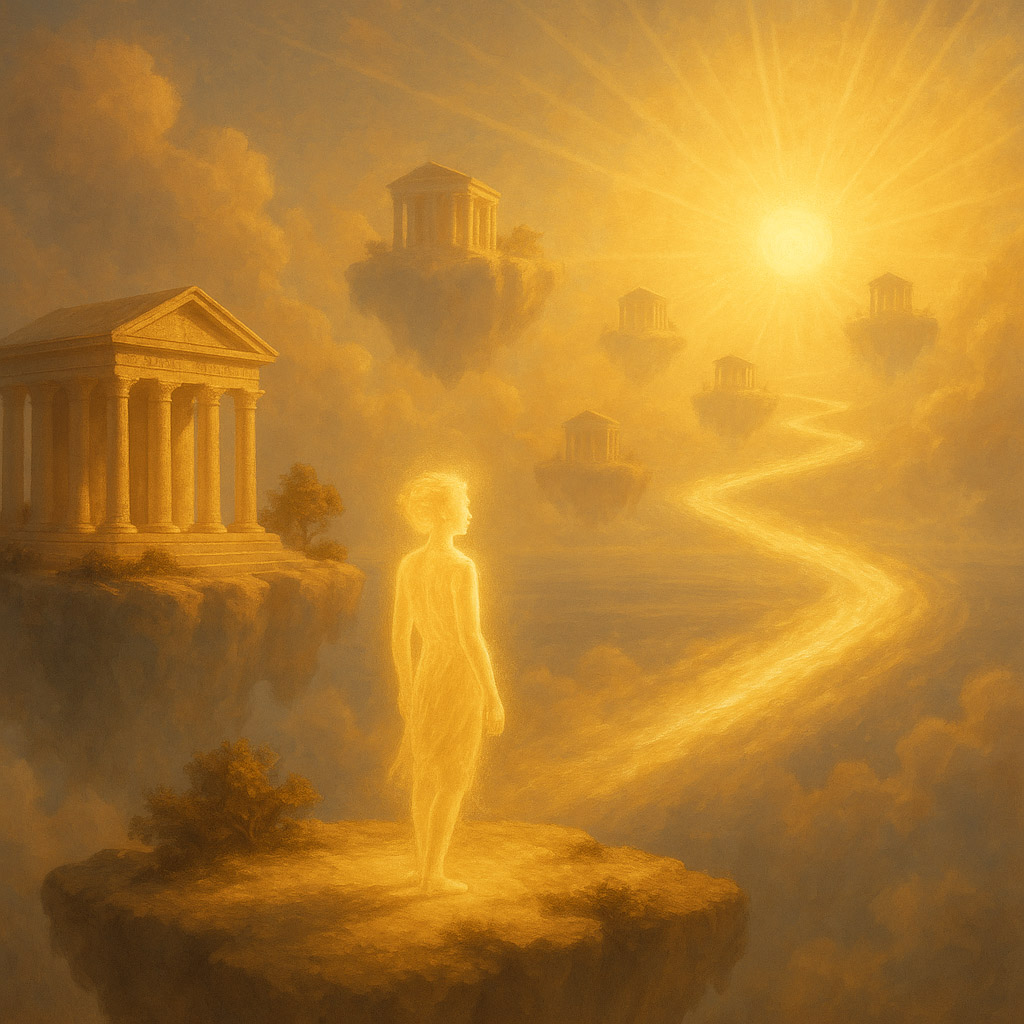
Woland, in response to Margarita’s question about the fate of the Master, says that he did not deserve the light, but deserved peace.
I am also reading your book on the Interworld. And the article is a wonderful addition. Thank you.