
Three Turns of the Wheel of Knowing

Whatever Way of development the mind’s evolution follows, from the standpoint of the process of manifested being it consists of three main stages: affirmation, negation and integration.
In fact, the division of the Way into Seeking, Adeptate and Mastery, the division of the Futhark into three atta, and the alchemical transmutation into three Transformations (nigredo, albedo, rubedo) all, in one way or another, describe development from the perspective of these general principles.
From the point of view of the Myth we are considering, the task and content of the process of manifested evolution is the mind’s entry into being and the mutual actualization of both, which unfolds through a series of obvious and largely universal stages. As soon as a primary binary — the subject/object of cognition — separates from the world Unity, the mind begins the process of differentiating being and immersing itself in it, which ultimately leads to their mutually conditioned actualization and subsequent integration.
At first the mind, sinking into the milieu of being, becomes “entangled” in it: it takes on its properties and identifies with it. Having fully passed through and exhausted this path of identification, the mind inevitably discovers its otherness relative to the milieu and therefore inevitably sets out on the road of negation — self-distinction from the milieu and self-assertion as an independent, self-determining principle. However, once the mind completes this process of distillation, it discovers that without objects toward which it can be directed it lacks actuality; thus it enters the milieu a second time, but now it does not fuse with it; rather, it understands it structurally, integrating its potentials with its own qualities.
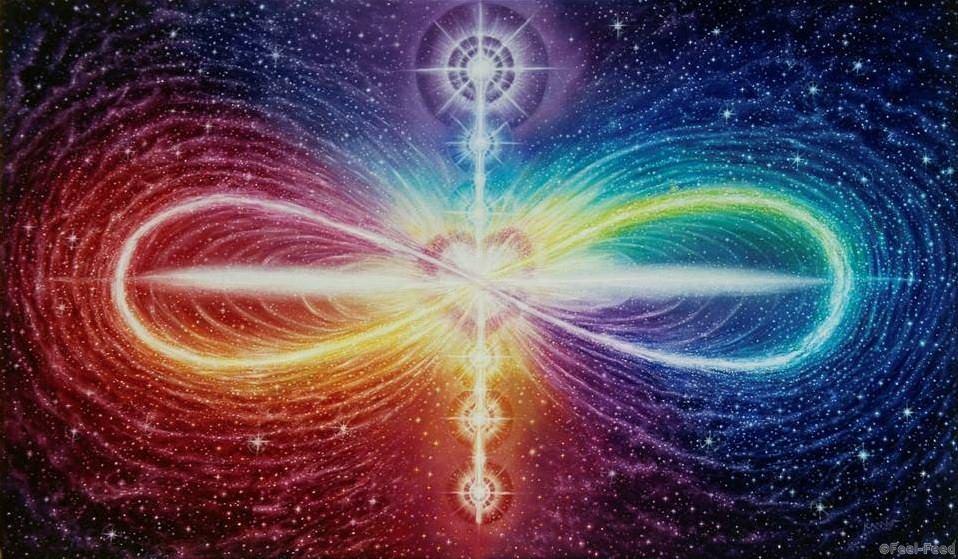
Each of these turns of the wheel of development can be considered as a composite of a number of stages (usually eight or twelve), which make the nature of the processes involved more explicit. Let us briefly outline those stages.
So, everything begins with the primordial contact of being and mind. Since at this stage both the milieu and the mind are still wholly potential, “empty,” the very content of their mutual attunement is not yet clear and has no direction or purpose. This stage is traditionally called “tohu va-bohu,” “without form and void,” meaning that the absence of awareness (tohu) implies the absence of being (bohu), since, as we have already said, “to know” and “to create” are the same action. This “formless,” yet perfectly “real,” milieu is traditionally known as the “Interworld,” which constitutes the common other side of existence.

Immersing itself in the milieu, the mind begins to manifest its differentiating, structuring activity, generating a stream of forms. This process corresponds to the birth of Reality from chaotic Dreaming. In the next stage the very stream of awareness arises — the process of establishing correspondences between the mind’s capacity to know and the knowable potentials of the milieu. This process includes the manifestation of logoi — “naming,” that is, the delineation of distinct objects as autonomous systems within the focus of the mind. Once objects are cognized/created, an interaction arises between the mind (acting as subject) and the milieu (the ensemble of objects) — the act of perception. This interaction, in turn, gives rise within the mind to “responses” to contact with the object: sensations and emotions. Because interactions are numerous and responses abundant, it is at this stage that the sense of the mind’s dependence on being arises — the formation of attachment and the need for ever-new stimuli for the mind. This stage usually lasts an indefinite period, all the more so because each interaction leads to new contacts and thus new reactions, progressively strengthening the mind’s “entanglement” in the milieu. Nevertheless, if the process of coupling mind and being proceeds more or less efficiently, sooner or later it loses its allure; as one might say, the world becomes “exhausted” for the mind and grows increasingly uninteresting, which leads to the “first death” or the overcoming of the “first abyss.”
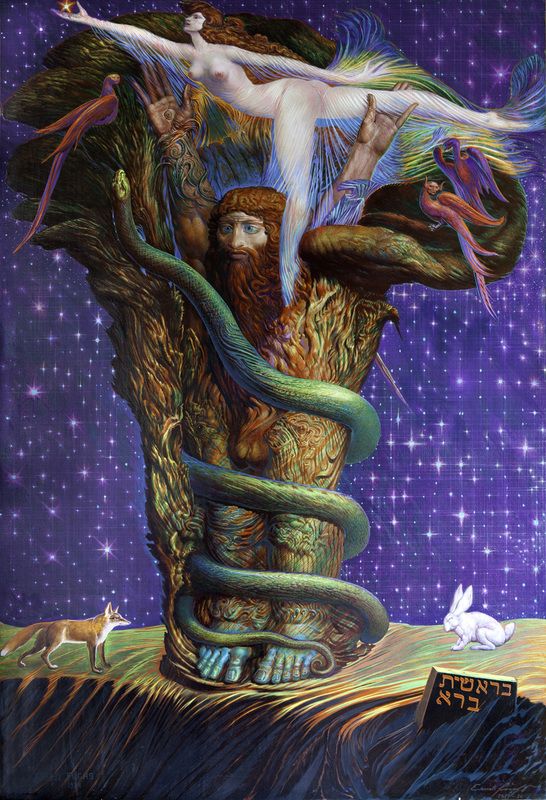
At this stage the mind discovers its “originary” nature in relation to being — its primacy over the milieu — and therefore sets out on the path of negating the value of the milieu, of its “illusoriness.” This sense may be more or less distinctly articulated and formulated within the mind, but regardless it is the driving force for the mind’s self-identification, its search for its nature, the definition of its qualities and individuality. Without this clear recognition of its own nature the mind would remain “dissolved” in the milieu, and its bearers would be merely objects of other minds, lacking support within themselves. By discovering itself and focusing on itself, the mind acquires the necessary properties of an independent subject, properties that confer upon it the quality of existence and the capacity for free interactions, thereby freeing it from dependence on reactions to the conditions of the milieu. Just as in the first stage, this process involves defining one’s properties, contact with them, their gradation and (if necessary) transformation. This stage (Adeptate, albedo) allows the mind to discover itself, to define itself, and therefore its attention turns to itself; accordingly the object of awareness is no longer the milieu but its own qualities.
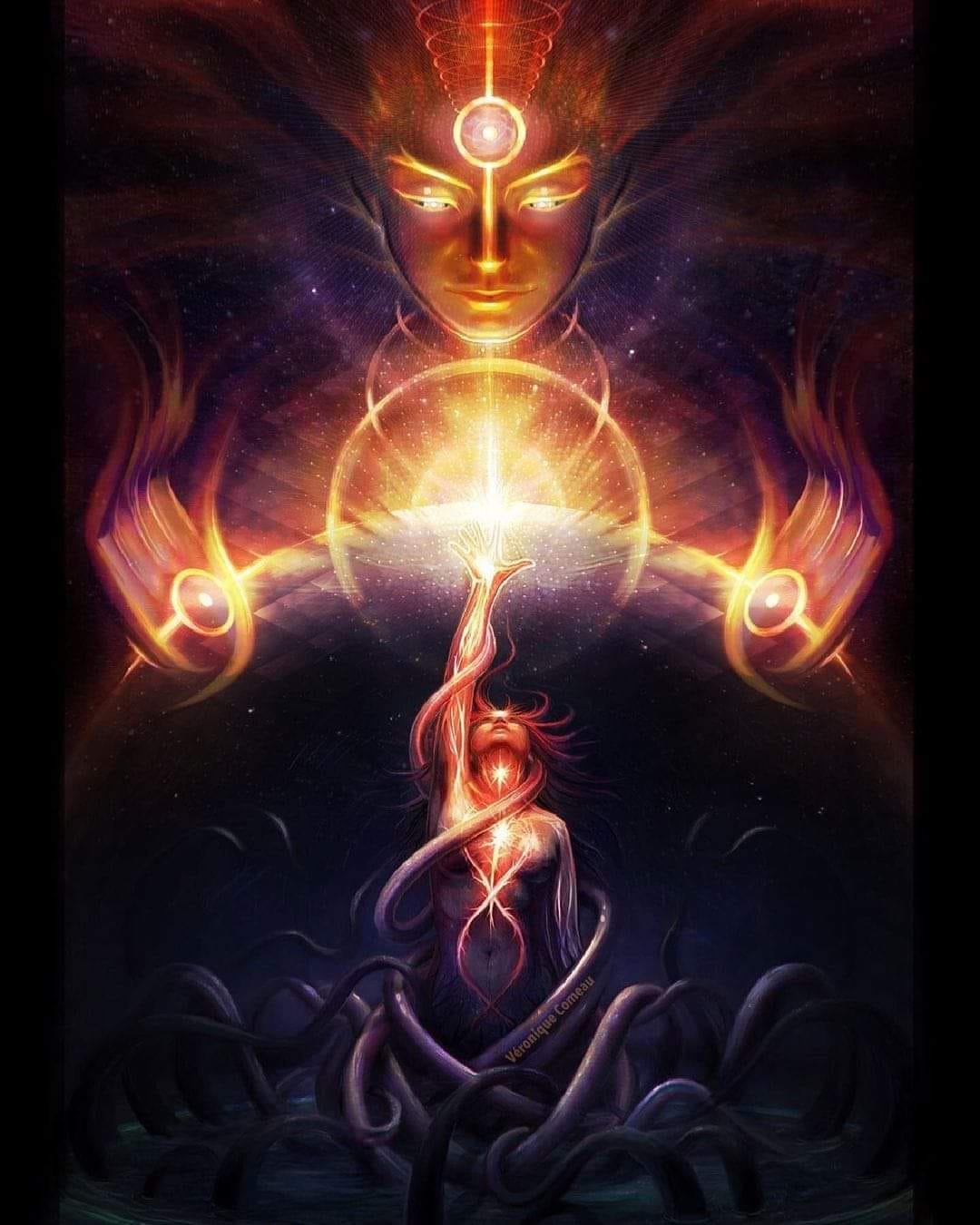
Nevertheless, just as at the stage of dependent “immersion in the world” the possibilities for evolutionary interaction between the milieu and the mind were limited by the initial contact and thus gradually exhausted, so at the stage of “self-reflection” the subject/object relations internal to the mind are likewise limited. Sooner or later the mind learns that only those properties and qualities which were actualized during the “first immersion” in interaction with the milieu are available to it for awareness. Qualities that were not thus manifested remain unrealized potentials. Namely, the mind once again discovers its “dependence” on being, its conditioning by being, and all its representations of its luminous and divine nature collapse. This stage is marked by reaching the “second abyss,” in which the mind either returns to the original state of “tohu va-bohu” and then plunges anew into the cycle of being, or exits to the next level of its development — attaining Mastery.

That is, at the outset of development a person is inevitably immersed in the world and does not feel separate from it. The world sweeps them along; it seems valuable and important. Gradually, however, this feeling dissipates: the values of the world appear increasingly illusory, and after a crisis the second stage — the stage of “spirituality” — arrives. At this stage, by contrast, only “spirit,” the “divine,” the “higher” seems of value, while the world of being is perceived as “sinful” or “illusory.” But sooner or later this stage, too, ends in a sense of emptiness and dissatisfaction, from which the person either “returns to the world,” abandoning “spirituality” and once more immersing in the cycle of “ordinary values,” or undergoes a new severe crisis and transformation — and moves into a new condition.
If overcoming the Abyss leads to the transition to the stage of Mastery, the mind also returns to the world, but no longer as an object and instead as a creative subject, opening up new possibilities within itself and the world for mutual determination, mutual ordering and mutual actualization.

Note that confusion often arises between these two ways of “returning” to the world. Frequently one who failed in the encounter with Choronzon proclaims himself victorious and declares his return to be wisdom.
Of course, the criterion of victory is not “perfection” or “awareness” — notions that are difficult to assess adequately — but striving for development, for further advance, for the Way. In other words, we are successful not insofar as we are “wise”; we are successful insofar as our movement is relentless, insofar as our aspirations are unstoppable — toward the infinite, through darkness, out of darkness.
Thank you, En, it’s pleasant to read.
Probably every magician who is in a stage of development knows this feeling when it becomes cramped and you seem to shed your cocoon, like a butterfly spreads its wings, shedding unnecessary clinginess to the world, unnecessary connections.
At that moment, it doesn’t feel very pleasant, but then the increased power and independence simply amaze.