Runes and the Way. The First Att
In our previous discussions of the Runes we took into account their cosmic and global aspect. However, the Runes, as a symbolic expression of vectorized forces, naturally manifest on different levels. At the same time, the Runic order can be regarded both as a description of the stages of the world’s formation as a whole, and as the Powers operating in the individual’s everyday life. As with in the macrocosmic sense, the First Att describes the becoming of Being, that is, the taking up of the Way; the Second Att shapes the Laws of that Way, and the Third establishes the connections within the Way and beyond it.
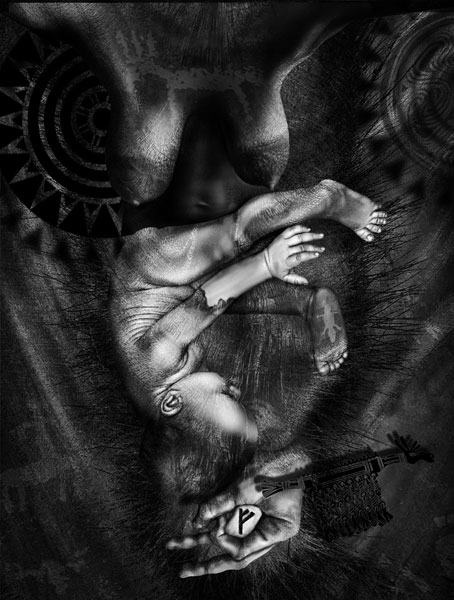
Thus, every Way begins with prerequisites that create the necessity for that Way, and, as their consequence, an initial impulse. This preparatory stage of “preparing for the Way” corresponds to the Rune Fehu. In the Fehu stage there is disappointment, a “burning” of previous Ways, the formulation (most often apophatically, “I need NOT…”) of the Way’s goals and tasks, and an acute desire to find that Way. One must overcome the resistance of old ties and attachments; yet this overcoming, fueled by general enthusiasm, occurs relatively easily. However, this enthusiasm makes the person intolerant of everything that is “not their own,” as the saying goes, “gold causes discord in the clan“. The completion of the Fehu stage is the awareness of one’s ownership of the Way, and of oneself on that Way.
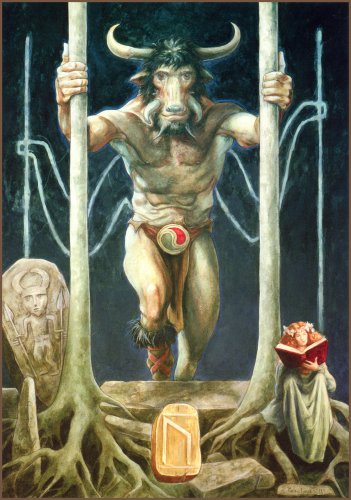
This awareness leads to a powerful awakening of power. If the Way has been chosen harmoniously, the very first steps along it produce staggering results; Power begins to seethe like a spring river breaking free from the ice — untamed and not yet mastered, but so desired and joyful. This seems like success; however, this initial release of Power has only a purifying function: like a river, it washes away the dirt and debris of past mistakes, clearing the field for further activity. It is crucial not to mistake this first awakening of Power for mastery of it, nor to take cleansing and preparation for completion. The result of correctly passing the Uruz stage is the formation of a stable direction of the Way, such that no random turbulence can veer it off course.
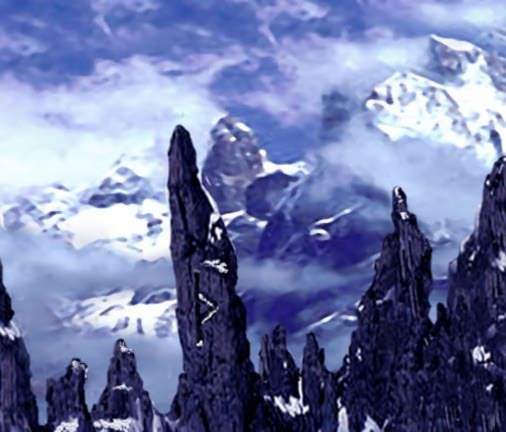
And then the entire inertia of previous movement, all errors and problems, crashes down on the traveler. When the first wave of Uruz subsides — and it subsides far more quickly than one would like — mountains of detritus lie on the cleared ground, which must be removed to allow free movement. This stage of first resistance is symbolized by the Rune Thurisaz, and, as Thor constantly battles the giants, so the Magus at this stage faces titanic effort to release power. This stage requires the directed application of Power — not merely intoxication by it, as in the Uruz stage, but the disciplining of oneself and one’s manifestations. The danger here lies in overestimating one’s capacities, in “undermining” the veins of power, and, consequently, in the first disillusionment with oneself. The result of successfully passing this stage is the formation of a direction of will.
Only now is the Way perceived as truly a new life. The first ardor passes, and there arises the opportunity to look around and assess one’s new condition and situation. In the Ansuz stage the capacity to perceive the elements of the Way appears; the Magus opens up to a new life and begins to understand its meaning. Such an expansion of view trains one to analyze the events and stages of the Way, to creatively comprehend it and to differentiate its elements. The danger at this stage is the “neophyte syndrome“. The traveler begins to think that he has already understood everything and develops a persistent desire to share his understanding with others, to become a Master. And it is very important here to understand that a person who has learned only the first basics of the Way does not yet see its whole picture — do not imagine yourself a guru — and to find the strength to go further. The result of a harmonious completion of the Ansuz stage is the formation of a measured approach to the Way, an awareness of one’s capacities and limitations.
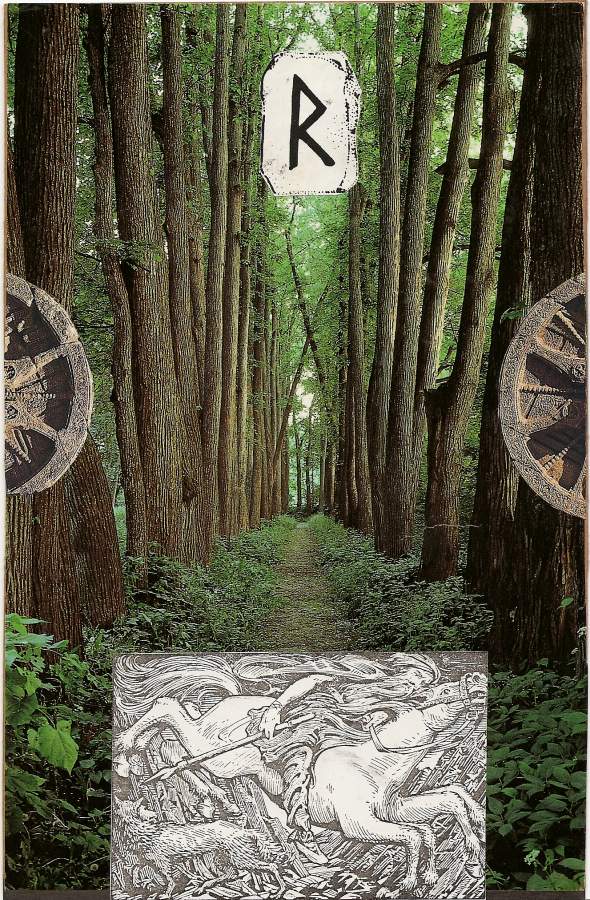
In the next stage movement acquires a progressive character, becoming even and rhythmic. The Rune Raidho brings comprehensive change, turning accumulated breakthroughs into transcendence, much as every attainment of a “critical mass” leads to qualitative change. In practice, this means, above all, awareness of oneself as a system in which one cannot change a single element without changing all the others. The Way also begins to be seen as an integrated system, in which its beginning already contains the potential for completion, and the Way itself appears as the successive actualization of that potential. However, this stage shows that the Way is, among other things, a constant effort of advancement and overcoming, “riding, as they say, is hard for horses“. Raidho is a long, even road without visible changes, and fatigue begins to accumulate, the danger of which may lie in developing faint-heartedness, a desire to rest, to pause. If these dangers are overcome, the result of the Raidho stage is the creation of a proper intention to move.
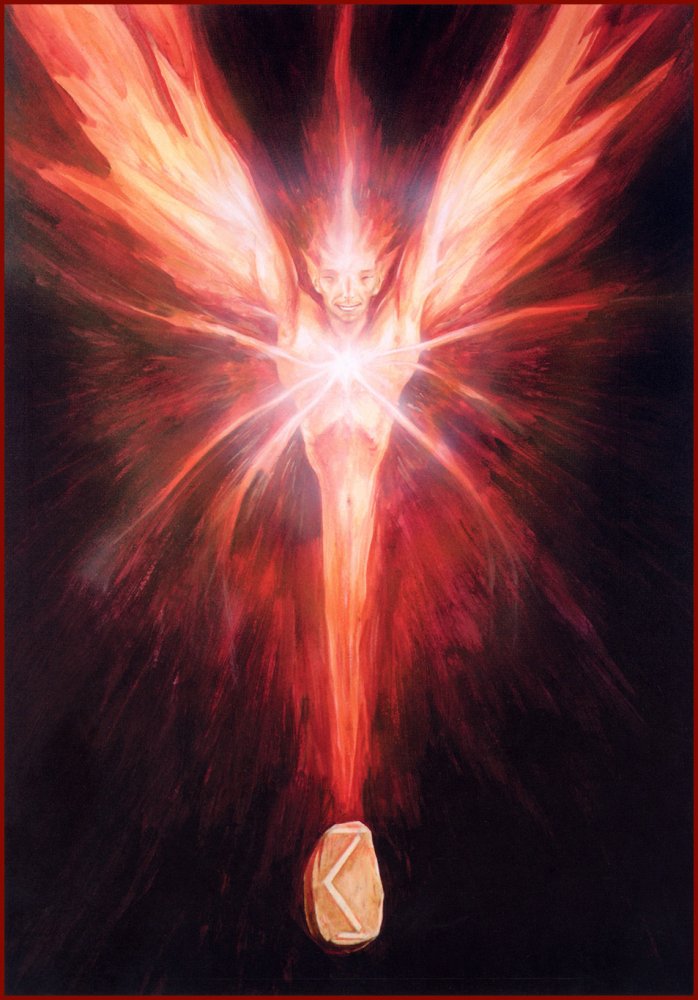
Overcoming the fatigue of Raidho leads to the clouds that had shrouded the mind at that stage beginning to disperse, and a ray of hope breaks through them. The Kenaz stage is characterized by the traveler’s calm conviction of his Way’s importance. This awareness gives birth to a new confidence, unlike either the enthusiasm of Fehu or the routine of Raidho — a confidence in a bright finale. This confidence, in turn, rekindles the desire to move, almost forgotten in the Raidho stage. Usually, at Kenaz some favorable opportunity for advancement appears — a new, energizing acquaintance, a timely book, or a fortuitously visited Place of Power. Kenaz is accompanied by the final destruction of the old world, remnants of which still hung as ballast in the Raidho stage, and this destruction is often rather traumatic, because the Way traveled by that time allows one to soberly appraise one’s past life, past motives, and to be distressed by their unworthiness. The danger of the Kenaz stage lies precisely in self-abasement, which may develop as a result of discovering the rottenness of one’s past life, and, consequently, in dejection and a feeling of one’s “unworthiness” of the Way. Overcoming this obstacle is achieved through accepting responsibility, realizing that the past is a burden that must be carried; nevertheless, the only way is to keep moving with this load.
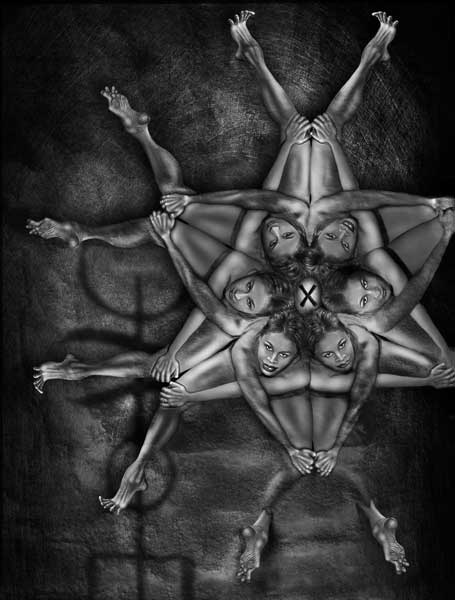
This thought leads to the idea of the Way’s “sacrificialness” (“I will have to carry my cross”), and the necessity of giving is sharply felt as a prerequisite to receiving. It turns out that accepted obligations must be fulfilled, and promises kept. In the Gebo stage the nobility and honor of the warrior are born. Feelings that seemed extinguished awaken again. This is simultaneously the main achievement and the main danger of that stage. It may seem that feelings themselves are the Way, since on ground purified by the Way they sprout strong and pure, transforming being. Many warriors veered off the Way at this stage, having found love and considering their Way merely preparation for that love. The gift of partnership, realized at the Gebo stage, together with the notion of giving and receiving, is meant to form the emotional roots of the Way. However, if the traveler does not exchange the Call of the Way for the call of marriage, or if he finds a way to combine partnership with further movement, he can discover a new level of harmony — this time, a harmony of feelings. The balance established when this stage is successfully passed leads to the balancing of the principles of intelligence and feeling and to the balanced accumulation of Power.
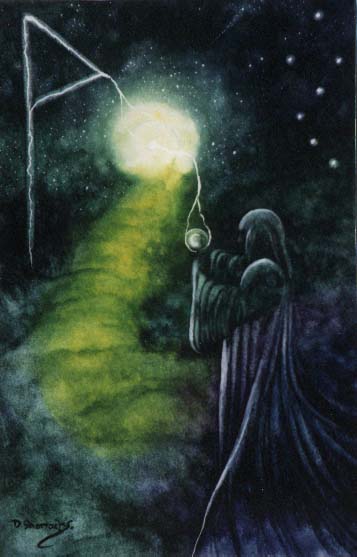
This feeling gives confidence in oneself, in one’s Powers and possibilities, and leads to a new release of Power. Unfortunately, for most travelers this release seems the final achievement, and the self-acceptance reached at the Kenaz stage — the highest wisdom. It seems that the war is already won, harmony achieved, and Power acquired. The Wunjo stage is indeed a stage of High Achievement; at this stage the Powers are controllable, and this control is accompanied by inner comfort and equilibrium. A person who has reached the Wunjo stage is successful in life and knows no inner conflicts. He is calm and joyful, strong and fortunate. Life brings him pleasure. Is that not the ultimate dream?
And only very few warriors understand that here lies a trap. Wunjo is the joy of the once-born, the highest a person can achieve while remaining merely human. However, to become a Magus, one must renounce all this and plunge headlong into the darkness at the beginning of the Second Att — the Abyss of destruction.
The esoteric meaning of the runes at the level of an individual person is described very colorfully and vividly.
Enmerkar, do you think the largest and deepest abysses on the Path can only be between the Atas?
If everything is somewhat predetermined, then this runic divination system serves as a map for those who have embarked on the path of Magic. And whoever uses it can at least determine where they are 🙂
The runes are in fact one of the paths to gaining wisdom. But wisdom is the harmony of the world. The path of destruction is the path of life. The way of the magician denies the path of the warrior in perception. I have always been amused by manuals for gaining certain qualities. There is a maxim in philosophy. A philosopher is always alone; paraphrasing it, I can assert that a magician is also always alone.
It would greatly help neophytes to understand the life of the last coherent arile Guido von List. It frees from many illusions in itself…
The runes deny socialization in their essence. The modern world denies the success of shepherds and skilled, illiterate sword masters. One needs to understand the significance and influence of information technology. The path of the warrior, the path of destruction, is primarily the path of the manipulator in the current reality.
Gaining harmony, perceiving Futhark in particular and magic as a whole, is completely subjective and depends primarily on the level of education and understanding.
After all, why did you write all this? I am familiar with people who finished the first att (as you call it) without actually starting it properly.
Hrаbаnаz. I believe that the path of life is the path of becoming, not destruction. And that a magician is always alone, I agree. Society is harmful to him as it leads to the dissolution of consciousness. Preservation of integrity is possible but requires sufficient willpower and significant energy expenditure. Personally, I find being in society unbearably boring. But despite this, I understand that there are very dear people next to me who, although they haven’t found their path yet, may be inwardly striving for it. I will seek a harmonious coexistence.
I would like to add. I concluded that any desire and motive that comes in any moment is a temporary state. One should never stop. EVERYTHING IS TEMPORARY.
Everything is temporary, even for the best among us. Normal magicians do not die; at a certain moment, they kill themselves according to their internal convictions. The path is interrupted, sooner or later, by the ceiling of possibilities. And each person decides how to break through this ceiling. It seems to you unbearably boring solely due to your awareness of your power over others. You indulge in it too much, feel too powerful. Honestly, it’s not worth it. Sooner or later, you will encounter a person who had angels tickling their heels in childhood. And it will be a complete disappointment. To be honest, I consider the second level as a level of understanding limitations. That is, some senseless, unreasoning mechanic, a drunkard who beats his wife, while the wife returns. And this cohabitant, it’s difficult to call such a husband, has a stamp all over his astral body, do not touch!!! Well, why is he needed by the universe? These people have a certain meaning. And there are always many of them. I would call the number of such citizens excessive. By the way, I do not recommend working with them; when you work with them, you twist not their fate but your own, even if they have never seen you, just as you have not seen them. Paradox. At one time, I faced such a backlash that the residual effects still occur. It all collapsed and tangled up fate completely. Well, how long? A few years, I established it piece by piece. Since then, I have begun to envy priests; they do not have to worry about such things. Happy…
Neophyte syndrome 🙂 , yes, indeed, there is something to it. But it is not entirely teacher-student. I perfectly understand that I still do not understand anything myself. But when I meet people who might also walk this path, I want to share what I have gone through. Something to hint or advise. Here I realized it’s important not to pressure and not to infringe on someone else’s will. All hints ))
P.S. On the contrary, the realization came that there’s still a long way to go and the most important is still ahead.
Finally, I have come to the runes. One meditation, a request to explain the connection, and I came to the understanding that the runes are essentially an egregore of the northern gods created by humans. The essence of wisdom is that, like any force, the power of the runes grows, accumulating and increasing its spectrum of actions in the worlds of reflections, gaining new meanings.
Hello Master! What can disrupt the order of progression through stages? Or is it just an illusion?
Yes, the order can be disrupted if consciousness ‘jumps,’ if it thinks it can already begin the next stage without actually finishing the previous one. However, in such a case, it will still have to return sooner or later and go through what was not passed, but already from that new basis – again go through the stage it prematurely and unpreparedly entered. So often the desire to ‘speed up’ the Path leads, on the contrary, to its slowing down.