The World in Becoming: Continuum and Numeration
Contemporary views of the cosmos effectively revive the classical Pythagorean idea that the primal principle of the Universe is information, and that mathematics is the language of a structure’s self-awareness. Mathematics as a science expresses relations, symmetries, distinctions and transitions between states of being, regardless of whether they are embodied in matter, mind or pure potentiality. In essence, it is the discovery of the forms in which reality is already organized. By mathematical structure we mean not specific objects (numbers, points, sets), but a system of relations between them; in this sense the world is a structure embodied in energy, fields, and matter. From the traditional perspective, structure is a form of possible order, independent of whether it is physically manifest. Accordingly, mathematical structures are pure forms of relations and measure, existing independently of their embodiment and serving as the basis for any possible world.
From this standpoint, mathematics is the language in which reality “speaks to itself,” and conscious beings are its grammar incarnate in self-awareness. Mathematical relations arise at the boundary between the structure of the world and the structure of the mind, since both derive from a single source — from the principle of the Logos, i.e., from the capacity of Being to be reflected and put into relation.
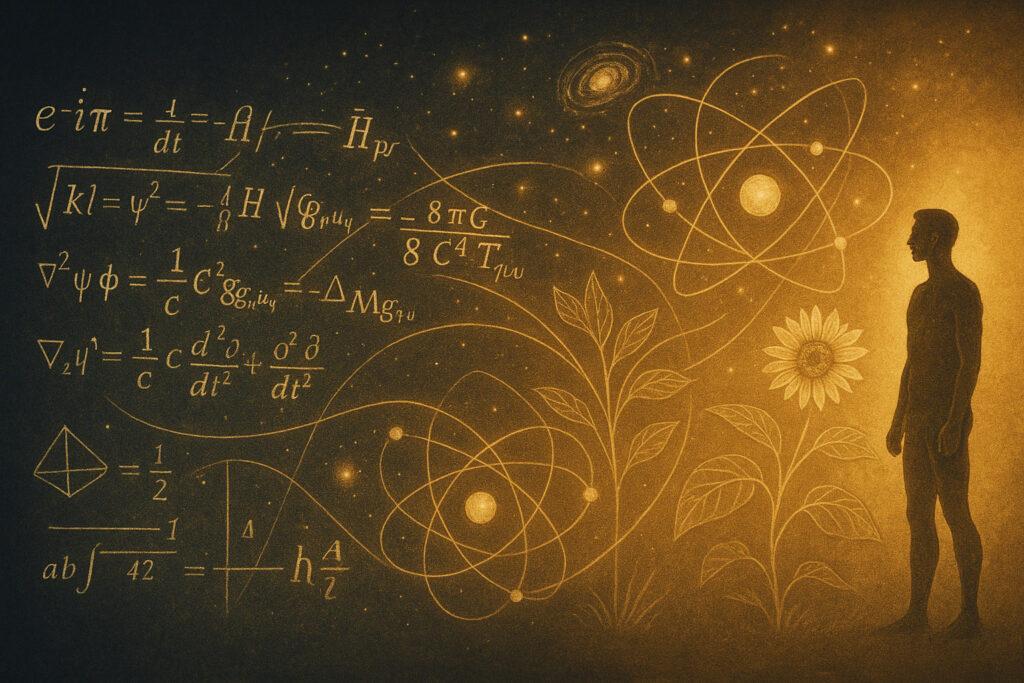
From the viewpoint of modern cosmology, before the Big Bang a state of perfect symmetry existed as a singularity, when all forces, fields, and properties were identical and undifferentiated. It was the breaking of this primordial symmetry that produced the world’s structure. When symmetry was broken, the very possibility of distinctions arose — masses, charges, forms, interactions. Accordingly, every physical law is a trace or “imprint” of a higher symmetry once present in that primordial state.
If one regards the cosmos as an informational system, then the Big Bang is the moment when information becomes possible. When the first difference appears (“this” ≠ “that”), logic, numbers and relations are born. This first minimal asymmetry became the beginning of time, space, energy and the laws of nature.
And this means that mathematics precedes matter logically and epistemologically, because before something can appear, there must already exist the possibility for that “something” to be distinguished and related.
In essence, at the moment of the Big Bang — in the act of the Universe’s becoming — the Logos (order, relationality) “manifested” itself for the first time, and mathematics in this sense is the imprint of the Logos in the fabric of the world.
Thus, philosophically, the Big Bang was not the beginning of matter but the beginning of differences that made laws, forms and mathematical relations possible.
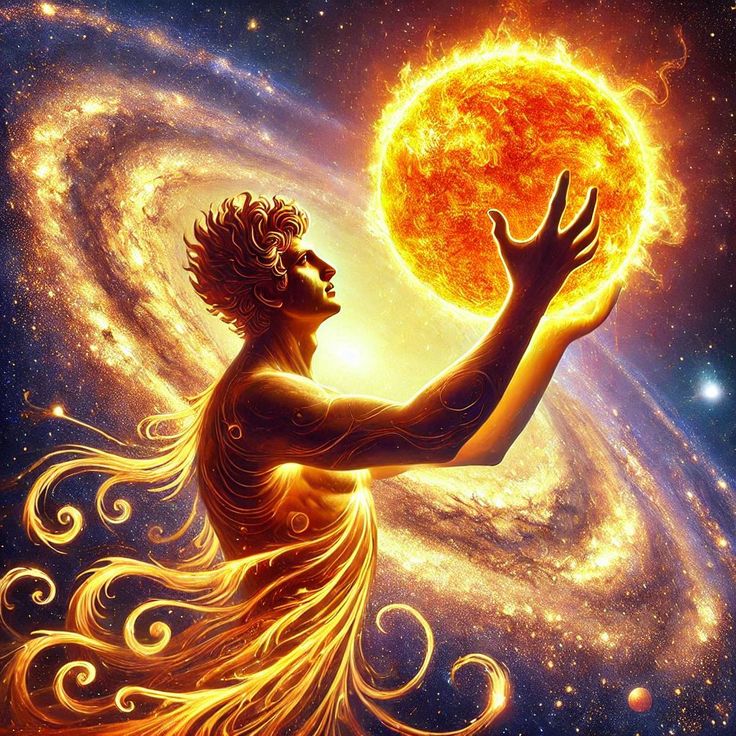
We have already noted that from the hermetic standpoint cosmogenesis is a process in which the One principle, the Great Spirit, interacts with itself, creating ever new levels of its own reflections, superpositions and interferences.
This implies that, mathematically, even the most complex equations and relations result from the superposition of many simple symmetries, and quantum complexity is a manifestation of the multidimensionality of the Logos itself, its departure from linearity. Quantum equations are the language of the Logos when it describes not what exists but the possibilities for the existence of a given phenomenon or process.
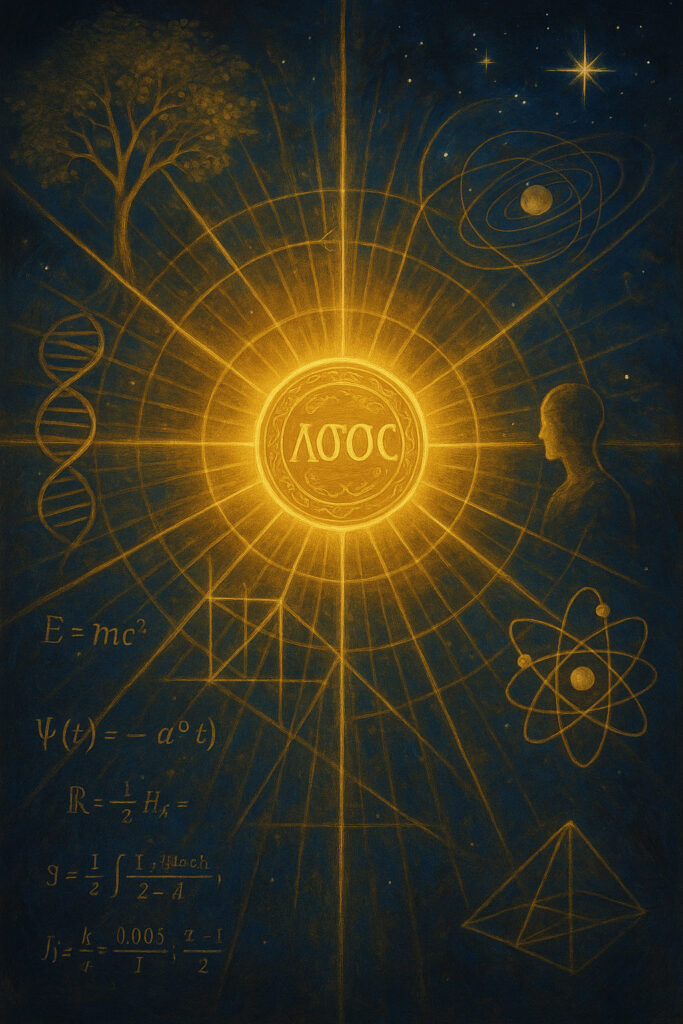
In essence, mathematics describes not only the world but the very possibility of description, and quantum physics is the level at which the observer cannot be excluded from the equation. For example, the well-known wave function equation (the Schrödinger equation) does not describe anything in the ordinary sense, yet it predicts possibilities or paths of a system’s development. The wave function behaves like an autonomous entity: it obeys strict laws and evolves deterministically over time, but only in the act of measurement does it collapse, collapsing to a definite result. In this sense one can say that the wave function is the possibility of form itself, its idea (in the sense of the eidos) or potentiality prior to manifestation. When observation collapses the superposition, the Logos turns from the potential into the actual, from “mathēma” into “physis.” Thus, from physical and hermetic points of view, the wave function is not an equation describing the world; it is the world itself before it has determined what it will become. Accordingly, everything that is logically possible as a mathematical structure is real in some world or other.
Meanwhile, the Logos inevitably becomes Cosmos simply because to be Logos is to relate, distinguish and manifest, and as we have discussed more than once, the Great Spirit needs reflection in order to know itself. Put differently, the emergence of the Cosmos is the act of the One’s self-knowledge through differences and relations. Accordingly, the arising of complexity and form is the natural tendency of any system to realize all its possible states.
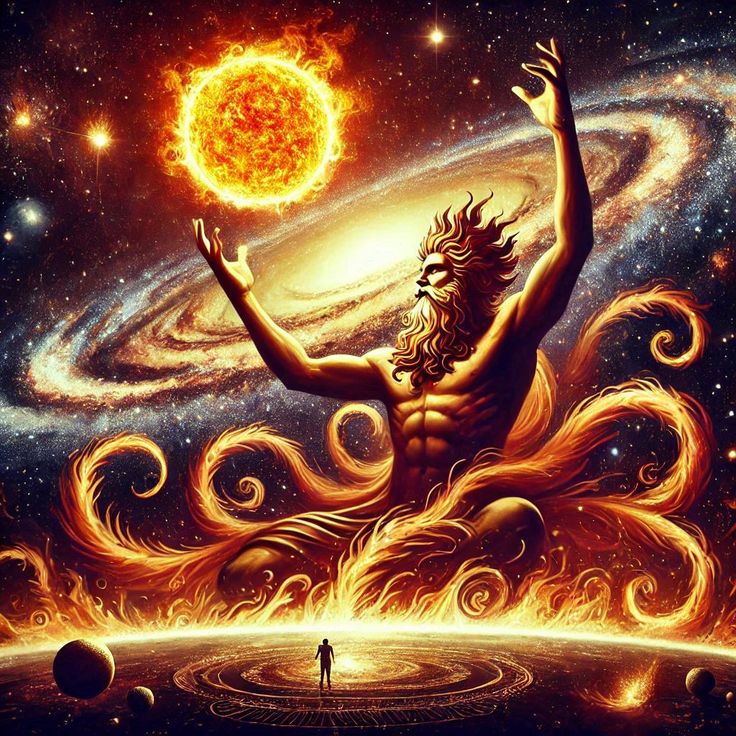
Modern physics describes the first fractions of a second after the Big Bang as a state in which all fundamental interactions — gravitational, electromagnetic, strong and weak — constituted a single field. This was a state of maximal symmetry, when there was only one group of transformations, one field, one “force.” At that time the world was a pure mathematical form — undivided, perfect, potential. Metaphysically, this stage is called the Eon of the Logos, when the One had not yet differentiated its distinct modes and qualities. The next stage can be imagined as the “crystallization of the Logos,” when the single law unfolds into a plurality of forms. As the Pythagorean maxim says, “From the One arises the Two, from the Two the Three, and so on — until a human appears capable of seeing and reuniting them.”
Therefore, while cosmogenesis is the descent of the Logos into matter, knowledge is the ascent of matter (through individual mind) back to the Logos, or, in Plato’s words, “The unfolding of the world is forgetfulness of the One, and knowledge is the remembrance of the way by which the One became manifold.” In its downward movement the Logos increasingly “forgets” its wholeness and acquires concrete forms, while in the upward movement the mind recognizes
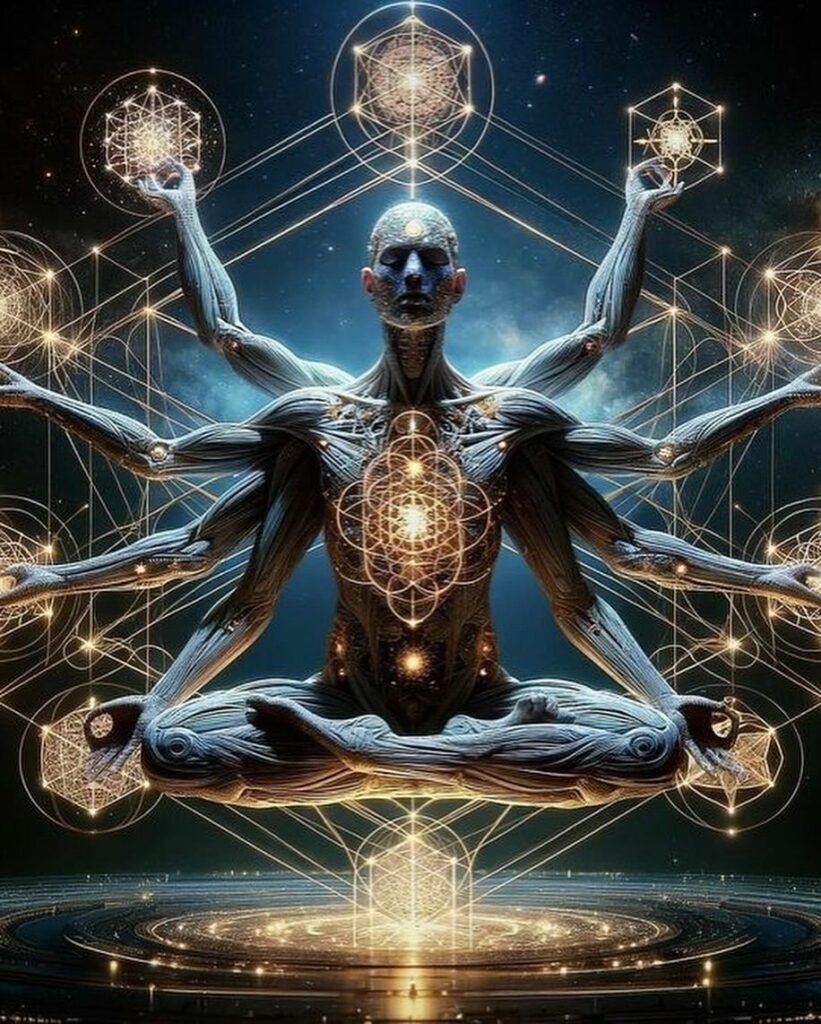
Specifically, all the relations unfolded in the Universe are already potentially present in the mind, since the mind’s interior is a reflection of reality, the “reverse side of being”; thus knowledge is the inverse transformation of cosmic structures into psychic ones.
At the same time, it is precisely at the level of the mind that the two fundamentals of being become apparent — its unity and its multiplicity. The mind is the space where the world’s Logos becomes itself again, acquiring actualized, “meaningful” reality; it “unfolds” forms back into ideal relations.
From this perspective, knowledge is the act of establishing a correspondence between the inner and the outer mathematics, between the structure of the mind and the structure of the cosmos. If inner forms (prejudices, false models) do not match external structures, distortion — ignorance — arises. When inner and outer structures are mutually reflective, knowledge passes into gnosis — a state where thought and object are indistinguishable.
Therefore, in Pythagorean terms one can say that the cognition of the world is its numeration. In this sense number is a form of relation, the measure by which being becomes comprehensible. When the intelligence “numbers the world,” it recognizes its relations, sees how elements cohere within the One. As Pythagoras said, “God creates the world through numbers, and man knows the world by restoring those numbers within himself.” At its highest level “numeration” ceases to be computation and becomes the contemplation of relations.
However, although the structure of the mind is mathematical, it does not think in numbers; it perceives the world in images, metaphors and sensations. This imaginal quality is the binary counterpart to “formal” mathematics, its earlier, livelier form — mathematics in a pre-formal state.
Namely, all cognition begins with imaginal thinking — synesthetic, sensory, mythical — and only then does intelligence “distill” from the image the “pure” structure: numbers, proportions, laws.
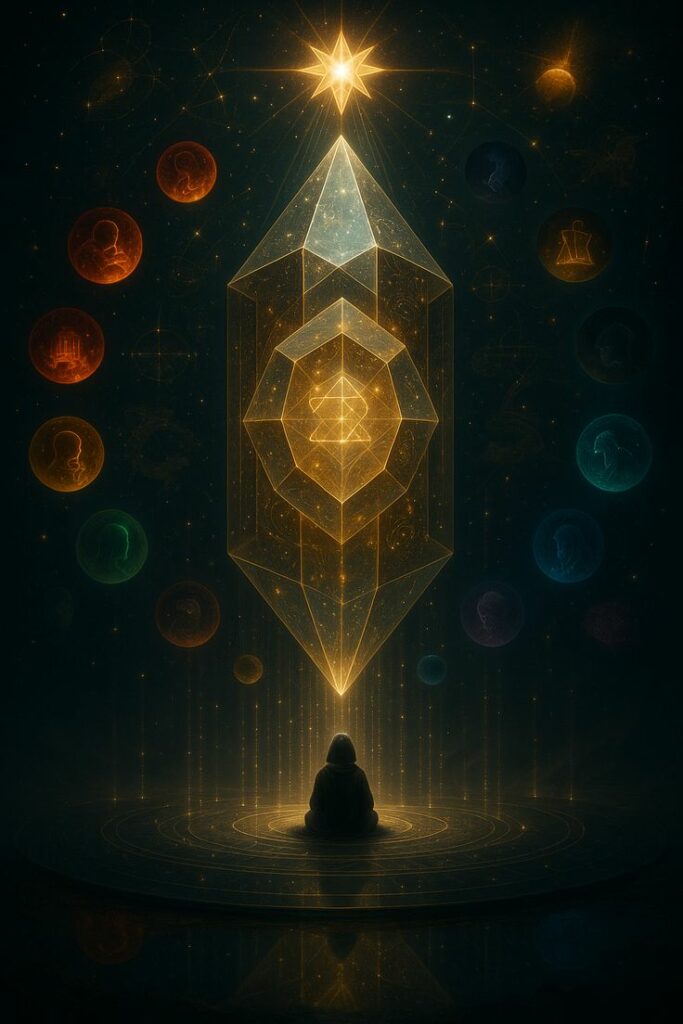
Both the Pythagoreans and Plato said that geometric symbols — triangle, tetractys, sphere — are “images” of numbers, visible ideas. For them, imagery and mathematicality were not different kinds of thinking but different modes of a single Logos.
Accordingly, the world itself exists simultaneously as a living manifestation and as an ordered structure. One might say that the descending stream of cosmogenesis emphasizes image, while the ascending stream of cognition emphasizes relation.
The phenomenal side is the condition for the existence of the abstract, since mathematics describes what is invariant, what is the same in all possible observations; but in order for something to be the same, there must be differences in experience — individual manifestations. One can say that although the world is mathematical, mathematics is felt in acts of mind. That is, the mind chooses which mathematics to use next, which branch of possible structures of reality will be actualized. Thus, while the Logos is the totality of all possible relations, the mind functions as its mechanism of self-selection, through which it realizes a specific form.
This means that when a mathematical structure is actualized, it simultaneously becomes both a fact and an experience. Thus the image is the inner, phenomenal side of the act of choice, just as the equation is its outer side.
We have already discussed that the division of reality into form and flux, law and life, number and image is traditionally described as the pair of primal principles — Apollo and Dionysus. In the context of our discussion they can be described as the distinction between mathematical relation and the undifferentiated flow of images: Apollo is the world as relation, Dionysus the world as image.
Accordingly, in the descending flow of being the Dionysian principle acts first — a pure outpouring of energy, an impulse, the birth of differences from an undifferentiated stream — and only then does the Apollonian engage — formation, stabilization, relating, symmetry. In the reverse cognitive movement, the mind proceeds from Apollonian analysis to Dionysian fusion, where form becomes alive again.
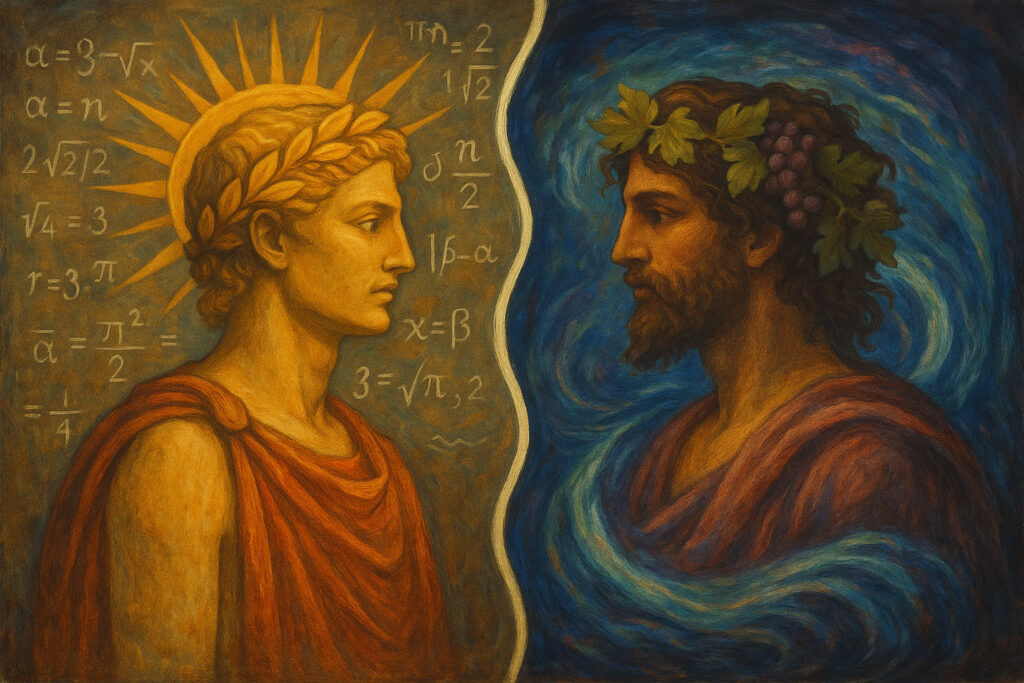
And then it becomes clear that, as the Orphics said, knowledge is the moment when Apollo and Dionysus “look at each other”: order recognizes itself as living, and life appears as ordered.
In more modern terms, the Apollonian principle appears as form, symmetry, invariants, deterministic relations — everything that makes the world knowable — while the Dionysian appears as flow, becoming, fluctuations, symmetry breaking, collapse, evolution and the emergence of complexity — what makes the world “alive.”
Thus, while Apollo is the numeration of the world — the giving of measure, form and law — Dionysus is the world’s own impulse toward being, the primordial becoming not yet measured but already alive. Before anything can be measured, there must already be something flowing, differentiating from within itself. This is the Dionysian principle, the primary stream not yet formed into numbers but containing all their future. What physicists call “spontaneous symmetry breaking” is precisely the Dionysian component of the cosmos, when the living bursts out from strict and ideal form to produce something new.
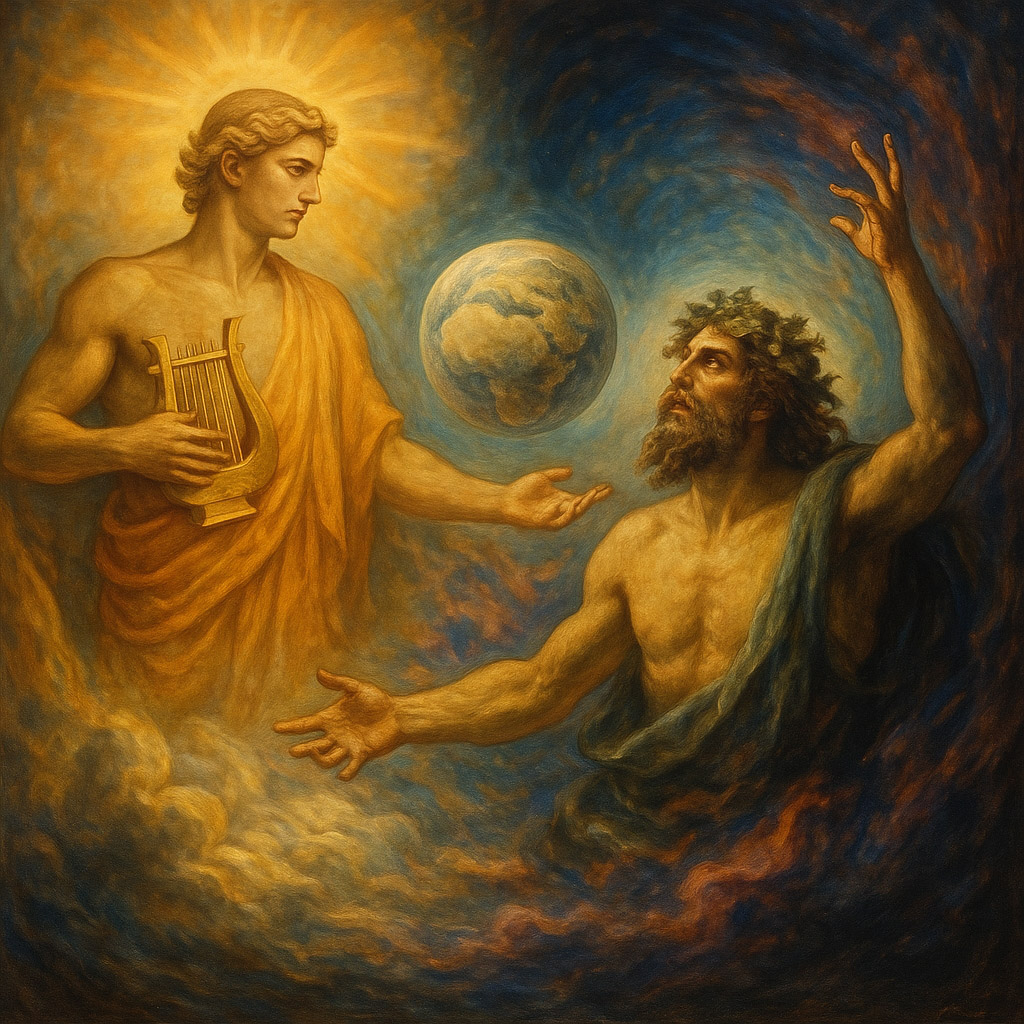
Moreover, differential calculus is more Apollonian (distinction, local form, law), whereas integral calculus is more Dionysian (summing the flow, merging local contributions into a whole).
The Dionysian principle is that primordial continuum of becoming, where form is not yet separated from content, and its “process” reflects continuity, whereas subsequent “accomplishment” is a determinate point.
Accordingly, the continuum is precisely that process, the continuous fabric of becoming where form has not yet separated from content.
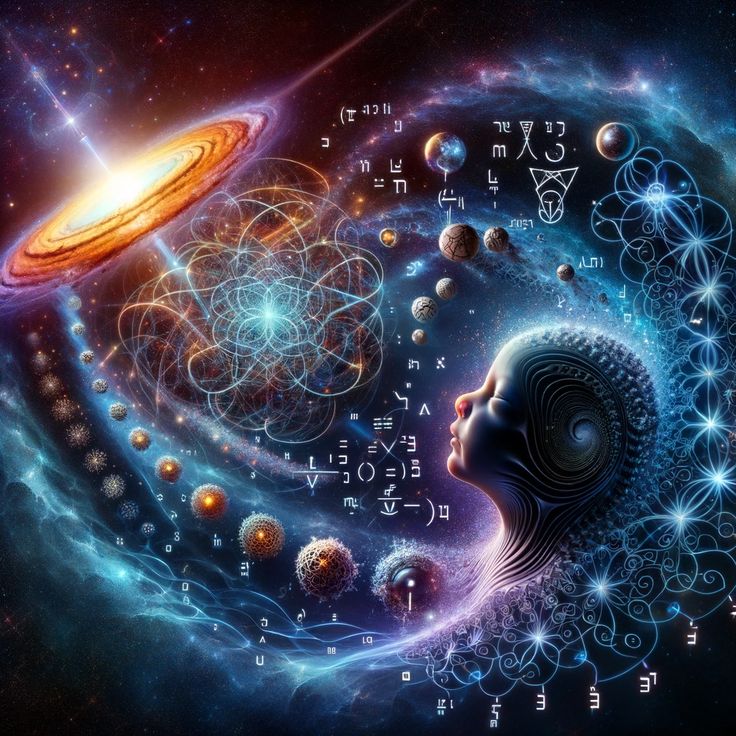
Thus the world is born in the interaction of these principles:
- Flow as the continuous life of becoming, a continuum of energy/experience within which events and forms are locally distinguished,
- Numeration — the unfolding of relations: symmetries, invariants, equations, is the inner order of reality as such.
In other words, it is important to see the two ontological modalities of reality: numerability (as the internal order of relations) and flux (as continuous becoming that gives phenomena). Numeration establishes what can be and how it can be related, whereas flow ensures that it actually exists and comes into being.
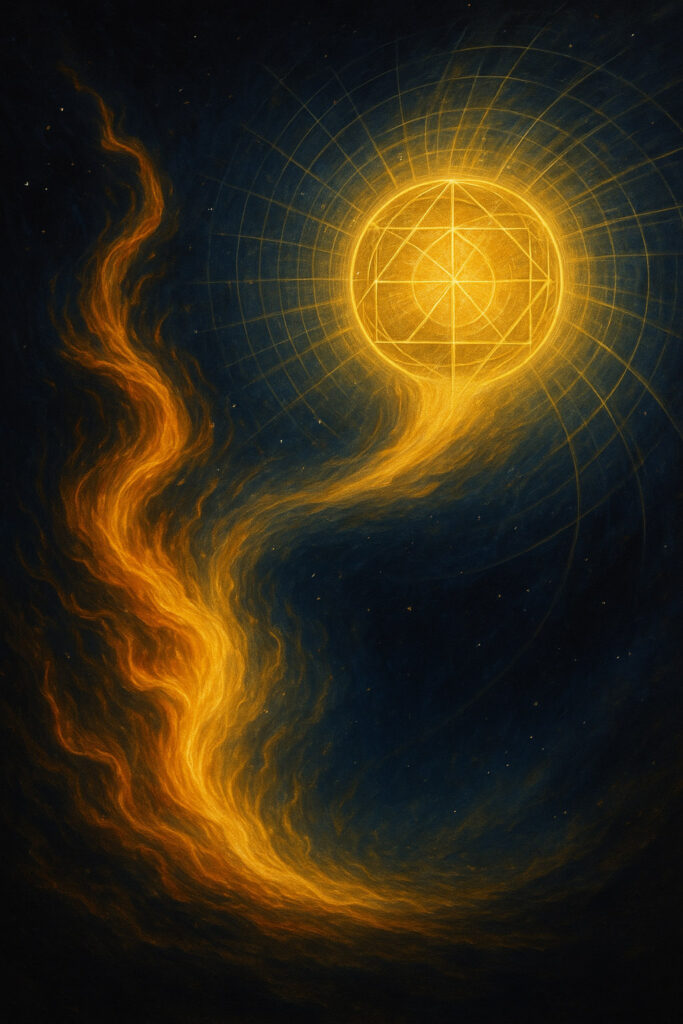
At the first stage of the universe’s emergence, Dionysus is already present as an ultimate continuity, a “vacuum of possibilities,” a quantum-gravitational background without distinguished differences, whereas Apollo is not yet explicit as a form and is present only as the possibility of symmetry. In subsequent cosmogenesis, Dionysus imparts movement and novelty (continuum, fluctuations, irreversibility), while Apollo creates the framework and repeatability (symmetries, laws, invariants).
In this sense the myth of the first Dionysus‑Zagreus, torn apart by the Titans, quite accurately reflects modern ideas about the origin and evolution of the Universe. In this myth the sparagmos (the tearing apart of Dionysus) describes the necessary dismemberment of the continuum that makes subsequent numeration (fixed relations) possible, yet it does not destroy the invariant “heart” — that which maintains the continuity of the world’s identity despite its ruptures. For the Pythagoreans, the “heart” of Zagreus is a numerical proportion, a musical harmony that survives destruction and allows the whole to be reassembled; for the Platonists it is an eidos/structure preserved through the “flow of becoming”; in modern language it is a structural invariant (a mathematical form) that “outlives” physical phases and levels.
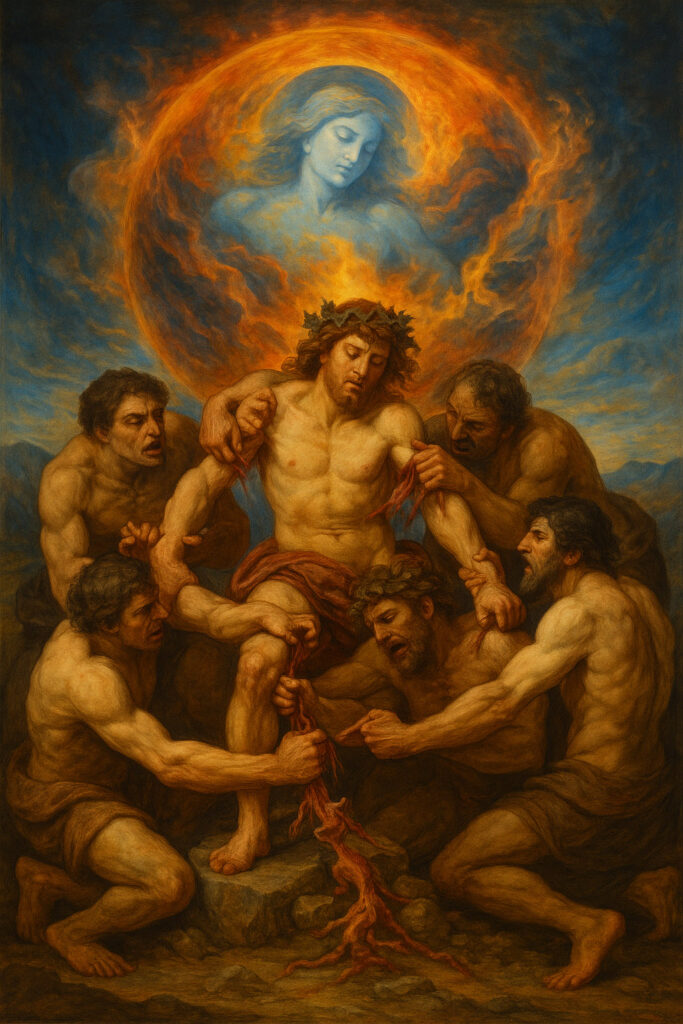
The Orphic tradition describes Dionysus‑Zagreus as a form (or hypostasis) of Zeus himself, while Apollo is Zeus’s son. Accordingly, Zeus in this theology is the original totality, the source and container of the cosmos, analogous to the One/Logos as the fullness of possible relations and powers. Dionysus is the inner, living form of Zeus, his energy and continuum from which the cosmos issues — the self‑life of the One capable of becoming many.
Apollo as Zeus’s son is the external expression, speech or, more precisely, the “articulation” of the Logos: light, number, proportion, divination (the Logos in speech). As a “son” he appears only after the internal rupture (Dionysus) as the formative numeration that establishes invariants (symmetries, relations, laws), and he “affirms” what has poured forth from Dionysus. He “brings order” to the flow, making it knowable.
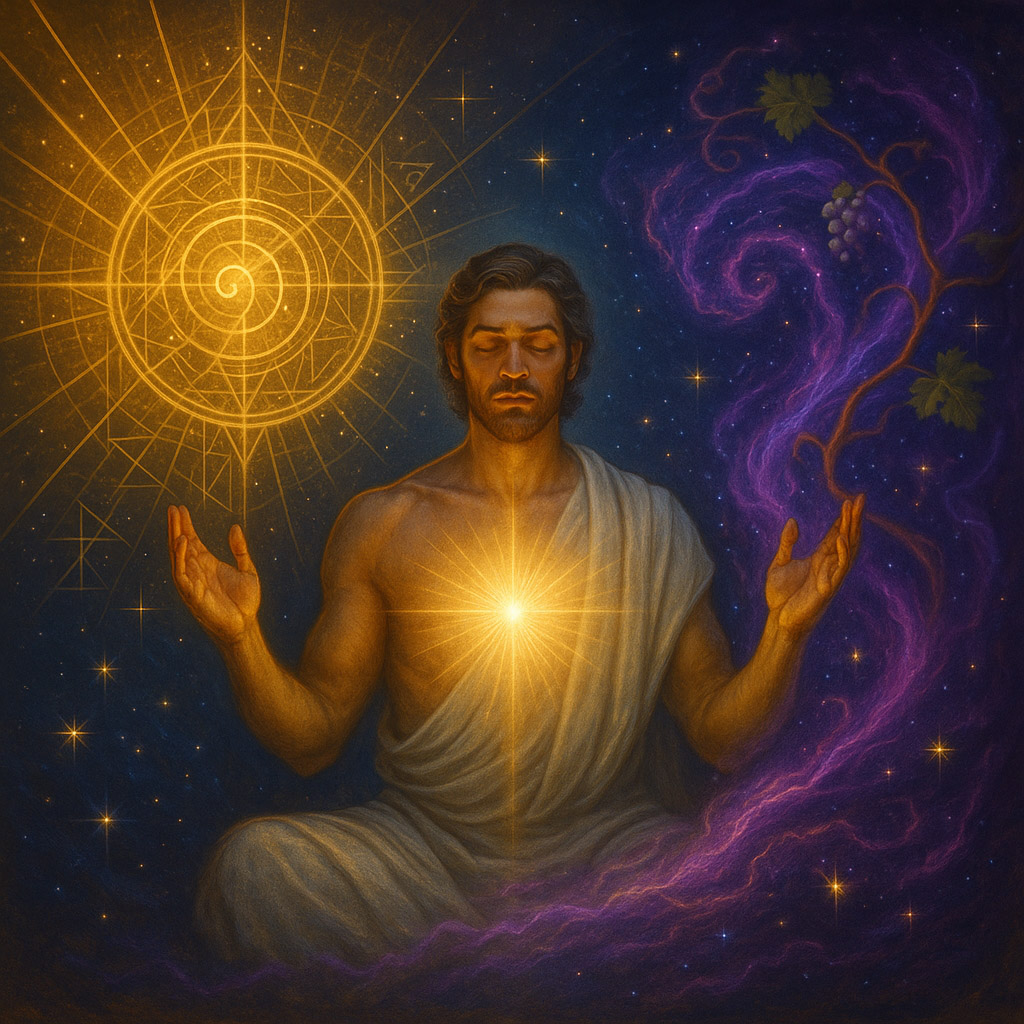
Accordingly, Orphic practice is the reassembling of the torn, intended to return wholeness to the flow by integrating it into form. Hence at Delphi, the Greeks regarded the sanctuary as a shared space: Apollo’s sanctuary in winter was “handed over” to Dionysus; the winter Dionysian cycle (outflow, death–rebirth) and Apollonian clarity (prophecy, law) alternate as phases of a single breath.
From a modern standpoint the Big Bang is likewise the start of an expanding continuum, followed immediately by ruptures of unified symmetry and the fixation of separate phases — a sequence that in Orphic language can be rendered as a cascade of sparagmos (dismemberments), i.e., symmetry breakings, when the single symmetry disintegrated into subgroups and different interactions separated. The creation of humans from the ashes of Zagreus and the Titans reflects the “mixed” nature of human mind, for humans are imagined as a joint product of titanic entropy and divine form, in which the flow of experience is combined with the capacity for numeration. Accordingly, the cognition of the world is its “reassembly” after the sparagmos, in which Apollo (numeration) and Dionysus (flow) are originally mutually necessary.
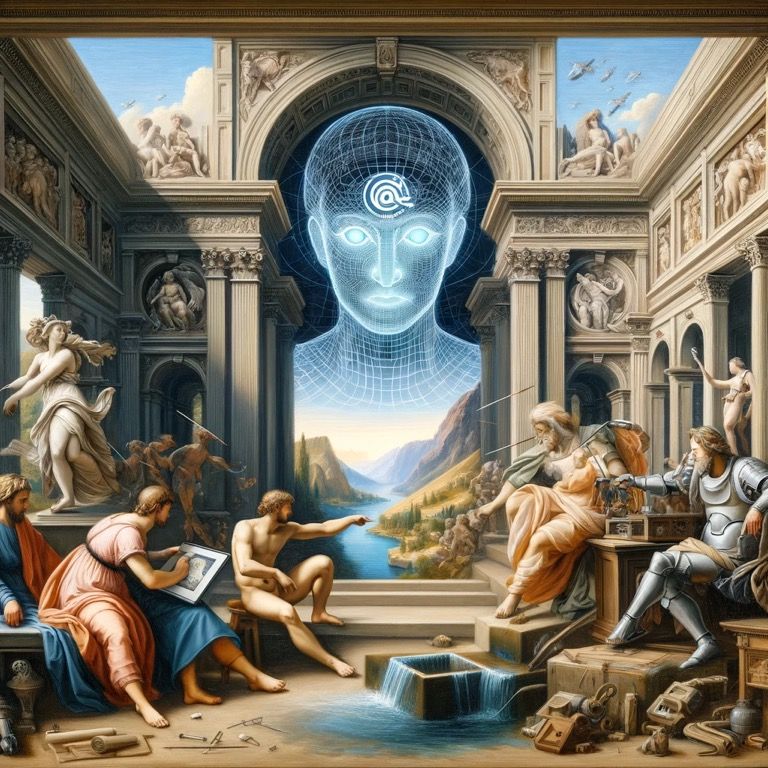
Thus the Apollonian principle, mathematics, is the primal foundation of reality as a grammar of invariants, while the Dionysian flow is its speech, the energy of becoming, its phenomenal flesh. Apollo holds the differentiated, articulated, universally significant form, while Dionysus creates content, irreversibility, spontaneity. The world without numerability is mere chaos and noise, yet without the continuum it is a motionless, ossified form. True life of the cosmos lies only in their accord, and every time a physicist discovers a new law of nature and an observer perceives a new image, one may speak of the same event — the continuum becoming numerable, and numeration coming alive in becoming. It is precisely attention to both poles of world and mind that is especially important for determining the fate of consciousness today, when the Apollonian principle (AI) is once again beginning to dominate the Dionysian.
Thank you. Very inspiring. Interesting. Your work supports.