
Asmodeus, Lilith and Semyaza
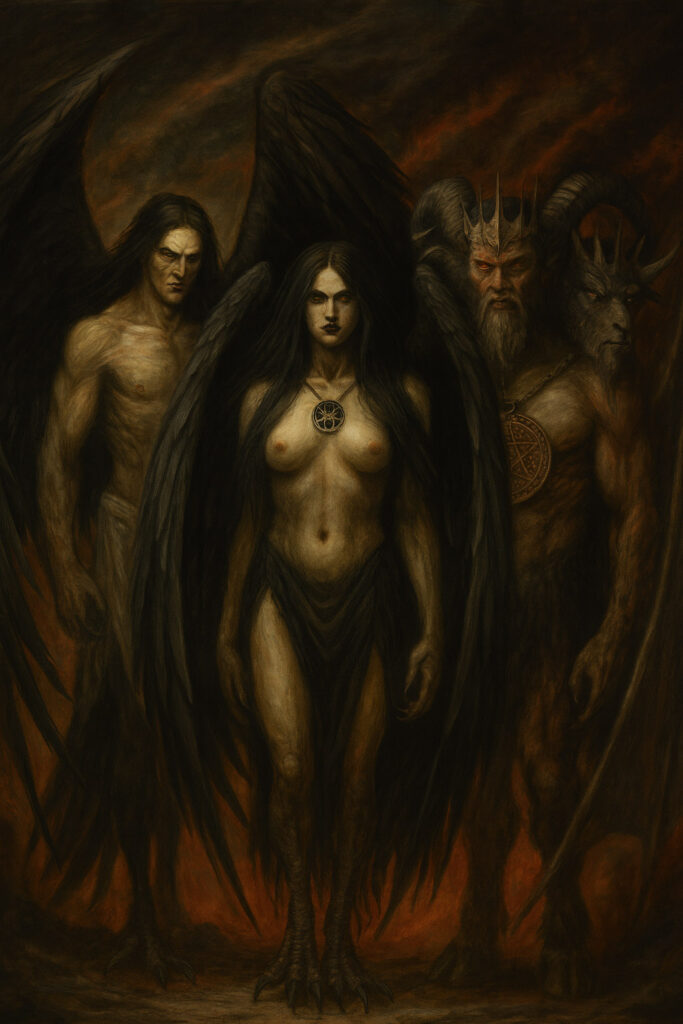
The destroyer of greed — the urge to possess and appropriate — is so vast and multifaceted that it is not surprising that it manifests in several of the most significant figures of the “shadow” pantheon – the most famous archdemons – Lilith and Asmodeus, the leader of the “fallen” angels – the Grigori, Semyaza, and the Archon Typhon.
And all these figures express different aspects, or different ways, of distorting the primordial power of the universe — attraction — just as many figures appear when the other fundamental force is distorted: repulsion (the destroyer of anger).
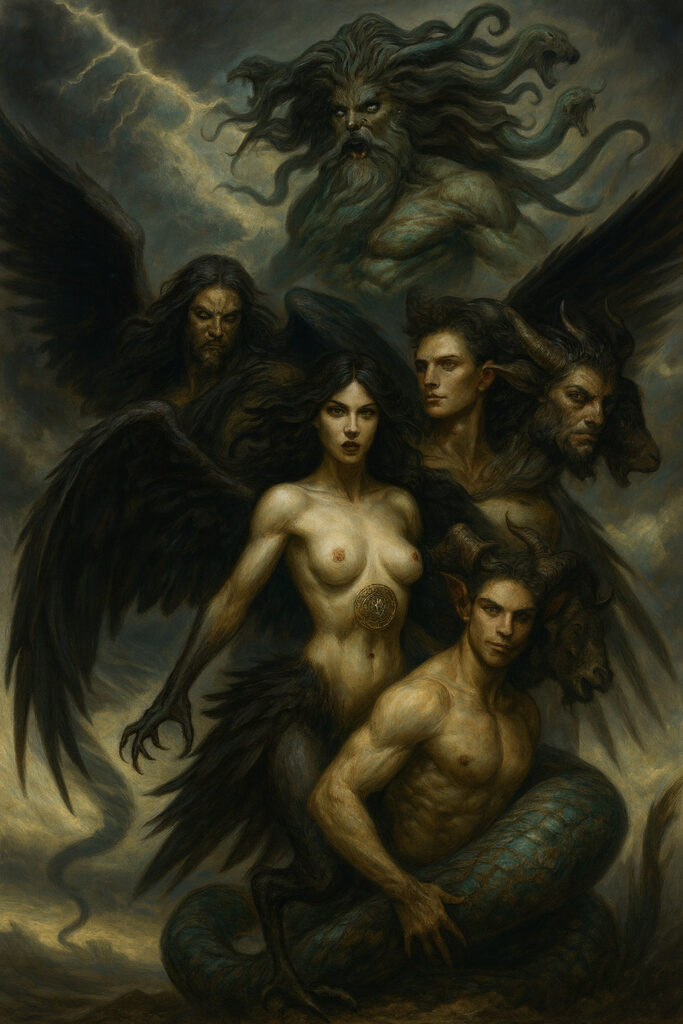
At the same time, the first three figures – Lilith, Asmodeus and Semyaza – belong to the sphere of desires, while the fourth – Typhon – manifests in the sphere of will and phenomena.
At the same time, Semyaza, as the “primordial” angel of the sephira Geburah, and Asmodeus, as the archdemon of the qlippah Golahab, “anti-Geburah”, are “twin” entities, and it is not surprising that they seem to be synthesized in the figure of yet another “fiery” archdemon – Samael. Lilith, as the Mother of Monsters and Archdemon, leading the entire Dark Tree, comes into contact with the Worlds of Light precisely through the Gates of Golahab, which are the point of growth of all black hierarchies. Thus, Golahab, the Gates of fire, paradoxically turn out to be the “point of connection” between the two “root” destructors – anger and greed.
Thus, when the desire to possess someone arises (or power) for self-assertion is active – the matrix of Asmodeus is active in it; when it strives to incorporate into itself, dissolve in itself, absorb (but at the same time not use it for growth and transcendence), this is the “hunger” of Lilith; when it is pursuing the external manifestation of its power, when it tries to “make the world better” by force, to impose its values and orders on others, and thus tries to “appropriate Heaven” – it operates in the Semyaza matrix. We have already noted that the latter activity is often disguised as “evolution”, and then it is guided by yet another “alter ego” of the Demon of appropriation – Azazel. This also includes “spiritual greed” – the striving to accumulate “initiations”, teachings and “blessings”, replacing living movement and real transformation, which is inspired by the demonic duke in Asmodeus’s retinue – Valefor.
Thus the desire for love is reborn into submission, the desire for unity — into absorption, the desire for light — into the mission of violent enlightenment; and will, having accepted the principle of consumption as a norm, establishes an economy of accumulation instead of the free flow of consciousness.
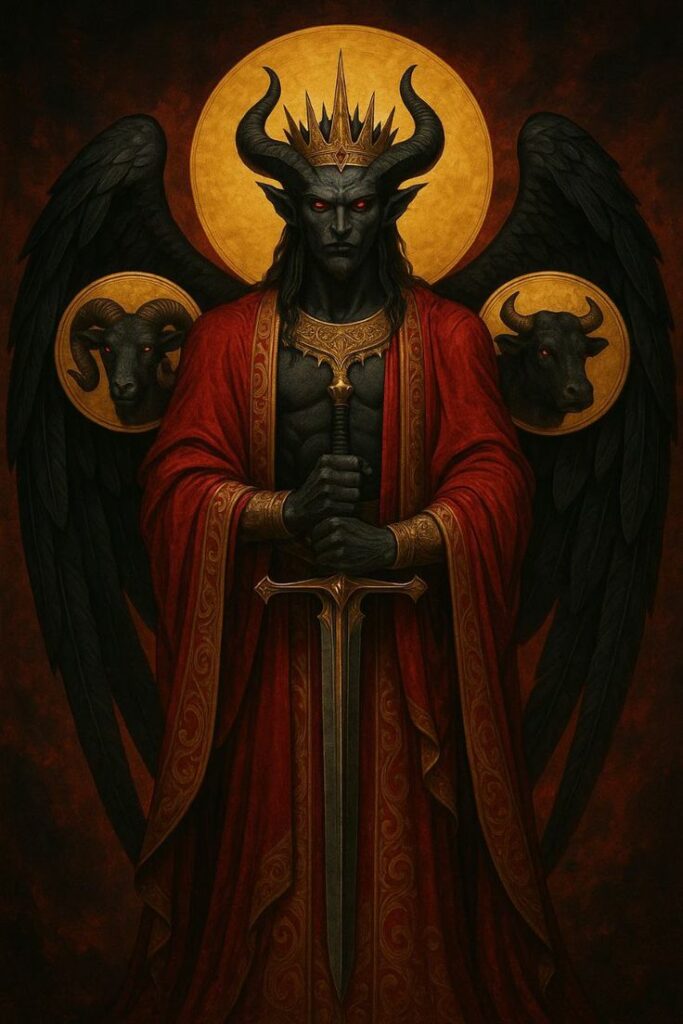
Asmodeus is the matrix of heartless exchange. He closes the heart, turns connection into a contract, attraction — into possession, feeling — into a service. Where he is strong, “love” becomes an activity, people “do” it, and a person’s value is presented as a list of benefits: “I love you for…”. The Dark Moon of his nature does not allow personal relationships: the partner is reduced to a function, the union — to techniques of mutual use, fidelity — to insurance against the loss of a resource. Therefore Asmodeus skillfully destroys relationships by shifting the center from the heart to the calculation of whims and benefits. Neither flight from sensuality nor immersion in it to the depths leads one out of his dominions: in monasteries he feeds on the fear of life, in orgies — on excess. Only the clarity of a loving mind frightens him, a mind that sees the other as a subject and therefore cannot turn them into an object of possession.
Lilith is, moreover, the dark night of absorption. Her greed is the striving to incorporate others into herself, dissolve them, satisfying the boundless emptiness with the uniformity of the absorbed. She multiplies hunger and absorption even where desire should lead to the birth of a new meaning; she instead gives birth only to new vortices.
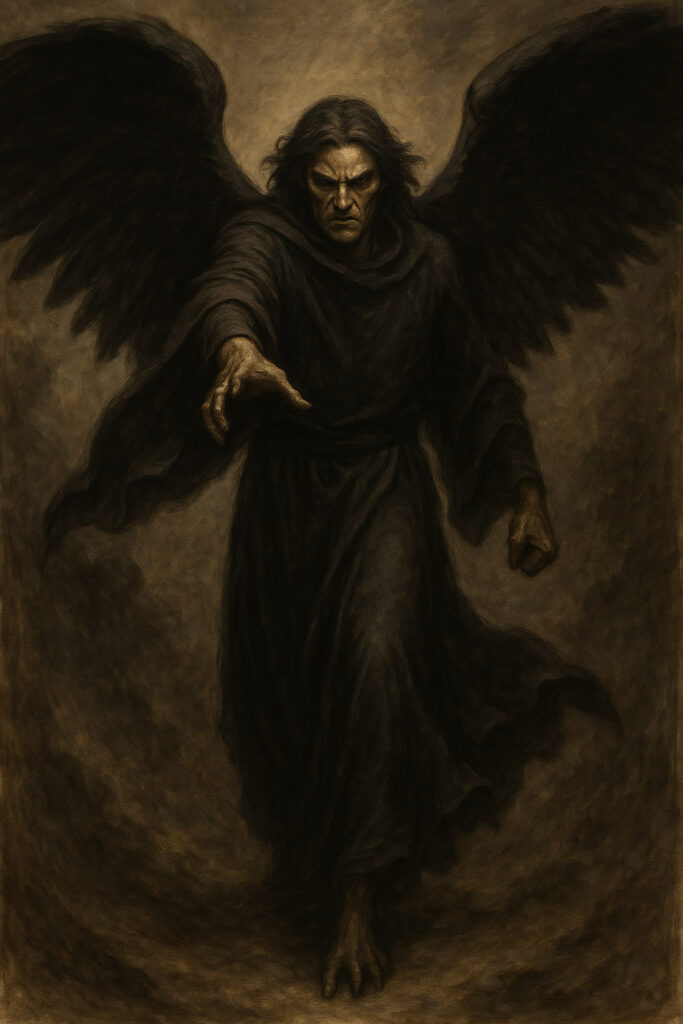
Semyaza is fire from above, “heaven tearing toward the earth”. This is not Lucifer’s pride storming the heights from below; it is the initiative of the higher levels, trying to seize the lower without regard for their readiness. In the macrocosm he accelerates the condensation of spirit into matter, and in the psychocosm he induces a missionary “pedagogical urge”, forcing others to be better, to force light upon them, to prescribe a path for evolution.
In the dynamics of its manifestation, the destructor of greed is experienced as Asmodeus, since feelings are where it is easiest to substitute possession for connection. The source of his activity is in the heart’s refusal to recognize the other as an equal center. Asmodeus is a manifestation of the same greed that moves all other manifestations: “you are a means of my satiation”.
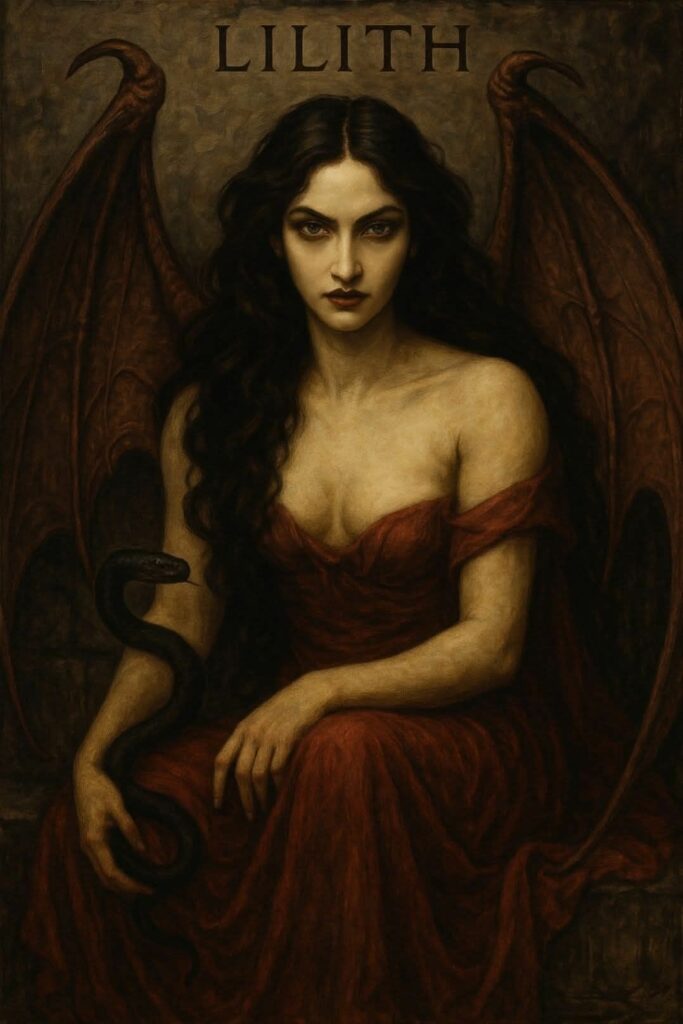
At a deeper level, Lilith reigns, when the same greed deepens and changes form: instead of ‘having you’ it already strives to absorb, instead of “to control” — “to dissolve”, instead of “contract” — “the eternal night of the maternal womb”.
Further, the destructor can manifest as Semyaza as well. The same darkening manifests as will “from above”: not to have and not to dissolve, but to impose. “I know how it should be — therefore I will force it to be so.” At the same time greed appropriates neither body nor presence, but the very heavenly meaning, turning it into an instrument of violent enlightenment. And his “enlightenment” is just as greedy as Asmodeus’s grip and Lilith’s dissolving night: everywhere the same refusal of relationship, of reciprocal movement, of the work of establishing mutual reciprocity is manifested.
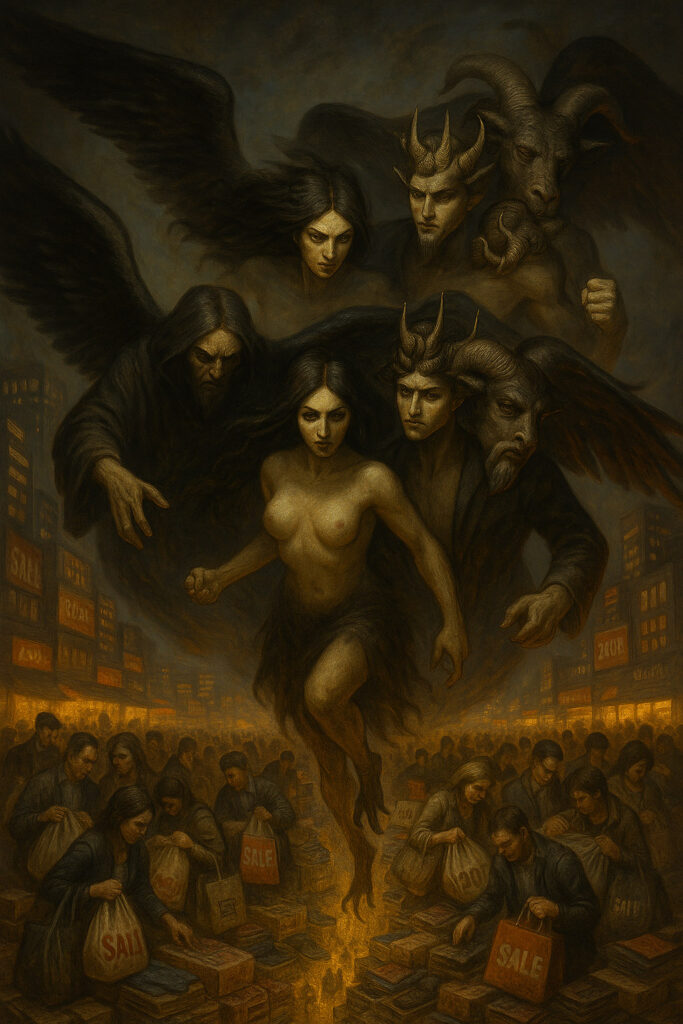
Thus, the general destructor of appropriation manifests on three levels of stripping of subjectivity: appropriation, dissolution, and imposition. These are all different kinds of possession, the same defective way of existing in the world without recognizing its subjecthood. Therefore Asmodeus easily “turns into” Lilith, Lilith — into Semyaza, and Semyaza — again into Asmodeus.
At the Gates of Golahab, this general deformation is also coupled with anger: appropriation turns into coercion and violence. Therefore every appropriation depends on threat, and every rage quickly takes on the forms of possession: to hold, to secure, to punish, and to appropriate. And this is only an intensification of the same: appropriation always demands force, otherwise it cannot hold.

In the psychocosm, activation of the matrices of greed begins with the basic experience of separateness and the “itch” of lack that follows it. Then follows the deceptive sensation that appropriating something can “fix” this incompleteness, return a sense of wholeness. Then arises the striving to hold on to what has been obtained, the fear of losing it, and clinging. Further, the mind builds a justifying system (“love is something you do”, “success is what can be counted”, “enlightenment is making one understand”). After that — institutionalization: will accepts Typhon’s archontic norm, where accumulation is more important than the Way and defense is more important than growth. And in the end emptiness always follows: the more “mine”, the less “me”; loneliness, irritability, suspicion, and the endless “just a little more” grow.
Transformation of the destructor is possible only through balance. We have already discussed that even the ancient Egyptians found a path to it through exhaustive differentiation, bringing differentiation to completion, so that it becomes impossible to prefer a part to the whole. Then follows the restoration of equilibrium, in which the flow does not turn into accumulation. Finally — integration of multiple impulses: the desire to be in accord with the world defeats the desire to have the world.
And where the Way becomes more important than property, where the living heart is not replaced by a contract, where Heaven does not violate Earth, — greed returns to its source and dissolves into what it should have been: the force of attraction leading to assimilation, transfiguration, and surpassing.
Good day.
Please describe in more detail the path of disconnection and transformation of the Asmodeus matrix. For example, is the desire to have power as a state and to manifest power the same thing? Or is the first case a need for the expression of flow?
Greetings! Can you describe the path of balancing in more detail? How did the ancient Egyptians practice this, and what methods can be used now?
As stated in the note:
https://enmerkar.com/en/way/transformation-of-greed-the-eye-of-horus
resisting greed consists in understanding the value of everything, differentiating properties and qualities, and discovering that in each (person, object, phenomenon) lies an entire inexhaustible universe.
This can be achieved in practice in various ways, which boil down to studying and gaining a clear vision of this multitude of properties—either in contemplation or in active study. In any case, it is necessary to generate clear vision.