
Azazel and Science

The drive to understand the laws of the universe is one of the key mechanisms ensuring human survival and development. It was gradually shaped by a range of biological factors and social conditions. In early human societies, knowledge about nature (poisonous plants, the behavior of predators and prey, the seasons and climate changes) was vital. Those who understood the environment better were more likely to survive and pass on their genes. This led to the emergence and development of a scientific mode of thinking: the ability to analyze cause-and-effect relationships, to predict, to experiment.
In the course of evolution, an interest in stories, myths, and ethics also developed — things that “cemented” a worldview, creating a shared picture of the world for the entire clan or tribe. At the same time, leaders, shamans, rulers always possessed exclusive knowledge (where certain animals could be found, how to use plants, what secret rituals exist). This supported a hierarchical structure in which knowledge became an instrument of manipulation and control.

As is well known, the human mind differs from that of animals in that it is capable of being aware of its own mortality. However, this gives rise to existential fear, which must be compensated for in some way. This motivates the pursuit of forms of knowledge that provide a sense of control: magic, religion, and science. Accordingly, the process of knowing oneself and the world also becomes a psychological defense mechanism, a way to avoid anxiety or to prove one’s worth to oneself.
As human civilization developed, this fear became abstract: people began to fear not only specific threats but also the unknown, loss of control, chaos. To compensate for this fear, people began creating systems of control — first as magic, then as science and technology.

Thus, one of the responses to fundamental threats to existence, alongside adaptation and harmony with reality, becomes the mind’s striving to master, understand, and control the laws of the universe.
Awareness of one’s own vulnerability, experienced as guilt over powerlessness, leads to a desire for control. At the core of this experience lies the conviction that weakness is something wrong — that it is a deviation from the norm requiring correction. Since ancient times, people who were aware of their weakness felt guilt, because their inadequacy could harm the group. As a result, people who feel their weakness experience guilt, because society seems to tell them: “You could have been stronger, smarter, more successful — you simply didn’t try hard enough.” This guilt pushed them to compensate for their weakness by learning new skills, by searching for alternative and not always honest survival strategies (developing cunning, resourcefulness). And over time, any sense of one’s inferiority is internalized as guilt for failing to meet one’s own ideal.

This existential, all-consuming guilt — a feeling of one’s own inferiority — demands compensation through the pursuit of knowledge, power, control. Namely, a person torn away from nature and aware of their finitude experiences frustration and guilt over his inability to be “omnipotent,” which leads to a pursuit of knowledge not for understanding, but for the sake of eliminating anxiety.
The matrix of such knowing, driven by fear, guilt, power, and thirst for control, as we have already said, is embodied in the figure of an archdemon bearing the energies of fire and mind — Azazel. It is precisely this destroyer that pushes humanity toward the path of technological obsession, on which knowledge becomes not a means of development, but an instrument of suppression, fear, control, and self-gratification.

Unlike the divine revelation, which bestows knowledge as a path to harmony and synarchy with the universe, Azazel “promotes” knowledge as a mechanism for compensating for one’s defects. Such knowledge is neither good nor part of the natural process of spiritual development, but becomes an instrument of desperate self-assertion, caused by a deep sense of guilt and inner inferiority.
Azazel’s destructive influence is a vicious circle: a person feels guilt about their weakness, begins to seek knowledge to eliminate that guilt, but the more they learn, the more they see how little they know; this causes an even greater feeling of guilt and inferiority, and they continue to learn — not to attain truth, but to escape anxiety.

In this sense, Azazel is the personification of a manic striving for knowledge aimed at filling unfillable gaps. He opens up knowledge, but does not lead the mind to wisdom; he helps reveal hidden structures, but does not teach awareness of their meaning.
This gives rise to the demonic aspect of modern science — a striving for knowledge devoid of an ethical or spiritual component. Following the path of Azazel’s matrix, modern science is rarely oriented toward harmony; more often it is driven by a thirst for control, power, compensation for one’s flaws. A person armed with this knowledge is able to change the world, but may not know whether it’s worthwhile; their obsession with technology, transhumanism, is an attempt to become a “new god,” an all-powerful master of the world.

According to the “Book of Enoch,” Azazel reveals the secrets of magic, metalworking, and cosmetics — everything connected with transforming matter and one’s own body. That is, he teaches techniques of change, but does not teach wisdom about the changes themselves.
The knowledge acquired within Azazel’s matrix always bears the imprint of a flaw, an attempt to overcome imperfection, and therefore leads to consequences that its bearer often cannot foresee. This is his trap: a person, driven by guilt, tries to correct their imperfection, not realizing that in the process they create new problems.
In this sense, modern science increasingly resembles the sacrifice of a “scapegoat,” when a person tries to banish their mistakes through technology, manipulating the world, avoiding self-knowledge and self-cleansing.

According to legends, Azazel is closely connected with the smith’s craft — a trade that, as a driver of technological progress, from the most ancient times also served the development of warfare. According to the “Book of Enoch,” it is he who passes on to people the knowledge of metalworking, the making of swords, knives, armor — everything connected with war and violence.
Accordingly, “ensoulless” science, whose patron can be considered Azazel, constantly seeks new ways of suppression and destruction. It would seem that Azazel grants humanity knowledge, but it is precisely through technologies of destruction that this knowledge finds its most powerful embodiment: the discovery of nuclear energy led to the creation of nuclear weapons; the development of aviation produced bombers; progress in chemistry gave rise to poisonous substances and chemical warfare gases; information technologies enabled cyberwarfare, autonomous weapons, drones and lethal drones.
In other words, the problem of knowing inspired by Azazel is that it has no ethical reference points. His knowledge is absolutely amoral that can be used both for good and for evil. At the same time, due to the activity of Yetzer hara in the human mind, it is precisely the destructive aspect that always tends to take priority.
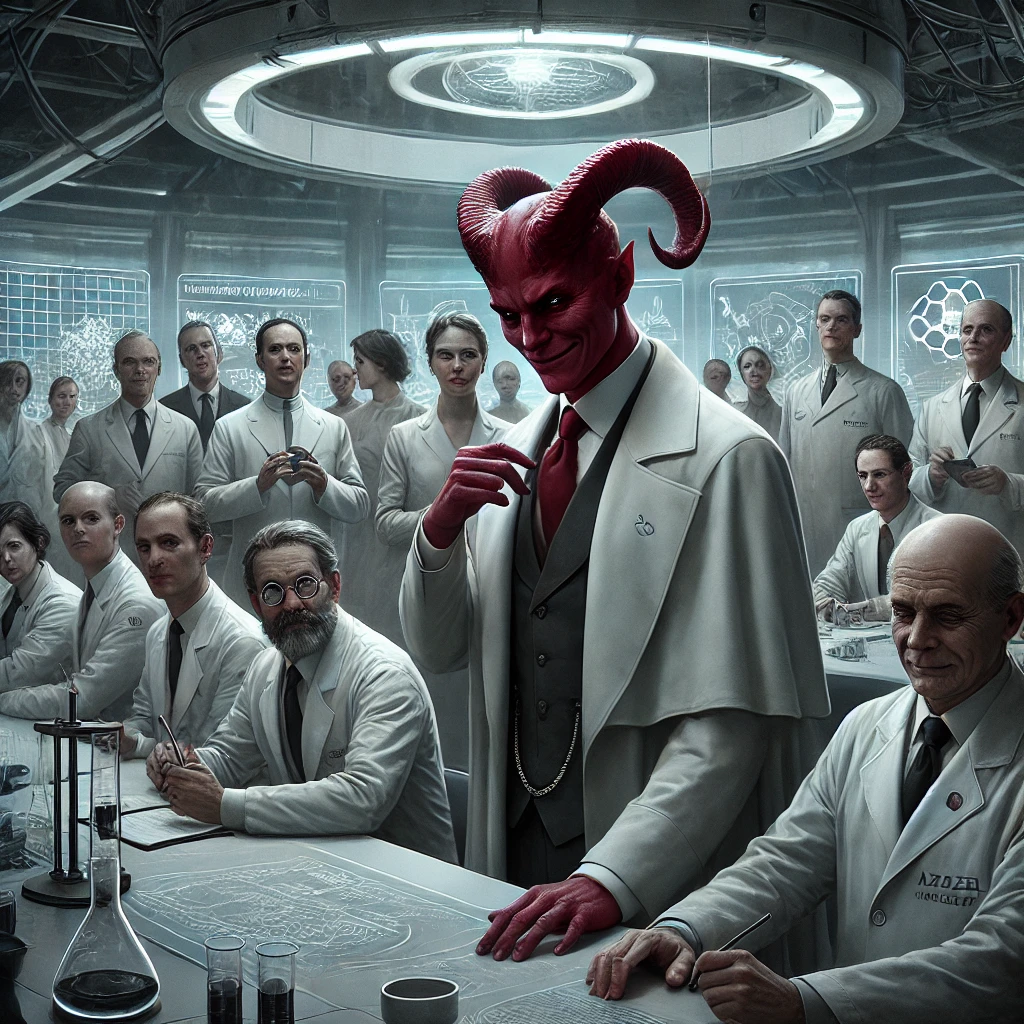
If we imagine Azazel appearing in the modern world, he would most likely look not like a demonic spirit with horns, but like a prominent scientist working on the latest weapons in a secret laboratory. Such a “scientist” does not commit atrocities, but provides the means and instruments through which they become possible.
The scientific community led by Azazel fears its weakness. It is aware of its finitude, vulnerability, insufficiency — and tries to compensate for it by building a force that surpasses all threats.

Unacknowledged and unresolved weakness demands weapons. People fear their powerlessness before nature, before other peoples, before time itself — and create weapons to hide this weakness.
In the same way, the sense of one’s own insignificance, not recognized as a destructor — the feeling of one’s own insignificance — demands power. The war supported by Azazel is, first and foremost, a struggle to confirm one’s strength, for the illusion of control over the world, over people, and over life itself.
Thus technological superiority becomes a mania: the pursuit of new weapons is an attempt to compensate for a sense of one’s own limitations, an obsessive desire to feel absolute might.

At the same time, science that follows Azazel doesn’t develop from a quest for truth or “pure” knowing, but from fear of one’s own insignificance. Each new spiral of militarization is another attempt to hide one’s weakness behind destructive power.
Azazel believes that one can become great only by destroying the weak, and this principle permeates the entire history of military technologies. This is the curse of Azazel’s knowing: he gives strength, yet this strength exists only in comparison with someone else’s weakness. People driven by his knowing will never be satisfied, because to remain great in their own eyes they need someone to always remain weaker.
Thus, each new discovery in the field of weapons is not a step forward at all, but only a new attempt to drown out the fear of one’s own weakness, translated into the realm of technological progress.

Azazel is not merely a demon of destruction, guilt, or the desert. He is a demon of fear of one’s nature, who turns knowing into a self-destructive process leading not to enlightenment, but only to an endless flight from one’s own vulnerability. As the initiator of such knowing, Azazel makes it empty: knowledge multiplies, but its meaning is lost.
At the same time, knowing led by Azazel always leaves the mind with an even greater sense of inferiority than before, because knowledge devoid of meaning does not make one stronger — it makes a person a hostage of their fear and a victim of their pride. The guilt that generates the illusion of knowledge does not make a person free; it turns knowing into a way to escape oneself, rather than to understand oneself.
And today humanity once again stands before a choice: either knowing will turn into a path to harmony, joined with ethics and wisdom, or it will remain under the power of Azazel, leading to a state where science is merely an instrument of war, manipulation, and an anesthetic against the eternal fear of one’s own imperfection.

Hello! If knowledge inspired by Azazel represents an endless attempt to compensate for a sense of vulnerability through control, technological superiority, and destructive power, what is the path to liberation from this trap? Is it possible to attain knowledge free from this flaw, and how can it be achieved? Is the combination of science with spiritual wisdom a solution, and if so, how can such a synthetic paradigm be created where knowledge serves not fear, but true development?
Hello! The path to opposing Azazel lies in understanding the very nature of the striving for knowledge. The problem is not in knowledge itself, but in the inner impulse that drives consciousness in this process. If knowledge is driven by fear, the desire for control, and compensation for a sense of vulnerability, it inevitably becomes an instrument of power and destruction. However, if it stems from inner integrity and a desire for harmony with the world, rather than its subjugation, then it becomes true development, avoiding the fall into destruction. I believe that science free from Azazel’s flaw is possible, but only on the condition that its foundation is built on the principles of ethics, responsibility, and inner harmony. Science, like magic, is a tool, and the question lies not in it itself, but in the state of consciousness of those who use it. A mage with deep knowledge sees that every discovery carries both the potential for creation and destruction. And if consciousness is chaotic and fragmented, if it is beset with the illusion of its own weakness and a desire for power, it will inevitably use science for evil, even if it is unaware of it. But if consciousness is rooted in wisdom, knowledge becomes a tool for liberation, not self-destruction. There have been periods in history when science was not separated from ethics and philosophy, and its development led to a holistic understanding of the universe. For example, alchemists were not seeking unusual ways to transmute metals, but aimed to transform themselves. In antiquity, philosophy and science went hand in hand, and scholars aspired to a universal understanding of the world and themselves. The modern scientific paradigm is driven by division and analytics, while harmonious cognition requires equally developed synthesis. To free knowledge from the demonic matrix of Azazel, it is necessary to introduce an awareness of ethical responsibility into the scientific discourse. Science cannot exist as an autonomous force free from questions of morality, harmony, and meaning. This awareness must become part of the very process of knowledge: before discovering something new, a scientist or a mage must ask themselves about the meaning and consequences. Such an approach generates not technologies of destruction but technologies of co-development: instead of attempting to modify and conquer reality, it forges paths of action in accordance with its laws. Such knowledge is not only intellectual but also internally experienced, based on the perception of the integrity of being. Without this, any discoveries are merely new cycles of self-destruction, but with this awareness, science can become something more, a path leading to the evolution of consciousness and the world.
I cannot imagine that a deep longing for wisdom would be driven by fear. Can you give an example?