
A Sense of One’s Own Unimportance
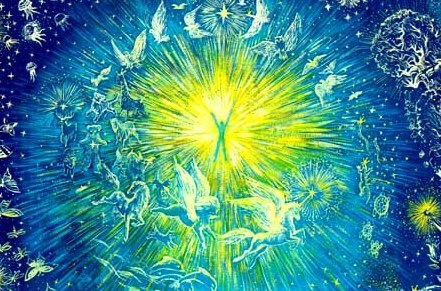
Religions and spiritual teachings, schools and lineages, in their struggle against the Luciferian element of human nature, constantly point to the destructiveness of an egocentric sense of “importance” at others’ expense. Yet that very idea often turns into two important pitfalls: 1) the notion of fighting the “sense of importance” in others and 2) the feeling of one’s “own unimportance.”
The first case is more obvious and is discussed more widely elsewhere. Very often, at the first signs of “attainment,” a person begins to consider himself a “messiah” (while managing to convince themselves they’re unselfish) and sets about to “save others,” in fact imposing their views on others and suppressing individuality.

The second pitfall is less noticeable and is the “shadowy” binary counterpart to the first.
The first steps in the development of the mind, the accumulation of a measure of power and the first glimpses of the sun through the veil over attention reveal to a person a world of infinite diversity and possibilities, where in every speck of dust and in every breeze the Great Spirit is present in all its majesty and fullness.
However, at the same time it becomes clear that the infinity of the cosmos far exceeds the scope of any single individual, and instead of finding the Spirit within and identifying with it, one easily falls into the feeling of being a “speck of dust on the road,” crushed by the immeasurable grandeur of the cosmos.
Note that the first pitfall, a masked megalomania, is often a partially or wholly unconscious reaction to this awareness: instead of seeking the Way of identification with his infinite nature, with his individuality, his monadic nature, the personality proclaims itself infinite, declares itself God and, having suppressed or hidden its insecurity and bewilderment, begins to imitate enlightenment. Yet behind the thin bravado and affected wisdom there is often deep despair and fear of the abyss that has opened within the mind.

Both outcomes — despair, the renunciation of effort (“why strive for anything, if death is inevitable and the cosmos is grand and terrifying“), and the imitation of attainment (“I have already achieved significant success and secured a high position for myself“) — are equally hopeless and lead to a halt in development.
The only constructive option is, as always, the middle path between the two poles.
The awareness of potential unified grandeur and the actual fragmentation of the cosmos can lead to the awareness of the equal value of all things, but not as equal worthlessness, rather in the sense of their universal necessity.
Each person on Earth is the Great Spirit. Each tree and tiny creature is the Great Spirit. And the one who observes this is also the Great Spirit.
And at the same time the Great Spirit is not a tree or a tiny creature, not a stone and not even the universe as a whole.
The mind’s all-embracing grandeur does not destroy individuality; on the contrary, full attainment of individuality is the fullest manifestation of the Great Spirit in one of the infinite number of its aspects. As they say: “Atman is Brahman, but otherwise.”
At the same time a Magus does not “seek” the Great Spirit in himself, but — transforms himself into the Great Spirit, builds and realizes himself and thereby actualizes the Absolute.
 The criterion of a correct understanding of this fact is the sense of universal value (“I said: you are gods”) and at the same time compassion for all manifestations of the Great Spirit, which suffer because of the incompleteness of their manifestation. “Life is suffering” precisely because the full manifestation of the Great Spirit within the limited space of manifested worlds is in principle impossible, and the cosmos only approaches it asymptotically in its eternal evolution.
A Magus, on the one hand, does not consider himself more important than a speck of dust on the Earth, but on the other — does not consider himself less important than the Sun or Svarog. It is very important that this feeling is genuine, arising not from intellectual understanding but from empirical awareness, direct experience. Only when this awareness is not imitated but lived through does it pave the way to self-confidence that does not diminish respect for others.
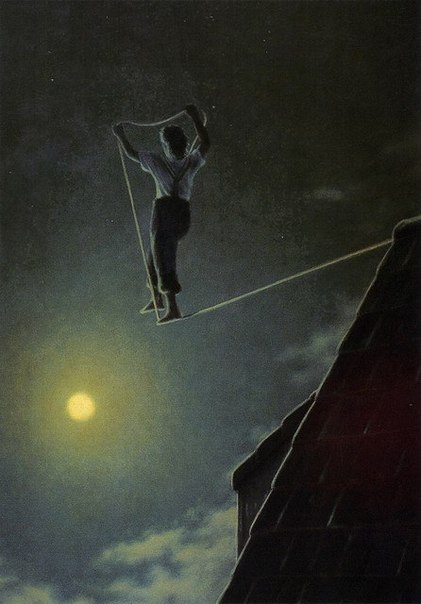
And sometimes it happens the other way around – everyone says that you have an inflated ego, but in reality, it is the radiance of a leader – leadership, guidance, the ability to organize people; some mistake it for pride without understanding its true essence…
“Have you observed it in yourself, or in someone else?”
Why doesn’t he clearly demonstrate this difference to those who doubt? If a leader is suspected of having “narcissistic personality traits,” as you put it, then he is not quite a leader. Something is not right with him; his ambitions (if they are indeed ambitions and not some idealistic and natural aspirations of the spirit) do not align with his capabilities. Typically, this is noticeable right away from the outside. A true leader possesses an inner, qualitative greatness and has a strength that no one in his circle doubts. Ultimately, it depends solely on the person how well he will meet the required conditions and possess the tactical acumen necessary to achieve the set goals. If such suspicions arise, it means your abstract leader is quite far from the level of authority he naively expects. Most likely, he needs people much more than they need him.
If the question arises about a leader’s alignment with leadership, one should immediately trace the “leader” within oneself and debunk it with the awareness of this fact.
The story about pride and many other similar things is, in my opinion, mysterious because those who truly know—except for a few rare cases—no longer want to say anything.
Maria, those who truly know once did not know, but they sought answers to their questions. Of course, you never know where you’ll find or lose something, but if you have questions, don’t stop searching for answers, and you will find them.
I don’t have a question about how to get rid of pride and self-importance. However, I do understand that life is a process, and there is little that can be fixed, and it’s important to check myself in every situation. It probably is true that these traits can’t be completely eliminated (but nothing prevents me from pondering this question)). And I know them well, and because of this article, I became familiar with a few more aspects. A good conclusion to a little quest!
What I have encountered on the topic are various ways of waging war with oneself and, conversely, ways to smooth things over. But maybe there is some magical text and method out there somewhere.
You see, Maria, there comes a time when you realize that until a person recognizes something within themselves, it is pointless to say anything to them. Even when awareness is presented to you on a platter, you seem to understand, but you don’t fully recognize it. Awareness is the bullet, while consciousness is the achievement of the goal. Awareness is ice, and consciousness is the melting of that ice and its merging into the ocean of consciousness.
Thank you. War is just that kind of thing – there are casualties on both sides.
Hunter! I completely agree, this is true even for oneself; you can read intelligent books, listen to wise speeches, accept things on faith, but until you accumulate a critical mass in your subconscious, until you become aware, all of this remains useless clutter.
In our world, a vast number of people have been destroyed not by a sense of their own importance, but by a sense of their own insignificance—imposed from above. It is the insignificant that bring about destruction, primarily of those who do not want to turn into something insignificant. This is essentially the whole story. Moreover, a person who does not consider their life important does not value anyone else’s life either. Such individuals can be sent to kill for unclear reasons, to destroy what has been created by those who did have a sense of their own importance. It is precisely the importance of oneself that a person needs to acknowledge, and through that, recognize the importance of all and everything. You may say that I am confusing it with self-esteem? Not at all. Self-esteem is actually a negative phenomenon, because each person is an irreplaceable entity for themselves. There are no objective reasons to showcase this to anyone else. However, a sense of one’s own importance is what people have completely lost. Hence the parasites, the manipulations, and all the other troubles. Of course, there are negative aspects to inflating one’s own personality, but it should be called just that: inflating one’s own personality, and not a sense of one’s own importance. The term originated from Castaneda. Perhaps its meaning got distorted in translation. But even if it didn’t, Castaneda was a complex and convoluted individual who essentially created a totalitarian cult. He seemed to have a Catholic upbringing, which probably meant something different for him. But for the majority of people who are driven into the gloomy hopelessness of a miserable existence, to also struggle with a sense of their own importance…
Self-esteem is a feeling of what you deserve. Self-importance is a feeling of how important you are to someone or something, important in current circumstances. Everything else stems from a false assessment of oneself, one’s place in the world, the strengths one possesses, and the possibilities. For example, everyone has their own opinion and has the right to express it, but most prefer not just to express it but to present it as the final truth that cannot be revised. Is this not evidence that a person considers themselves more important than all others? ))
“What do you deserve” is from the realm of buy-sell. “I have a diploma as a nuclear physicist, but I clean sewers.” It’s from this area. No one really knows what they deserve. Again, according to what value system? Your second sentence. The words “sense of self-importance” do not include additions, for whom and under what circumstances. You added that yourself. That is, you infused your meaning, which does not follow from the phrase itself. Someone could add it differently. Say, a sense of one’s own importance is when someone wanted to build the city of St. Petersburg and does not care how many thousands of peasants will die in the process. Regarding the latter. Well, forgive me, if someone wants to feed me a whole paradigm or system overloaded with various prejudices and archaisms, I am in no way obliged to swallow it whole and limit myself by it. There are systems that are useful at 10%. Or 50%. The rest is spam. There are no systems that are 100% effective. Since perception is individual and introduces distortions one way or another. To increase efficiency, there is such a thing as dialogue. If the author of a particular concept does not allow anyone to act outside the given concept, then there is no dialogue. As there is nowhere to expand. For example, Freud considered Jung a traitor for going beyond his concept. This is not evidence that he considered himself more important than all others. But it is evidence that he selfishly regarded his own theory and did not wish for anyone to expand it and thus become better than him. Or let’s say dictators always knew a good way to become the smartest and most talented in a given country. They just had to destroy everyone who was smarter and more talented than they were. This way they could become the greatest scientist, writer, agronomist, strategist. Anyone. Or simply torment them. Forcibly drive them away, etc. By the way, something similar is happening now in one specific country. And not in just one. In general, this is called Becoming the King of the Hill. Elvis Presley – the King of Rock and Roll. And that’s it. That’s why he hated the Beatles.:)
For oneself, any person undoubtedly considers themselves more important than all others. Because their dharma, their conscience is primary to them. Without this, there would be no realization for Buddha, Jesus, or Castaneda, whatever it may have been. And if a person thinks otherwise, there is a known film ‘Autumn Marathon’. This is about a person who did not consider their tasks more important than the tasks and problems of others.
The logic of language (as is known, language is one of the systems of reflecting the world and thinking) clearly includes at least two additions to the phrase “sense of self-importance” – to whom the feeling belongs and what or whom the feeling is related to. Usually, a speaker picks this up even if they do not realize it. For instance, the word “hit” implies a subject, object of action, as well as place, time, and instrument – who hit whom, where, when, and with what.
So Sergey did not add that himself.
It also seems to me that the sense of one’s own unimportance is much more dangerous than pride.
I watched this article concerning myself. My friend and I are discussing this topic. Not because I am having a dialogue with you personally and need something. To me, the feeling of insignificance is the same pride, just from a different angle. As far as I can see, every logos (I say this in this blog as it is accepted here) represents a continuum, for example, with pride and self-deprecation at the extremes, and pride in the middle. And freedom is in choosing each of these manifestations according to the moment and from the understanding of harmony. I also believe that it’s impossible to know all this in theory and to anticipate it and sit in the middle beforehand. However, from my experience, one can understand the opposite by carefully looking at what is before you. For some unknown reason – the complete comprehension of one pole – gives knowledge of the opposite.
Why is the feeling of one’s own insignificance more dangerous than the feeling of importance: in the first case, a person takes less responsibility for themselves; they preemptively make themselves a victim.
Exactly: “it is impossible to know all this in theory.” This goes to our conversation about conversations, techniques, and living through them. After all, “it is very important that this feeling is honest, arising not from intellectual understanding, but from empirical awareness, direct experience.”
You are answering me again as if I am addressing you personally, as if you are knowledgeable and for advice. I am not asking you why. And no one is asking, and if someone does ask and is ready to accept, then that is shifting responsibility and precisely that position of victimhood that frightens you. I would continue, but I think that’s enough) Your statement, for example, illustrates how the pole of the binary “being a victim is bad” makes you a pursuer in some sense and creates this position of “from the mountain” and “flailing” people in your perception. And paradoxically, it makes the very person with such a worldview their own victim. At the very least – excluding from reality that part when being a victim is necessary, positioning part of the world in opposition and forcing oneself to search for a theory that justifies it, and expending energy every second to maintain that theory. I am not saying that I am free from the traps of the mind, but the binary of good-bad and always-never, that is what I monitor within myself.
))) The comments are like flashlights over the theme, inviting to take another look at the page; you read it and see some moments anew. You can return to the comment and further develop your thought.
If I had a need to test Maria’s worldview, to diagnose her statements for any imprints and traps of the mind, I would understand why she addresses her questions to the stream and not to a person, while redirecting my answers to a person and not leaving them with the stream. And why Numen can simply depict her as a savior of the race, while she needs to depict me on the mountain with justification. ))))
Good time, Aurelius.
“For oneself, any person undoubtedly considers themselves more important than all others. Because their dharma, their conscience is primary for them. Without this, there would be no realization for Buddha, Jesus, or Castaneda, whatever it may have been.”
What about those cases when a person deliberately invests their strength in the realization of another person? For example, grandmother Nyura fully dedicates herself to her grandchildren?
There is a legend about how Michael defeated Lucifer.
One angel rose up and spoke in his heart: “I will ascend to heaven, above the stars of God will I raise my throne and sit on the mount of the congregation, on the sides of the north; I will ascend above the heights of the clouds; I will be like the Most High.” And another angel opposed him and said: “Who is like God?”.
Lucifer?! Are you sure you didn’t mix anything up? According to objective conclusions by Blavatsky, Lucifer is the primordial Logos and the creator of the world.
“Every person on earth is a Great Spirit” – I’m sorry, but that’s an outrageous lie. Alternatively, I can imagine the true filth that the so-called “great” spirit represents if it is associated with paid-off scum claiming to be human.
I currently really enjoy testing the Buddhist approach. It flips the activity, and if before I needed to get hurt and then search for the root and dig with my hands based on the pain – now I know what to watch for. By tracking myself and establishing the rule of non-violence (including towards myself), I have found that, for example, I do not need to discuss what I have learned with someone at all. Earlier, it was important to me; often the material was external. Now, there is no shortage of material. For example, my strange reaction to discussing money – I simply see that I have emotions about this, and they are as visible as my palm. Why did I catch this on violence? – envy is also violence. This is spiteful glee and a desire to take away. And that kind of shade was caught today. Then also, a slight glee during a discussion that was laughed about, in the office, about some employee. The balancing act of non-violence consists in that I need not gloat but also not throw myself into defending her because participating in a war that does not concern me is violence against myself. Perhaps for the first time in my life I tried to adopt someone else’s criterion and question, in that I will catch it by the tail. I just tried to, and it turned out to be a very complete and comprehensive question.
My vision at this moment. It is clear that we all live in a world of death. Everything you have will crumble to dust sooner or later (except for consciousness, soul (fill in yourself)). People do not want to live in such a world and have created an imaginary realm – culture, civilization. They would rather ideologically go mad than soberly look at life without ideas. Narcissism is one of the central elements of this game in human meaning. When you accept your position, you can see this game and not take it seriously. The sandbox before the asphalt roller. Then society is just a backdrop, life is a battlefield for awareness. Narcissism is always here, but it’s no longer sticking out of every hole.
In the context of the article, the emphasis can be placed not on the value and devaluation of a living being, but on the idea that narcissistic self-importance is equivalent to a Fixed Self-Image, the maintenance of which consumes a lot of energy that could be spent on expanding the Horizons of Consciousness. In other words, the excessive importance of fixing one’s self-image hinders the fluidity of consciousness.