
The Poison of God: Two Samaels
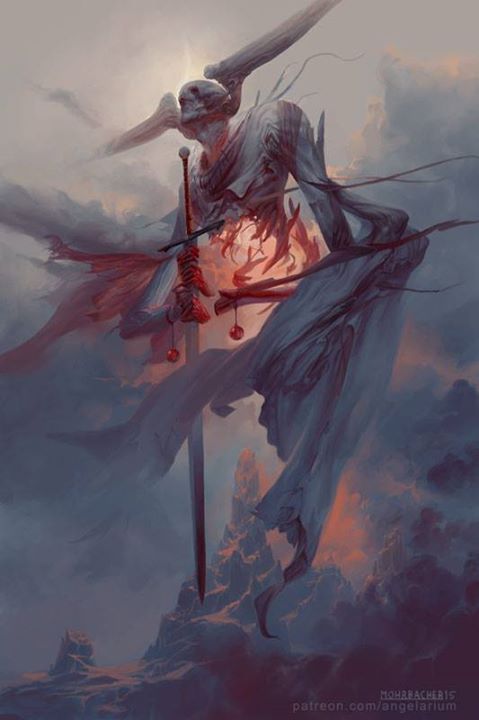
Although destruction is as integral and necessary a component of any process as creation, it is clear that, from the point of view of the system on which these forces act, they are perceived very differently. The ambiguity in understanding the inevitability and manifestations of destructive forces has always been accompanied by particularities in their descriptions. The Kabbalistic tradition describes the principle of destruction in two aspects, as both a “beneficent” and a “dark” form of destruction.
The Pillar of Severity on the Tree of Life rests upon the protective powers of Archangel Raphael and is rooted in the overcoming forces of the Archangel Samuil (transliterated synodally as Chamuil). The two middle sephiroth of this pillar — Geburah and Hod — “Severity” and “Glory” — define two modes of affirming the manifested being: through the external removal of obstacles (Geburah) and through the self-purifying forces (Hod).
At the same time, two spirits associated with these spheres share the same name, although one belongs to the “evolutionary” forces and the other to the “involutionary” forces.
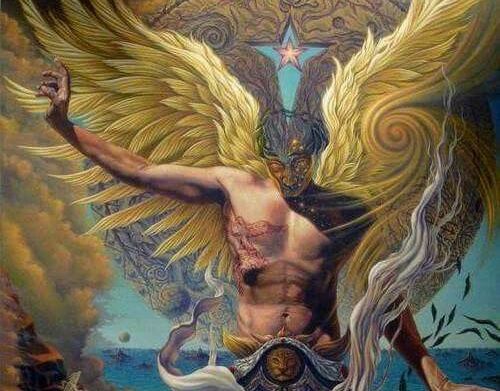
The name “Samael”, סמאל — “the Poison of God” — is traditionally applied both to the Archangel of the sefirah Geburah, the ruler of the Martian forces, and to the demon(s) Shaarimot, the Dark Gates of the Qliphoth, opposing Hod.
Such duality often gives rise to confusion in magicians’ ritual practice. Nevertheless, it is clear that, since “a name is an essence,” two forces bearing the same name can be regarded either as manifestations of a single principle or as two different forces that manifest similarly. Depending on that understanding, the nature of interaction with such forces proves entirely different.
The Archangel of Geburah is known by three names: Samael, Kemael (קמאל “He Who Sees God”) and Barachiel (בארכאל “Lightning of God”; the Book of Enoch mentions this name among the leaders of the Grigori), and all these names point to a destructive activity originating from God. It is this force, the “Angel of Death,” that is often perceived as the “negative” aspect of power, its destructive, wrathful manifestation. It is not surprising that in the human mind the “Angel of Death” is commonly associated with the Gates of Death, Shaarimot, and therefore subjectively these two forces are described similarly.
Subjectively, Samael is a force devoid of compassion (the meaning of Geburah), and therefore a force of retribution and absolute recompense, lacking any trace of mercy.
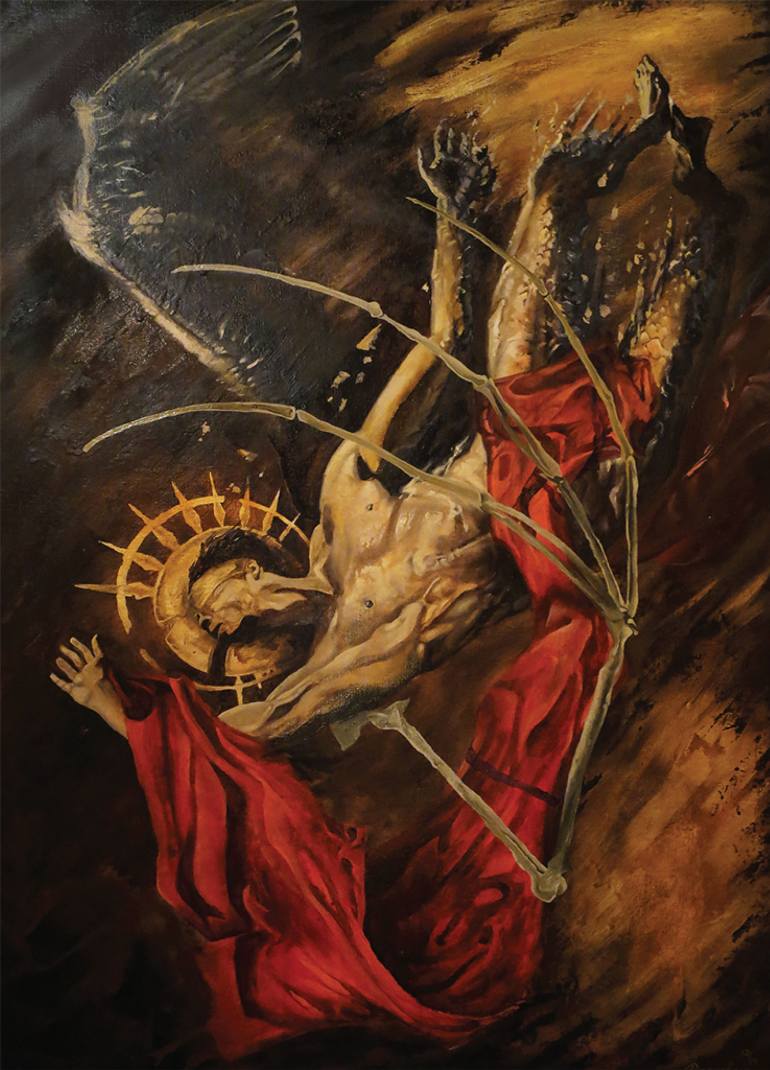
However, the “Poison of God” that belongs to Geburah and stands behind the Gates of Death is, nevertheless, a different manifestation of the Force of destruction. Tradition adds the epithet “the Black,” Shachor (שחור), to the name of the “lower” Samael.
The destruction of the “Upper Samael” is accompanied by a “vision of God,” and therefore serves evolution, although it may be perceived as negative or even hostile. It is no surprise that the Sacred Tradition of Judaism calls Samael the guardian angel of the Garden of Eden, protecting primordial perfection from the imperfect manifestations of humanity. In this sense, Samael is a typical “wrathful” divine destroyer, a force well known in all mythologies, defending the infinite from the “pollutions” of finitude.
The destruction emanating from the Black Samael, however, is “destruction for the sake of destruction”; his epithet — Malchira (King of Evil) — testifies to his destructive influence. If the “White” Samael guards Eden (with the Flaming Sword), the “Black” one “tempts” people (according to tradition, it was he who appeared to Eve in the form of the Serpent), and thus also “cleanses Paradise” of people, contributing to their expulsion. Both forces pursue similar aims, but they do so in entirely different ways.

According to the Gnostic Tradition, Samael (in this key, the name is interpreted as “the blind God”) is one of the names of the demiurge, the artisan-God who creates the manifested world, destroys primordial fullness, and thus generates the suffering of limitation. From this point of view, such a force is clearly ambivalent: on the one hand, it sustains manifested existence itself, but on the other, it is the destroyer of Divine fullness. Hence, once more, the need for a “double understanding” of the “Poison of God.”
Another important aspect of understanding destructive forces is their “opposition,” on one side to creative forces and on the other to unifying forces. In this sense, it is clear that both Samaels, in a certain respect, oppose the harmonizing power of Tiferet — Michael, although the character of that opposition differs: if the “White” Samael prevents Michael from bringing people into Eden prematurely, the “Black” one seeks to draw Michael himself into the “fall.” Another feature of the forces of destruction is their interaction with the forces of union, and again this interaction is twofold — Samael tempts Eve; he, in a sense, cleanses Eden of humans (similar to how Raphael “cleanses” people themselves from evil), and Samael is described as the “husband of Lilith,” “Mother of Evil,” acting as an expansive aspect of Lucifer, promoting division as necessary for possession.
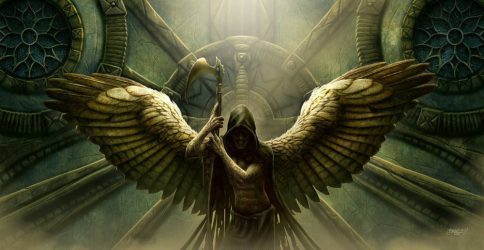
Thus, an understanding of the nature of destructive forces, their aims and manifestations accounts for their various mythological descriptions, and for a magus, it is important not to confuse different manifestations of the same force or similar manifestations of different forces. In this case, the destructive activity belongs to streams of very different nature, and distinguishing these streams by their source is necessary not only for correct understanding but also for establishing the right mode of interaction: the forces of Kemael are beneficent in nature, though wrathful and destructive, and sometimes quite traumatic. The manifestations of the Black Samael, however, are purely destructive and have no constructive outcome. To understand what “kind of destruction” a magus faces means either accepting that destruction as necessary (and perhaps even to facilitate it), or opposing it. To avoid error in this decision, a Magus must trace the forces to their sources, to classify their streams, and not just observe their final effects. The ability to “look to the root” is not merely philosophical; it is an absolutely necessary practical skill on the path of mental development.
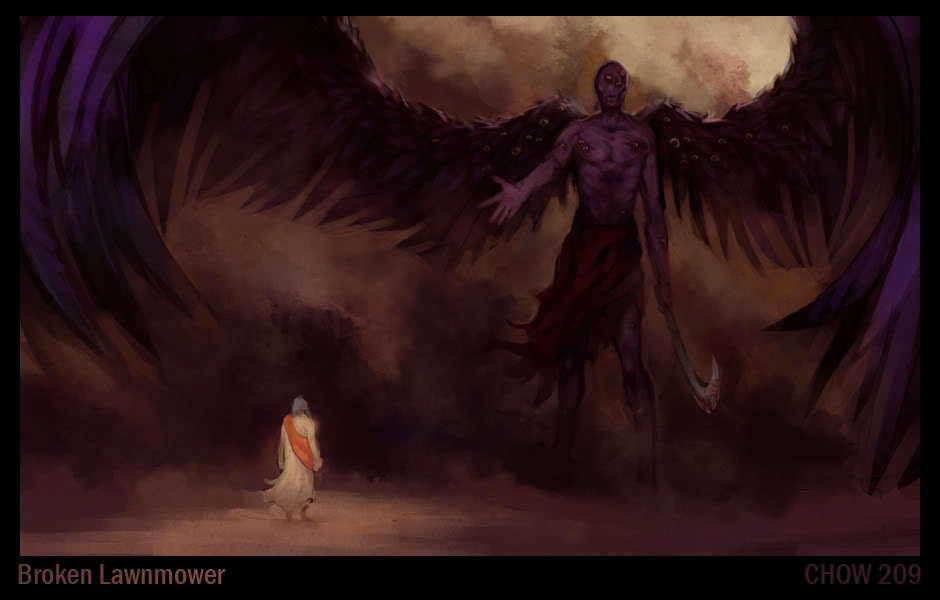
Maybe this is too primitive a judgment, but I imagine it this way. The Bright Samael is the one who cuts the television you watch with his sword instead of practicing. And the Black Samael is the one who takes away the money you set aside, for example, for buying a useful book on Kabbalah.
The Black Samael is the one who tempts – with that money you set aside, for example, for the purchase of a useful book on Kabbalah – to buy a new television.
How can everything said be transferred to Northern myth? The forces are the same, but the myths are different. I apologize for the silly question. Respectfully, Andrey!!!
Although it was not the task of the Northern Myth (at least in the form it has reached us) to describe the processes of the evolution of consciousness and the induction of power, nevertheless, like any Myth, it has many planes of interpretation, including – the psychocosmic one. From this perspective, one might roughly compare “destruction for the sake of creation” with Loki, and destruction for the sake of destruction – for example, with Surtr.
Thank you!
If we draw parallels with the Jewish tradition, from which the author derives a number of concepts related to the so-called “secret Torah” – Kabbalah, then “destruction as good” can be characterized by the term רע (“ra”). In fact, “yezer hа-ra,” “the evil inclination,” is another name for this angel (its real name is traditionally abbreviated with the two letters “samekh” and “mem” – ס-מ, as writing it in full is undesirable), and the very creation of the evil inclination on the sixth day is described in the Torah with the phrase “טוב מאוד,” “tov meod” (“God saw all that He created—it was very good”). This seems absurd—on one hand, “the evil inclination,” and on the other, “very good.” However, the author has managed to explain well why this is the case (though in tradition, it is explained just as well, and also implies that within the “bad,” there are still some grains of goodness, sparks of light, and one must work to extract them to rectify the world). The second flow corresponds to the term לא טוב (“lo tov”), “not good,” and from here it is clear that in the “not good” there are no such sparks and nothing valuable that would require elevation and lead to a positive outcome, because it is the void and formlessness of the worlds of klipot, devoid of light. See the midrash: “Once, kindness, typical for Rabbi Eliezer, was praised in Heaven. They decided to test him. They asked: ‘Who will go to test him?’ Samekh-Mem said: ‘I will go.’ The prophet Eliyahu, blessed be his memory, said: ‘It is not good that you will go, [only I will go].'”
Very interesting, thank you. Please send an article about the archangel Samuel.
https://enmerkar.com/en/myth/archangels-guardians-of-the-tree-of-life
Hello Master! I have two questions bothering me. Although I probably already know the answers. An illegal action was committed in an unstable world, but I defended our world, and now they are trying to question me. And secondly, I constantly feel like I am possessed by a demon of pride or whatever it is. Perhaps you know how I can protect myself and those I see.
Hello! The “demon of pride” can be a distractor of vanity, that is, dependency on external evaluations (the hierarchy of Zagan), or—distortion of self-adoration, a distractor of separateness and opposition (the hierarchy of Paimon). Accordingly, the paths of resistance differ. As for the “forced illegal action,” it can be balanced by “merit,” the energy of dinitas, if it was driven by compassion. Thus, “protection” may consist of those for whom such an action brought benefits clearly and definitively recognizing this, thus highlighting the energy of dinitas.
Thank you. Yes, a distractor. Exactly. And they call it the main one.
It gives a lot, and it’s time to give it up, but the question is what will remain of me afterward. A big scar?