
Lack of Realization, Dissatisfaction, and the Shadow

The operative mind, knowing itself and the world through realizations — by translating potential impulses into manifest form — is successful insofar as its actions are effective. In other words, the more fully the mind manages to express the impulses arising within it as actions and manifestations, the more successful its self-knowledge and self-actualization, and therefore – the higher its level of functioning. Since, from the point of view of the Myth described, the sole task of manifested mind is the actualization of its potentials, it feels more satisfied the broader and deeper the scope of that actualization.
In this sense it is clear that the driving force of realizations, of the mind’s development and refinement, is its thirst for realizations — that is, the thirst for self-knowledge of its actual aspects, which manifests as the subjective feeling of incompleteness, dissatisfaction. Put differently, it is precisely the sense of incompleteness, under-realization, under-actualization that is the driving force behind the world’s process.
The mind can rid itself of this sensation in two ways — either by plunging into the abyss of its potential realm, where there are not yet any “disturbing surges,” active impulses, or by attaining the Great Perfection of the Pleroma, actualizing its potentials within a single non-dual field of activity; in other words, by neutralizing the binary of mind and being either by “contracting into a point” or by integrating into infinity (which, ultimately, is the same and does not differ in the final result only in the path to that result).
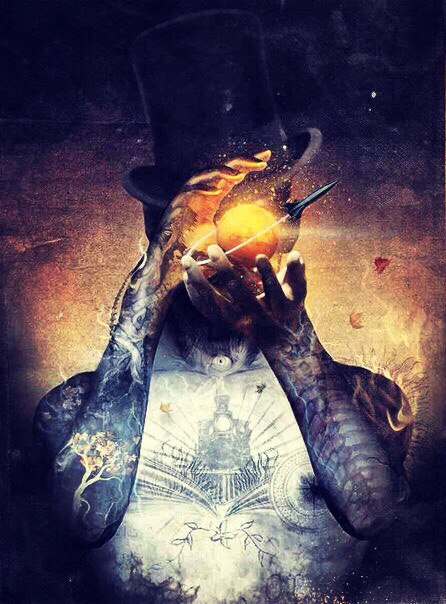
In any case, the impetus for the mind’s development is its dissatisfaction with its partial actualization. At the same time, it is clear that not every action or realization is a way of developing the mind. The Western myth distinguishes three sources of such actions: 1) “true desire,” rooted in the mind’s own nature; 2) need, arising from the conditions of embodiment and aimed at mere maintenance of the body; and 3) whim, whose source is the destructive part of the actual mind. The Discipline of the Western Magus is directed toward realizing desires as fully as possible, needs to a minimally necessary degree, and toward trying to prevent the realization of whims.
Deviation from such a strategy leads to a variety of negative consequences. Failure to realize current desires is accompanied by growth of the shadow, neglect of needs may lead to weakening the conduit of awareness, while excessive attention to them can turn the conduit from an instrument into a dictator, and indulging whims degrades the mind and immerses it in destruction. The greatest problems usually arise precisely in distinguishing desires from whims and, accordingly, in directing the flow of realizations into one channel or another.
If a mind that generates impulses of desire fails to realize them, the energy of those impulses forms a shadow. Depending on the level at which this suppression occurs, the shadow may be either a feature of the mind’s regions (“shadow of the mind”), or an energetic structure of its manifestation (“shadow of the soul”). The first case creates an environment for the formation of destructive impulses; the second — an instrument for their manifestation. For example, a person who suppresses, or simply fails to realize impulses that seem “inappropriate” to him, or who does not see “paths” or “means” for their realization and thereby accumulates a shadow, discharges its energy as aggression, anger, and other manifestations of destructive activity. It is in this sense that the well-known saying should be understood: “a person is angry to the extent he is unhappy.” And, of course, outbursts of aggression, anger, and hatred are always manifestations of dissatisfaction and of refusal to realize constructive inner impulses.

A very difficult situation also arises when a person simultaneously suppresses the expression of needs and desires. A typical example is the distortion of sexual energy, sexual non-realization, because this energy, on the one hand, is the result of the body’s life activity and therefore its expression is a need, but on the other hand sexual energy manifests striving for unity, pleromization, and thus is a desire. Hence a wide range of destructive manifestations arises from sexual non-realization or from the distortion of the flow of sexual energy.
On his Way, the Magus, of course, does not immediately achieve full control and harmony of his manifestations. But self-study, motives, impulses, and inner honesty serve as the foundation upon which he builds the edifice of his realizations. For the Magus it is equally important to find a balance in satisfying his needs, to recognize and neutralize whims in time, and, of course, to recognize and support emerging desires. An imbalance in any of these areas will impede development, and the most dangerous and significant obstacle in this regard proves to be the growth of the shadow. By exposing his negative manifestations, understanding that their root is most likely some imbalance of realizations, the Magus seeks to find the root of the problem, to lessen not only the internal destruction but also his destructive effect on the surrounding world; the Magus strives not to be a demon to himself or others.

Is the statement correct that “true desire” has no specific goal other than the realization (manifestation of the impulse) itself, so to speak, action for the sake of action, while a whim pursues its goal, namely the pursuit of pleasure, wherever that may be expressed?
Hello! I’m curious, why does the Western Path introduce the concept of the shadow? After all, generally speaking, any practices teach in their own way to “kill” the shadow, the “day persona,” and so on. But the persona can be viewed as a cascade of reactions to certain stimuli that make up the conditional “us.” And if we do not intend to leave our environment or retreat to caves, we have to do something about it. Yes, by gradually practicing mindfulness, something occurs that is referred to in the East as working off karma, and in the Western Path as inner alchemy; reaction by reaction, we remove the distractors, the hooks in which our “sleeping” self resides. But here, in my view, there is an important point about how we name and perceive this; there is a loophole that helps this “sleeping” self, which is exactly the disidentification from our actions, shifting the responsibility away from ourselves, similar to addicts projecting their actions onto the drug. Even discussions about the “sleeping self” can be a form of that subtle shifting.
Here’s a personal observation: I practice everyday mindfulness, and I used to sometimes encounter a situation where, after long tension, I let go of the harness and immediately found myself feeling almost possessed—suddenly feeling rage, intolerance toward any irritants, the urge to suppress, to lecture, and so on. But as I noticed later, I was roughly delineating within myself—”the harness is released.” And once I stopped delineating the boundaries, that feeling passed. While I don’t yet have a sense of crystal clarity here and now 24/7, there is also no stagnant place inside me that opens up as soon as I say “it’s allowed.” Without conditional boundaries, the movement of attention has become smoother.
You once mentioned that the amount of Force can be considered as the degree of hierarchy of a particular matrix of consciousness, and I think a similar expansion might be possible precisely through the removal of some disidentifications. I bring this up because, in my view, mapping states of dissatisfaction as a shadow, as something almost external, makes it quite easy to feel that “here is the shadow and all the nastiness, and it’s to blame, while here is the beautiful, shining ME.”
Hello! The Western myth does not strive for a premature liberation from personality as such, just as it does not seek a premature liberation from the body. Just as the body sums up the existential foundations of the consciousness’s support on being, personality functions as a specific conductor of consciousness in the actual world. The issue is that this personality must be as harmonious as possible and effectively fulfill its task—awareness. Therefore, the aim of Inner Alchemy is not the complete destruction of personality but the achievement of its egolessness; personality must cease to be the conduit for a limited and oppositional “I” and must transform from a means of opposition into a specific expression of the individual process of awareness (to be precise, those aspects of personality that set themselves against must be destroyed, reformed, and what arises from this transformation can only conditionally be called a new personality). For this, mental processes must become internally whole and internally consistent. Accordingly, the manifestations of mental processes, flows, and subpersonalities that clearly hinder the harmonious flow of consciousness must be overcome first and are referred to as “shadows.” That is, shadows, distractors, parasites, and predators are those manifestations that must be overcome first to give personality the chance to achieve the level of internal wholeness necessary for more total restructuring. Of course, for a destructive personality that clings to itself and its ego, blaming destructive manifestations on the “shadow,” “parasite,” or “demons” and somehow evading responsibility is a very appealing idea. Nevertheless, the myth unequivocally asserts that the creator of the shadow is the being itself, and demons enter consciousness only with its consent, clinging to its destructive manifestations and maintained there through contractual relationships. The way to overcome shadows, distractors, parasites, and predators lies in their recognition, acknowledging them as products of one’s own activity, one’s own mistakes, one’s own weakness, and irresponsibility. This should not serve as an excuse for self-justification or inaction, but rather—as an incentive and motivation to eradicate distractors and free oneself from one’s own destruction. However, it is by no means necessary that this path should suit everyone; it does not claim “truth” or “universality,” although it has proven to be quite effective for many travelers over a long time. Those who find other paths of development to be more effective should, of course, follow those paths without worrying about what myths and traditions think, as the main measure of success is one’s own effectiveness and personal development.
“…must be overcome…own mistakes, own weaknesses and irresponsibility…liberation from one’s own destruction.” Is it about becoming right by eliminating everything wrong or using unnoticed resources shown by helpers? Strict correctness or creativity? What path of the mage does your myth describe?
Correctly means creatively. Correct means freely. Incorrect is what restricts.
Is creativity limited to the removal of restrictions? Is the meaning of creativity deeper than the construction and destruction of limitations? Is freedom merely the absence of restrictions?
Creativity is not limited 🙂 Freedom is not the absence of 🙂
Great). So, does being right or wrong create limitations or not? Does correctness enhance freedom or create another step on the path to freedom?
Can correctness exist in the presence of freedom?
For me, freedom is being above the right-wrong dichotomy. Therefore, the impulse probably lies outside the effectiveness of completeness. In my view, the impulse for effectiveness lies in copying. The impulse for creativity lies in the desire to step out of the comfort zone for unique expression. Uniqueness—that is the impulse. In my humble opinion.
In order to move beyond duality, one must first go *through* duality, as we begin our journey in a dualistic reality regardless. “Correct” in this context denotes this path, the path leading to freedom, while “incorrect” denotes entrapment in a cycle of limitation. “Correctness” in itself is not yet freedom, but it is a chance to attain it. Any specific existence is dual, and the binary of “uniqueness” – “sameness” is yet another such duality. Just as “correctness” can become a path to liberation or a trap (if taken as an end in itself), “uniqueness” can turn into a desire for opposition, into showiness, and similarly become a trap. The question is not about which dual terms we use to describe our Path, but rather about what we are actually *doing*, what is truly happening in our consciousness and whether it becomes freer as a result, whether there is more harmony and love in it. All disputes about words are merely a matter of terminology.
Cool.