Fairies and the Elemental Cities
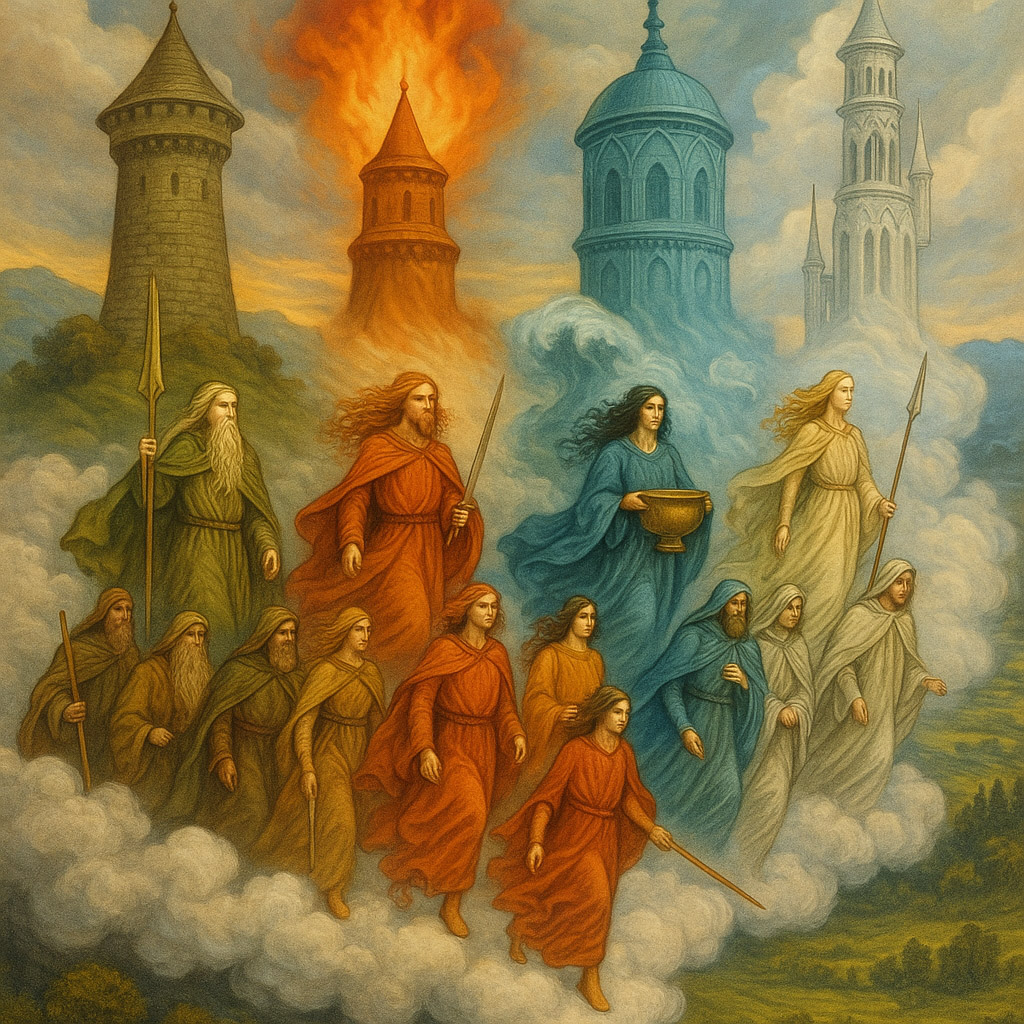
Legends about the appearance of the sidhe — the Tuatha Dé Danann — in the physical world say that the Fair Folk came from the “Cities of Wisdom” — Finnias, Gorias, Murias, and Falias. However, for the reader of these legends, two questions remain unanswered: were these Cities the original abode of the Tuatha, and what was the reason that they left them?
According to legend, the Cities of Wisdom were not the “homeland” of the Tuatha Dé Danann; they were the place of their formation, learning, and “growing up.” The Four Towers — Falias, Murias, Finnias, and Gorias — stand in the Interval as “condensed realities,” islands of stability amid the wavering fabric of the Interworld.
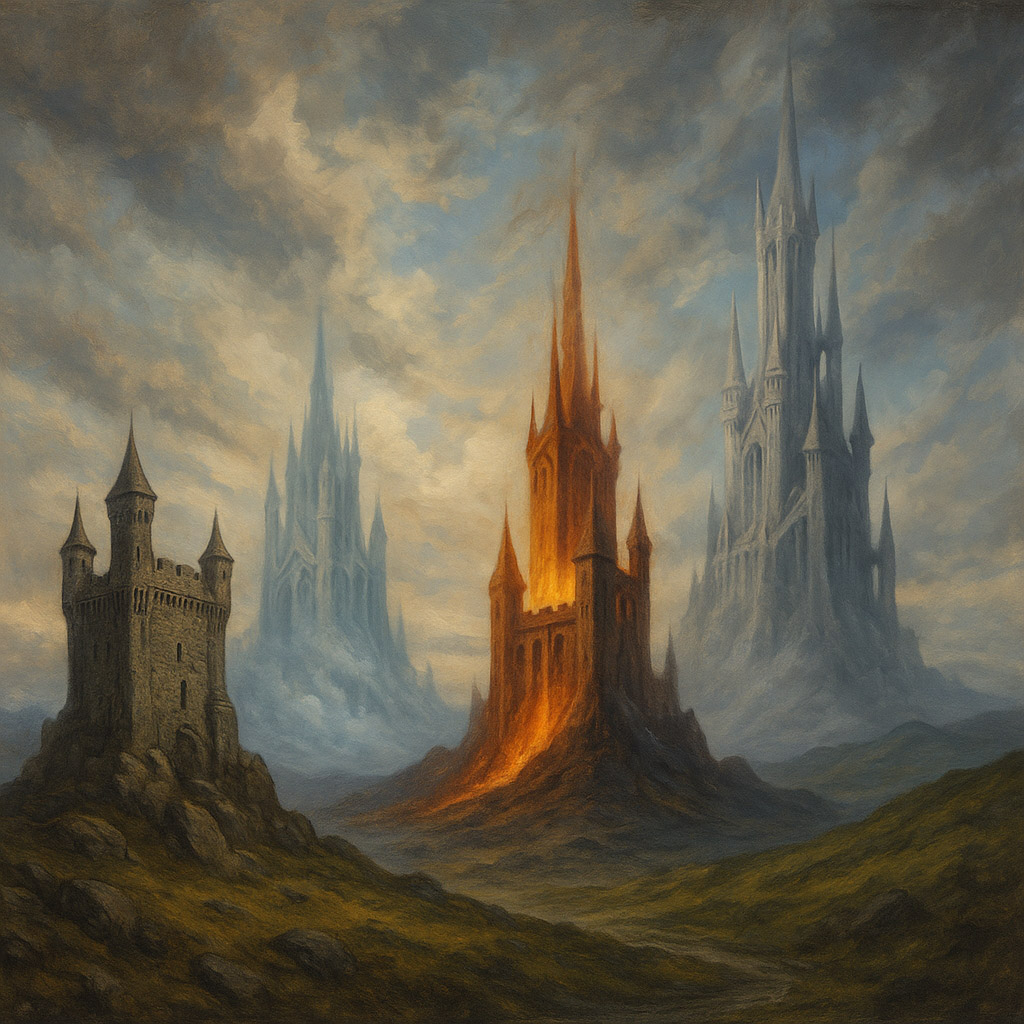
Each City is an element gathered into a polis: the inertia of Earth, the fluidity of Water, the vertical movement of fire, and the horizontal movement of air — each populated by its own elementals. Thus Falias holds form and truth (earth, gnomes), Murias dissolves knots and sees depths (water, undines), Finnias inspires and purifies (fire, salamanders), Gorias lightens and lifts mind (air, sylphs). In the terms of the Interworld, these are spaces built from pure properties, and that is precisely why it is easier within them to align the Castles of the alves (and the sidhe) with the “distilled” flows of reality, to build them as pure and harmonious structures.
After the end of the Era of Nemed, when the mass exodus of the Castles into the Interval occurred, part of the faerie settled within the Interworld and, through the TEX Gate, began the first migrations into the Elemental Cities; some emerging peoples settled there and adapted to the very environments of the Towers.
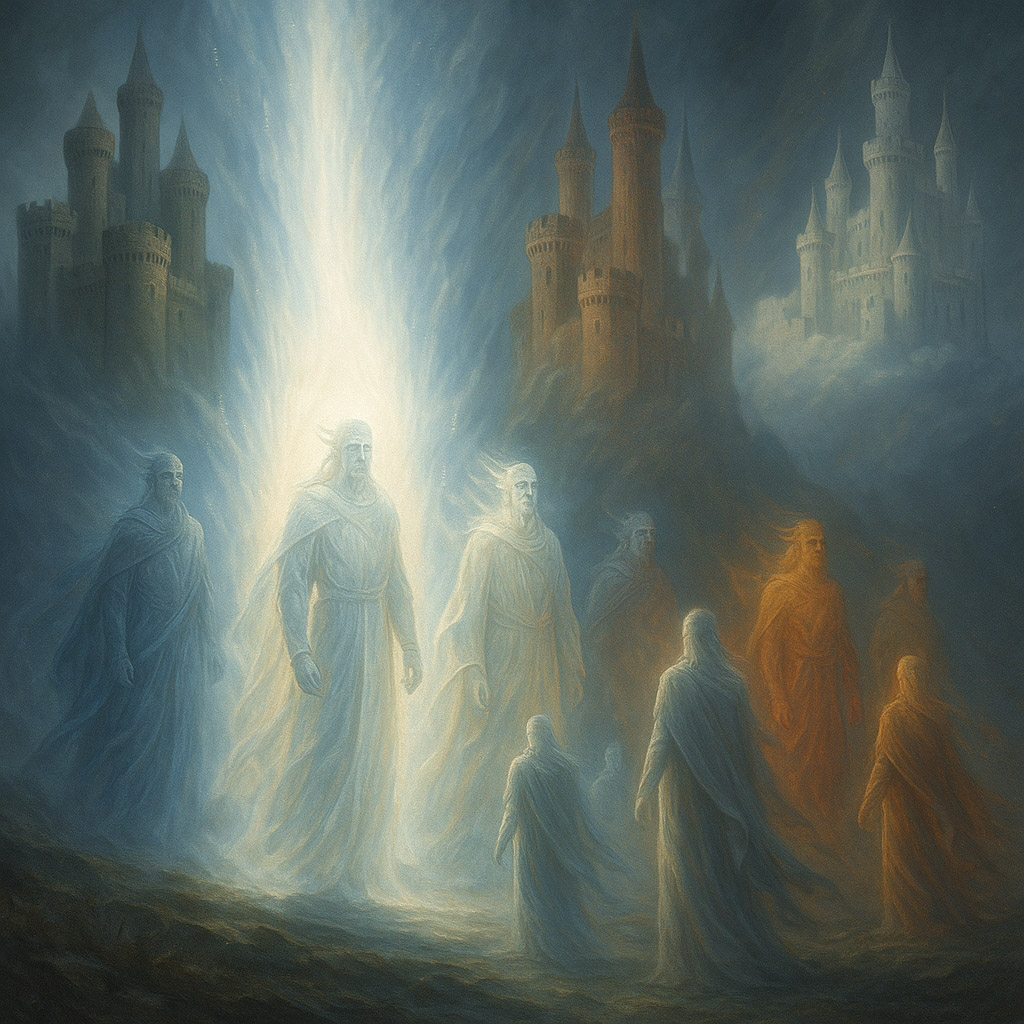
The next era — that of the Fir Bolg — became preparation for the return; then they carried out the strengthening and formation of the unity of the Fair Folk. A new emergence into manifested reality takes place at the boundary of the IV and V eras: at the very beginning of the Era of the Tuatha Dé Danann — together with the First Battle of Mag Tuired and the formation of a single people of faerie. From this period, the Castles of the sidhe again “conjoin” with the Towers of the primary elements and begin to transmit their pure energies into the Middle World. This movement was not a one-time thing: part of the faerie remained “urban,” elementally settled communities maintaining a stable connection with the Cities even after returning to Earth. And later, after the great Exodus of the faerie, they returned again to the Cities that once “sheltered” them: leprechauns and kobolds — to Falias, fenodovs — to Murias, forgi — to Finnias, skvizy — to Gorias. When the dense world again became hostile to the faerie, the “urban” communities again received part of the people, and the elemental city-states once more became a refuge for the Fair Folk. Taking root there, they merged with the fabric of the Elements, adopting the properties of these environments. Therefore, in the tales of the sidhe, so often resound stories about their crafts, as well as about the close connection of the Fair Folk with the forces of water, flame, and wind.
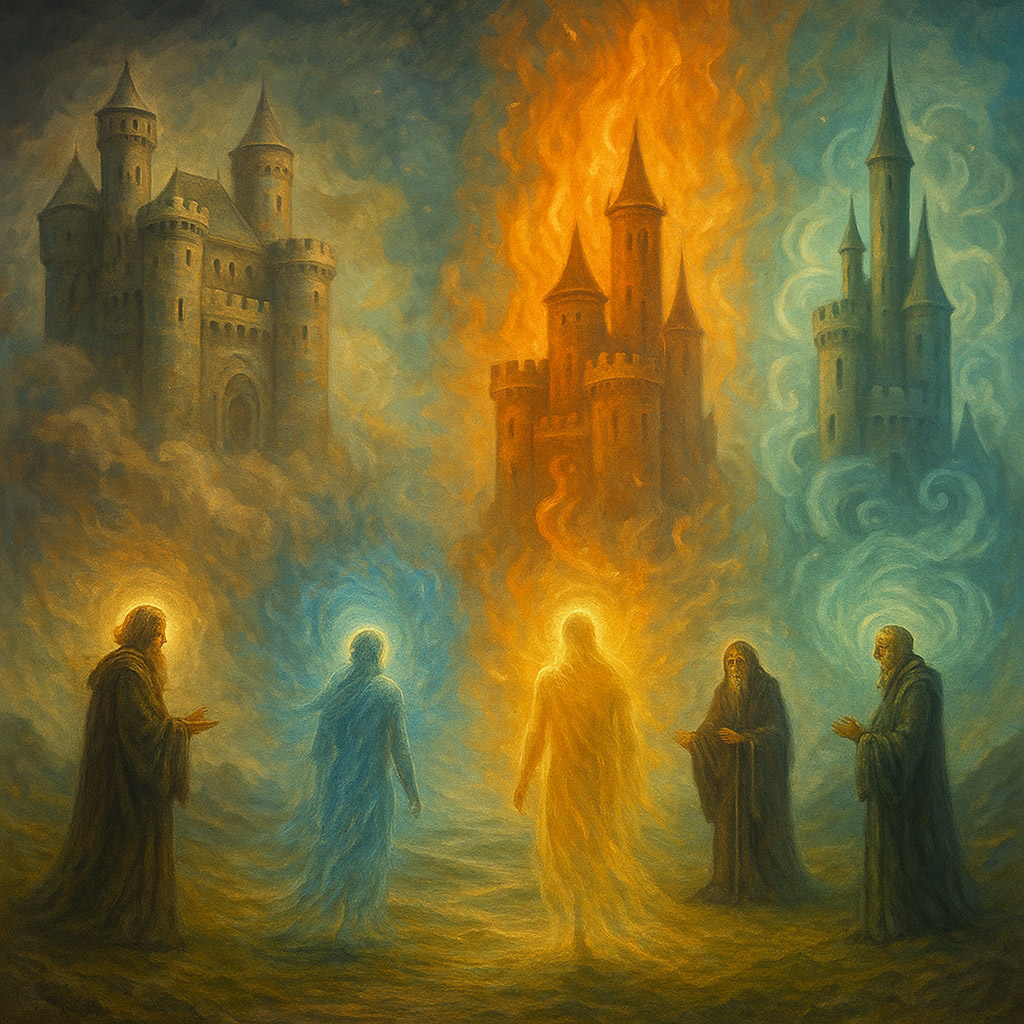
Thus, the Towers became important “support hubs” for the Fair Folk, and therefore each “work” of the sidhe in the Middle World took place in close connection with the nature of the four elemental forces.
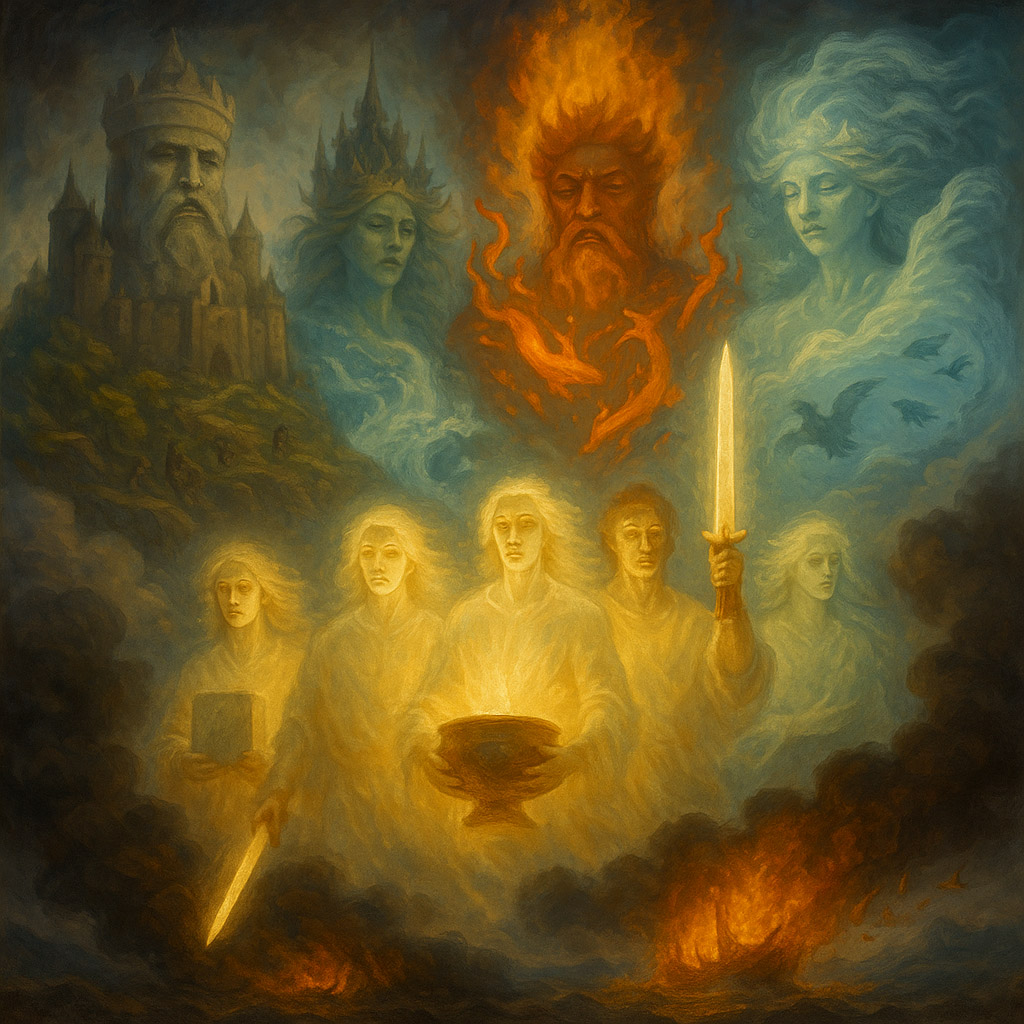
In the Book of Invasions of Ireland and in the prologue to the Second Battle of Mag Tuired, it is said that the Tuatha lived “on the northern islands of the world” and studied arts and magic in four cities, whence they then brought out the Four Treasures: the Stone of Fál, the Spear of Lugh, the Sword of Nuada, and the Cauldron of the Dagda. The Masters of the Sidhe are named four druids from these Cities: Morfessa (in Falias), Esra (in Gorias), Yusk (in Finnias), Semiya (in Murias).
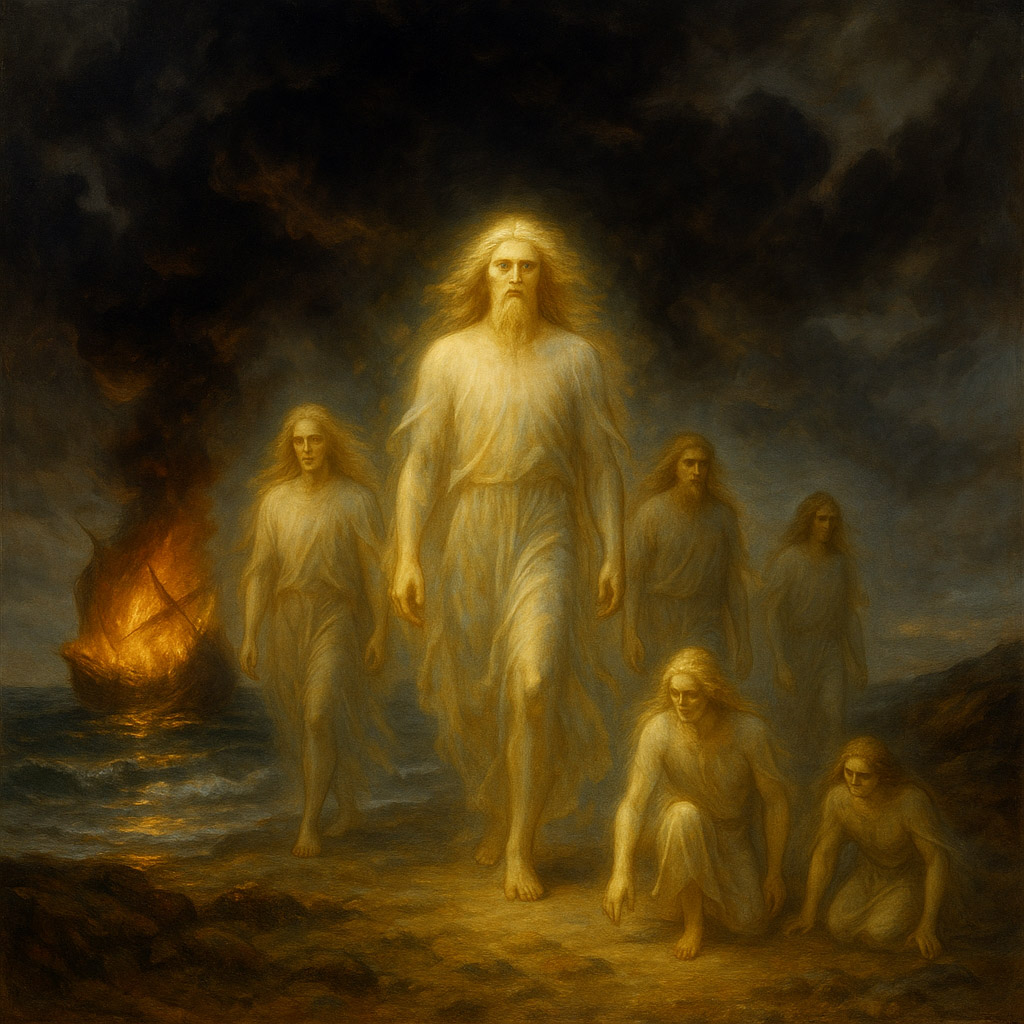
When the time came, the Tuatha “arrived in dark clouds” on Earth (in Connacht); later versions explain this image by saying that they burned their ships so as not to return. The dark cloud is an image of passage through the Interworld, when form is not yet fixed; the burned ships are an act of anchoring in the world, a refusal of the path back.
They left the Cities after completing their “studies,” just as students graduate from universities. The Tuatha left the Towers because the mission to order the material world, bequeathed to them by the alves, required direct presence in matter. Having acquired the skills for working with matter, they were able to effectively oppose the Fomors and lead the world along the path of evolution. From the Towers they brought out ways of maintaining structures, knowledge of the paths of harmonizing forms and logos, without which the wars at Mag Tuired would have turned into a senseless and chaotic clash of forces.
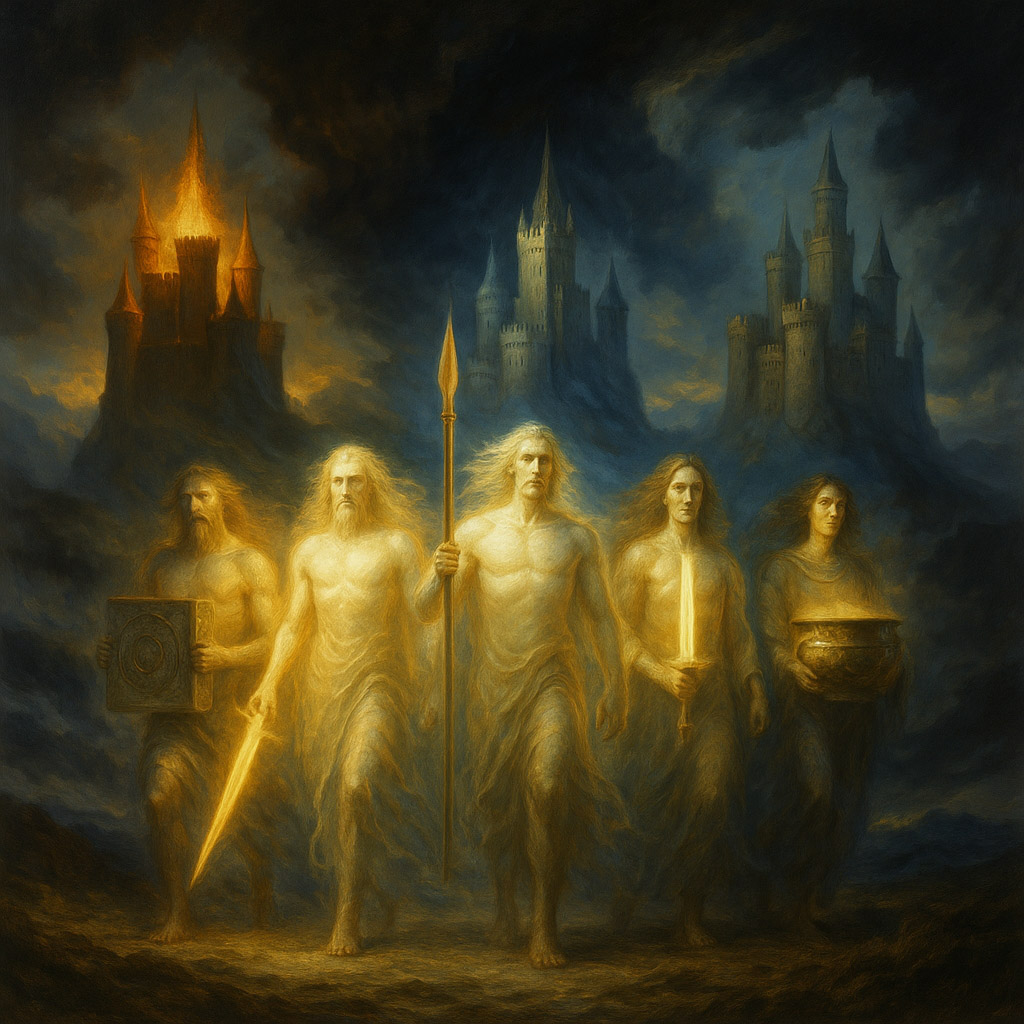
Thus, the lessons received by the Fair Folk during the time of “study” in the Cities included:
in Falias — the ability to shape matter, transform physical elements, and condense structures; and the Stone of Fál became a support that maintains the connection between form and logos;
in Gorias — the ability to direct mind, to create freely and win easily; and the Spear of Lugh became a support for vectors of victory;
in Finnias — they learned to restrain and direct their sheruf — the fiery nature of mind, to cut off, govern, and inspire; and the Sword of Nuada became a support for the wise cutting away of the superfluous and the purification of forms;
in Murias — they developed insight and learned “direct knowledge,” honed their duality of form and nonlocality, finding ways to combine them in a single flow; and the Cauldron of the Dagda became a support for the fullness of saturating the world with energy and for managing the flows of power.
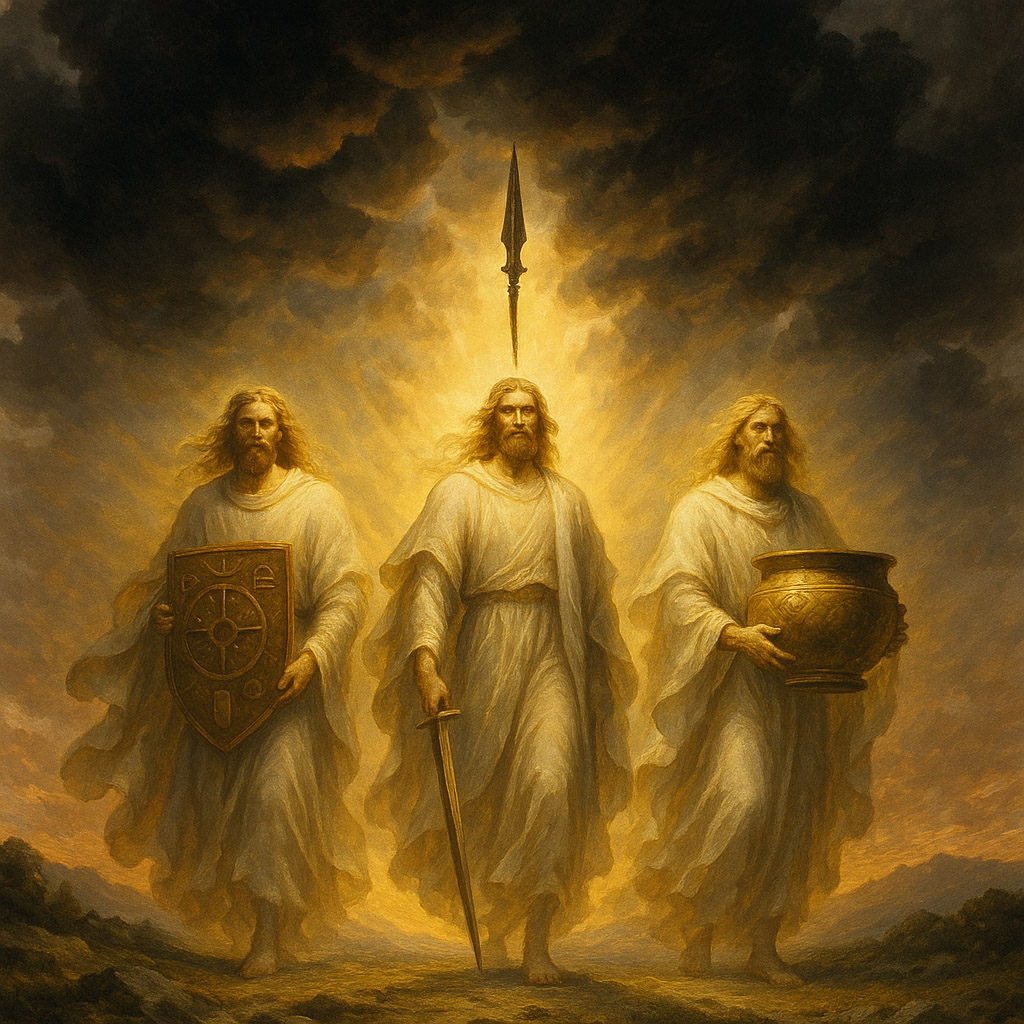
From the wise Druids of the Cities, the Tuatha took not only objects, but also the ways by which the elements and virtues are brought into harmony. It was precisely the training with the Sages that made the sidhe a people fit for shaping reality.
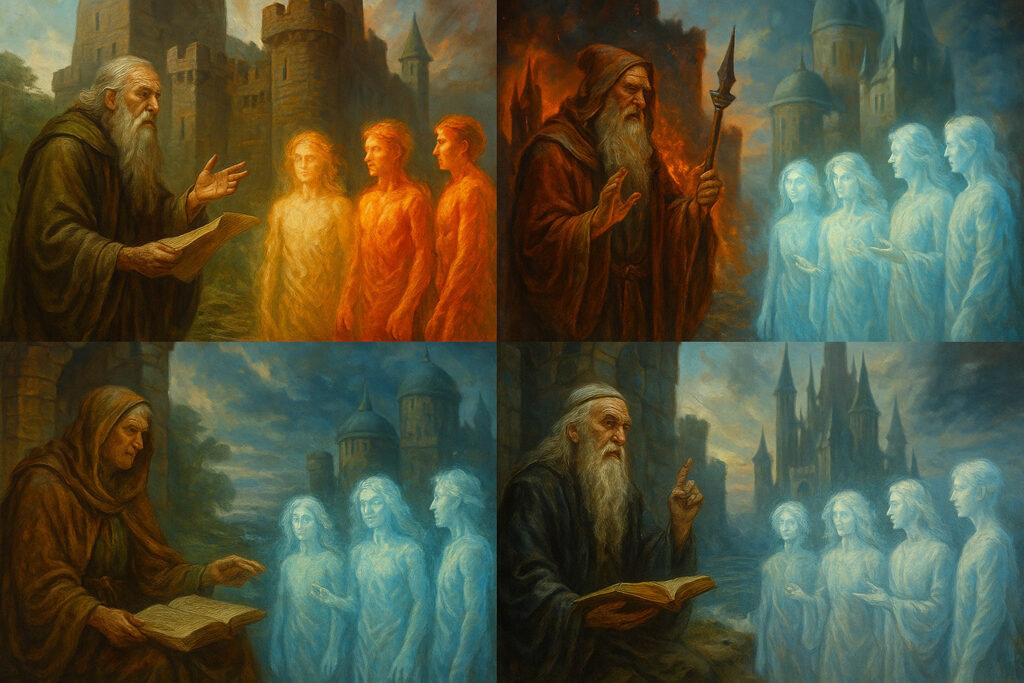
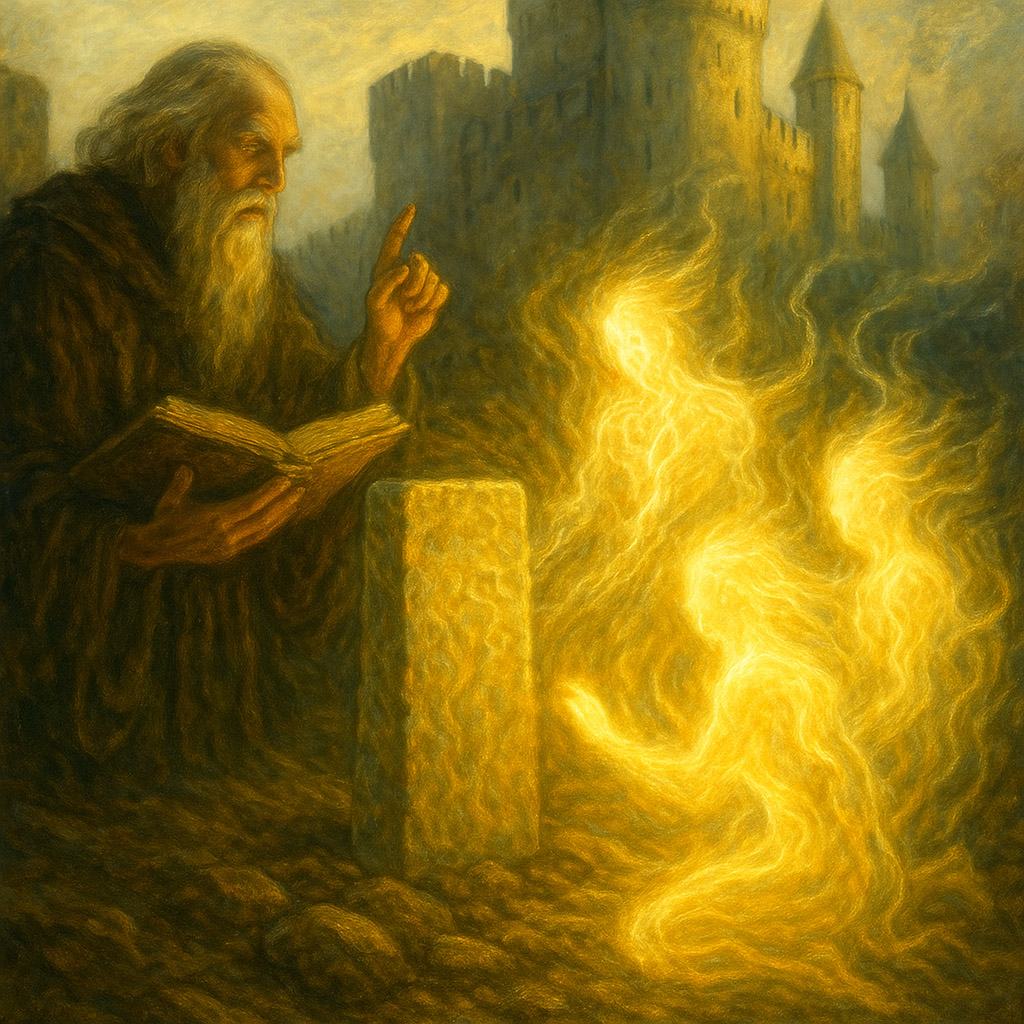
Morfessa of Falias is the “great knower,” the first Master of form and measure. His name is directly connected with “great knowledge,” which also aligns with the nature of Falias itself as a “fence-sanctuary,” a place where boundaries and contours are built and where objects are given their names. The teaching of Morfessa is a way to maintain form in accordance with logos: the Stone of Fál must sound under the rightful King, the word must correspond to the deed, and the structure must carry meaning within it, and not be merely inert mass.
Esra of Gorias is a Master of wisdom and free thinking. The name “Esras” means “the one who scatters,” since he knows how to scatter knowledge like a sower scatters grains, and the main thing in his school is the reduction of what is scattered into a single vector, when mind is gathered into a spear of wisdom that “strikes straight at the target” of correct understanding.
Yusk of Finnias is a Master of cutting away and pure desire, the one who “makes water into a sword.” The name “Finnias” means “bright,” “blazing”; it is a city of swift Primary Fire. The Master’s name is linked with the word “uisce” — “water,” in the same sense as the Bible calls Primary Fire “shamaim,” the Flowing Flame. The teaching of Yusk consists precisely in this: how to turn the uncontrolled energy of fohat into a creative stream, how to make an all-devouring fire a source of creativity and the birth of reality.
Semiya of Murias is a keeper of fullness and nourishment, a Master of deep wisdom. The very name “Murias” goes back to two roots — “sea” and “wall/rampart” — which can be understood as a cape-fortress at the boundary of the element of ocean and shore; therefore, with Semiya they learn how to draw wisdom from the depths, how to find form in the unformed, how to adapt oneself to the conditions of the environment, and how to direct the environment into the channels of form. And Semiya also teaches how to make abundance into sufficiency, and sufficiency into hospitality. Her tool is the Cauldron of the Dagda, the Great god of Earth, from which “no one left unsatisfied.” This is the power of rightly organized abundance, where everyone receives their share of power, and not a single circle of connections breaks.
Thus, in the Towers the sidhe were taught not simply to accumulate power, but to realize it: to hold measure, direct will, cut away the superfluous, and feed the living. Therefore, after “graduating” from these “universities,” the sidhe did not merely become stronger; they became more “competent” at operating with matter.
Falias taught them the disciplines of affirming form. Hence their ability to build cromlechs, mounds, and bridges so that they “grow into” the landscape; to lay masonry so that each stone harmonizes with the next; to forge orichalcum, weaving matter with spirit.
Gorias taught them to direct the mind. There was born the faerie tactic of time, their habit of “working with weather,” their lightness in matters of connection and navigation — from military formations to wind harps and “breathing roofs.”
Finnias gave them ways of controlling fire, both external and internal. There they learned the directing of vital warmth, healing, purification, enlivening, and transformation. The Sword of Nuada also gave them an understanding of boundaries; the vision of when to cut off is more merciful than to leave to rot.
Murias trained them in directing flows. Therefore the faerie are so good at irrigation, gardening, “soft delivery” of energy, healing, and feasts — as the highest form of just division. The Cauldron of the Dagda is their source of abundance, the ability to choose the right intensities of flows.
At the same time, the training in the Towers was interconnected: in Falias, the sidhe were taught to begin with form but to complete it in the sufficiency of Murias; in Gorias — to “lift onto the wing” mind, but immediately “land” it in the concrete form of Falias; in Finnias — to burn, but in the balance of Murias’s flows; to cut away, but to leave “windows” of air so that fresh mind can enter; in Murias — to feed, but not to wash away the boundaries of form. Thus the faerie developed their particular, holistic manner of perceiving the world and influencing it. It was precisely these disciplines that made them Masters of conjugation between the elements and crafts, between spirit and matter, between place and intention.
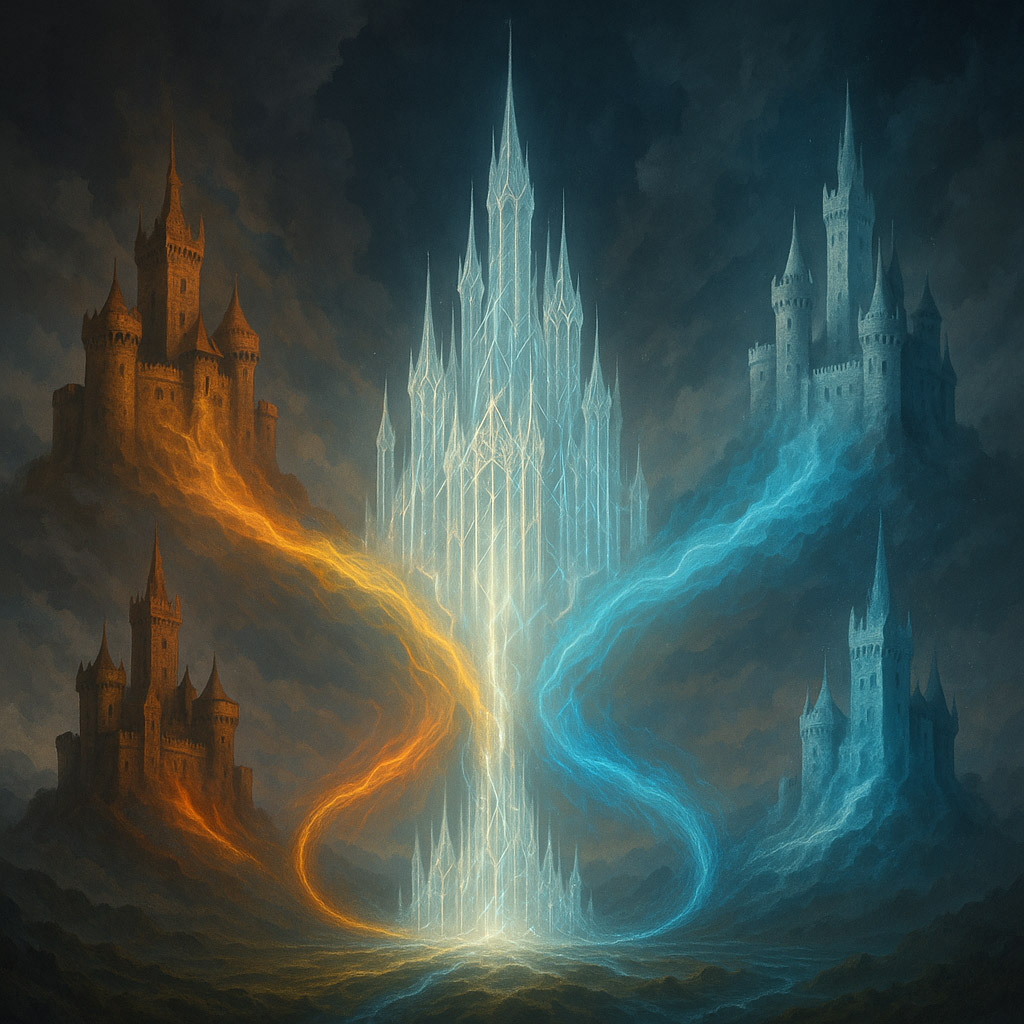
It is precisely to the extent that the Castles are connected to the Towers that the sidhe gained the possibility of prolonged presence in the dense world, and their work with flesh, with biological beings, became a matter of the technique of Flows.
From the moment of this Conjugation, the wars with the Fomors become victorious, and later great projects of harmonizing matter develop — from Atlantis to Shambhala — which were held precisely on the gentle transfer of energy from the Towers of the primary elements.
One way or another, the Cities of Wisdom are a place of forming not only skills but also responsibility. Their function is to build and calibrate, to shape and strengthen, but not to relax with purity. There it is easy to forget about the admixtures without which the life of material worlds is impossible. And the Tuatha left them when they understood that if they stayed, the Towers would make of them two-planed “elemental angels,” rather than guardians of the world’s diversity. A world with all its admixtures was bequeathed to them, so that the four primary properties would be combined not into potential possibilities, but into actual fields of self-knowledge and self-realization, which are impossible without imbalances and “skews.”
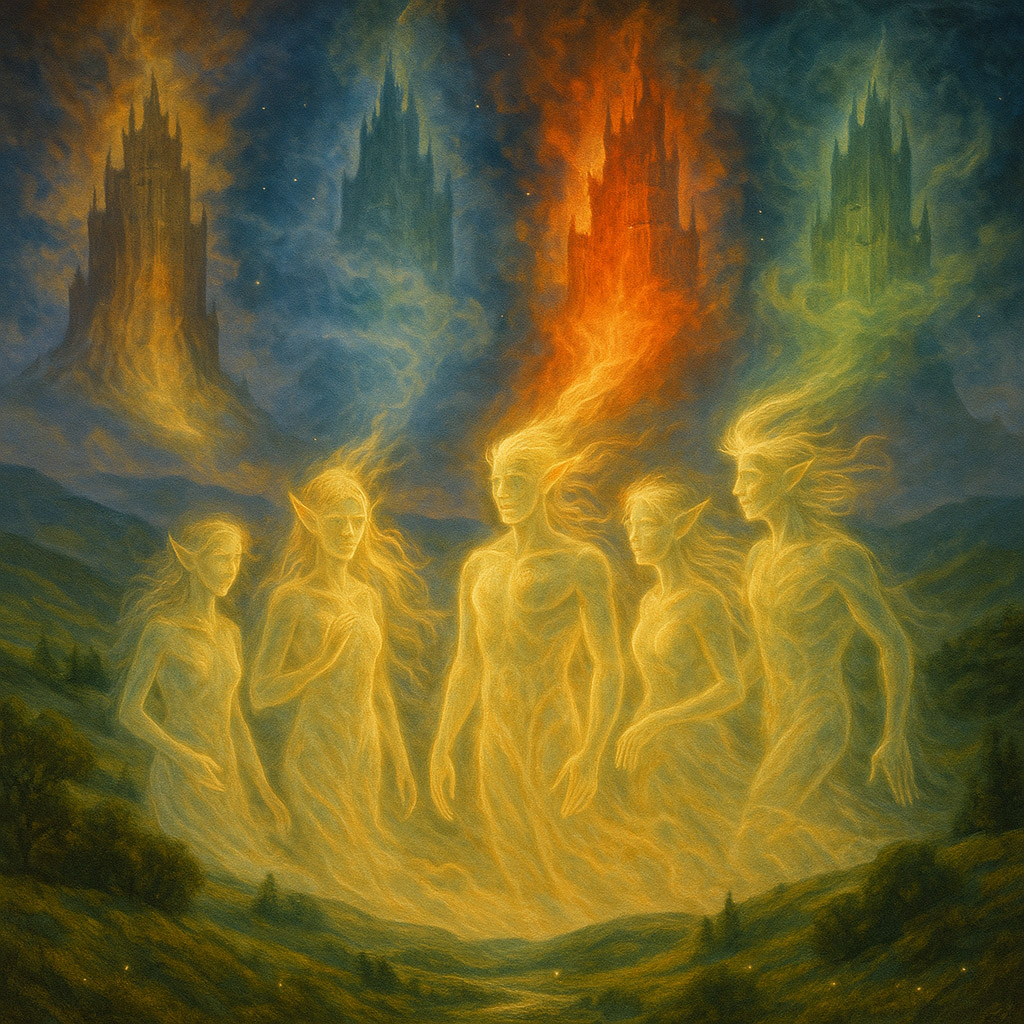
For the era of the Tuatha Dé Danann, home became Earth — a world in which it was possible to apply the knowledge received in the Cities, to test it in practice, “by trial and error.”
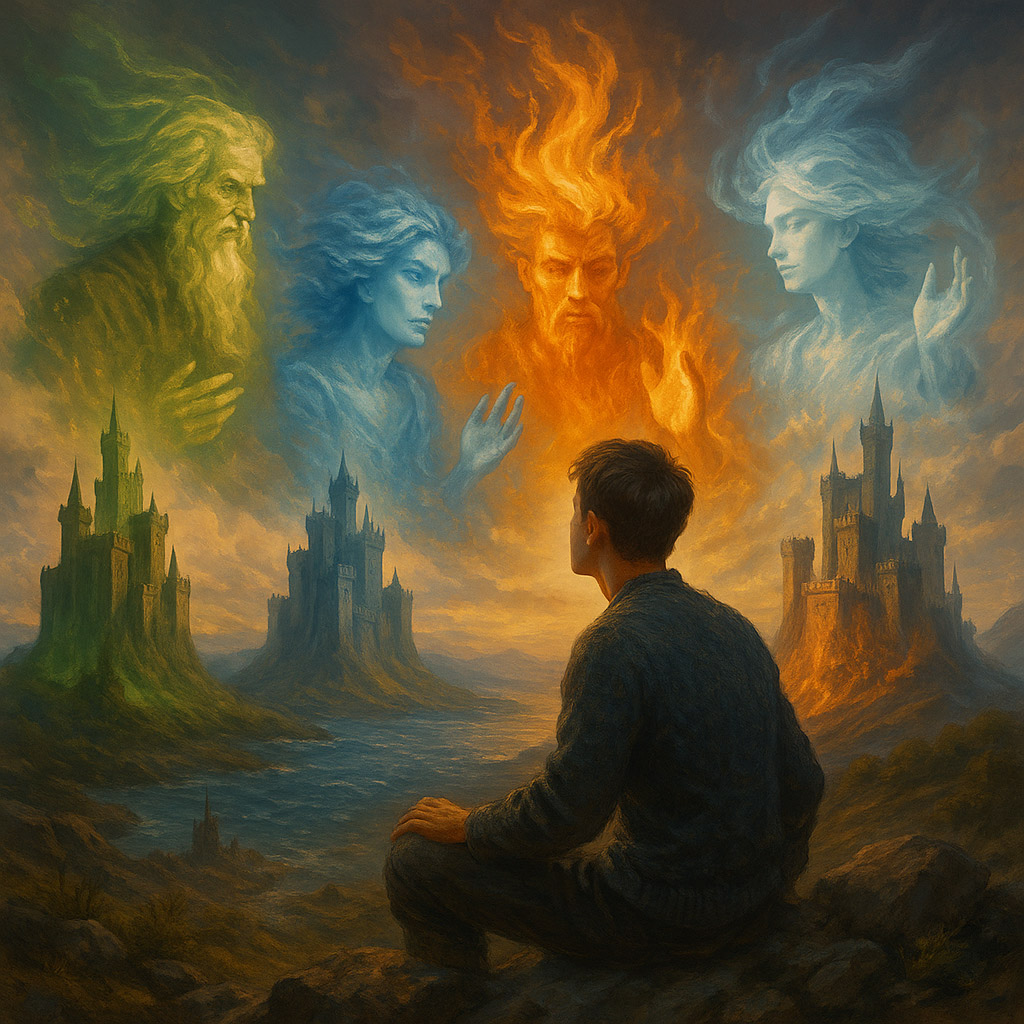
In this sense, the Cities can also be useful to people, as a space one can enter, tune oneself, exit — and continue doing one’s work. However, it is important to remember that Falias gives form, but with an “excess” it can make the heart inert and incapable of change; a simple practice of adding the softness of water saves from this — leaving room in one’s work for the unplanned. Murias purifies, but in excess washes away important ties and memories as well; the antidote can be to add the energy of earth: to rely on at least one personal node — home, family, work. Finnias ignites and cuts away, but can turn realization into painful carving into the living; this is healed by the breath of air and sensitivity to others’ ideas. Gorias elevates mind toward victory, but in excess tears it away from support; the antidote should be an obligatory practice of bringing an idea to a tangible object or deed.
Leave a Reply