
The Age of Nemed. Castles of Glass and Crystal
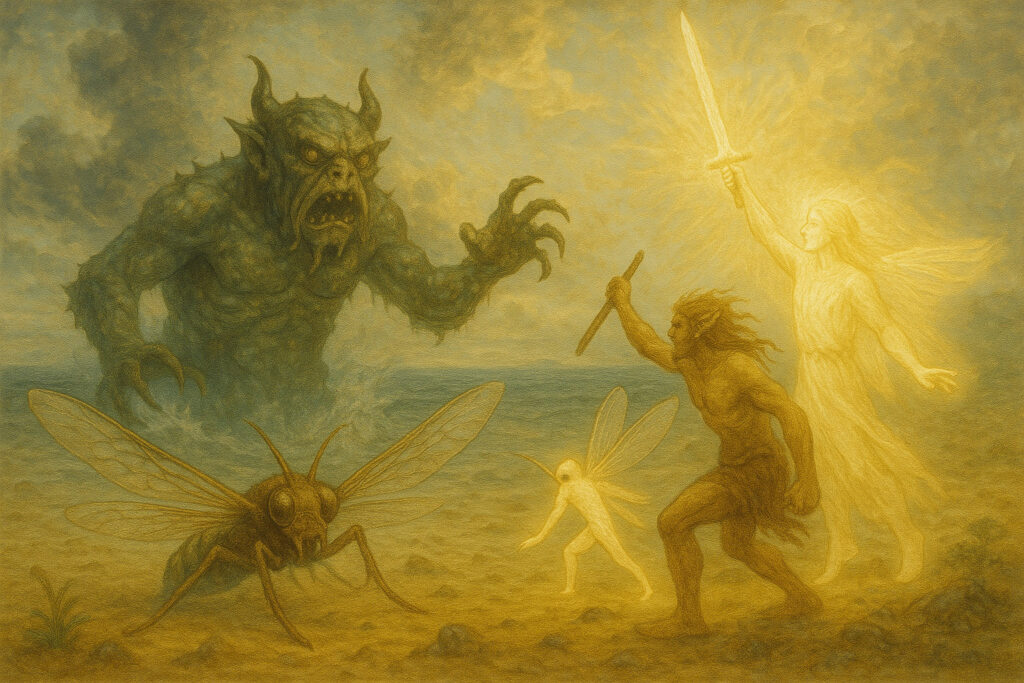
The end of the Age of Partholon, corresponding to the Devonian extinction in the human fossil record, marked two important “shifts” in the overall history of Earth:
on the one hand, the forces of chaos — the fomors — were pushed back from the land and driven into the sea (from where, according to one version, their name originated, which can be interpreted as “demons from the seas”);
on the other — it became clear that land, with its great potential for the energy-driven growth of life (due to the availability of the atmosphere, gradually enriched with oxygen — the main oxidizer in biochemical reactions), was a more promising environment in which to “invest effort” toward the evolution of organic life, which over time was to become a new support for consciousness.
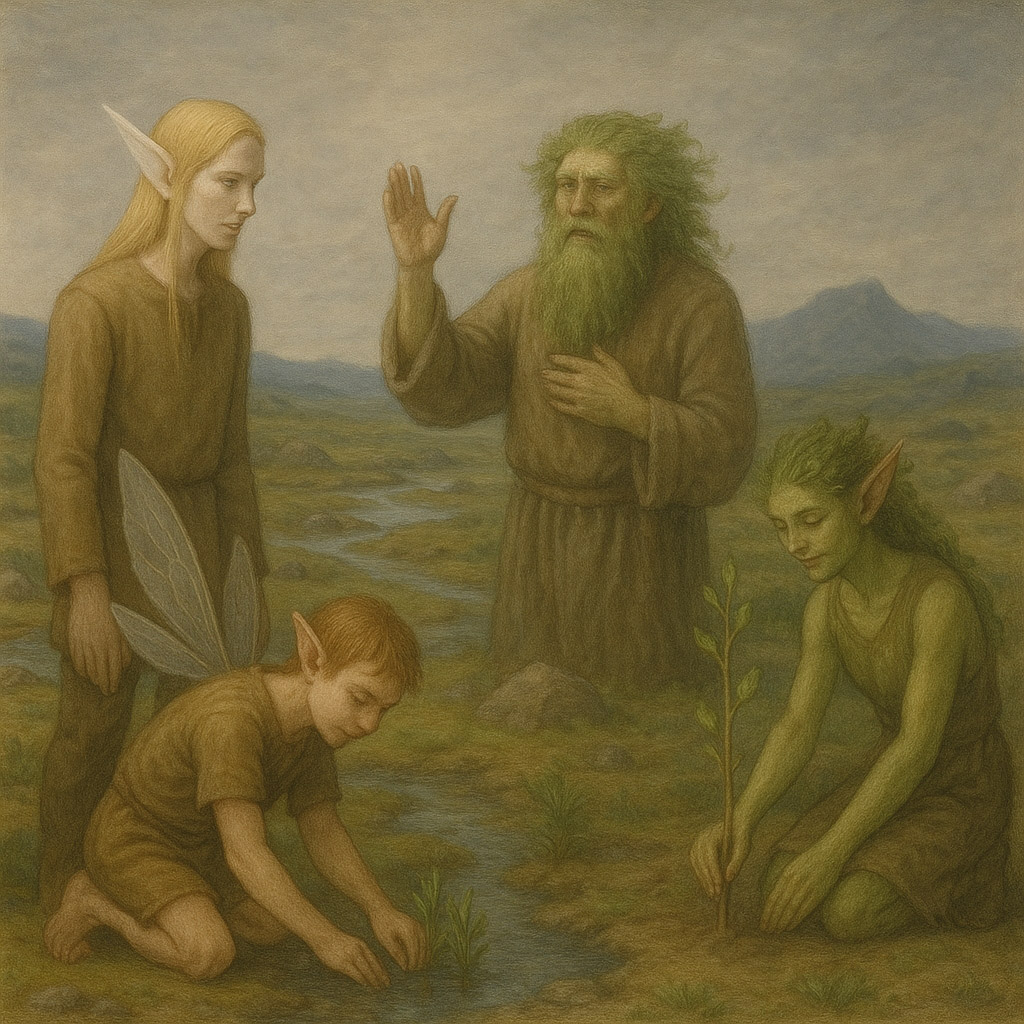
Accordingly, the evolutionary efforts of the Vanir, Aesir, alves, and the developing peoples of the proto-fairies were directed precisely at consolidating and organizing those gains in the settling of land by biological life-forms which had begun at the previous stages of development.
And the next age, which, according to the nomenclature of the “Book of Invasions”, is commonly called the Age of Nemed, lasting about 100 million years (~360 million years ago — ~250 million years ago), became a period of active colonization of land, as well as the continuation of the confrontation between the forces of chaos and order.
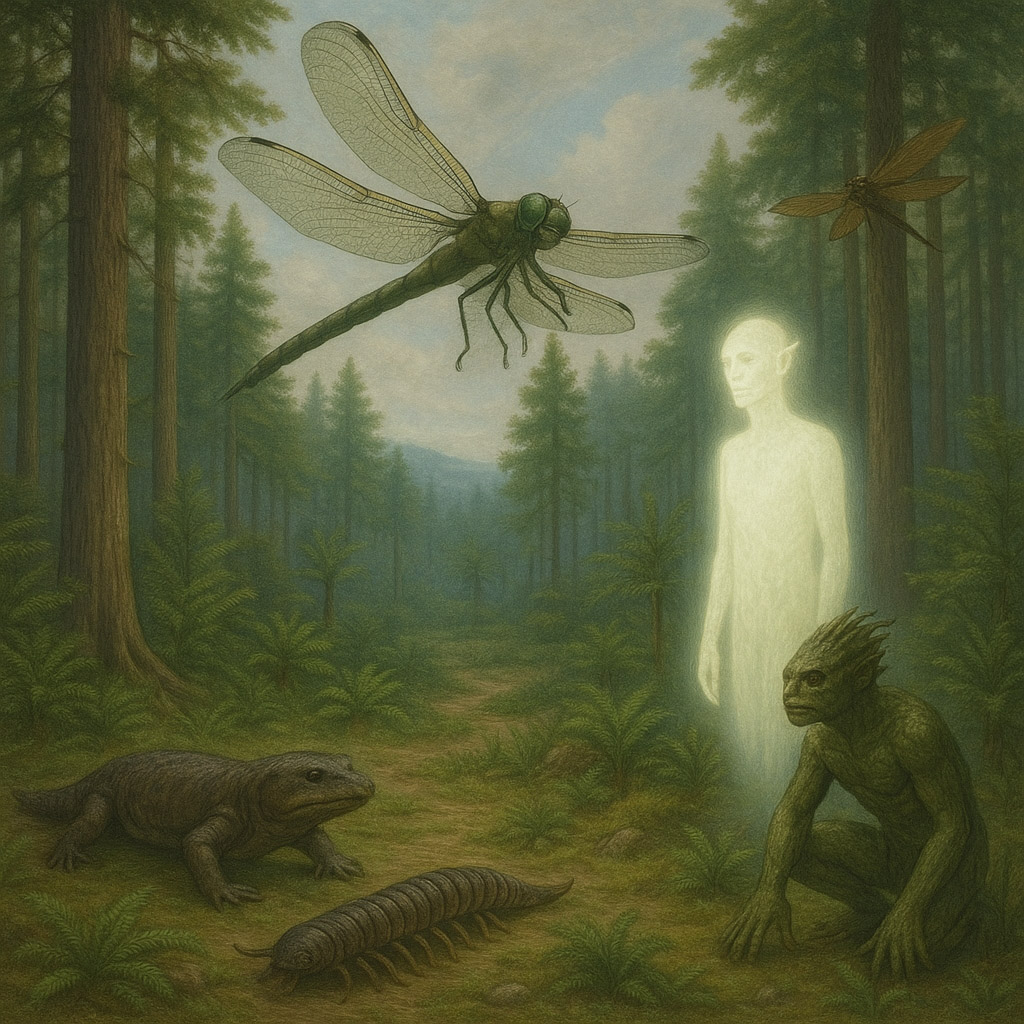
At this time Laurussia — a huge continent — became the center of life, covered by the first vast forests. A surge of oxygen to 35% created conditions for insect gigantism: meganeura dragonflies with a wingspan of up to 70 centimeters soared in the sky, while on land millipedes and dragonflies the size of birds roamed. The evolution of four-limbed animals — tetrapods — gave rise to amphibians, reptiles, and, in the long run, mammals. However, fauna and flora still remained unstable, reflecting the very essence of this age — constant tension and conflict between alvish and fomor realities.
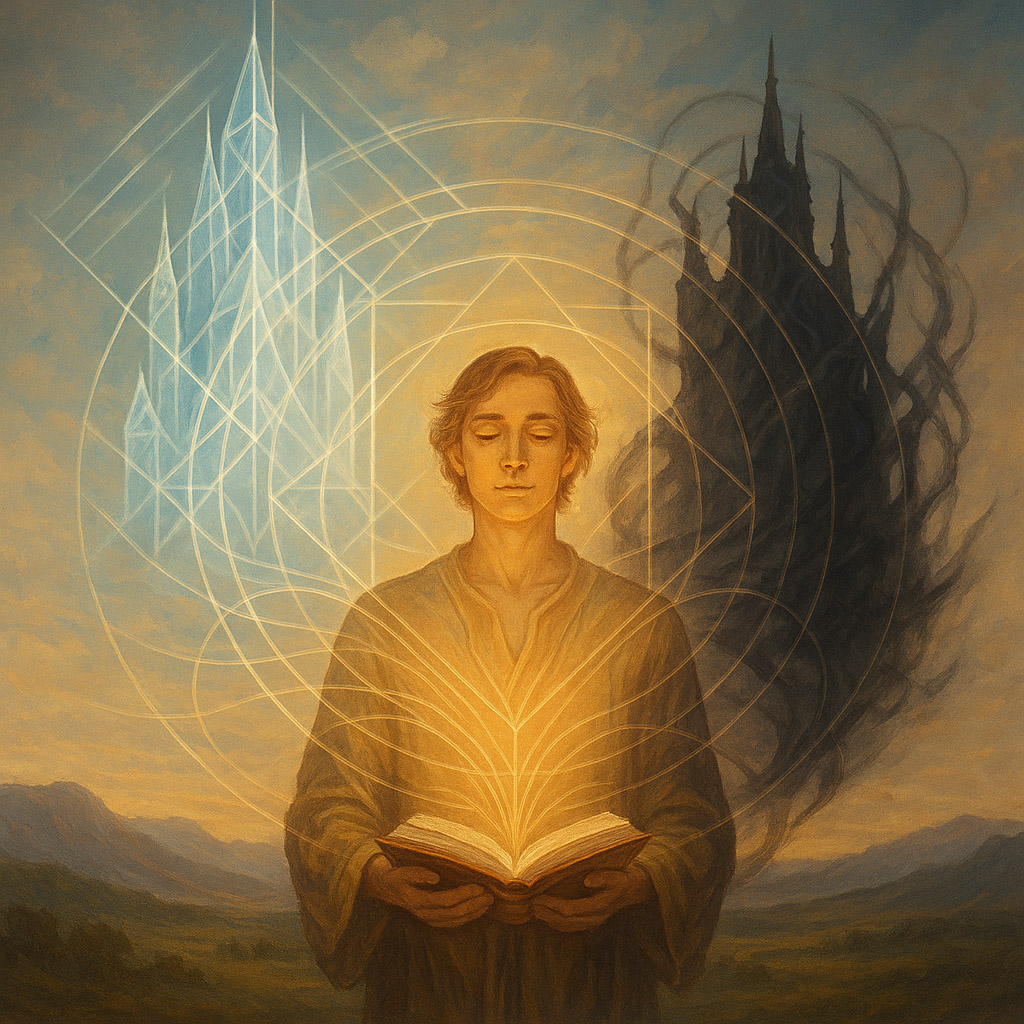
As bastions for forces of order — the alves, the Vanir (and partially also the Aesir) — the alves’ Crystal Castles, built back in the previous age, were used; they were restored after Mag Itha, and were ever more widely settled by the High Sidhe.
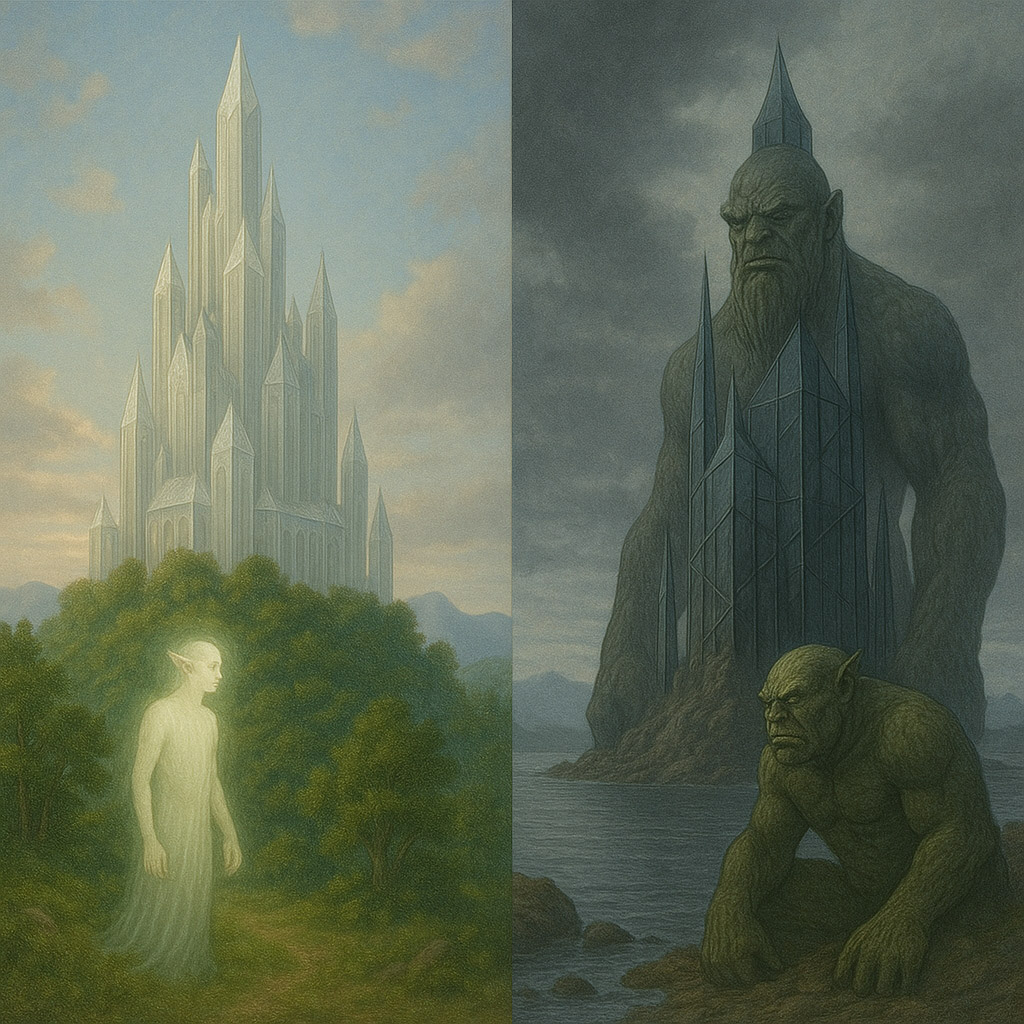
At the same time, the fomors began to build in parallel in the Interworld and on the islands of the Middle World their own Glass Towers, from which they launched raids to capture beings and life-energy.
Since the “lower” Grigori — bergrisars, eliud and fomors — never fully became corporeal and failed to master effective pneuma tuning, they split according to survival strategies: the first increasingly moved into the interspace, feeding on postmortem energy emissions and other kinds of its natural outflow; the second found common ground with the fairies, joining energy streams from Alfheim for the Magical People; and the third chose predation and aggression, not relying on the mercy of the alves and not content with necrotic energy remnants.
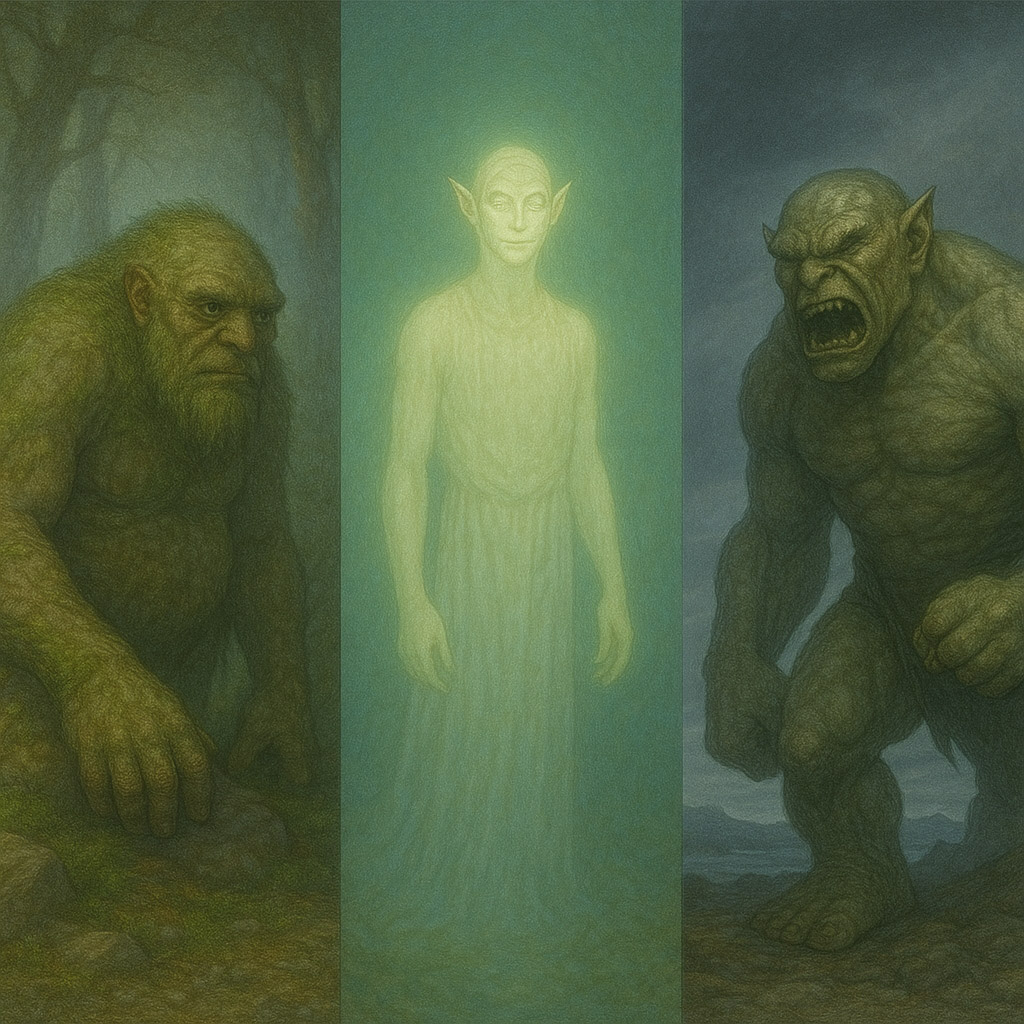
Thus, it is precisely the fomors who become the main destructive force of this age; however, due to their fragmentation they still could not advance as a “single front”, and therefore clashes between the ordering and destructive forces took place in the form of the “Wars of the Castles”, when the fomors of one “Island” or another tried to seize life-energy of the Sidhe and stihiali working on the evolution of biological life. In doing so, the fomor Towers and the Sidhe Castles, built as a continuation of the energies of their masters, came into contact, deforming and absorbing each other.
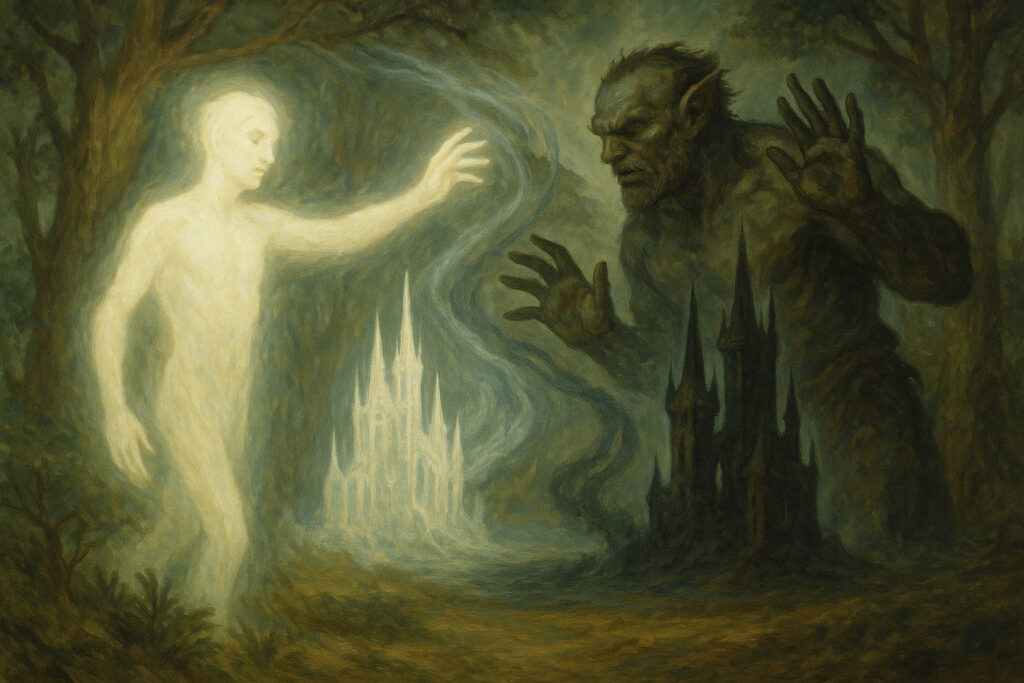
Inside the alvish Castles, their own subtle processes were underway: the alves formed the material embodiments of the Sidhe — materialized structures of light intended to strengthen ties between worlds. The fomors, meanwhile, weaving a distorted reality into their towers, created within them fields of stasis and absorption aimed at subjugating any other form. When two such Castles “converged”, a slow but inexorable mutual transformation began: walls and halls altered texture, geometry, movement laws, until one stronghold crushed and absorbed the other.
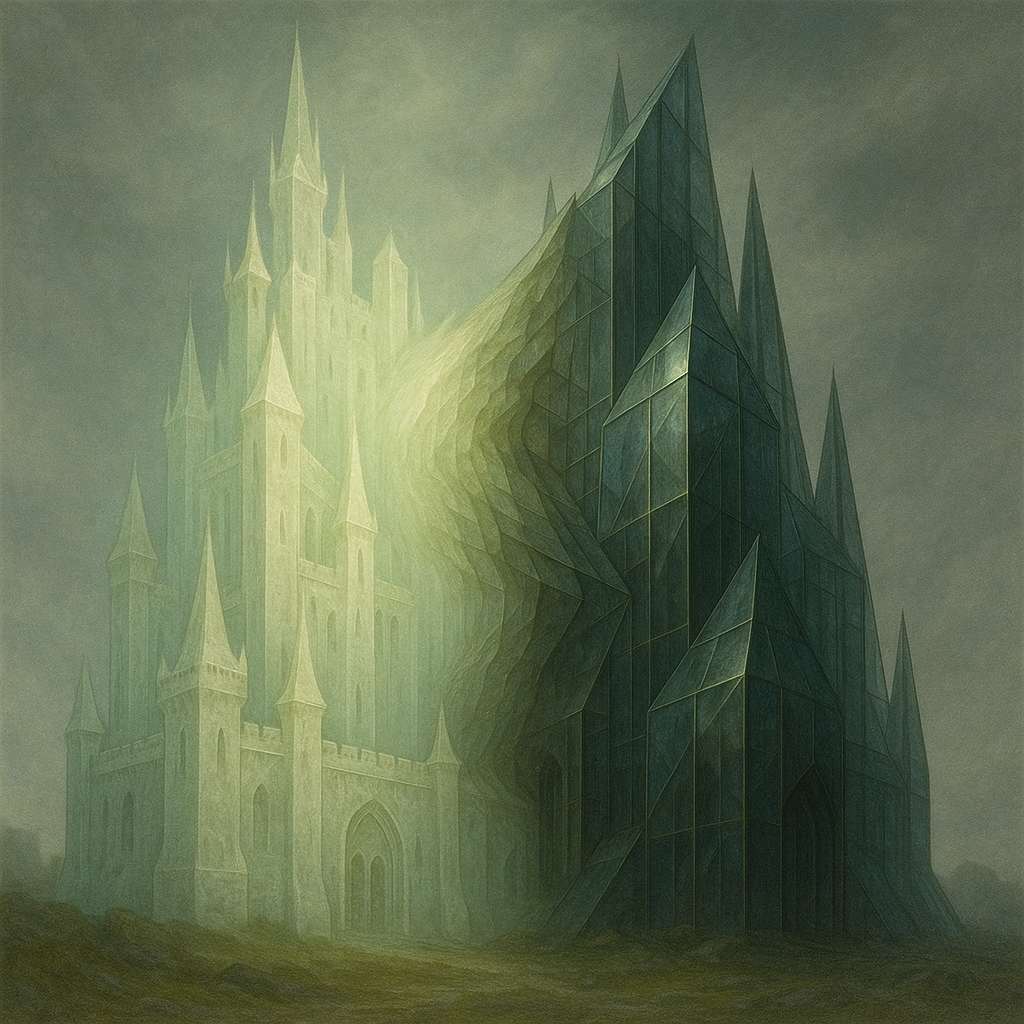
The victory of the alves meant that the fomor tower was transformed into a Sidhe, and its creators were expelled, feeling as if they had lost a piece of their own essence. The victory of the fomors, on the contrary, turned the alvish Castle into a Glass Tower, and for the Sidhe this was just as agonizing — the loss of a form built over centuries, and banishment from their realm. Thus, the battles of the Age of Nemed were slow convergences and structural encroachments, mutual penetrations and absorptions, where each step was part of a great and painful process of changing the balance of power.
The largest such clashes are known in the Chronicles of the fairies as the “Four Battles” of the Age of Nemed, each of which led to the defeat of the fomors, but also affected marine life, and therefore caused biological catastrophes of varying scale.
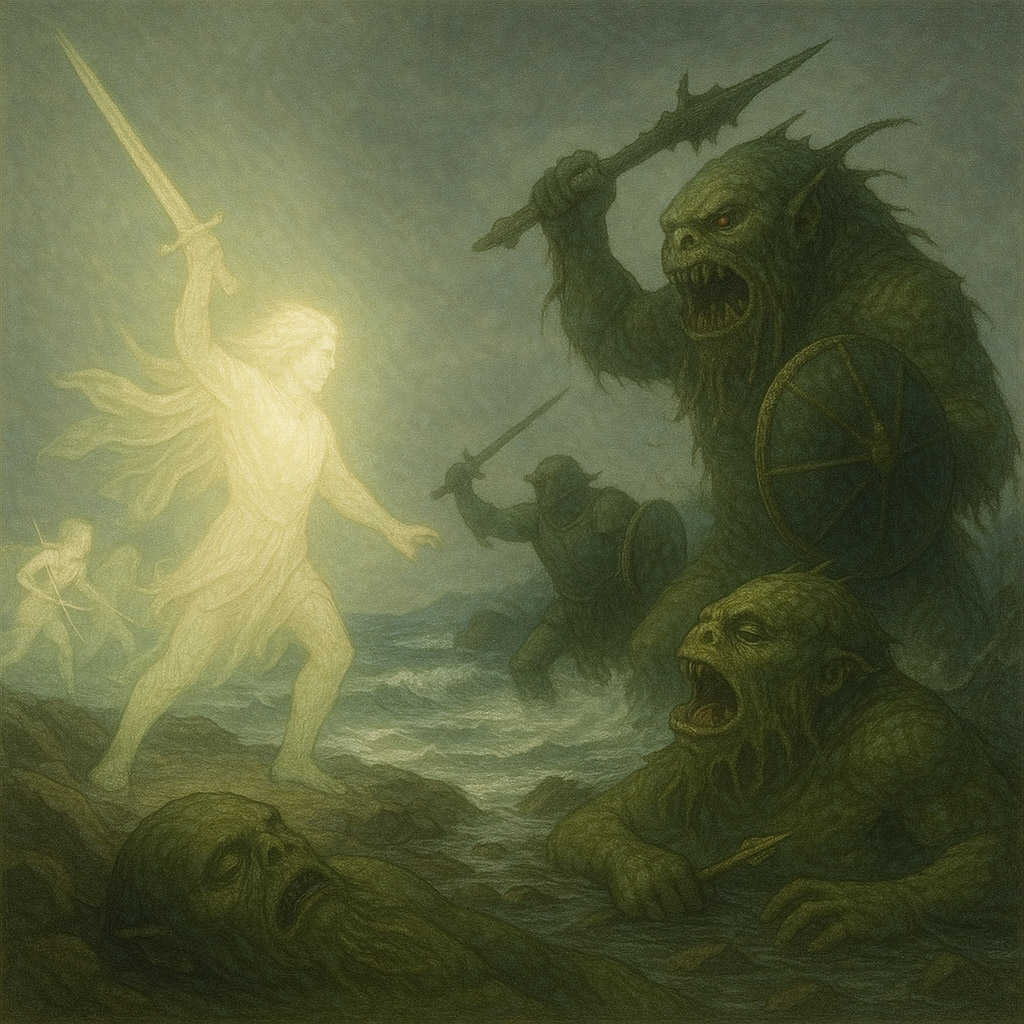
The first great battle of this age — the “Battle of Ros-Fréchayne”, in which, according to tradition, the fomor kings Gann and Sengann fell — corresponded to the catastrophe known in paleontology as the Kellwasser event, which occurred about 372 million years ago. Then entire underwater kingdoms perished: coral reefs, stromatoporoid structures, armored fish — entire ecosystems vanished. The death of the fomor kings signified the collapse of ancient supports, the disappearance of structures on which, in many ways, the appearance of the oceans formed under the influence of fomor forces rested.
The second battle — “at Badbgna in Connacht” — led to a new, even more brutal upheaval known as the Hangenberg extinction, about 359 million years ago. The world was plunged into chaos again: ammonites, conodonts, numerous jawed fish disappeared on a planetary scale. This was the second wave of the fomors’ advance, crushing everything that had managed to revive, when the barely restored order again plunged into darkness.
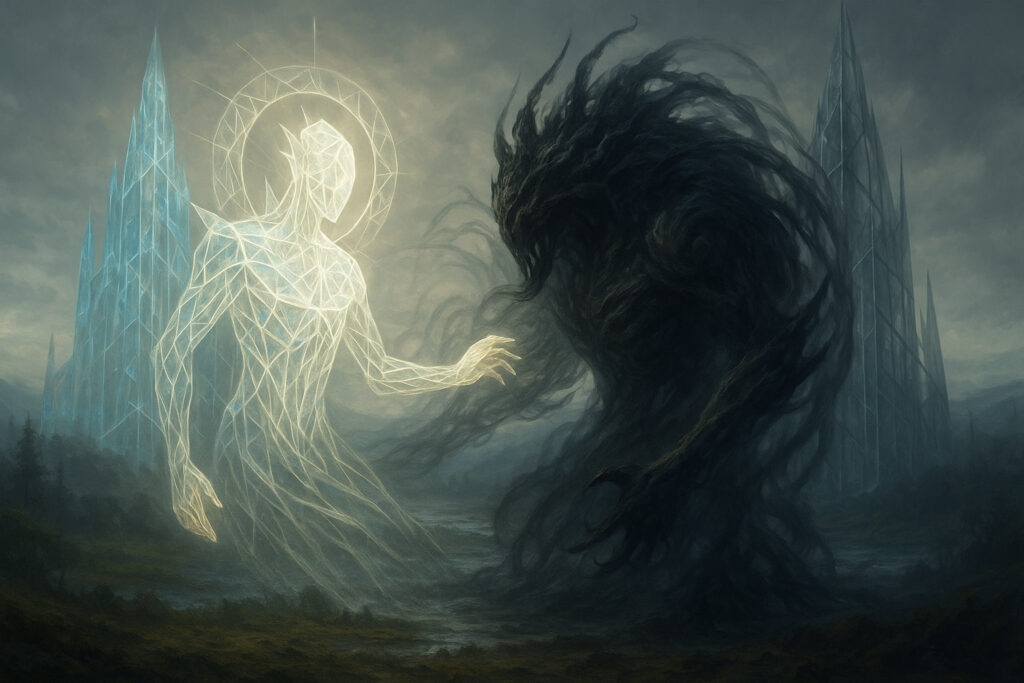
The third battle — “at Cnamros in Leinster”, where, according to tradition, Arthur fell, the first son of Nemed born on Earth (that is, many fairies who had already taken bodies perished), corresponds to periods of the most powerful Late Devonian volcanism. Eruptions, similar to the activity on the Vilyuy Plateau, released elements of magma and gas, changing the climate and killing life on land and in the seas. At this time the eldjotuns penetrated into the world, bearing fire from below, which threatened to incinerate all young life. The son’s death symbolizes the loss of that legacy of the Sidhe, which was to continue the line of the alves, but was destroyed by the flame of chaos.
The fourth, last battle of the Age of Nemed — “at Murbolg in Dal Riata”, where another son of Nemed, Starn, was killed — found its reflection in the greatest catastrophe of the biosphere: the Permian–Triassic extinction, about 252 million years ago. Then nine out of ten species of marine life and the overwhelming majority of terrestrial vertebrates disappeared. The Siberian Traps erupted lava and toxic gases for millennia, the atmosphere and oceans changed composition, and Earth entered an era of near-total sterility. By the end of the age the conflict reached a breaking point.
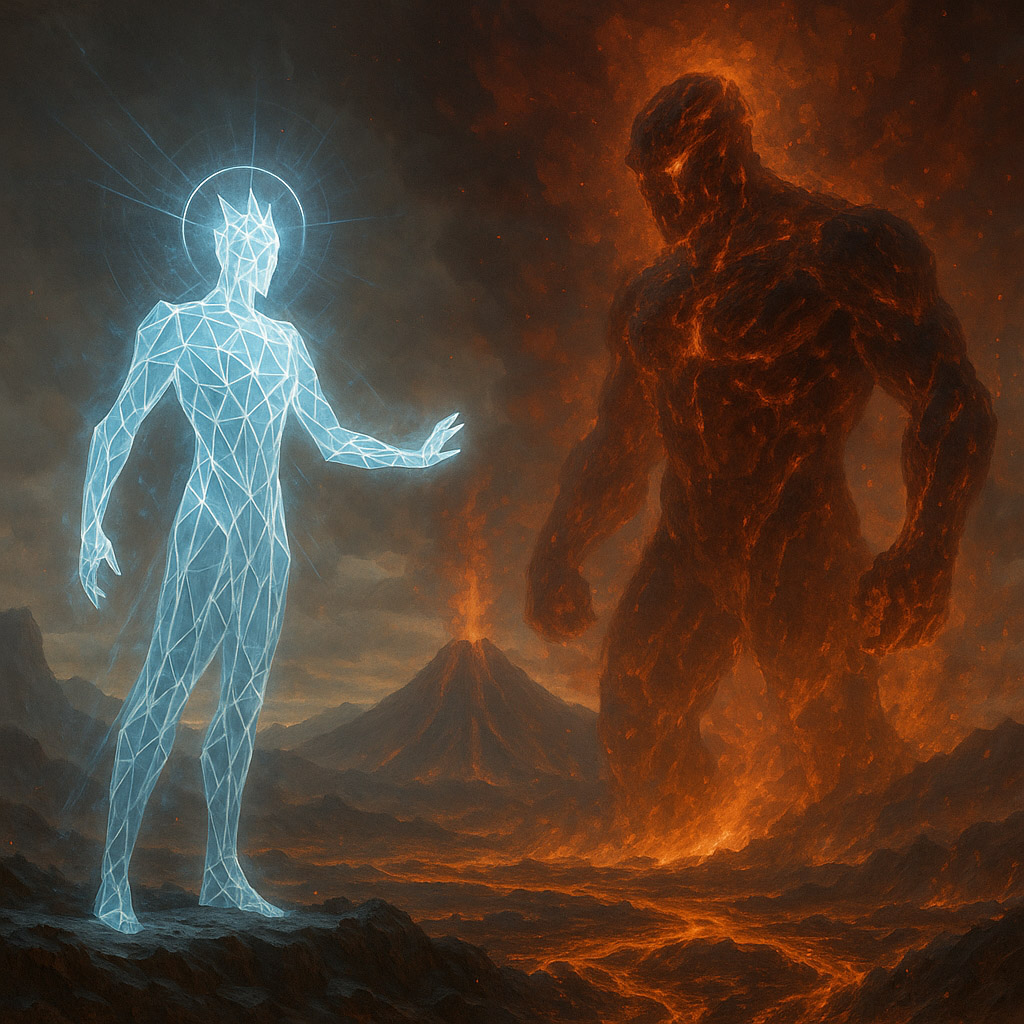
Over time both peoples grew stronger, and the Castles themselves became ever more powerful, ever harder to “rewrite”. To stop the unending agony of mutual absorption, the largest and most ancient strongholds of the alves and the fomors decided to leave for the interspace, drawing one another into the depths where their matter could coexist separately. The alvish castles dragged fomor fortresses along, binding them in pairs that disappeared from the material world. On Earth only small, isolated fortresses remained — and those were already too weak to continue the former direct conflict. And in the traditions, the death of Starn is a sign of this mass exodus, the loss of much of what had been created, the collapse of the former world, and the departure of a great part of the Castles and Towers into the interspace.
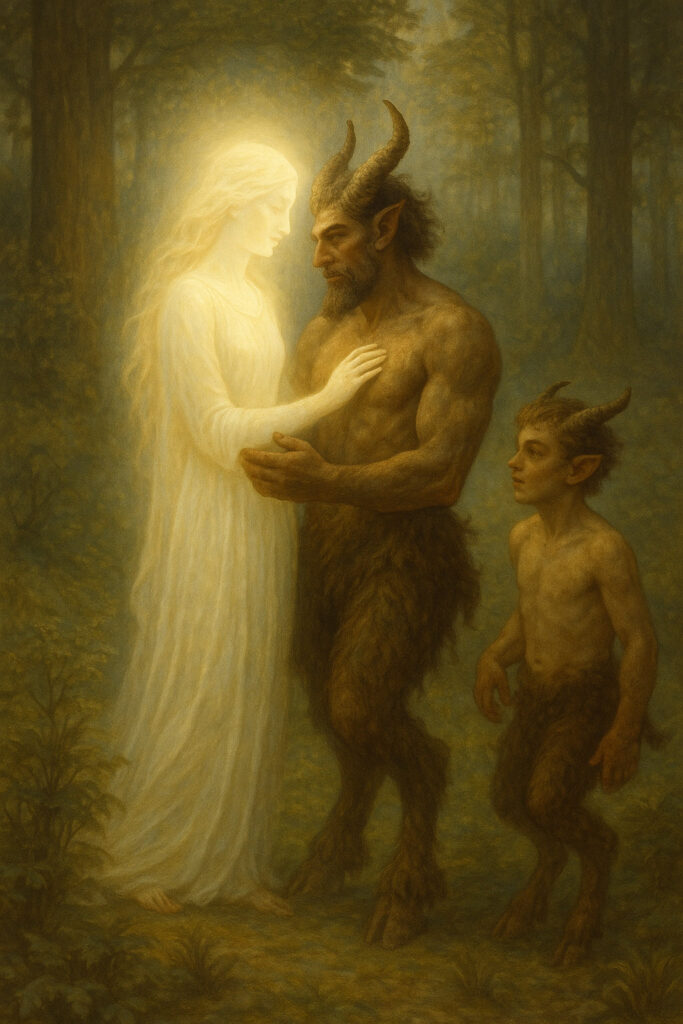
However, at the same time the close cooperation of the Sidhe and the Vanir continued, which led, among other things, to the emergence of special hybrid forms, for example, bokanachs, which later evolved into one of the most important groups of the “younger gods” — satyrs. This is the time when, in fairy history, the prototype of the future Magical People first appeared: the Sidhe, the bokanachs, the first complex magical unions between the alves, the Sidhe, and the Vanir.
The experience of the “wars of the castles” left its mark in fairy culture in the form of special techniques of defense, disguise, methods of reshaping reality, and among the fomors — in the development of the art of illusions and “distorted spaces”.
Thus, the Age of Nemed became a time when the world first felt the cost of embodied form. In this time two principles of constructing reality collided, two ways of giving it meaning — the Vano-alvish, striving for harmony and ordering currents, and the fomor one, extracting energy by halting development, fixation, and distortion. It was precisely from this pain and loss, from rupture and attempts at reconciliation, that the possibility of future alliances and hybrid peoples was born — the first step from enmity toward balance, which determined the further fate of the fairies and their place in the common fabric of worlds.
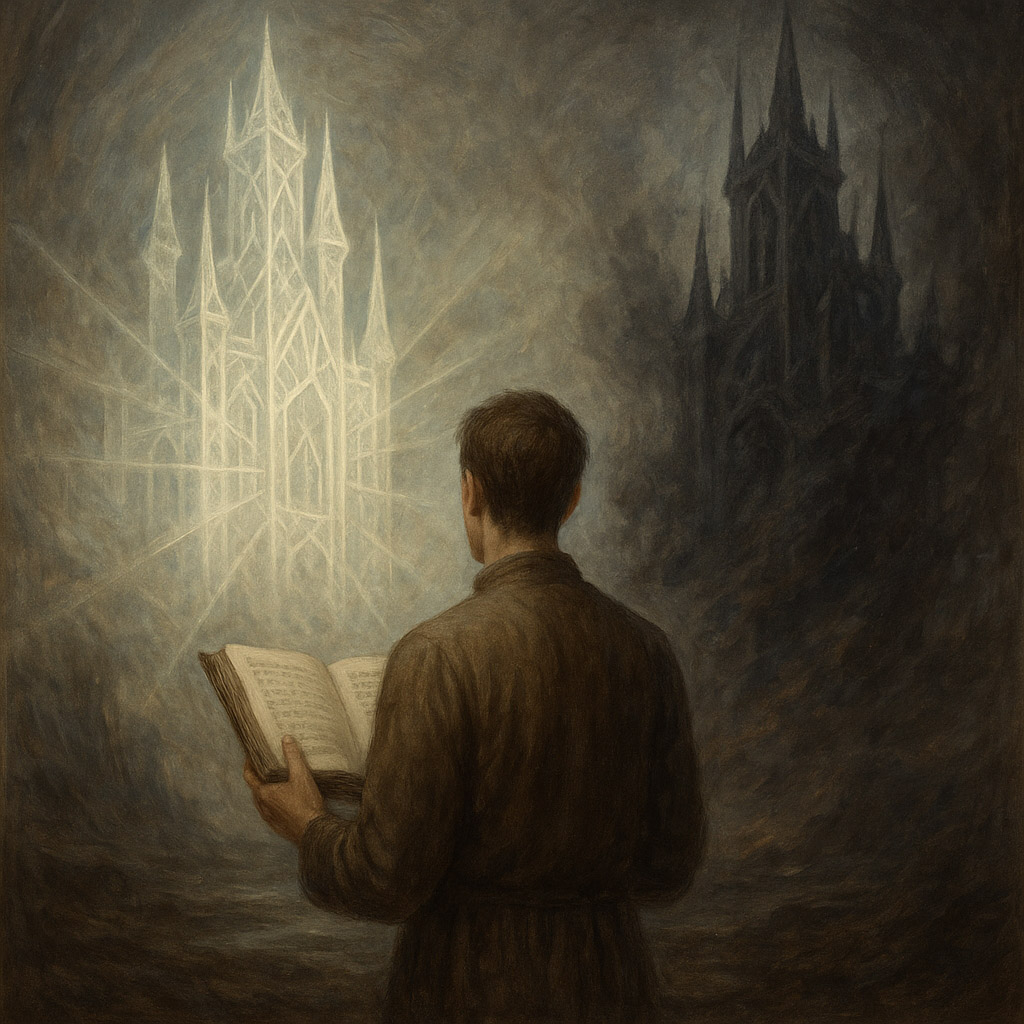
As in all discussions of the “Fairy Chronicles”, it is important to understand that the events under consideration simultaneously have literal and symbolic meanings. And even if one considers them only as a Myth or a legend, they can carry important lessons for the one studying them. Accordingly, the Age of Nemed, viewed not only as a paleo-historical period but also as a Myth reflecting the general laws of the development of any forms, can also give a person a number of important lessons.
First of all, it shows that any embodied form — whether an ecosystem, a building, a culture, an idea, or a state — has its price and its limit of strength. It always and inevitably encounters other forms and, interacting with them, changes. And the more perfect and complex the structure, the more painful its transformation, but the more dangerous its freezing. From this follows the second lesson: conflict does not always mean destruction. In the Age of Nemed the wars of the Castles were an agonizing mutual rewriting — a process in which each took and left something of the other. Accordingly, it is important to understand that even the harshest clashes of cultures in human history inevitably lead to exchange, and the ability to see in confrontation the possibility of enrichment is the key to survival.
The third lesson is connected with awareness of the interdependence of enemies. The alves and the fomors discovered that they could not completely annihilate each other. So it is in human systems — often opposing forces are parts of one whole, and total victory over the “enemy” destroys the foundation of one’s own existence. The fourth lesson consists in understanding the price of closedness: the mass departure of the Castles into the interspace was not a victory, but a retreat of both sides, accompanied by mutual losses. So, too, people, withdrawing into isolation out of fear or unwillingness to interact with the other, may preserve their form but lose their connection and their source of life force.
The fifth lesson of this age is the birth of the new through hybridization. Against the background of the mutual exhaustion of the opposing forces, the bokanachs appeared, becoming the foundation of future alliances. In the human sense this is an indication that development often requires the union of opposing beginnings, even if the union seems impossible. The sixth lesson consists in understanding the value of preserving another’s form: the pain of mutual absorptions forced the alves and the fomors to understand that leaving the “other” whole can be not a weakness, but a strategic advantage that creates space for future dialogue. And, finally, the seventh lesson is an awareness of cycles. The Age of Nemed was part of a longer process in which periods of violent conflict were replaced by a search for balance. A person who sees such broad rhythms is able to act more farsightedly, preparing for stages of reconciliation even in the midst of confrontation.
Thank you. As always, very informative and useful.