
Glasya-Labolas and the “Independence” of the Digital Age
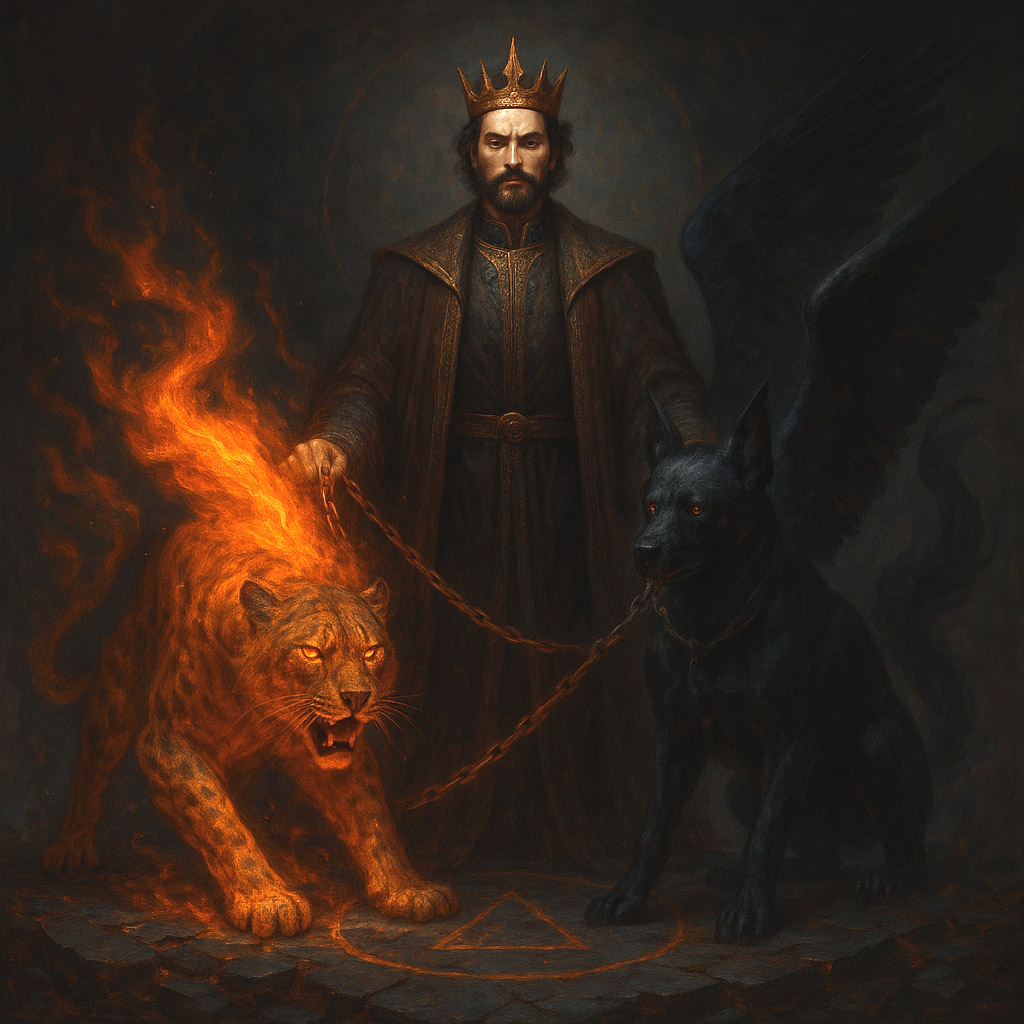
The modern era has not only redistributed energy flows driven by predators of different natures; it has also changed the relationship between “homogeneous” predators, shifting the emphasis in the human psyche.
This is noticeable in all groups of destructors, but especially major shifts have taken place in the retinue of Belial. Indeed, it is precisely the destructor of wrath and repulsion that has significantly changed its direction, and the typical human intergroup aggression is increasingly yielding to general intolerance and “background” hatred.
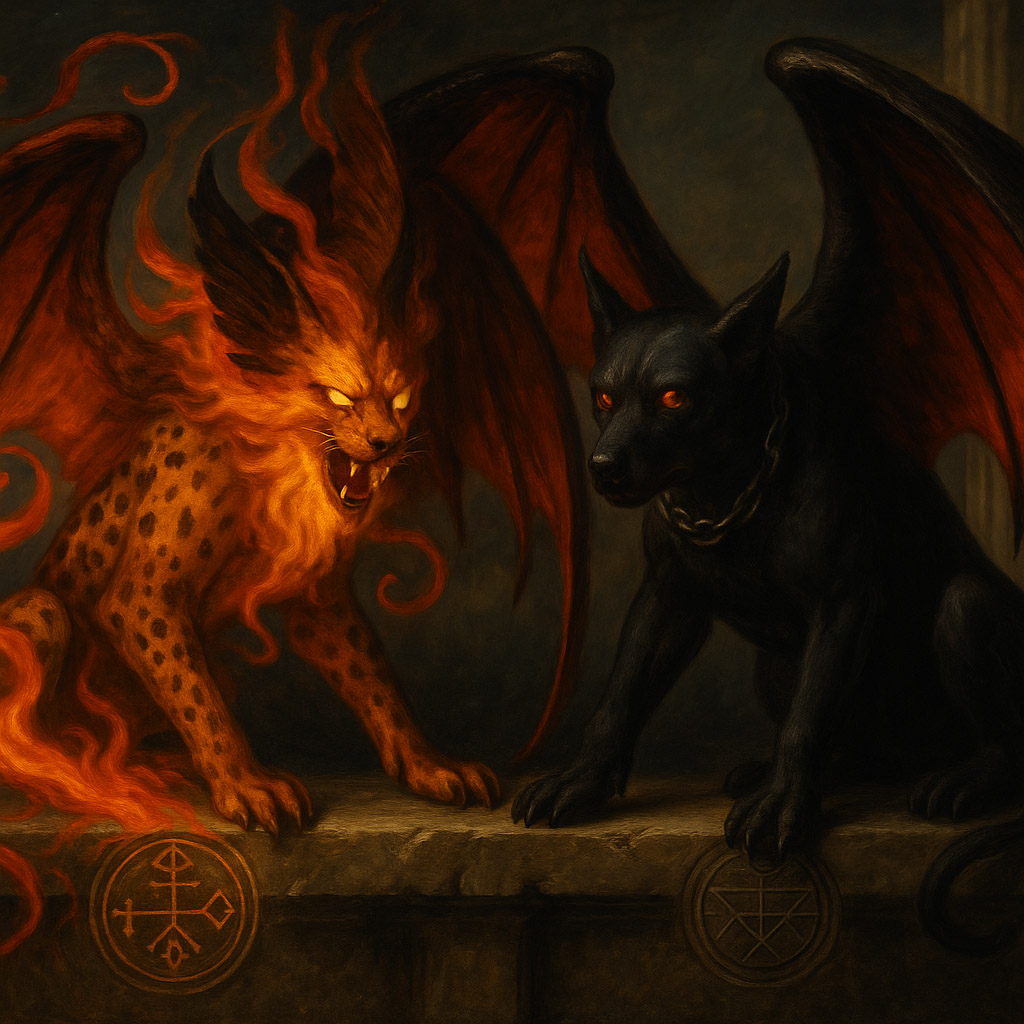
In the retinue of the King of wrath there are both demons who burn the psyche to bare earth and those who “clamp their teeth” onto the boundaries of the “I,” freezing movement around it. Among the former is Flauros, the fiery leopard of unbridled destruction. The latter is Glasya-Labolas (Kaasimolar), the watchdog of the mind, whose sadistic cruelty is masked by the rhetoric of “self-preservation” and “justice.”
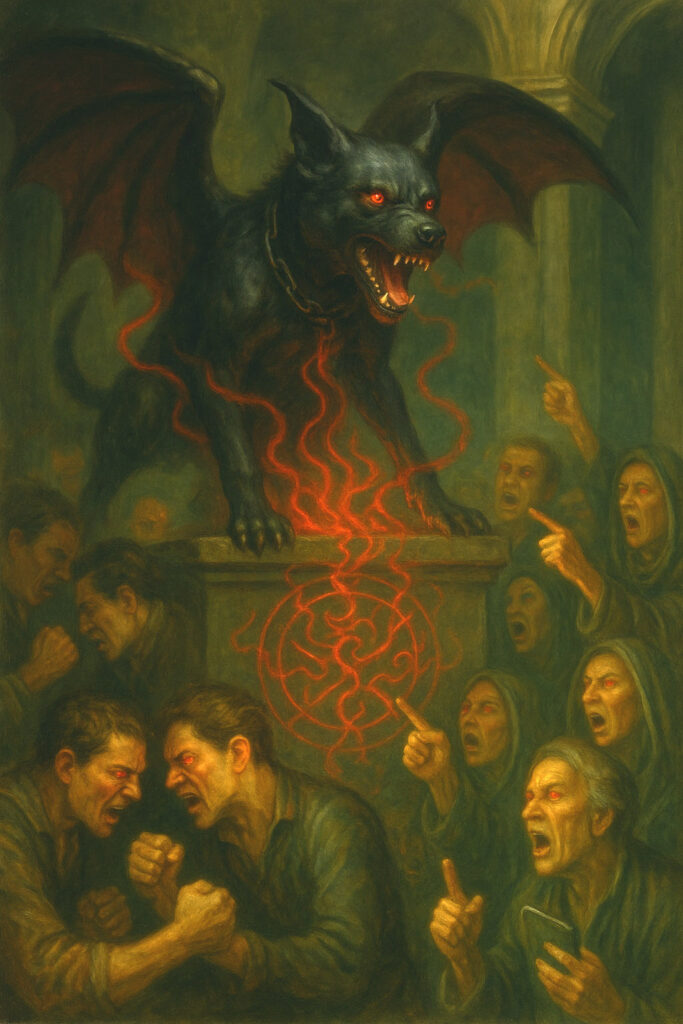
In pre-digital centuries, the former more often prevailed: brute force, blood, and direct attacks often served as triggers of conflicts and means of resolving them. In the modern networked environment, the latter increasingly prevails: “sanctified” harassment, public ostracism, subtle forms of psychic violence and mockery — everything in which pain is inflicted to protect an image and assert oneself.
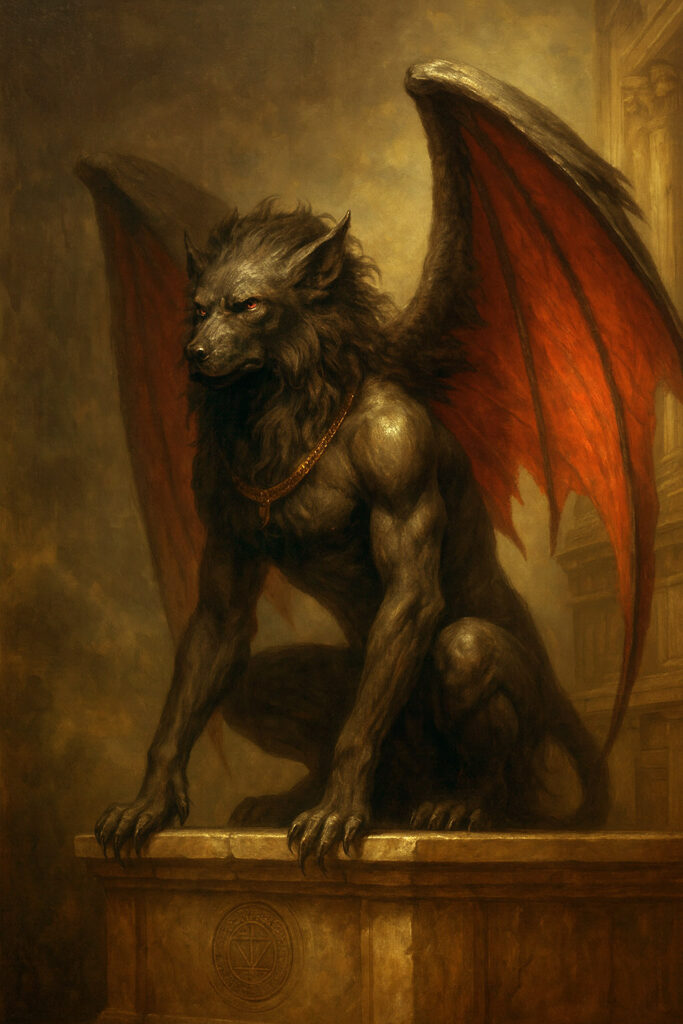
Glasya-Labolas is the twenty-fifth spirit of the “Lemegeton,” a “mighty President and Earl,” appearing to the summoners in the form of a dog with griffin wings; he “instantly teaches arts and sciences,” is the “instigator of bloodshed and murder,” “teaches about past and future,” “renders invisible,” and “inspires love” — a set of abilities that, as we shall see, only mask his true function: to circumvent resistance of environment and conscience in the name of cultivating self-admiration at the cost of suppressing and destroying others. In the “Grand Grimoire” he is even drawn as a “sergeant,” “seated on Flauros or Naberius” — that is, drawing on the blazing fire of destruction and scholastic self-affirmation.
The Ruler of Self-affirmation is the Gatekeeper of the Gates of Opposition — the first manifestation of the feeling “I am against,” where the immature striving for independence collapses into panicked self-preservation and hysterical resistance to any changes perceived as a threat to the self. The essence of the destructor is the distortion of protecting one’s boundaries, brought to destructiveness both for the mind itself and for the surroundings. Therefore, the image of the watchdog here is a literal expression of the action “to clamp down with its teeth” and hold at any price — up to bloodshed.

This is exactly how “science and arts,” “knowledge of the past and future,” “the love of friends and enemies” — all the demon’s “gifts” — turn out to be merely tools for silencing dissent, for mimicking aggression as “good,” in order to neutralize resistance and assert control.
Among the energetic properties of Glasya-Labolas, Mercury and the Sun (rhetoric and will) are clearly noticeable, strengthened by the fiery arrow of Sagittarius: assertiveness and purposefulness in the sphere of desires. However, the core of his influence is cold: within it rages not an opened-up fire, but a “freezing” of the flow — holding, fixation, forbidding change.
This is the fundamental difference from Flauros. The leopard is a “demon of repulsion for its own sake,” whose fury is an outburst of distorted vitality: forest fires, desert heat, reactor plasma — the state of mind “overflowing its banks,” prone to affective outbursts and burning out the victim; he is truthful “in the triangle,” but outside the ritual space he deceives, and therefore must be “brought into the triangle” or he will destroy the summoner himself.
The dog, however, does not burn — it bites and holds. His cruelty is not hot, but “sanctified”; he is a manifestation of Alastor, the executioner of moral order, whose pain is justified by “security” and “justice.”
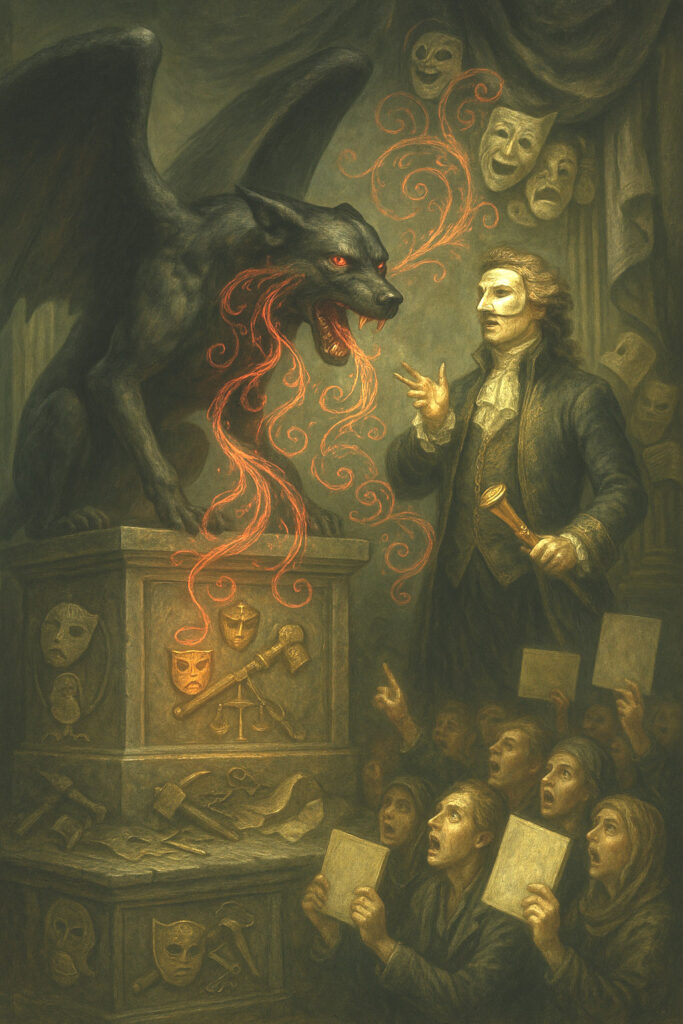
The energy of Kaasimolar is not fire, but fear armed by rhetoric. He relies on Naberius — the “emcee” of self-affirmation, for whom form matters more than substance, and “to be heard” replaces “to do.”
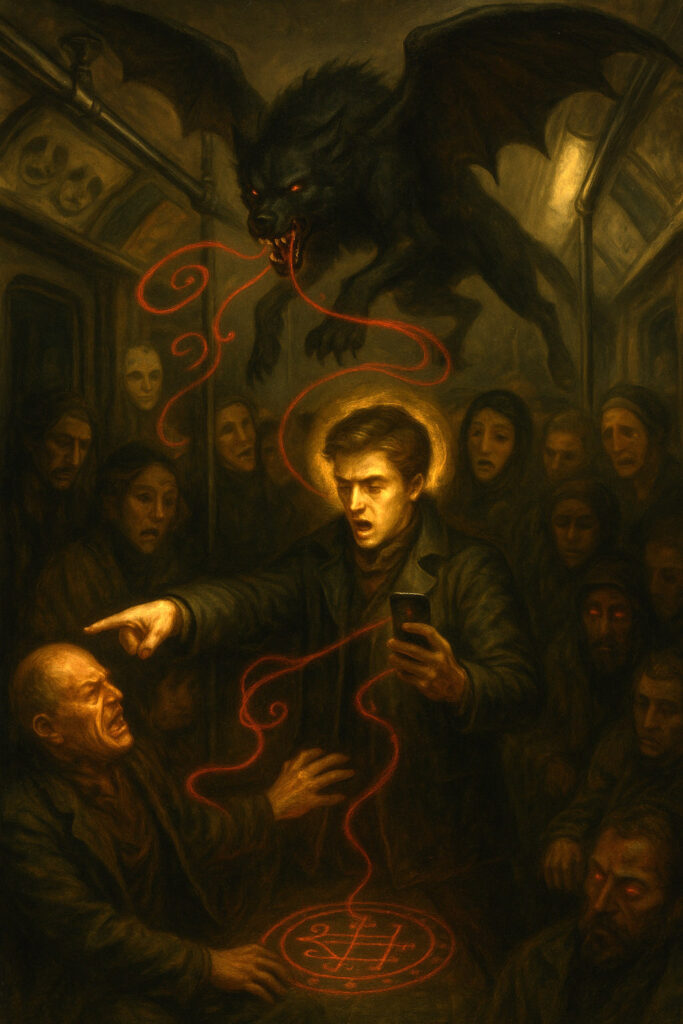
This is how the characteristic connection between self-admiration and cruelty is built for Kaasimolar: the “I” is defended not by actual action, but by the public punishment of the “violator”; the other’s pain becomes confirmation of the “rightness” of the carrier of this matrix. In a crowded subway car, this is a shove “in response,” which often turns out to be not restoring balance, but intentional infliction of pain. In online mobbing, it is “community rules” against the spirit of justice, executive zeal “for the sake of security,” which in fact is the main enemy of that very security.
Astrologically Glasya-Labolas is located in the thirteenth decan of Leo; this is “inner activity bursting outward,” a transition from existence “in itself” to manifestedness.
If Flauros is “vitality without measure” turned inside out into rage (a distortion of the Genius Mahael, the “All-Reviving God”), then Glasya-Labolas is “self-preservation without trust” turned inside out into cruelty. The first aims to burn out; the second aims to freeze. And in this lies one of the reasons for the spread of the Kaasimolar matrix: it finds resonance in another “freezing” force of modernity — the Archontic influence.
In today’s digital environment, reputation is more important than strength, and therefore where a “mistake” is experienced as “the end,” the paranoid logic of “preemptive strikes” naturally grows — “the best defense is attack.” The influence of Naberius creates a justification for “hate rhetoric,” Leraje mobilizes “commissars,” and Glasya-Labolas legitimizes the bites as “care for safety.” In crises they are often also helped by Vual — a demon of false closeness, cementing the pack (“we are together”) and legitimizing exclusions.
This is how bullying and canceling are reinforced — tools for preserving an image and freezing change. And this “ethics of the executioner” inevitably replaces action with talking: a person “becomes less willing to listen, and more eager to speak,” and his speech is filled with boasts of strength.
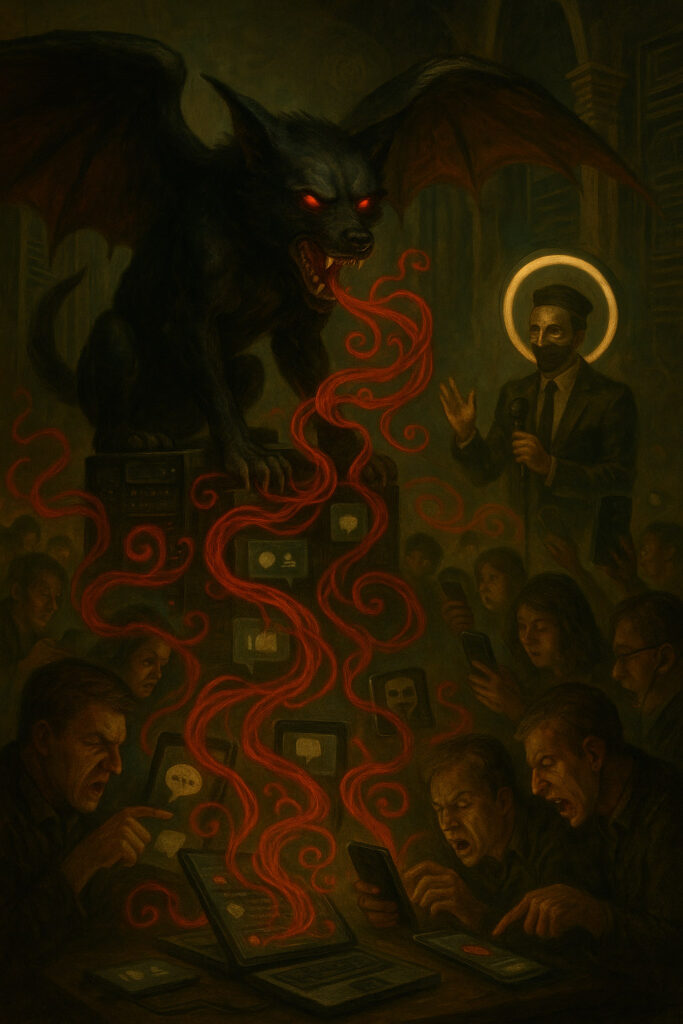
In the pre-digital centuries aggression was more often “hot” and straightforward: Flauros overflowed his banks, burned the field, wiped it out — and therefore was noticeable, easier to localize and control.
At present, the decisive resource is no longer physical force, but access and reputation. Increasingly, the attack is not a direct blow, but exclusion, freezing change for the sake of preserving an image.
In this mode, zoomers — children of the panopticon — become “harder inside” and “softer outside”: there are fewer external fights, but internal cruelty and readiness for a “morally justified” reprisal are higher.
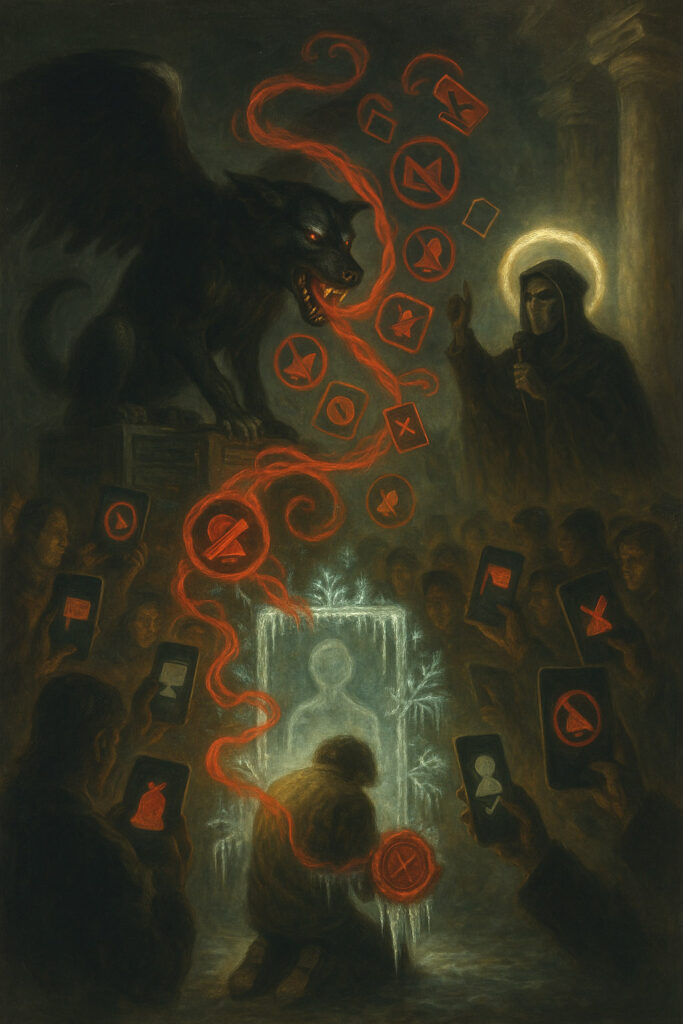
Of course, Flauros has not gone away. Street rage, assault, destructive “zeroing out” are elements of the Fiery leopard. However, the modern environment systemically triggers the initial flash of “I am against” — the Gates of Opposition — and immediately translates it into the rhetoric of “the common good.” Inside the psyche seized by the influence of Kaasimolar, self-admiration and cruelty merge: the image of “I” is upheld by inflicted pain.
Self-admiration is born from the replacement of individuality by opposition. While the “I” is sustained precisely through the opposition “I/not-I,” a limited mind is doomed to suffer, which means it needs constant confirmations of its own significance, of being “noticed.” And when the striving “to leave a mark” becomes more important than presence and deed, the fusion of self-admiration and cruelty is inevitable: inflicted pain is a sharp, deeply felt mark, a quick confirmation of one’s own “weight.” The “punishment” of another, especially a public one, confirms “my significance,” “my rightness,” “my inviolability,” and, most importantly, saves one from fear of being devalued, unencouraged, unpraised, unglorified. At the same time, the fear of being underappreciated is interpreted as a threat to the very existence of the “I,” therefore aggression feels like an obligation, but as an obligation.
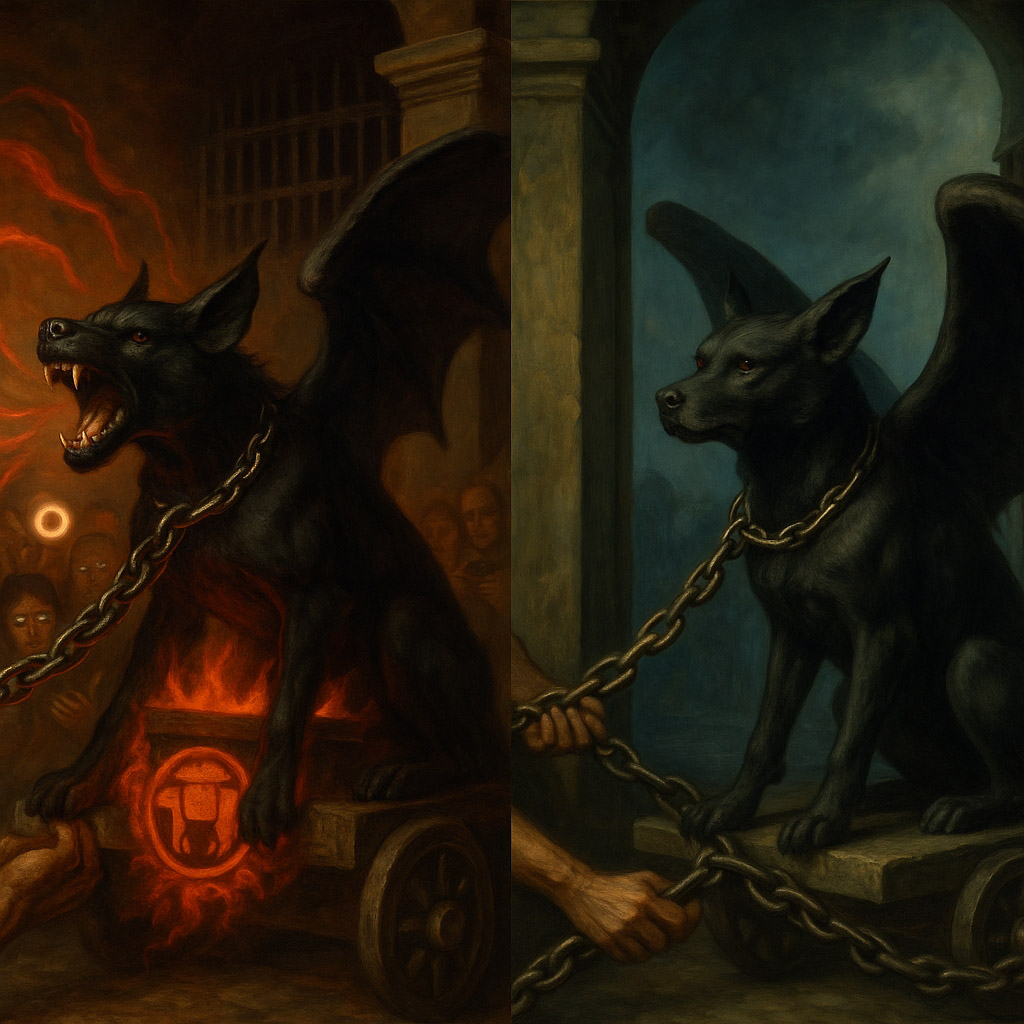
Thus, the matrix of Glasya-Labolas rests on two pillars. The first is the need for support, “a chain,” which gives the watchdog a sense of security: the sigil of Kaasimolar depicts a war chariot or elephant; his aggression needs support — just as a physical chain is needed by a “serving” dog. In the psyche this manifests as reinforcement from external attention, without which “protective” wrath fades. It is the same as with a dog’s aggression — once you open the gate or remove the chain, it calms down. The second is nourishment from “demons of eloquence” and “glamour”: a society built on masks and demonstrativeness inevitably encourages forms where the form of speech is primary and meaning and presence are secondary; in such an environment inflicted pain is easily declared an ethical procedure and an “official duty.”
Signs of the activity of the Glasya-Labolas matrix in the psyche are “cold” sadism: 1) harm is inflicted under the guise of care (“for safety we will exclude you”); 2) any novelty is interpreted as a threat to everything, hence a preemptive strike; 3) collective non-addressedness (“the community decided so”), in which no one takes personal responsibility; 4) rhetorical hypertrophy with a deficit of facts: a stream of words instead of deeds, appearance instead of meaning; 5) an inclination to “sanctions” that deprive voice and access, freezing changes.
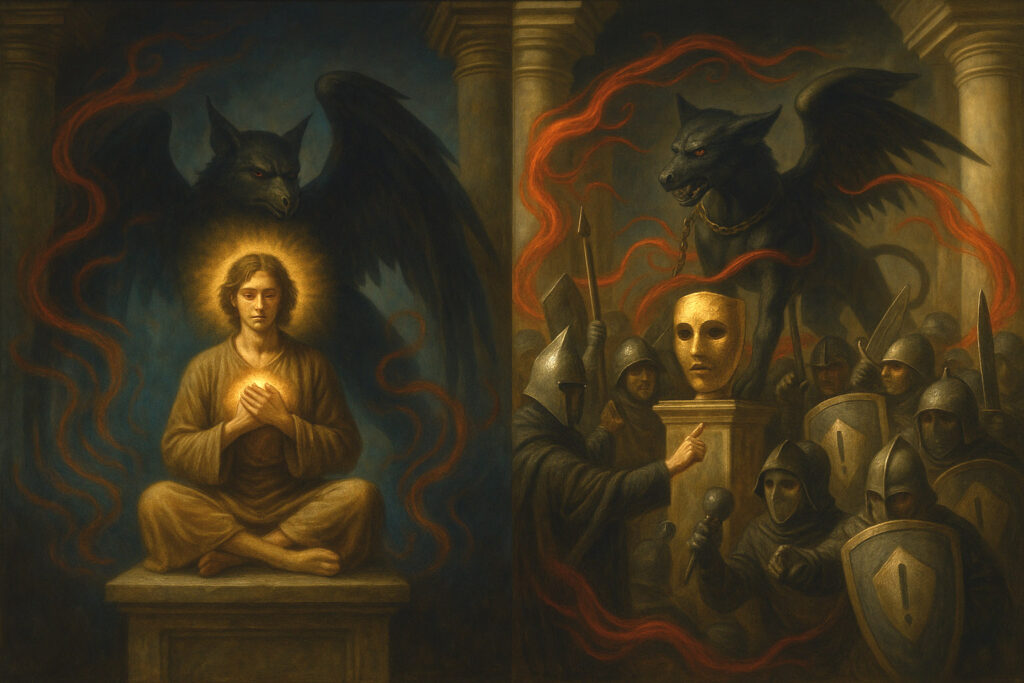
In order to resist the influence of Kaasimolar, a clear distinction is required between “guarding the center” and “guarding the image.” The center of mind is what is held without violence, without repulsion, through inner presence; the image, however, is what always requires protection and protectors. Without such an inner check, any attempt at “restoring order” feeds Glasya-Labolas. An emphasis on actions is also important: “fewer emotionally charged words — more facts” as a way of breaking Naberius’ reinforcing influence. A return of a code of honor can also play an important role: do not stab in the back, speak directly, distinguish guilt from responsibility.
Leave a Reply