
The Ideology of the “Great Grimoire”
«O people! feeble mortals!
Tremble at your frivolity when you blindly imagine that you possess sufficient knowledge.”
(The Great Grimoire)
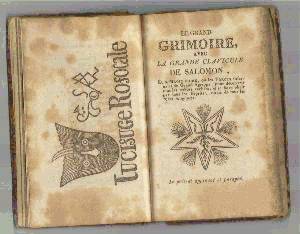
Among the Grimoires of the so-called “Solomonic” cycle, aside from the “Keys”, the best known is the Great Grimoire (Grand Grimoire), preserved in several variants that differ little from one another. The best-known of these variants is dated to 1522 and appears to be of Italian origin.
The book is divided into two parts. The first part describes methods for summoning spirits, the circle of invocation, and the ritual’s procedure. The second part contains descriptions of spirits, an alternative procedure for summoning, and is devoted to circus-like “magical secrets” such as invisibility, swift movement, and the like.
In its invocatory section the Great Grimoire offers little that is original, yet amid this purely technical material, important ideological points emerge.
The first of these points concerns the scheme of the hierarchy of spirits with which this Grimoire operates. According to this scheme, very similar to the description in the “True Grimoire”, the hierarchy is headed by Lucifer, here called the Emperor; Beelzebub, the Prince; and Astaroth, the Great Duke. Subordinate to them are four spirits styled the “Generals.” Even this arrangement, both theoretically and practically, is superior to the picture given, for example, in the “True Grimoire,” which assigns two servants to each of the three principal spirits — that is, treats them in binary pairings — a configuration that is theoretically permissible but practically inconvenient. The “Great” Grimoire, by placing the quaternary beneath the ternary, simulates the septenary of Creation, thereby introducing a significant cosmogonic element into the act of invocation. The “Personal Universe” the Magus constructs during the ritual is far easier to govern than the binary vortices of the “True” Grimoire.
At the same time, the text of the Great Grimoire obviously contains lacunae characteristic of all magical books and intended to confuse the uninitiated reader.
In particular, there are two variants of the hierarchy: the first — which is septenary — we have just mentioned; it is followed by a second — hexary — which seems to contradict the first, yet in fact complements it. In this variant two more spirits are added to the four “Generals,” producing a hexad that gives rise to the subsequent divisions. The idea behind such variability is simple: vortex processes and their vectors can be considered from a cosmogonic perspective (as a septenary) or from a cosmological one (as two mirror ternaries, i.e., a hexad). A Magus who wishes to govern the ministering spirits must be both the Demiurge of his universe and its ruler; he must master both the septenary and the hexadic systems.
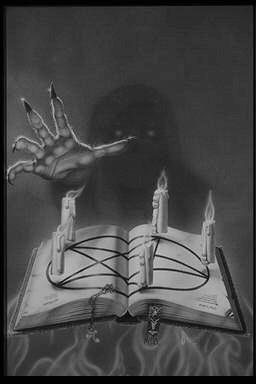
Below this group are 18 lower spirits, forming three hexads. Most of these spirits are known from other Grimoires, including the “Lemegeton.” Each of the six “Generals” controls his own triad of simpler spirits. Thus the hierarchical scheme offered by the Great Grimoire is straightforward: the first three Demons correspond to the creative ternary; the next four or six Generals correspond to the principle of manifestation, where each element can be represented by a ternary, which in turn gives rise to the 18 lower spirits.
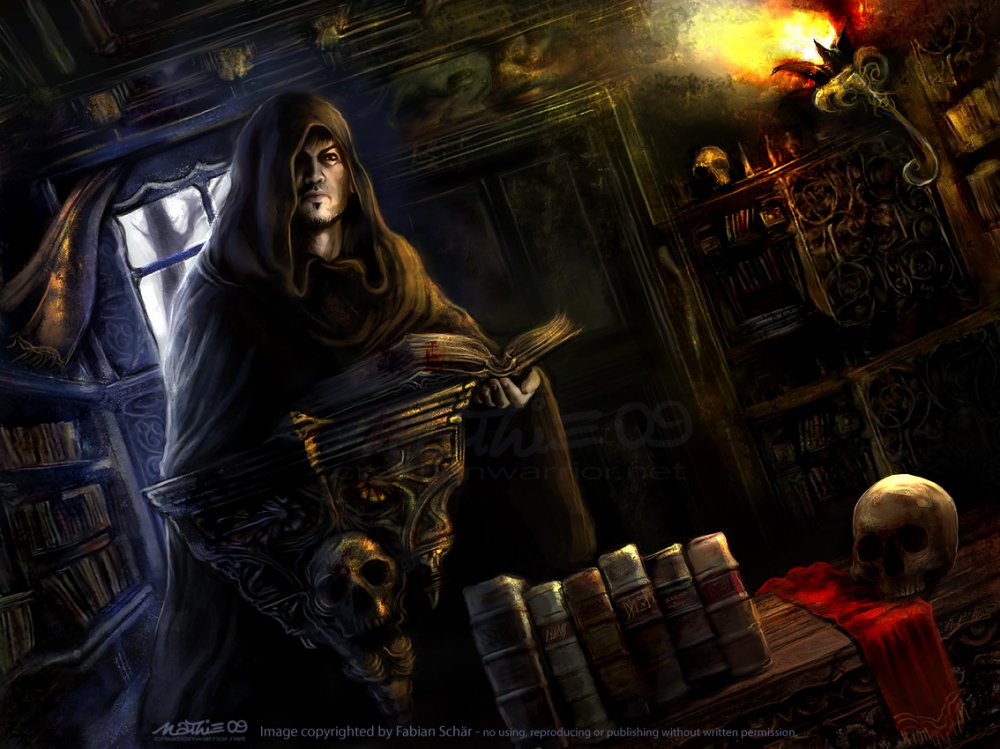
The second important point distinguishing the “Great” from other Grimoires is the special attention it pays to preparing the summoner. Among such instructions:
«You must spend a quarter of a month avoiding the company of women or maidens so as not to fall into impurity.», «do not undress and sleep only as is absolutely necessary throughout the said quarter of a month — constantly thinking of the work you have undertaken, and place all your hopes in the boundless goodness of the great Adonai».
And, most importantly, the Great Grimoire clearly describes the conditions under which Spirits may agree to serve a Magus:
«If you leave me in peace, I will give you the closest treasure provided you dedicate one coin to me on the first Monday of each month and that you do not summon me more than one day a week, namely: from ten o’clock in the evening until two hours after midnight. Take the contract; I have signed it; if you fail to keep your word, you will be in my power in twenty years.»
And, in fact, A. Waite was quite right to note that
«A convenient justification is the claim that a pact with the devil is only a pretext and that in reality the contract gives the demon nothing; as often happens in folklore, is deceived and receives a shadow instead of flesh».
The Great Grimoire is precise in this regard: a Magus who wishes to obtain from a spirit anything other than Power and Authority must pay.
And although many Summoners, ignoring this point, hoped to outwit the fallen spirits’ ancient cunning, the vast majority of such magi, unable to disembody, remained in the elements, serving as food for those with whom they had so imprudently entered into contact.
Very interesting article, could you tell a bit about the grimoire imperius?
Very important clarification-conclusion. Thank you