
Typhon and Archontic Avarice

The power of consumerism, greed and the desire to possess as a distortion of one of the primordial forces of the universe — attraction — is one of the primary disruptors that hinder the harmonious development of consciousness in all its manifestations.
At the same time, unlike the demonic manifestations of this force, archontic greed is a property built into the very nature of the will, which is not perceived as something vicious or negative, and herein lies its particular danger. Therefore the Gnostic tradition chose to describe the corresponding Archon, the classic image of the eternal enemy of the gods — Typhon, appearing at once as the “Father of monsters,” just as Lilith (Echidna), expressing the possessive force as desire, is their “Mother.”
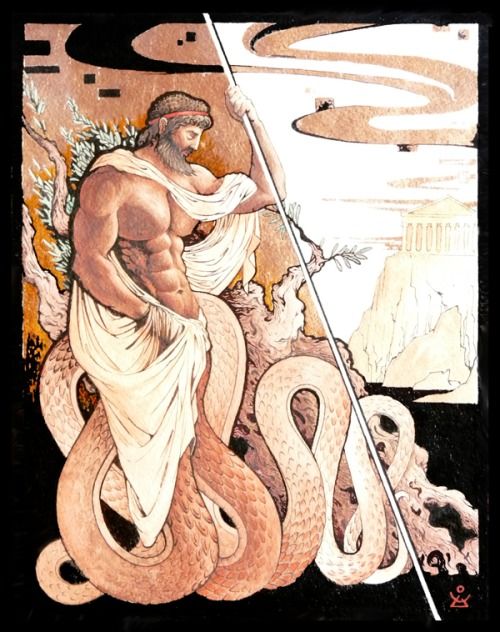
Typhon as the embodiment of archontic greed is a special “structural mode” of the will’s orientation, in which the primordial force of attraction is distorted into willful appropriation. Normally, attraction leads to assimilation and integration along the path: “accept — become commensurate — transform and surpass.” Archontic greed, however, translates this vector into another “coordinate system”: “take without becoming like it,” to turn a flow into a stockpile, the living into a warehouse, and a relationship into an “asset.” Resource-based ideology, the striving for enrichment for the sake of enrichment itself, the idealization of wealth and the normalization of greed — all these are manifestations of Typhon’s activity.
Therefore Typhon manifests as a destructor in the element of will and in the phenomenological aspect: he seemingly “normalizes” unrestrained appropriation as a “rational order of things,” turning the lack of something and the fear of losing what one has into the basic backdrop of the “natural course of events.”
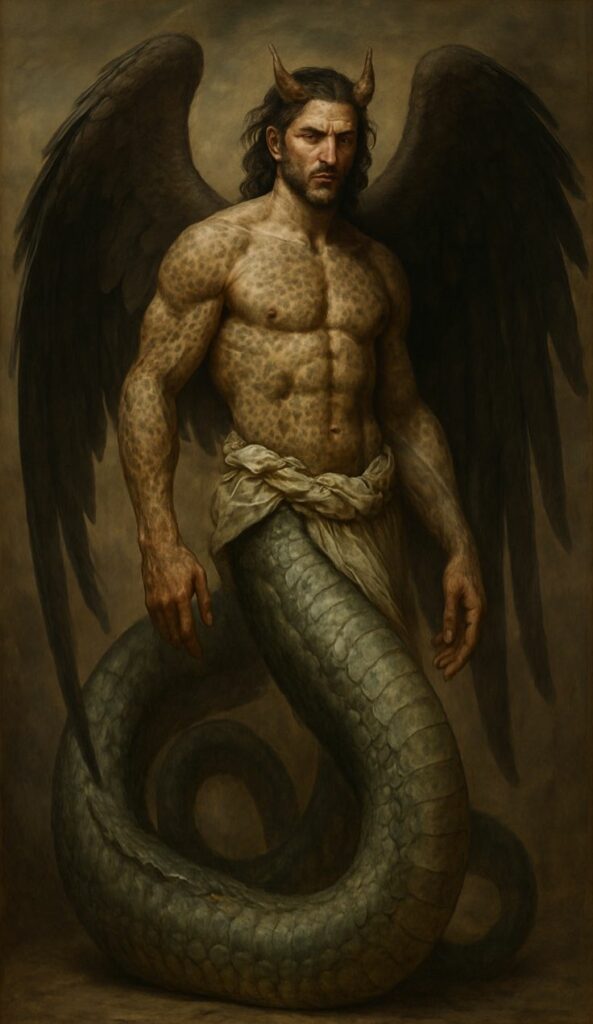
In mind, Typhon uses two main levers to direct energy toward dissipation — the striving for victory and the fear of loss. On the one hand, under the influence of this matrix, achievement is replaced by material evidence — the acquisition of expensive or status items, the accumulation of wealth, and other external signs of “success.” At the same time, it becomes unimportant how honest and inwardly grounded this acquisition was; the very fact of possession becomes a source of reinforcement. On the other hand, there is the fear of “being shortchanged,” anxiety over not possessing what the entire market system proclaims as “necessary,” what it is “shameful” not to buy, what it is “frightening” to lose.
The Archontic nature, gemarmen, is always an “inner” part of the manifested world; it is never perceived as imposed or alien. Where Typhon operates, the energy of flow is systemically held by such control mechanisms built into the mind, and at the same time “access” to something becomes more important than content: accumulation, collecting, inventorying, and warehousing become ends in themselves.

At the same time, will is reshaped from an engine of growth into drives of possession and anxiety about “how much has been accumulated? how is it protected? what else should be held just in case?” That is why archontic greed is rarely identified as something excessive or destructive; it disguises itself as “success,” prudence, foresight, thrift. A person feels fulfilled, sober, and careful, although in fact the focus of attention is shifted from self-realization to accumulation. In phenomenological experience this is recognized as a narrowing of the field of possibilities, in which the living process is replaced by conservation, “flow” by “reserve,” and the value of any interaction is assessed only by the resources it brings.
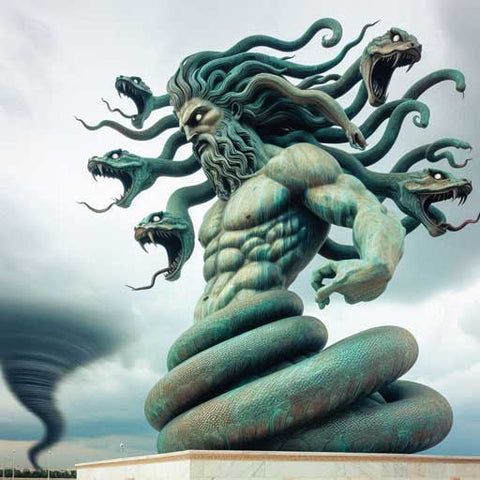
The classic image of Typhon turned out to be astonishingly precise as a reflection of this force. His serpentine nature and gigantic scale describe an “all-encompassing” coverage of the environment: the coils encircling the world are a firm holding, a twisting of flows of energy and mind into spirals of possession. Typhon’s kinship with Echidna (Lilith) points to the complementarity of will to possess and desire to possess: the “father” sets form and methods, while the “mother” multiplies derivative entities — monstrous precisely because they are born without proportion between vessel size and what it is trying to contain. Another key correspondence is the episode of Typhon’s theft of Zeus’s “sinews,” which signifies depriving the creative, divine principle of its driving force. Archontic greed does exactly this to every subject: it pulls out the “sinews,” that is, the real motives from actions, leaving only the ability to retain and blocking the capacity to surpass; as a result, will fixates only on holding, not on evolution or transformation.
Where Typhon is active, a person begins to consider “victory” not as a process but as a result expressed in an object of possession. Success is measured by what can be shown, registered, counted. The winner feels this way not because he has become better, but because he has a status item, a symbol, or simply a noticeably greater amount of wealth. Thus the “joy of becoming” is replaced by the “joy of possessing,” and will gradually lose its driving nature, turning into a warehouse guard. As a result, the very structure of mind is rebuilt for Archontic needs: the meaning of action disappears, and in its place arises the fear of loss and the thirst to “add” just a little more.
Elemental and weather motifs in the ancient images of Typhon can also be seen as a description of his Archontic activity: “storm,” “typhoon” is not only destruction but also turbulence, thanks to which the environment is constantly “restless,” “jostled,” and therefore constantly requires insurance, reserve, double fastening.
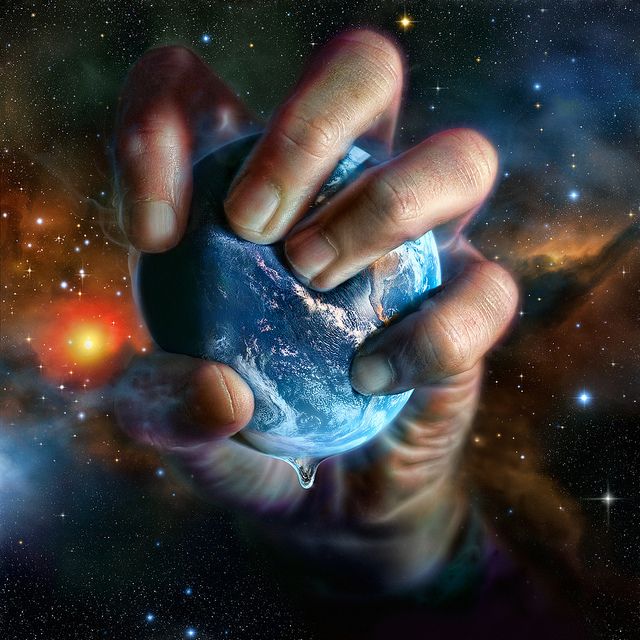
In the social sphere, this manifests in cults of “exclusive,” fashion and scarcity, the value of possessing hubs, straits, or gates, where the primary value is to control passage, not to create content.
Three important signs of high activity in mind of the matrix of archontic greed can be identified:
- At the level of mind — a narrowing of horizons, the equating acquisition with success, when planning for insurance displaces development; a feeling develops that “I’ll start living after one more acquisition.”
- At the level of speech — an abundance of vocabulary such as “access/limit/entitled/just in case.”
- At the level of the body — constant tension of holding (jaw and shoulder girdle are tense), inability to “let go” even of what is completed.

Thus is formed an entirely familiar “economy of property” for manifested worlds, in which everything is subject to marking, everything belongs to someone, and even the invisible and intangible still requires registration and insurance. From such an attitude follows the illusion of safety, which asserts itself against the background of a growing sense of inner lack of freedom: the more is secured, the less free living space remains for development and self-realization.
At the same time, it is necessary to remember that Typhon of classical mythology and Typhon as an Archon in the Gnostic system are analogous but not identical figures. The ancient Typhon is a cosmogonic adversary, a storm-like “enemy of the gods,” playing a role in theogonic myths. The Archon Typhon is a force of the Interworld, a law of the environment that translates attraction into appropriation and binds will to an economy of accumulation. The first is a force of the cosmos’ formation; the second is a personification of a special mode of being. The Gnostics chose the image of Typhon — the opponent of Zeus, the God of order — in order to use the emotional and visual possibilities of the ancient plot to describe such a way of organizing the world in which the suffocating “coils” of the mania of possession around living mind are a “natural” norm.
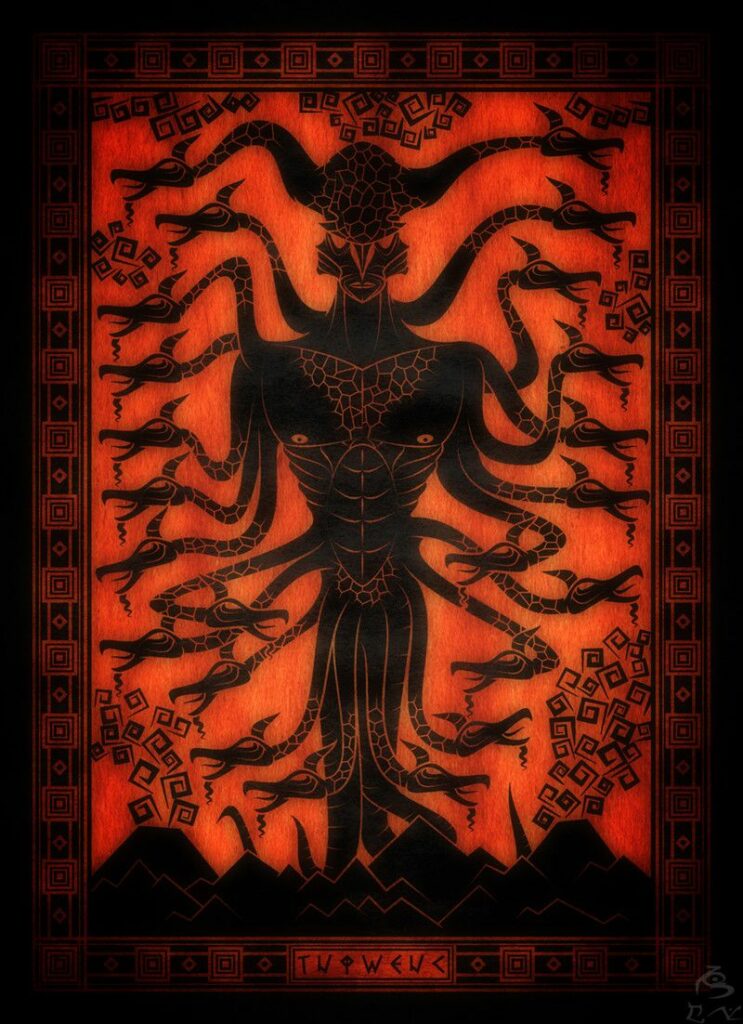
Typhon as an archontic force of greed is opposed to Zeus as a force of order, because they manage the movement of energy in completely different ways. Typhon treats appropriation as absolute and therefore stops circulation, narrowing the world to the level of a warehouse or a safe. Zeus, on the contrary, personifies measure and distribution (nomos, dike): his lightning is a way of bringing to harmony, where energy flows according to the logos, harmoniously given and received, maintaining the integrity of the cosmos.
Identifying Typhon’s activity in mind begins with distinguishing between the sense of “measure” and the itching drive toward “stockpiling.” Where a being strives for what is necessary and sufficient for its life and development, Archontic influence weakens; where drives like “possession equals achievement” or “just a little more — and it will be enough” are felt, it intensifies. Where activity includes obligatory stages of giving — not necessarily material resources but also time, knowledge, creativity — will reverts to primary attraction — that is, to assimilation, transformation, and surpassing. Where everything turns into warehousing, accumulation (of resources, knowledge, identifications, and so on), Typhon strengthens his bonds and turns the striving for victories or prudence into unfreedom.

The description of archontic greed in the image of Typhon makes it possible to see that the striving to possess as a destructive force against the will acts in attraction devoid of measure and suitable vessels, and therefore inevitably collapses into manic appropriation. And as long as will agrees to this order as “natural,” the coils of the Serpent remain closed.
Their grip is broken only by returning to moderate attraction: “take in order to become — and become in order to give,” otherwise any growth turns into Typhon’s warehouse. Accordingly, the diminishing of Typhon’s power consists not in prohibiting property, but in clearly distinguishing possession as responsible care from possession as an end in itself.

“Take to become – and become to give”–can be framed on the wall of my heart). Thank you.