
Thunderer: The Sky Guarding Order
“I will tell my name,
though I stand among enemies,
and speak of my kin:
I am Odin’s son,
Meili’s brother
and Magni’s father;
you converse with the lord of the gods — with Thor!”(The Song of Harbard)
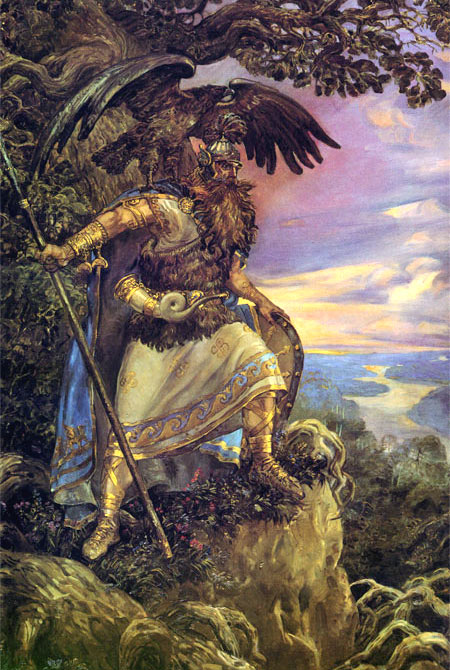
Among the divine powers that guard the Cosmos, the thunder god plays a vast, though often underestimated role. The common view holds that this “popular” god, standing in the shadow of the All-Father, is merely a force controlled from outside.
But it is not so simple.
Not without reason did the Thunderer preside over the folk pantheon, and at times (as in Greece) the entire Pantheon.
The names of Thunderers are connected, of course, first and foremost with their power. Thor (Donar), Perun, Taranis — these names contain the root “to strike, to conquer” (“par,” “Veor”).
The Sky, as the boundary between earth and heaven, has been regarded (and still is regarded) as the field of battle between Ascending and Descending forces — gods and titans, the Aesir and the Jotuns — of which the former strive to order the world, while the latter seek to return it to primordial chaos.
And it is precisely this boundary that belongs to the Thunderer — the Keeper of the Horizon. It is unsurprising that this Keeper in some respects opposes the Guardian of the Threshold, the Master of the vertical axis. Yet the struggle between Perun and Veles is not a conflict of opposites; it is an interaction of forces on perpendicular axes.
If the Guardian of the Threshold is the Primeval Power that establishes the very principle of separation, then the Lord of the Horizon is a younger guardian of order, one in which “everything has its place.”
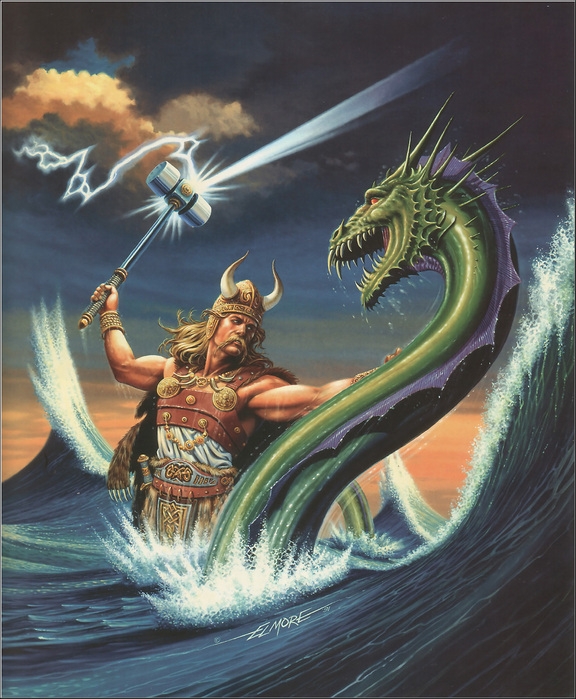
In this aspect the Thunderer appears as a defender of the world, for the world order is established by the Heavens, and the Sky preserves it, preventing violations. Therefore Perun is the protector of Prav and Yav from Nav, and Thor guards Midgard from giants. The middle world is thus regarded precisely as the realm where those laws operate preserved by the Thunderer.
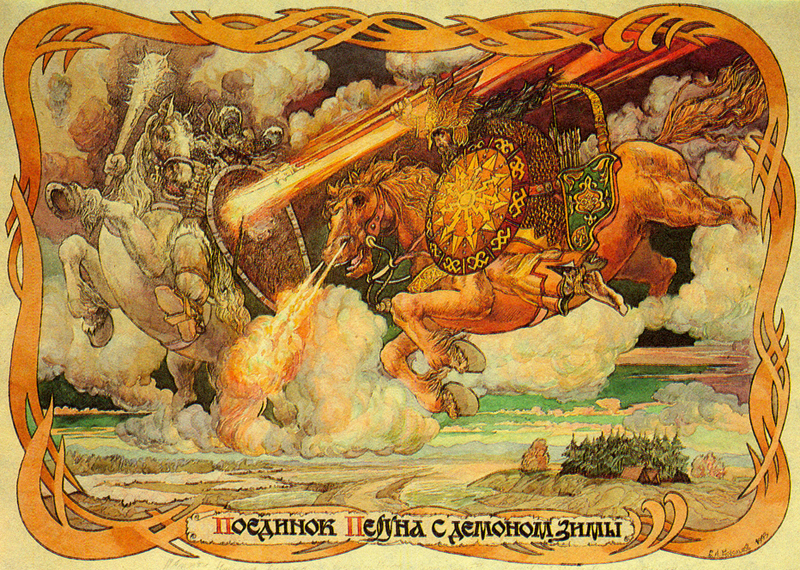
Besides its separating function, the Sky also serves as a conduit — through it, transformed, the power of the Heavens reaches the earth. In this aspect the Thunderer acts as the Bestower of life; it is he who turns the fertilizing but formless power of the Heavens into a concrete stream of Life. He is regarded as the originator of celestial fire which, descending to earth, gives life. With the coming of spring warmth he fertilizes the earth with rains and draws forth the clear sun from behind the clouds. Through his efforts the world each time seems to be reborn.
This same function of the Sky is reflected in its genealogy: it is the result of the union of Sky and Earth (for example, Thor is the son of Odin and Jörd, Perun the son of Svarog and Mokosha).
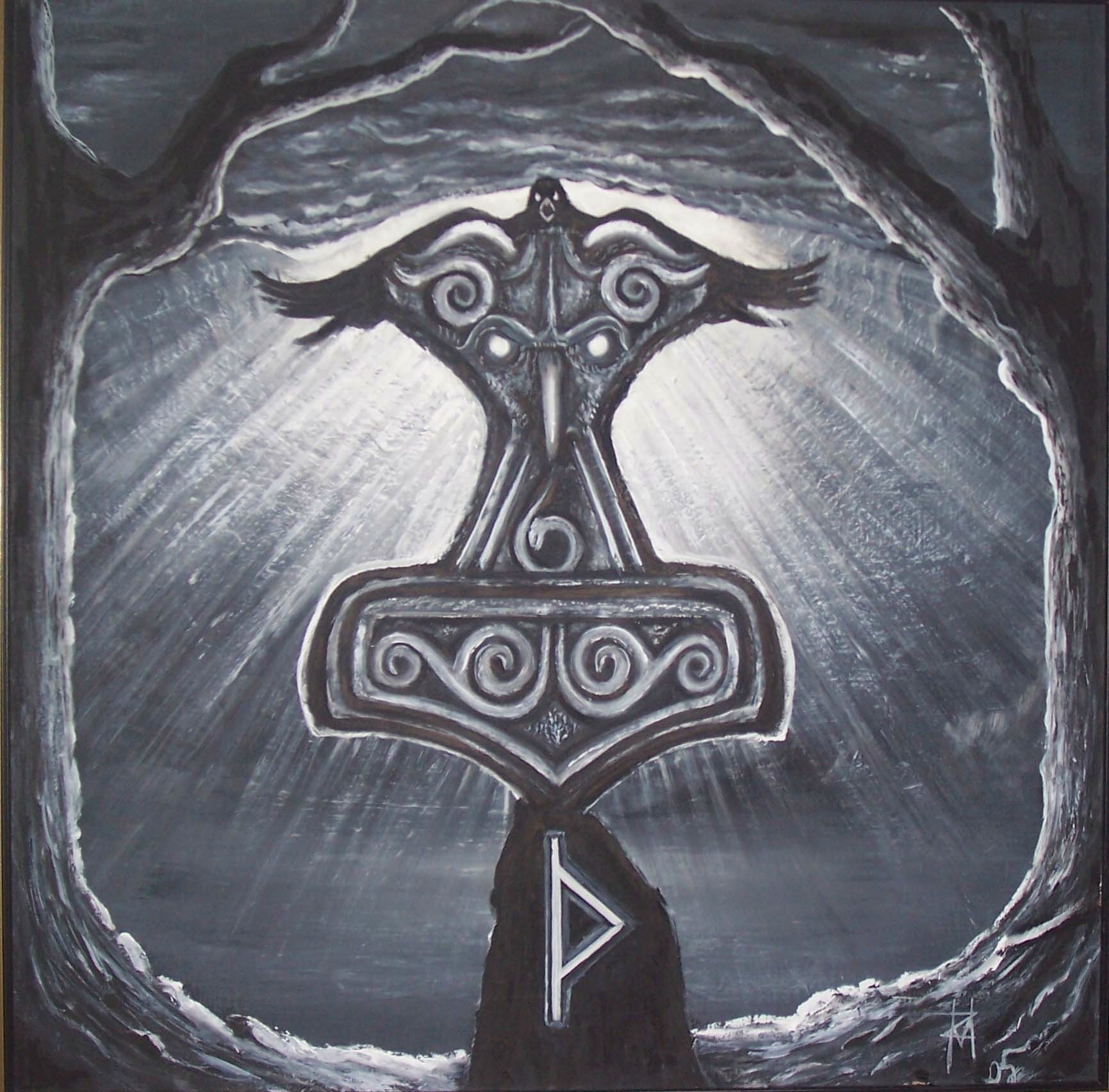
A characteristic trait of the thunderer is his binding weapon, which is, on the one hand, a striking weapon and, on the other, a sacred unifier: according to legend, Perun’s lightning was of two kinds: lilac-blue, “dead,” deadly, and golden — “living,” creative, awakening earthly fertility. The same is true of Thor’s Hammer — it not only smites giants but also “consecrates” the food of the gods and their oaths.
Despite the Thunderer’s “fertilizing” power, power alone is useless without the second (the “Velesian”): for the fertility of the earth both the “vertical” and the “horizontal” components are needed; for birth it is necessary not only to impart the spirit (to bring it down from the Heavens) but also to form the body (that is, to shape and organize matter).
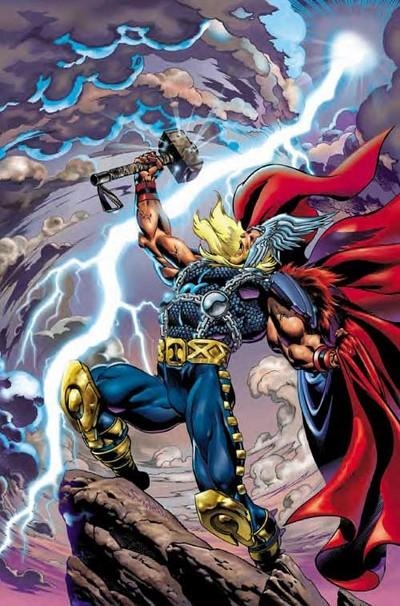
Regarding the earthly world, the Sky acts as the supreme authority. Therefore an important attribute of the Thunderer is precisely his sovereignty. Perun was called “the princely god.” He is the patron of princes, symbolizing their authority. In famous treaties between the Slavs and the Greeks it is recorded that warrior-princes swore oaths by Perun, and Veles appears only secondarily in those treaties.
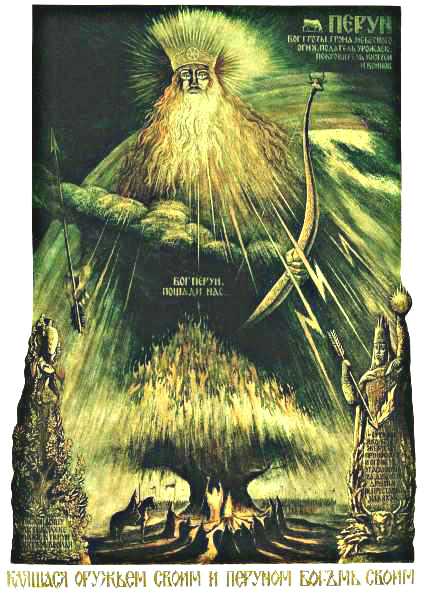
The flower of the Thunderer is considered to be the blue crocus (six violet-blue petals, the thunder-sign). On Perun’s Hill in Kiev there stood a wooden idol representing Perun, with a silver head and golden moustaches. A red beard is an indispensable trait of the god of thunder among many peoples. A similar image existed in Veliky Novgorod. Russian tradition endows the Thunderer with a club, a whip (in the ritual lament on Vasiliev Day — January 1), a bow and arrows (in Belarusian tales).

Perun’s shrines are arranged in the open air. They take the form of a thunder-wheel; in the sanctuaries excavated by archaeologists the “petals” usually number eight, but in the most ancient times, according to scholars, there were six. In Novgorod there was the most famous Perun sanctuary in Rus’, built in the form of a wheel with six spokes — the thunder-sign. The thunder-sign was carved on every Slavic house as protection against Perun’s lightning.
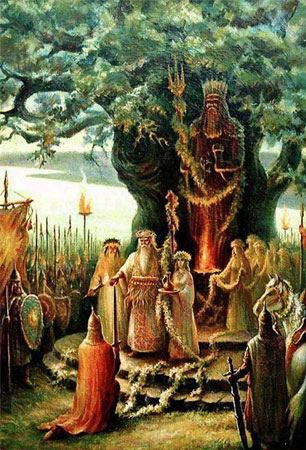
In the center there stood an image of Perun — an idol (kapish). In front of the image was an altar. Offerings were placed there and sacrificial blood was poured out: animals, children, and captives were sacrificed. An oak was dedicated to Perun (and to Thor), from which, according to tradition, living fire was obtained; solemn oaths, for example in the conclusion of treaties, were sworn by his name.
Perun’s day is Thursday (Thor’s day among the Germanic peoples), and the period from July 20 to August 2–4. Perun’s day is also observed on June 21. His metal is tin, his stone is belemnite (the devil’s finger — Perun’s arrows), sapphire, lapis lazuli; his trees are oak and beech. An oak struck by lightning was especially venerated, and amulets, staffs, wands, and arrows made from it were considered the best guardians against Nav.
The symbols of Taranis are the triskele, the spiral, and sometimes the wheel, which links him to Jupiter. To this day customs dedicated to him survive in the form of breaking glass or rolling burning wheels downhill.
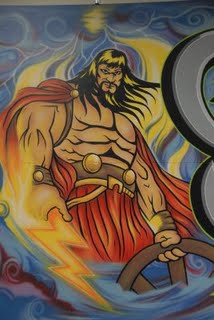
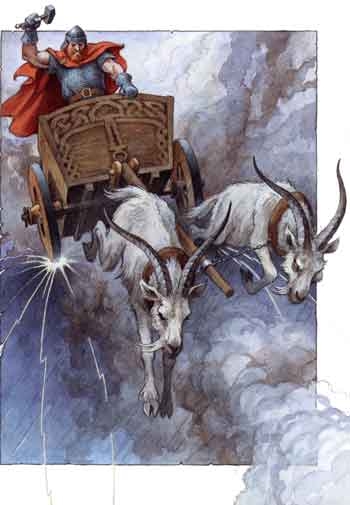
Perun’s chariot is drawn by winged stallions, white and raven-black. Thor’s chariot is drawn by goats (gnashing). Both horses and goats likewise express the dual power of the Sky-God — on one hand force, on the other fertility.
Thus the figure of the Thunderer is part of the great foundation of the cosmos, necessary for the separation and union of Sky and Earth, since separation and union are two sides of the same process, the process of ordering of chaos.
Thank you very much for such interesting materials. I visit you repeatedly – and always with great pleasure draw so much interesting and unexplored. Such interesting truths are revealed, it is written so wisely. Thank you again for your wonderful site.
With respect.
Thor protects Midgard and Asgard from
the chthonic Forces of the Jotuns, right now,
it’s winter and strong frosts can destroy all life, therefore right now Thor hunts the Jotuns, the harsher the frost, the fiercer the battle of Thor,
very soon it will be Thor’s battle.