
Overcoming the Abyss
We have said that all ideas are binary, and that it is precisely the increasing degrees of mutual reflection between their poles that form the evolutionary ladder of concrete states from chaos to the ideal cosmos; it is binary nature that creates the potential difference necessary for manifestation. That is why every Way is paired with two Abysses (“Abada“, אבד) — at its beginning and at its end. In fact, the Abyss’s consciousness is the unsupported consciousness of Dreaming, and in this sense the chasms are a completely unordered, groundless, and unsupported state of the Interspace, the “underside” of the Interworld, just as the Interworld itself is, in effect, the underside of the worlds.
As states, the chasms correspond to the mind falling into a one-sided affirmation of one pole or the other of an antinomy. In other words, emphasis on any pole of the binary draws one into its one-sided assertion, continuing to infinity, with no possibility of moving to the other pole to neutralize it. If the Traveler approaches any of the principles in an overly one-sided way, destabilization and destruction await him.
The Magus meets the first Abyss when he first sets foot on the Way. It turns out that the world of men and the world of Magic are founded on completely different principles, and an evolutionary transition between them is impossible. The Abyss itself requires total entry into the Way, not merely an intellectual “understanding” of it, nor a simple “call of the heart.” At the same time, a one-sided development in the Magus of the principle of Intelligence, as well as in the principle of Feeling — the binary driving forces of the Way — destroys him in the corresponding aspect of the Abyss.
Thus, a one-sided development of intelligence in someone on the Way of understanding leads to his differentiating activity being taken as the sole creative principle. The inner meaning of content yields to formal meaning, and the striving for harmony is replaced by the chase after the illusory neatness of abstract constructions. Ordering and systematization, once in a functional position, turn into ends in themselves, capable of justifying anything. Everything outside these narrow bounds is not only rejected, but its very possibility of existence is denied. The assertion of individual forms and any coupling of them into systems lose all living meaning and become speculation devoid of any real sense. At the same time, Apollo’s crystalline clarity degenerates into lifeless ossification, into the deadening of the whole being.
At the same time, the Way of the mystic, of the dreamer, when developed one-sidedly leads to the principle of Unity, which nourishes life, being taken as the sole principle, while the principle of form is left without independent justification. The tendency toward unity attempts to realize itself apart from the action of organizing principles. Everything that constrains movement, even that which should make its flow directed and ordered, is not only rejected, but its very right to exist is denied. The whole organizing side of nature, all differentiating forces and processes, is declared purposeless. The Dionysian sense of participation of all living things in a common source of life and the feeling of the unfolding universal unity in multiplicity loses all real living content and becomes a negation of any manifested being. Detachment from the intelligent principle entails complete unfitness for real life.
The Second chasm appears when the Magus’s knowledge, experience, and achievements stand in his Way, paradoxically drawing him away from Power. Here the same binary of the Primary Principles of the Psychocosmos is at work. This Abyss is the confrontation between Power and the Magus’s powerlessness.
Note that this Abyss (Tehom) is precisely the nothingness, the chaotic space, which appeared when the primary creative potency of the cosmos arose, when “heaven” and “earth” (the Transcendent and Immanent faces of the One reality) were separated. It is of this Abyss that the second verse of Genesis speaks: “Now the earth was formless and void, and darkness was upon the abyss.” In other words, the Abyss is the force opposing Creation, which prevents it from unfolding uncontrollably, a force of annihilation — a vacuum formed after the separation from primordial Darkness (Choshekh) of the creative potencies (Heaven, Shamaim).
As he ascends in the understanding of the cosmos’s structure, the Magus discovers ever deeper, more general ideas in his mind. At first, under their influence, all material accumulated by previous experience is successively organized into systems that increase in order and beauty. But then comes a period when a further elevation of the mind’s hierarchy inevitably entails the need for a fundamental breaking and reconstruction of earlier constructions. Each such rupture is an experience of death and rebirth. The chasms opened in the mind spontaneously engulf all that was previously achieved; the creative task of producing new, deeper systems proves beyond one’s strength, and the Magus’s principal enemy in this case turns out to be the Way he has already traveled.
Overcoming the Abyss by evolutionary progress alone is impossible. There are no bridges across the chasms. The Demon of the Abyss does not sleep and will not allow a mere imitation of crossing it — one can reach the other side only by jumping into the chasm, descending to its bottom, and, pushing off from it, passing through the Horns of the Demon to emerge victorious.
In the case of the First Abyss, the overcoming is achieved by entering the World of Magic without reservation or expectation. It is important at this point not to fall either into the blind pride of understanding — the Apollonian aspect of the Abyss — or into the beatific idiocy of “all-unity” — its Dionysian aspect. Only by subordinating Intelligence and Feeling to the principle of Will does the Magus avoid at this stage becoming either a powerless philosopher or a mad sorcerer.
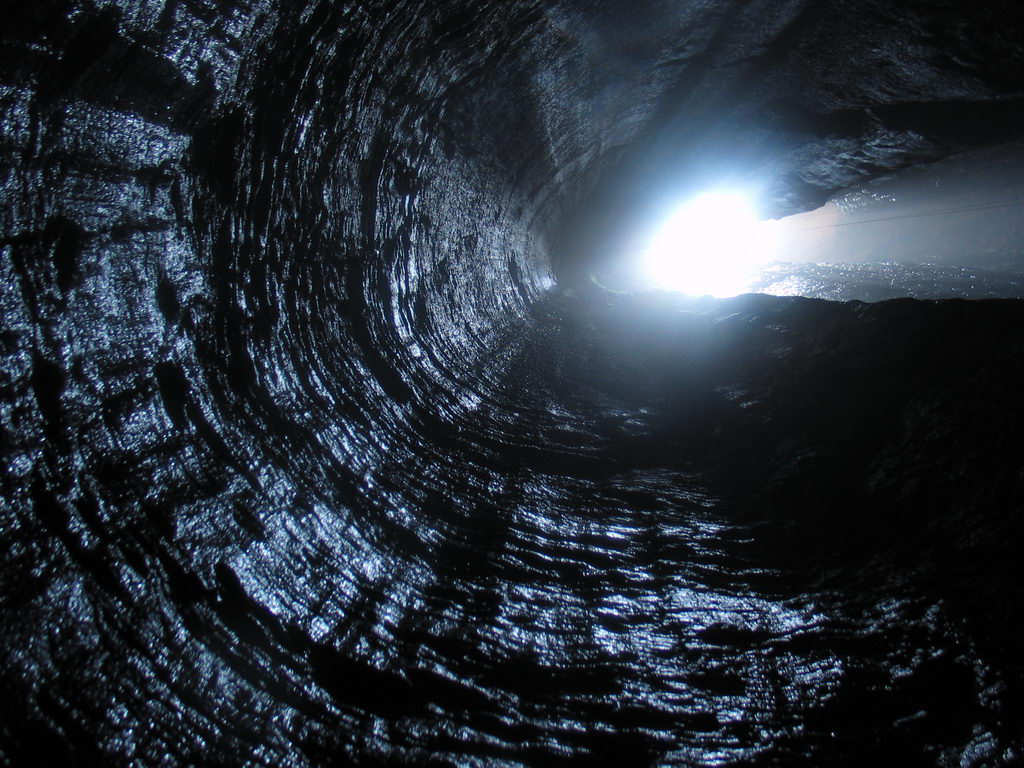
The Second Abyss is far more serious. In addition to the encounter with the Demon of the Abyss, the Traveler meets there the Initiatory Forces of Daath, and both are encounters with death. The Demon of the Abyss confronts the Traveler with his past, destroying the personality through a feeling of its deficiency and imperfection, while the Hierophants set the Traveler face to face with his Archetype, and destroy the personality by revealing its incompatibility with that Archetype. Only by fully accepting himself and his Way in the full measure of its imperfection can one overcome this chasm.
However, few reach the Second Abyss, and even fewer cross it. If overcoming the First chasm makes a person into a Magus, then overcoming the Second transforms the magical Traveler into a Master.
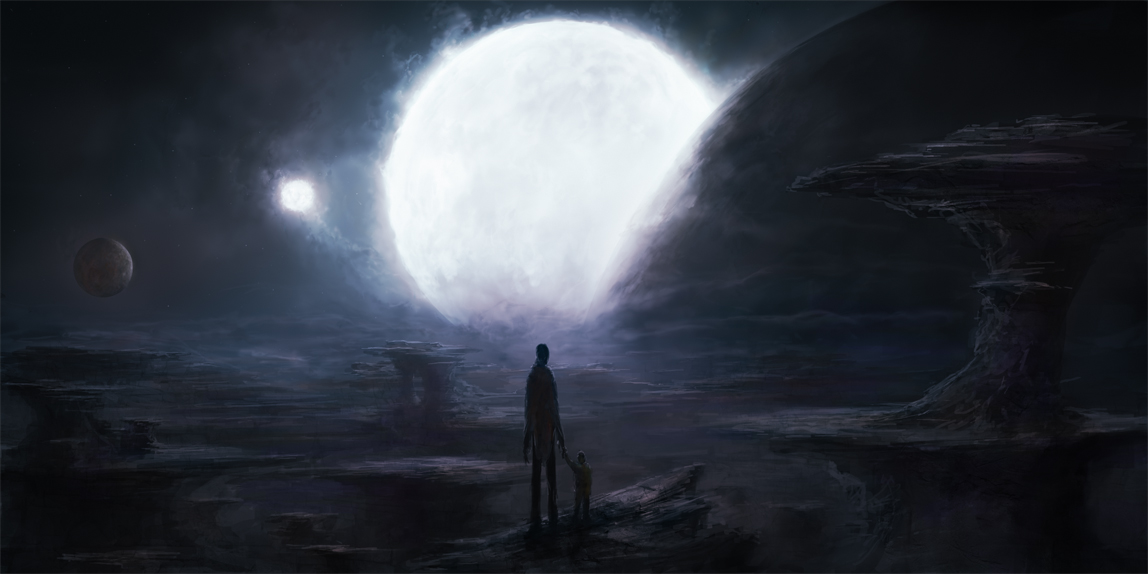
Overcoming the First Abyss this way is a synthesis of world contradictions through identifying them within oneself with the subsequent merging of those biners into units of higher order, all the way to obtaining wholeness, unity, if one can say, obtaining the Self. Overcoming the Second Abyss implies renunciation of oneself for the sake of the Self. And here my mind refuses to try to understand further. The magician is a self-sufficient power at the boundary of world contradictions. The master – an impersonal power…???
Yes, tell me, who is the Master? Is he no longer a Magician?
Transitioning to the next level does not imply the denial of the previous one. In a way, the magician is no longer a human. But he exists and acts accordingly in the world of humans. One can also say that the master is no longer a magician, but that does not mean he leaves the world of Magic.
Essentially, being in the abyss gives the consciousness a new birth. Therefore, why not draw strength from there. Not to be these abyss demons ) Generally, the description of the Abyss Demon resembles Charon or Veles. You can indeed address it if you really wish to visit there)
Veles is a god, not a demon, and even in his dark aspect, he is benevolent and evolutionary; the Demon of the abyss, on the other hand, is entirely destructive, interaction with him cannot yield strength, although victory over him is certainly one of the most important victories for an embodied being.
Tell me, if it failed to immediately overcome the second abyss, is there an opportunity to make a second attempt?
An epiphany came to me when I thought again about the Ehwaz-Sleipnir runes; perhaps it could carry the rider over the First Abyss, I just need to direct Sleipnir inward, clearing the Path before me with Thursiaz…
‘Only by neutralizing the binder Mind-Feeling with the BEGINNING OF WILL, does the magician at this stage risk neither becoming a powerless philosopher nor a mad sorcerer.’ Enmerkar, I need help. If I firmly set goals and force myself to go, despite the feeling of ‘not wanting to live’, how can the ‘beginning of will’ be awakened?
Do not force. The will is not in violence. The will is in allowing. You need to allow yourself to be. Allow yourself to be yourself, not someone else, yourself. Moreover, both components are important: you need to allow yourself to be, and – allow yourself to be.
Hello! Could you please tell me what force so frightens a person into being themselves? Is it a parasite of awareness, or something else?
Can an adept try to cross Daath a second time during one incarnation? If the first attempt was unsuccessful.
Perhaps you are talking about crossing the Abyss? Since Daath is not a “place,” but a state, the force of attraction of Chokmah and Binah.
And if we are talking about crossing the Abyss, then it is not something that can be “attempted to do”; it is a necessary process that follows the very logic of development. And an “unsuccessful” attempt in this case means death and dissolution in the Abyss. If this did not happen, it means that the “attempt” has not yet occurred, that contact with the Abyss and the Horizon has not yet taken place, and therefore – when the time comes – it can still take place.
Maybe I didn’t understand something… So I will clarify. From your book “The Paths of the Mage. The Fall of the Guardian” it seemed to me that you tried to cross the Abyss, but unsuccessfully, while remaining alive. Did I misunderstand what was presented in the book?
No, I didn’t try to do anything specifically 🙂
Thank you for your response. I read the book again for better understanding.
“Asking about experience (hal) is absurd, because experience is the destruction of speech” – said Sufi thinker Al-Hujviri many centuries ago. ___ Experience occurs within the human being, activating the entire complex of their visible and invisible components. _ A person is capable of perceiving the very experience of another being in all its entirety. To enter into past events. Outside of words. This is a different form of communication available to a person under certain circumstances. A potential ability, like a seed that needs the necessary nutrients for sprouting. One could say – Arcanum.
If it’s not a secret, tell me Enmerkar, did the Great Abyss Demon also pose riddles during your passage?
What do you think is meant by a sacrifice for the further path?
Currently, the Great Demon of the abyss Yaldabaoth is the Lord of a group of hell worlds. Upon meeting, he asks three trick questions. Anyone who answers correctly dedicates himself completely to the Great work. Since there is much work in the worlds, the place of residence will depend on the necessity of the one who has passed.
If you are needed, a throne in the form of a star will be offered.
He helped restore natural balance in several worlds.
Regarding Drivers, I am not sure, but later I encountered huge glowing beings in the form of humans, who called themselves the people of Aifa (Eifa), and yes, their task is to manage the flows of worlds.
P.S. By the way, the main task of archons (Archontus) is to consume excess shadow. They are like “sanitizers of the forest”; where there are many shadows, they are there.
Regarding the properties of the Abyss, I have figured it out, thank you.
Wishing everyone successful development.
Clear and straightforward. An important beacon article. Thank you.