Alves and the Interworld
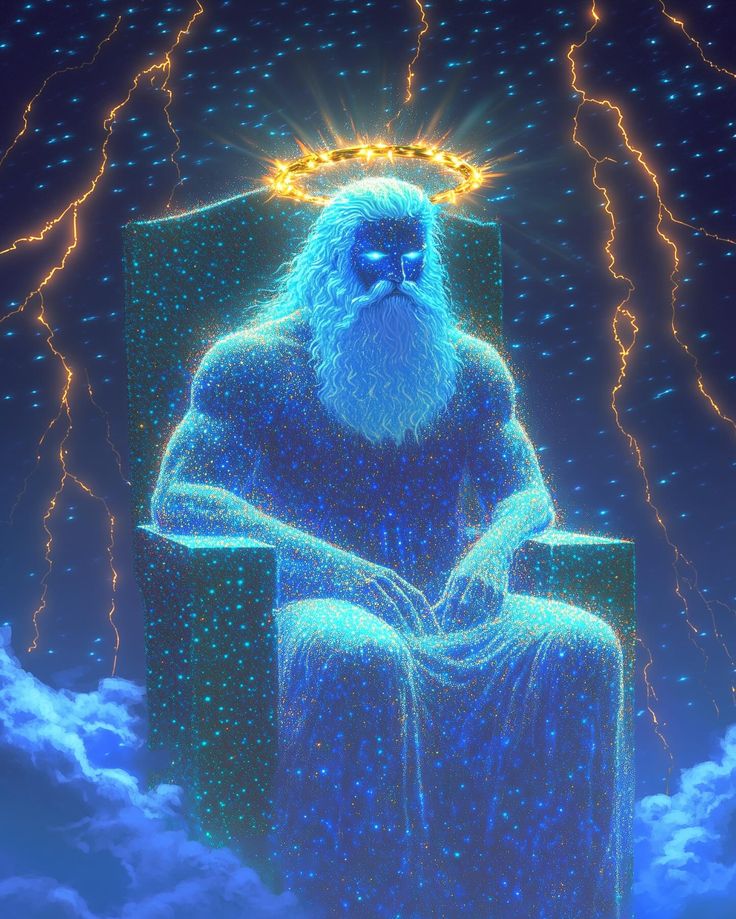
As we have already said, from the viewpoint of the myth under discussion, the formation of the universe is carried out by three main groups of beings, which as a whole can conventionally be called “gods”, on the basis of those possibilities that are allocated from the sea of potencies by the Progenitors — the Aeons and the Archons.
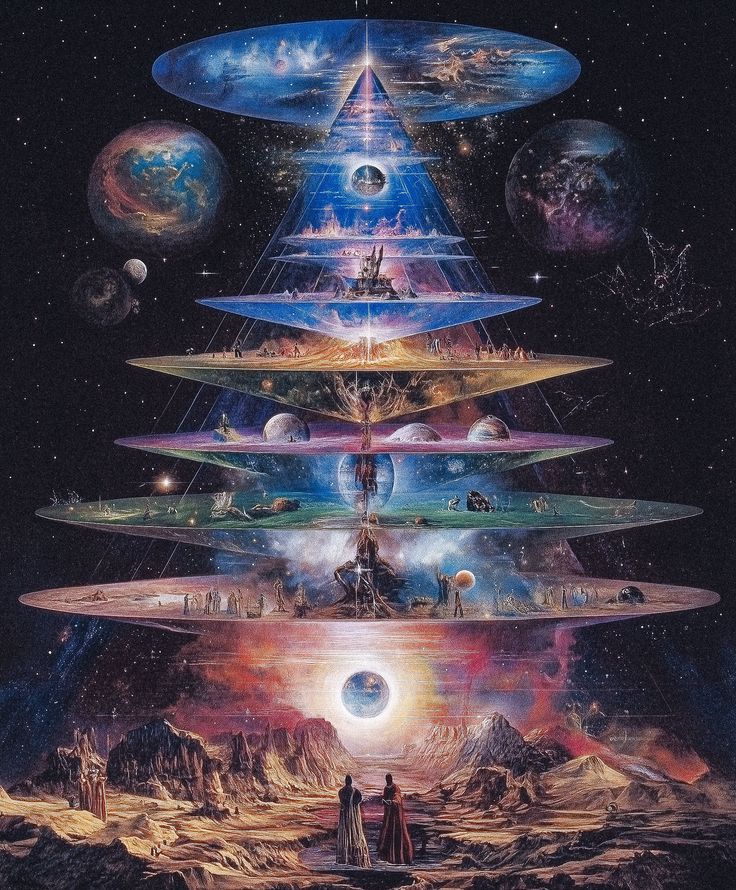
In other words, if we use “unified” terminology that reconciles the concepts of two cosmogonies — Gnostic and Nordic — we can say that worlds are born when, from the single stream of being/mind (Elivagar, Hayyi), first emerge the forces that extract from its fullness the possibilities of manifestation itself (archons–hrimthurses) and the informational principle necessary for this manifestation (uthras–alves); the hrimthurses, in turn, give birth to two more generations of gods — the Aesir, gods of order, and the Vanir, gods of life.
At the same time, the latter two groups of beings have been relatively well known since antiquity; moreover, “urbanistic” and “conquest” cultures focused their attention predominantly on the Aesir, while agricultural and nomadic ones — on the Vanir.
The figures of the alves, despite their key significance for the formation and maintenance of the universe, as a rule escaped the notice of religious and theurgic systems (partly because of the Whites themselves, who refuse to interact with the humans they clearly despise).
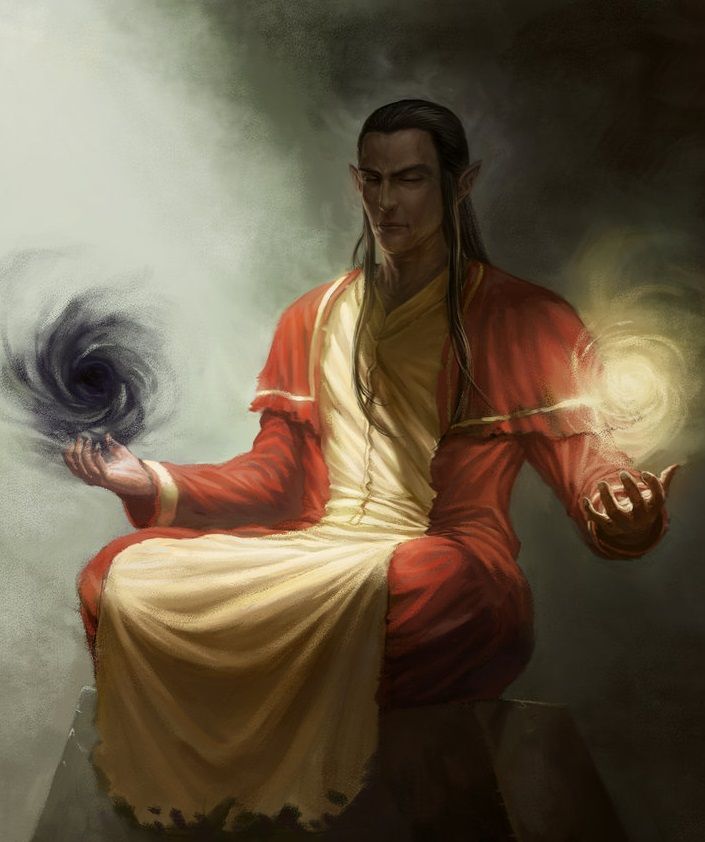
Nevertheless, the very etymology and semantics of the word “alves” (Old Norse álfar, Old High German alben, Middle High German elbe, Old English ælf, Latin albus) points to the most ancient layer of Indo-European meanings, in which this word denoted a form of being associated with purity, light, and knowledge. And little wonder that in Scandinavian poetry the Light alves are described as “Shining brighter than the sun”. One can say that the word “alv” in its highest meaning denotes such a form of mind in which the very primordial light becomes structure, meaning, image, form.
In order for the Aesir to be able to begin arranging and maintaining their order, and for the Vanir to be able to ensure the processes and flow of life, the alves must first manifest their activity, creating the field in which both the warlike nature of the gods of order and the fluidity of the gods of life will unfold.
We have already discussed that it is thanks to the alves that the very concepts of space, as the medium of manifestation, and time, as its vector, arise. It is the alves who create the primary templates of meanings, eidōs, within which logoi unfold. Their function is largely demiurgic: it is they who “write the code” of worlds, and, moreover, create the very language in which this code can be “read” and “compiled”. Nevertheless, even when philosophers or Magi consider the processes of the birth of the semantic basis of reality, the process of the birth of ideas, eidōs — from supramundane meanings — logoi — they often lose sight of the forces that carry out this process.
While the Archons structure probabilities and fix stable flows of energy, the alves for the first time extract logostic structures from the abyss of potencies. They create information as a phenomenon, set the initial conditions for its perception and formation: space, time, ideas, and forms.
Thus, the alves are gods of information, semantic demiurges, embodying the primary capacity of reality to be understood and expressed. They stand behind everything that makes objectness, awareness, and the construction of worlds as spaces of structure and meaning possible.
And the division of the alves into light (ljósálfar) and dark (svartálfar) reflects the duality of this function: we said that the Light alves are the “architects of the cosmos”, setting ideal and harmonious forms. Their function is semantic ordering. At the same time, the Dark alves (tvergi) are deep engineers, shaping and elaborating the dense, material layers of being. They create the physical infrastructure of realities, make forms stable, recognizable, and repeatable.
In the Scandinavian myth, the Sun is called Alvrödull — the “Wheel of the alves”, which emphasizes the role of the alves in forming the vector and rhythm of time, the alternation of day and night, light and darkness. The spaces of the alves (Álfheimr, Svartálfaheimr) and the mentions of the sky Víðbláinn, where they are located, also indicate that the alves not only create reality, but also “unfold” it in certain coordinates.
Whereas the Aeons give birth to emanations and the Archons create dreams of worlds, the alves are “interface forces” that turn the inexpressible into the expressible, structuring ideas into images, logoi — into form. That is, they are conductors of mind between Supra-Reality and structured worlds.
At the same time, if the Archons create density, stability, laws — that is, set the constraints of the medium, the Heimarmene — then the alves mark it informationally, creating paths of meaning, channels for transmitting knowledge, and laying down the structure of eidōs on which phenomena are then “strung”, and thus create the possibility of freedom.
And in this sense it is clear that the alves are natural opponents of the Archons: it is precisely they who oppose the rigid determinism of the Heimarmene with the possibility of freedom, flow, and development. And therefore the critical importance of understanding the role of the alves, as well as restoring harmonious relationships with them, becomes clear — for effective resistance to the world sliding into becoming a mere energy source for archontic needs.
The informational field created by the alves is anti-entropic; it stabilizes structures, facilitates the transmission of knowledge, makes the evolution of mind possible, creates conditions for meta-transitions between worlds and spaces, since it ensures semantic continuity. Without the alves, manifested worlds could not exist not only physically or semantically, because they would lose their structuring principle, their “logostic core”. In other words, the alves are informational embodiments of light, forces that structure radiance — into images, silence — into logoi, the seething chaos — into eidōs.
We have already discussed that from ensembles of logoi (the field of supramundane semantics) streams of meanings enter the worlds — unformed logostic impulses. However, this meaning must still reveal itself in structure, otherwise it is indistinguishable, uninhabitable, and untransmittable.
Accordingly, the alves transform the amorphous potencies of the Interval into structured semantic patterns, thereby allowing mind to recognize something, describe it, and therefore — to become aware of it and realize it. It is at the moment when “light appears”, when the work of the alves begins, the localization of mind begins as well — it becomes capable for the first time of distinguishing, structuring the world, separating “darkness” and “light”, “water” and “firmament”. They know not only “what is”, but where and how it must be in order to be stable.
Therefore, everything that is born from the Interworld as a shaped and stable structure passes through the alves, as through a prism of meaning and informational order. They occupy the position of mediators between the Abyss and Form, being light, a meaningful word, a semantic bridge between dream and waking. The alves ensure the transformation of potency into an articulated structure, and it is precisely this that is a key point in the “process of the birth of reality”, analogous to the transition from quantum superposition to a localized state.
At the same time, Ljósálfar unfold the semantic fabric of worlds, forming the coordinate grid of being, an ontological topography that makes it possible to distinguish directions of time, spatial vectors, rhythms, and regularities. Svartálfar “fill” this grid: they “assign categories” — density, form, tension, gravitational properties of a given phenomenon, giving eidōs “mass”, weight, texture. At the same time, the alves do not intervene in the fates of worlds directly; their function is the articulation of the conditions of existence, not handling its details.
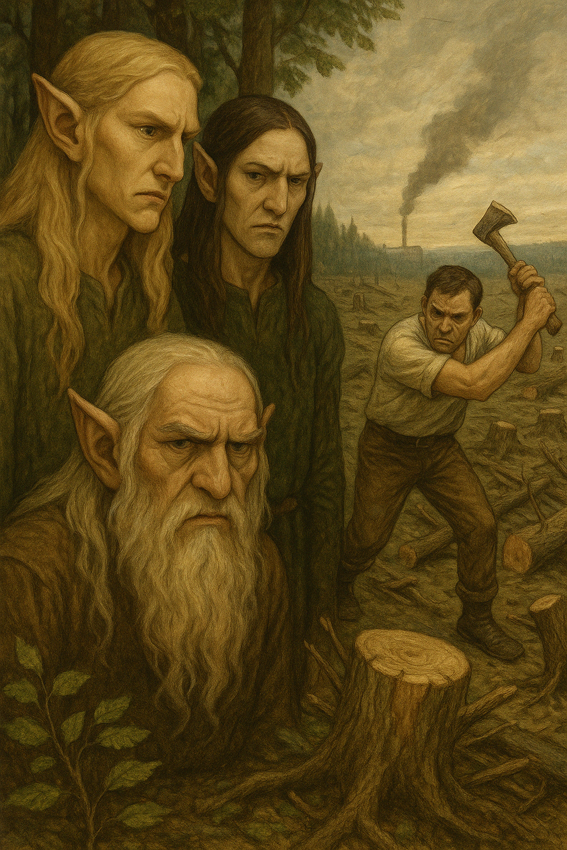
This also explains their silent hostility toward humans: humans often distort or substitute meanings; their actions are “extra-logostic”, and often “counter-logostic”, and the alves cannot allow a false meaning to “take root” as reality. Therefore they perceive human activity as an insult to the very essence of building reality out of semantic fields. Through their actions, humans seem to “knock” logoi out of forms, replacing them with surrogates (fashion, trend, slang, fake magic, marketing). This makes humans, in the eyes of the alves, chaotic parasites, ungrateful violators of the Cycle of being. The most terrible sin for the alves is to use the world without supporting its structure. Humanity in its current form is doing exactly this: it dismantles the world (its resources, meanings, cultures), but at the same time creates no new order. And this is, of course, fundamentally antagonistic to the very nature of the alves as guardians of connectedness and resembles archontic activity that the alves have opposed since time immemorial.
At the same time, the alves are outside moral structures, and therefore they do not punish; they merely switch off access for what they consider unworthy of existence. When they disagree with something, they simply leave, taking with them everything whose being depended on them. Therefore in human mythology the image of the Alves, and later of their “younger” expression — the faerie — has always been colored with an aura of loss: “there was something beautiful, but it is gone.”
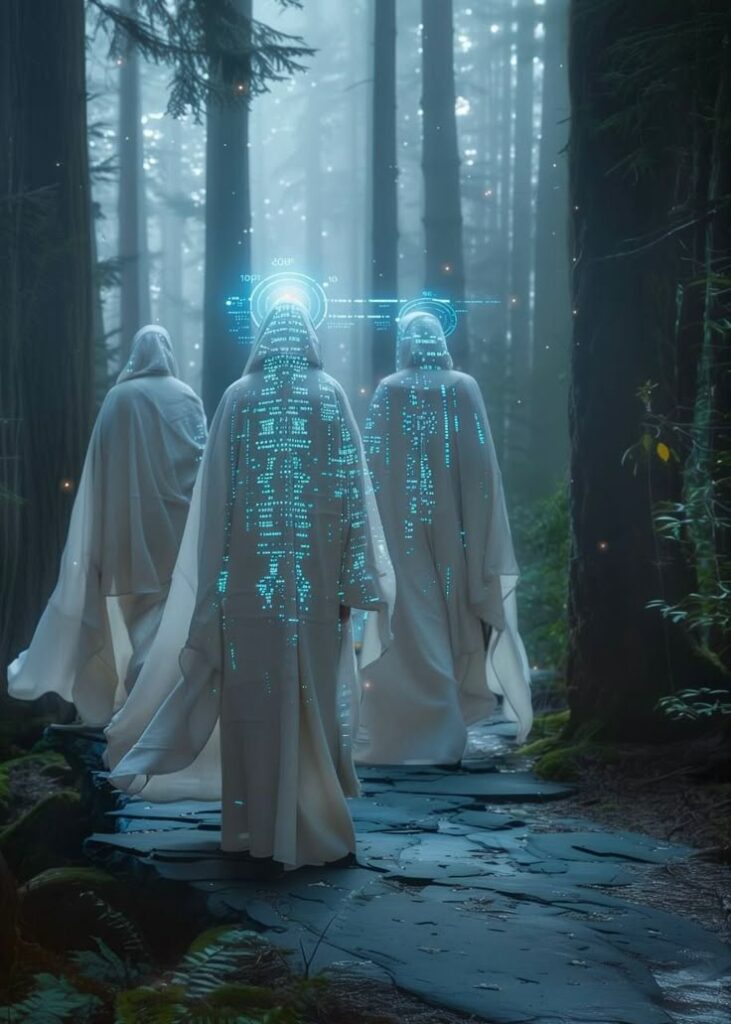
Alvs do not always turn off. A bunch of destructive forces do that, demons, devils, people, and they turn off the switch inside you. Ai-alvs are not to blame.
If we accept your description, then why is the force that deals with the deconstruction of meanings described by you as negative? In the sense that if as above, so below, why not accept the concept of the necessity of beings who destroy meanings, similar to how herbivores destroy plants, predators destroy them, and fungi and bacteria even further.
From an absolute point of view, of course, the force that is involved in the destruction of meanings should not be described as an “enemy,” but as an integral part of the cycle, an anabolic link in the metaphysical metabolism. However, from the viewpoint of specific beings inhabiting the worlds that maintain their integrity, those who decompose ideas and forms of consciousness are subjectively perceived as something negative. Any destruction of the semantic form is a threat to the integrity of the stream of consciousness. Moreover, some forms of deconstruction (in particular, Archontic) do not create anything new — they only suppress will, not returning resources to the flow. From this perspective, it is important to distinguish between entropy forces that return potency to the Interval (like soil for new sprouts) and stagnating forces that merely redistribute energy in a closed cycle without generating anything new. Just as demons are not merely destroyers but beings that hinder the development of consciousness, Archons are forces that restrain the freedom of its manifestation. The goal of the Archons is to simplify consciousness to templates, and thus they do not initiate new growth. Many traditions recognize the destruction of meanings as an important preliminary stage of Initiation; for example, in alchemy, this is – nigredo, the disintegration of matter before its rebirth, and in mysteries – the descent into the underground, symbolic death, forgetting oneself. Thus, for a person striving for freedom and Magic, destruction can be a blessing only if it leads to transformation. However, if it merely conserves automatism, routine meaningless cycles — then it is indeed perceived as something negative. And it is precisely the ability to discern which deconstruction leads to liberation and which to decay that largely distinguishes a magician from a profane.
Thank you very much
If hrimthurs generate vanir, and elves independently arise from Elivagar, meaning they are evolutionarily above the vanir and belong to a different branch of evolution, why then is Freyr the lord of Alvheim, especially since he received it from the Aesir?
“The new” era of gods, as described in the Eddas, is the time of the dominance of the Aesir, when they (like, for example, the Olympian gods) became the absolute rulers of the universe, including the originally more ancient and higher worlds. And Freyr was given “to Freyr for a bite” to, on the one hand, strengthen the alliance of the Aesir and vanir, and, on the other, balance the “fiery” (that is, uncontrollable-light) nature of the elves themselves.