
Dodecada: Interdependent Manifestation
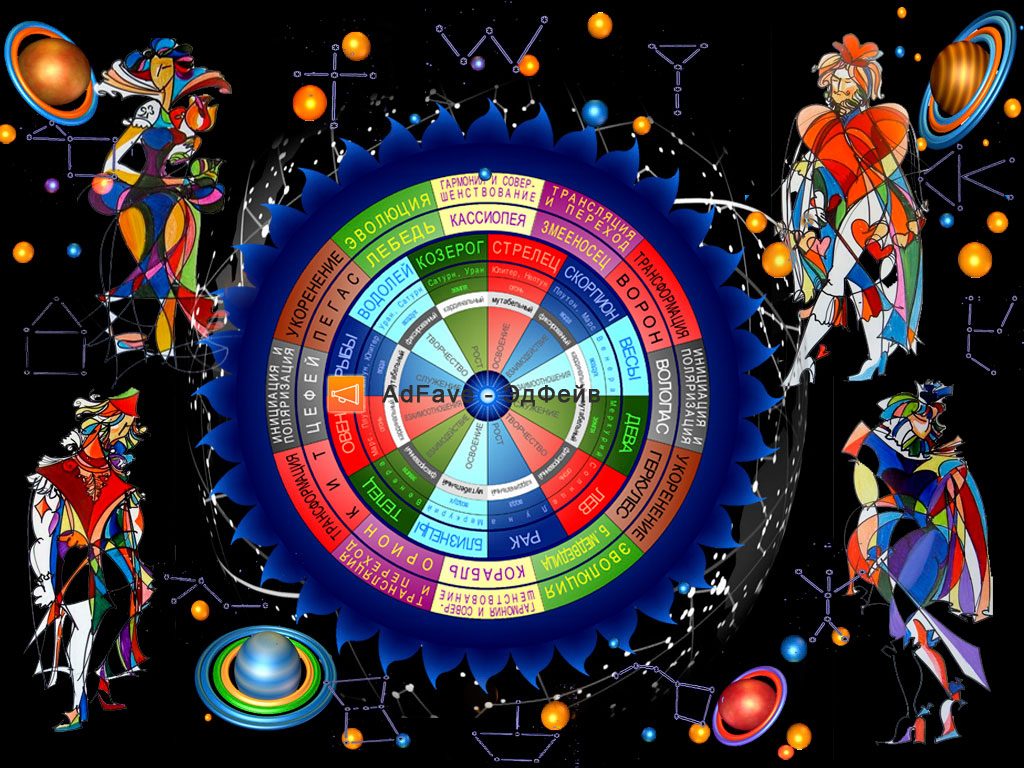
From the standpoint of the Myth we are considering, the manifest world is described as a projection of mind (“Spirit“) into the Medium (“Matter“), and from this standpoint it is represented as the superposition of the Triad of Primary Causes upon the Quaternary of embodiment, and therefore, in its full extent, is described as the Dodecada, a dozen manifestations.
Here the crucial distinction is between a volitional, purposeful movement and a self-sustaining, spontaneous process. Accordingly, the active, volitional, realizing action is regarded as Ritual — the octad, the Wheel of accomplishment, whereas the self-perpetuating process, Gilgul, samsara — is described as a duodecimal structure.
In fact, the idea of the Zodiacal circle arose precisely from such notions — the Primary causalities — Being, mind, Experience — plunging into the quaternary world become “entangled” within it, giving rise to a dodecade of “tertiary” forces — the “zodiacal“, “astral” influences.
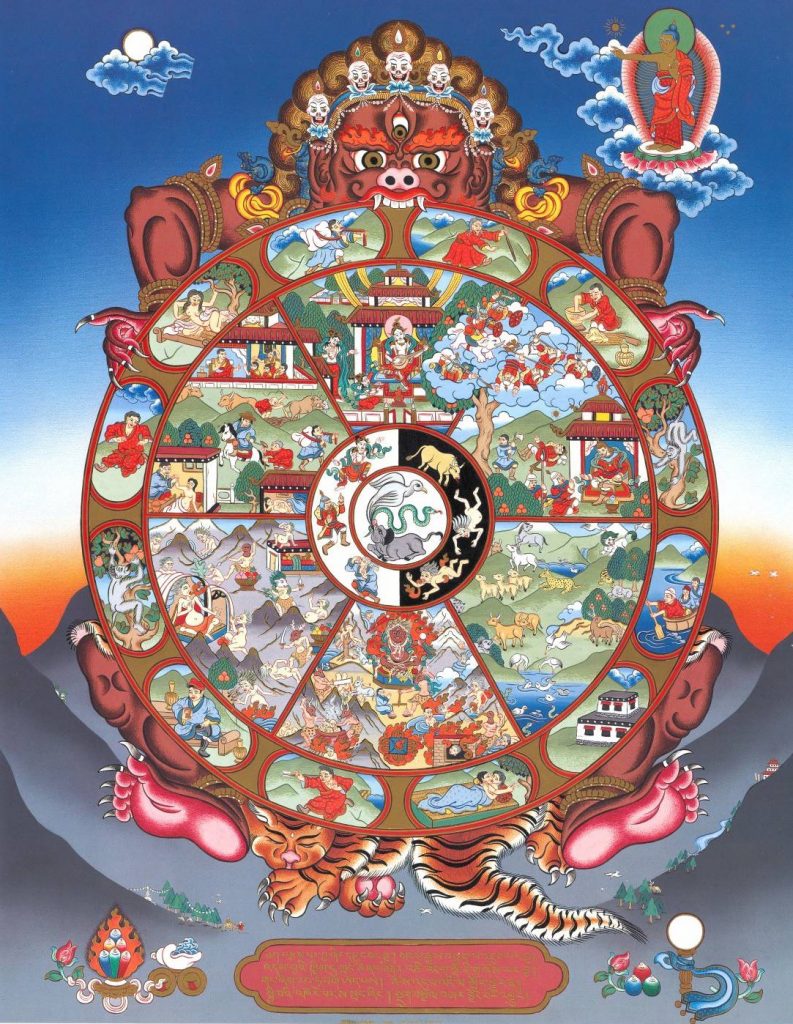
The idea of a duodecimal structure of Gilgul is most clearly reflected in the concept of “Dependent Origination,” formulated by the historical founder of Buddhism — Buddha Shakyamuni. According to this concept, the whole world-cycle rests upon 12 successive mutually arising, mutually conditioning and interdependent stages — the “nidanas“, and the force of their interconnection is so great that breaking it is usually impossible. Indeed, an illustration of this principle (“Bhavachakra”, the “Wheel of Being”) is depicted at the entrance to nearly every contemporary Buddhist temple.
As is usually the case, this principle can be considered on the macrocosmic level (unfortunately, discussion often stops there), as well as at the level of the looping action of any scale, and a clear understanding of this mechanism is extremely important for finding ways to “hack” it.
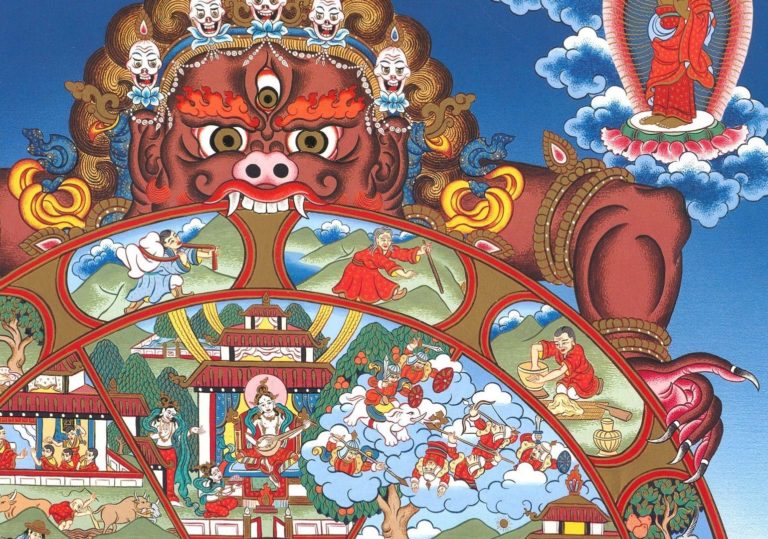
So, any Gilgul begins with “ignorance” — the mistaken belief that only this action will satisfy a particular need. The key error at this stage is a lack of understanding, analysis, and vision that the action itself is merely an instrument for self-knowledge. On the nidana diagram this stage is symbolized by a blind man who does not know where he is stumbling.
If this first error is committed, the next stage follows — formation, the development of a system of ideas, concepts, judgments applicable to and conditioned by the given action. This step is symbolized by the potter, shaping vessels from formless clay.
The process of developing concepts triggers a stage of cognitive activity aimed at their elaboration, which is symbolized by the image of a monkey leaping from branch to branch and gathering fruit after fruit.
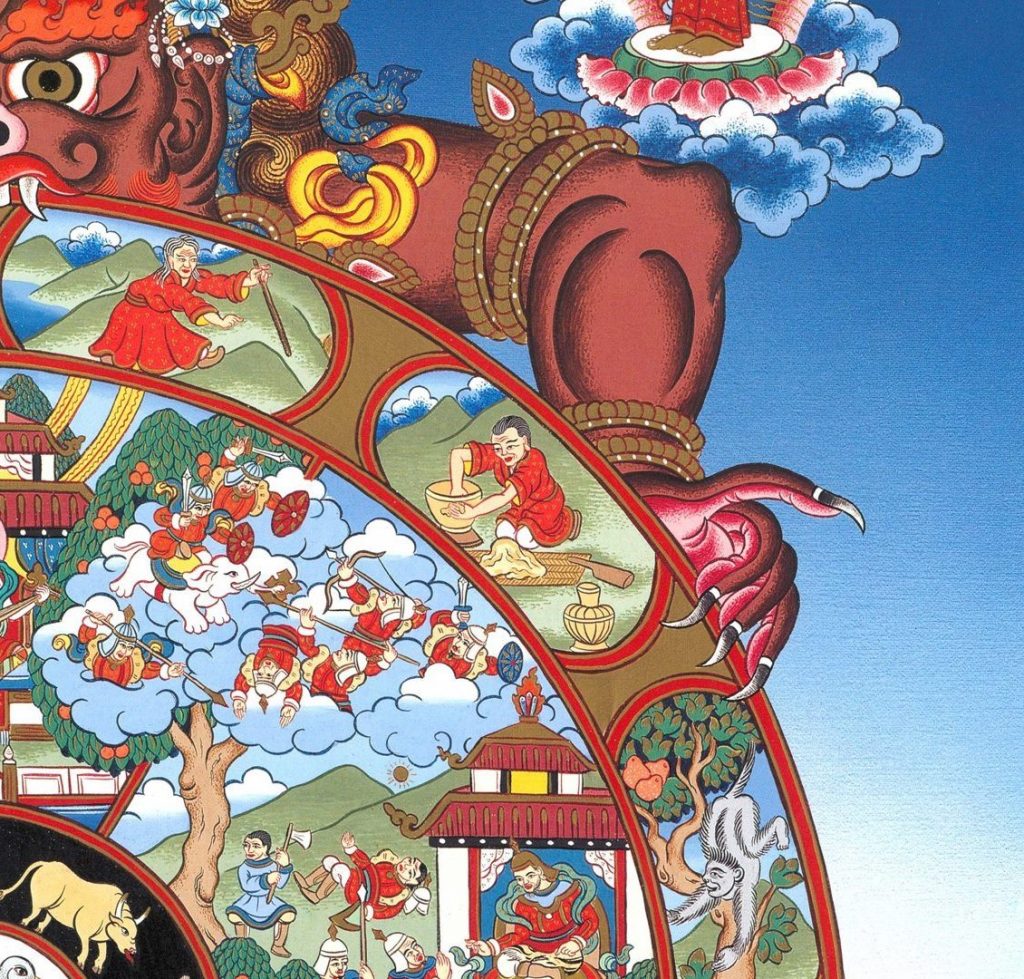
Once enough knowledge has been accumulated, a paradigm emerges — a glossary, a set of established notions, correspondences between concepts and processes, an “internal naming,” a private jargon characteristic of any established system. On the diagram this stage is depicted as a boatman in a boat (sometimes a person under a tree), corresponding to the formation of the “narrow world” of that action.
Within this private world its own laws and principles arise, its supporting structures, corresponding to the depiction of a house — a structure within whose walls there exists its own “separate” world with its own “order.”
However, no system can be completely isolated; additional interactions arise within it, and it must enter into relations with the surrounding world. As soon as the system perceives itself whole, it immediately begins to strive to extend beyond its boundaries, to spread itself outward (or to include something external). This stage is symbolized by the sexual act shown on the diagram.
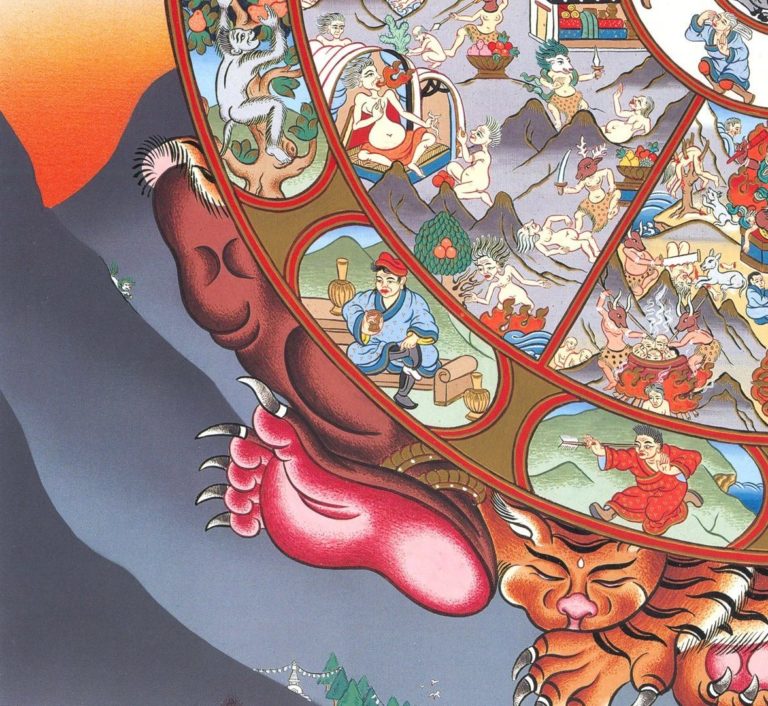
This contact is accompanied by more or less constructive sensations, yet because another party is involved, withdrawing from these interactions becomes difficult. This stage is symbolized by a person with an arrow in his eye.
It is clear that the active inner life of the system, together with its “external” interactions, becomes grasping in itself, which on the diagram is symbolized by a person drinking wine.
Accordingly, a fear of losing this attachment arises, an addictive dependence on it, a striving for ever greater “doses” — the attainment of ever new “goals” and “tasks” — the hoarding more results. This stage is shown as a monkey tearing off ever more fruit (or as a person stripping the orchard to its last fruit).
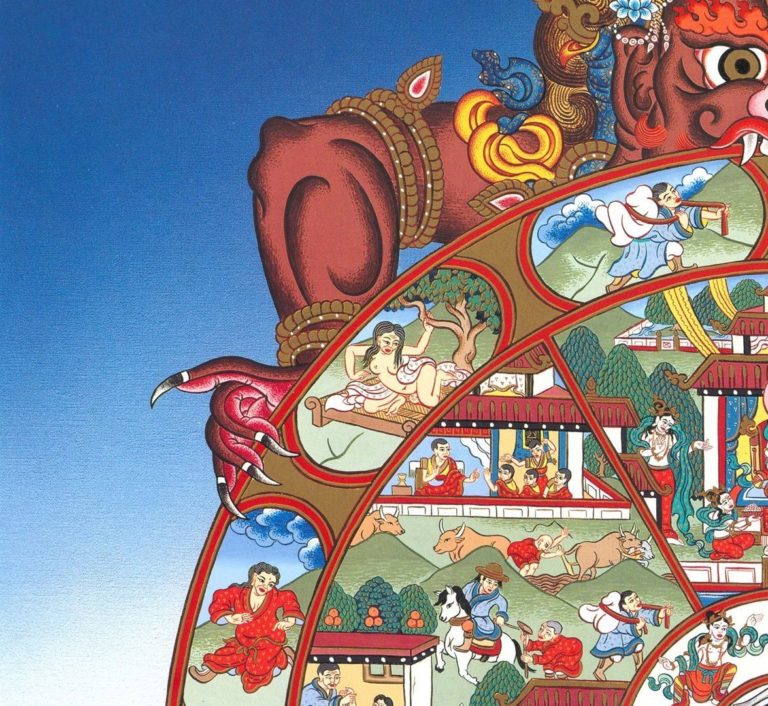
The expanding system becomes less centralized and less controllable; within it new “subsystems” and subprocesses arise, each of which gradually turns into an autonomous element. On the diagram this is symbolized by the image of a pregnant woman.
Eventually, the new systems are born into independent life, which leads to a redistribution of attention, and thus —
to the disintegration of the old system. These stages are respectively symbolized by the image of a woman in childbirth, and then an old man carrying a corpse on his shoulders. The cycle closes, mind turns to the search for a new activity, and everything repeats from the beginning.

It is evident that this scheme can be very easily applied to any process — from the existence of the universe as such to the birth of a new business or even simply a sustained occupation. It is no hardship to map the “life cycle” of a corporation or even the stages of an amateur gardener’s obsessional cultivation of his crop onto the nidanas.
In any case, the idea is that mind, by immersing itself in some activity, “loses” itself in it, dissolves in it, identifies with the actor, and from an “acting mind” becomes a barely conscious activity.
The transformation of the twelvefold system of Gilgul’s “self-enclosure” into the twelvefold process of the Great Doing is a direct consequence of a clear understanding of this system.
At the same time
ignorance is lived through as a “firing“, a processing by the “fire of wisdom”,
formation is transformed into dissolution, a liberation from forms,
the flow of concepts becomes differentiation, analytical activity,
glossary is transformed into union, the sense of the inseparability of the object and its naming,
a set of sensory perceptions becomes “decay”, the sense of the impermanence of all bonds,
contact is experienced as crystallization — the harmonious union of opposites,
sensation is transformed into nurturing, a proper expansion,
instead of attachments paths of purification are followed — the distillation of energies,
clinging transforms into fermentation, brewing — a hierarchical acceleration of evolution,
becoming provides the soil for “Exaltation” — the transcending of current qualities and states,
birth is transformed into multiplication — the process of accumulating activities, and finally,
instead of aging and death projection is achieved — the spreading of the properties of perfected mind beyond its “horizons“.
And the realization of each of the twelve stages of Doing proves most effective when the basis, the substrate through which each transformation occurs, is understood.

As I understand it, at the peak of nigredo, a new state is released (born), a new point of assembly (the white stone), which is cultivated in life situations, aggravated under the influence of external/internal degrees, cemented at stage 8. Additionally, in this sense, when the 12-fold cycle of Doing is structured as an answer to the Wheel of Existence, the 12 Arcana gains a special flavor when a Person responds to the suffering of samsara with Conscious sacrifice. And this sacrifice is conscious and in some way joyful, because “the lower is sacrificed for the higher.”
Apply this wisdom to the construction of a state.
The Tarot system, as an initiatory system of the Earth, fully reflects the reality being formed. Moreover, if we look at the Kabbalistic Rose from the Tarot Arcana, we will see some similarities with the Buddhist Bhavachakra (the Wheel of “dependent origination,” the Wheel of existence, the Wheel of Samsara, the Wheel of causation). Is it possible that the Kabbalistic Rose is an “answer” to the Bhavachakra? And does it reflect the principles of the Great Work, serving as the second pole of the binarism of the Wheel of Samsara?