
The Black Art of the Solar Earth
When people say that alchemists were driven by greed, they speak nonsense. That’s a misrepresentation, unrelated to alchemy.
Everyone knows how many alchemists died in explosions, how many were poisoned by noxious gases, and how many were murdered by thieves or superstitious peasants. No one would have risked searching for the Stone if its only power had been the transmutation of metals.
But the alchemist who produces the Philosopher’s Stone also attains the Elixir of Life.
This is the soul of alchemy.
A person who becomes the Stone attains personal immortality.
Whether this immortality is true immortality, or, in other words, whether Death is overcome — is another matter. We will address that later. However, such a person avoids the burdens of successive mortal rebirths by merging with the universe’s flow of life. What this means and what the subsequent fate of such a person is are likewise not the subject of today’s discussion.
Although possession of the Stone implied possession of the Elixir, there existed many “elixirs” and rejuvenating remedies, and a variety of methods ranging from drinking human blood or eating vipers to absorbing the breath of young women. Naturally, charlatanism was common.
Observation and application — two sides of essentially one cognitive activity — gave rise from antiquity to two equally venerable and at the same time, in a certain sense, opposing sciences. The science of transformation and the science of transmutation, the science for humanity and for the individual — chemistry and alchemy.
According to the modern alchemist Fulcanelli, alchemy served as a link with civilizations that disappeared millennia ago and are unknown to archaeologists. We will not now venture into discussing the possible existence of such civilizations — much has already been written on that subject. According to old legends preserved by rabbis, an angel at the gates of Eden initiated Adam into the mysteries of the Kabbalah and Alchemy, promising that when the human race had perfectly mastered the secret wisdom hidden in these arts, the curse of the forbidden fruit would be lifted and man would be able to enter the Lord’s Garden once more. Just as man put on a “garment of skins” (the physical body) during his Fall, so these sacred sciences were given to him in the lower worlds embodied in dense shells. Chemistry is regarded as the earthly body of alchemy, the rest of which is hidden behind the veil of the heavens. Alchemists shrouded the process of making the Stone in secrecy, which often bewildered other alchemists and made their art even more unknowable, because the operations performed were not only of a chemical but also of a mystical nature. The Philosopher’s Stone not only turns metals into gold; it also effects the spiritual transformation of man from a state of earthly impurity to celestial perfection. Some alchemists never even approached the laboratory and ridiculed attempts to make gold to get rich, but many of those who worked hopefully at furnaces and athanors believed that the Stone could be obtained only by those who had attained a deep understanding of the hidden mysteries of the Universe. These mysteries cannot be expressed in plain language, and not only because their disclosure would turn them over to the unworthy. They can be conveyed only by symbols and allegories, and the full extent of their meaning can be grasped only through mystical experience.
One of the manifestations of the most ancient alchemy may be regarded as shamanic practices whose aim was the transformation (transmutation) of objects of nature into fetishes, venerated objects (often through the use of fire), and of an ordinary person into a shaman (the crisis of Initiation). The terms “fetish,” “fetishism” do not denote some specific kind of venerated object, but a certain attitude of man toward the supernatural world: precisely the attitude in which a person believes in his ability to compel supernatural forces to serve him — the alchemical attitude. Fetishism, which arose at the dawn of civilization, remains to this day an integral part of any religion. It is doubtful that the greatest expression of fetishism can be dated to the early stages of religion: it is still an open question whether it is stronger among Australians with their sacred churingas or in the Christian cult with its countless images of Saints, relics and shrines.
With the emergence of the earliest states and the priestly class, a significant portion of both chemical and alchemical activity was to be found within the walls of Temples. On the one hand, applied knowledge helped priests carry out technologies under their control and thus influence the development of society. On the other hand, Alchemy, by means of manipulations with matter, gave them power over forces of a metaphysical nature (whatever was meant by those words).
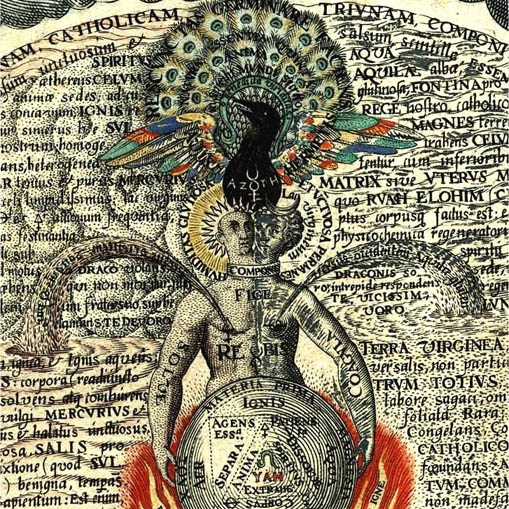
Alchemy, like all magical sciences and arts, is founded on the assumption of the unity of all things in the Universe. Alchemists discovered the basis of that unity in a substance they called the prima materia, a substance that remains unchanged amid diversity. Prima materia is not matter in the strict sense of the word; it is the possibility of matter. Prima materia can be described only in contradictory terms. It possesses neither properties nor qualities, and at the same time has all qualities and properties, for it contains the possibility of everything latent within it. Prima materia is what remains of an object when it has been stripped of all its characteristics.
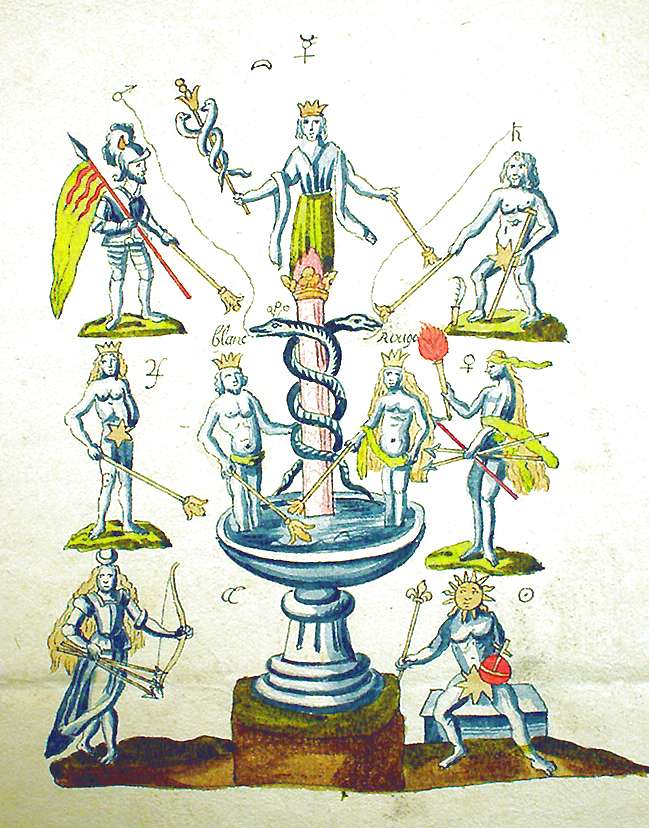
To this day alchemists hold that an object can be stripped of all its properties and reduced to prima materia, and then brought forth again from it with new, better qualities. They use the theory of matter developed by Plato and Aristotle, according to which, as a result of formation, prima materia divided into four primary substances — fire, air, water and earth. Each of these elements possesses two of the four sacred properties of Prima Materia. Fire is hot and dry, air is hot and moist, water is cold and wet, and earth is cold and dry. Everything is composed of the four elements, and differences between objects and materials are explained by differences in the proportions in which these elements combine in them. If one of the properties of an element is disrupted, it turns into another element: if hot and dry fire loses its heat, it becomes cold and dry — earth (ash). When cold and wet water is heated, it becomes hot and wet and turns into air (evaporating). This notion is important for alchemy because it allows the possibility of transmutation.
Craftsmen of the ancient world strove to imitate nature, using pigments and alloys so that artificially created materials resembled the natural. The conviction that nature could be imitated is one of the fundamental concepts: the most natural and perfect act of creation is to make something like oneself. At the same time there was the idea that “ignoble” metals were imperfect creations of nature. Nature always strives toward perfection, seeking to create the best metal — gold — least prone to decay and corrosion. But natural processes often go awry, and imperfect metals result. Note that nothing said here, nor what will be said about the “magical” side of Alchemy, claims a single interpretation. Indeed, one can regard magical practices as objective phenomena and as psychic states. In other words, one must always be aware that it is impossible to determine the ontological status of these phenomena with precision. It is fundamentally impossible. However, such duality does not diminish their value, for in any case their beneficial influence on the practitioner is present. Moreover, in the course of these processes the alchemist’s life becomes fuller and more authentic. It is precisely the yearning for a genuine life, and the longing for it, often drives people to the Way of Magic. Nor does the significant number of charlatans, always eager to profit from the name of alchemy, reduce its value.
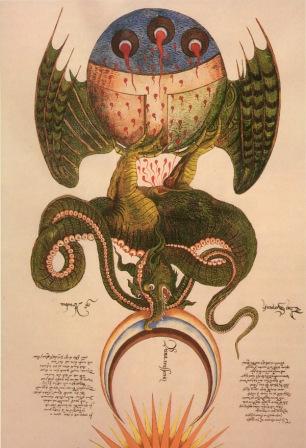
The parallel between the existence of a metal and the life of a person is clearly evident in many alchemical treatises and reflects the supreme Magical Law of Analogy. The first important step in the alchemist’s work is the reduction of the starting material to prima materia. This consists in “killing” the external form of the metal and releasing the seed of gold contained within it just as the soul is enclosed in the human body. Then the seed is united with prima materia to generate the embryo of the metal, which will possess a natural striving to become gold, as man strives for perfection. Properly nourished, the embryo will grow and finally be born in the athanor as perfect gold, the Stone.
But let us return to history. Priesthood culture developed two principal sciences: astrology (this included calculating the timings of the Nile’s floods, predicting epidemics, and planning agriculture) and alchemy. It is clear that they had many points of intersection. One of the oldest alchemical texts, the Emerald Tablet of Hermes, explains these correspondences with the already mentioned Law of Analogy: that which is below is like that which is above. Therefore it is understandable that the best-known planets were assigned (their earthly representatives) the seven known metals. The Sun corresponded to gold, the Moon to silver, Mars to iron, Venus to copper, Jupiter to tin, Mercury to quicksilver, and Saturn to lead. Naturally, there were other variants of correspondence, but the principle always remained.
Surviving fragments of the religious texts of Ancient Egypt testify to the important place magic, and therefore alchemy, occupied in Egyptian religion. They determined the Egyptians’ views on the transient and the Eternal. Most ancient peoples used magic to endow a man with the power of a supernatural being, to allow him to achieve what lay beyond his capabilities and to become for a time as powerful as the true possessor of that power. But Egyptian magic, like alchemy, compelled friendly and hostile forces (and later — even God Himself) to do a man’s will irrespective of their desire. “Faith in magic, in the best sense of the word, in Egypt was older than faith in God” (Wallis Budge).
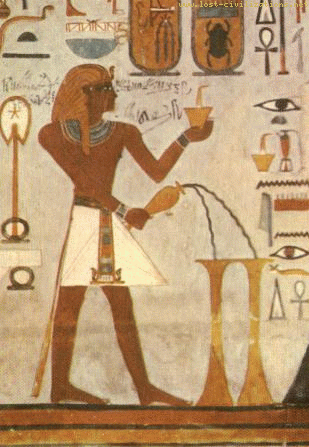
From the religious books of Ancient Egypt we know that the power of a priest, or of a person who knew and could apply magic, was considered almost boundless. The whole world was created by the power of Thoth’s words; with words one could unseal waters against their nature, and even halt the Sun’s course in the heavens. For the transmutation of metals, however, fire was required — an auxiliary complement to magical formulas. Egyptian “wisdom” was dual: they possessed two different kinds of “wisdom” — for the material world and for the spiritual world — and therefore the peoples of neighboring lands misunderstood what was taking place. The ancient name of Egypt — “Kemt” (Kem, Ta Kemet) — means “black” or “dark.” Its origin is due to the dark color of the silt that makes the soil along the Nile’s banks, as opposed to the “Red Land” — the sands and foothills of the Libyan and Arabian deserts. This word is also translated as “enigma,” “mystery,” which is connected with the understanding of black as the color of mysteries, of the hidden. (The very word “Egypt,” apparently, derives from the altered Egyptian name of Memphis — Het-Ka-Ptah — or the Phoenician Hi-Ku-Pta, which means “Fortress (temple) of the soul of the god Ptah.”) In the form “Heme” this word passed from the Copts to the Greeks, Romans, Syrians and Arabs. Throughout the ancient world the Egyptians were famed for their skill in working and transforming metals. According to Greek philosophers, the Egyptians separated gold and silver from natural ores using mercury. The result was a BLACK powder. It was believed to possess wondrous power and to contain the individualities of various metals, uniting their true essences. In a mystical sense this “black” powder was identified with the body of Osiris in the afterlife: both were ascribed magical properties; they were considered sources of life and power. Thus, in Egypt as metallurgical skill increased, belief in the magical power of alloys grew. The art of manipulating metals, studying their composition and magical properties was called “chemy,” that is, “the preparation of the black” — the active principle in the transformation of metals. To this name the Arabs added the particle al (meaning “of”), thereby forming the word alchemy, which immortalized the Egyptians as brilliant investigators of “white” magic and the “black art.”
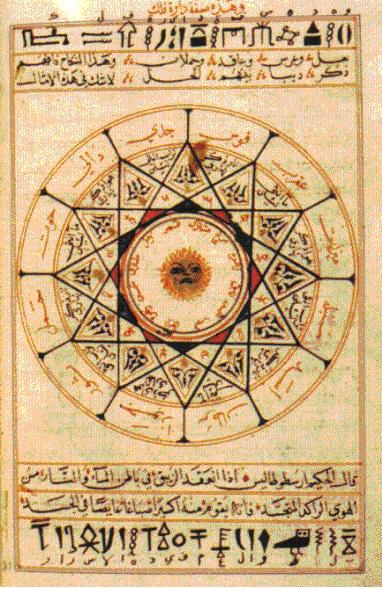
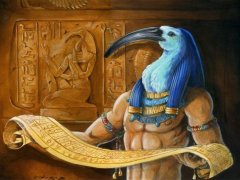
Leaving behind the Chaldean period, of which there are practically no written records and from which the names of alchemists have not reached us, we now approach the historical period when books began to be written on papyrus. A number of early Egyptian books are attributed to Hermes Trismegistus, who may have been a real scholar or may represent a personification of several generations of writers. The Greeks identified him with the god Hermes and the Egyptians with Thoth (Djehuti), and he was depicted with the head of an ibis crowned by the crescent of the Moon. The Egyptians worshipped Thoth as a god of wisdom, calculations and writing. Remarkably, his wife was considered to be the goddess of truth and order — Maat. The arrival of the ibis — Thoth — was linked with the Nile’s inundations. As a heavenly Deity, Thoth was identified with the Moon; he was regarded as the heart of the god Ra — his deputy at night. Thoth guards every deceased and leads him into the realm of the dead. On that basis he was identified with Hermes, who was considered a psychopomp (“leader of souls”). Thoth was credited with creating all intellectual life in Egypt; the “Lord of Time,” he divided it into years, months, days and kept count. Thoth created writing. In the Hellenistic period Thoth was credited with producing the Sacred Books (Iamblichus claimed that Hermes was the author of 20,000 books), including the “Book of Breath,” which, together with the “Book of the Dead,” was placed in the tomb as possessing magical power. A single figure, even of colossal scale and clothed with divine prerogatives, could hardly have undertaken such monumental work. Among the sciences and arts that Hermes allegedly revealed to humanity were medicine, chemistry, jurisprudence, astrology, music, rhetoric, magic, philosophy, geography, mathematics, anatomy and the art of oratory. His all-encompassing knowledge caused early writers to identify Hermes with many early sages and prophets. He was worshipped in the form of the planet Mercury because that body was nearest the Sun: among created beings Hermes was closest to God and was known as the messenger of the gods. The epithet “Thrice Great” was applied to Hermes because he was considered the greatest among all philosophers, the greatest of priests, the greatest of kings. Because of the enormous respect in which the old alchemists held Hermes, chemical writings were called “hermetic,” and to this day the phrase “hermetically sealed” survives. Among the fragments most likely belonging to Hermes are two famous works. One is the already mentioned Emerald Tablet, and the second is the “Divine Pymander,” or as it is commonly called, “The Shepherd of Men.” It is highly notable that Hermes was one of very few pagan philosopher-priests whom the early Christians did not pour their bile upon. Some Church Fathers went so far as to acknowledge considerable intellectual ability in Hermes, asserting that had he been born into a more enlightened age and had he been able to hear their wise teachings, he might have been a truly great man.
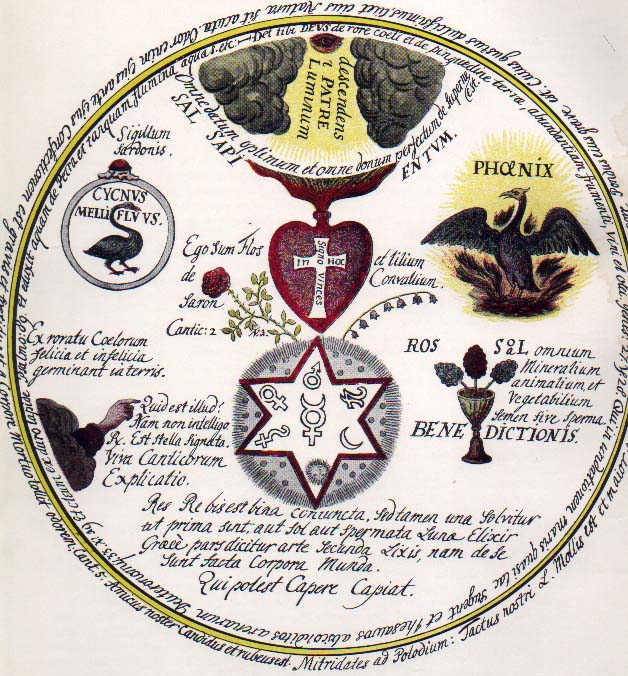
In his work Stromata, Clement of Alexandria, one of the few chroniclers of pagan wisdom whose writings have survived to our time, provides practically all the information now known to us about the 42 books of Hermes and the importance attached to them by secular and religious authorities in Egypt. One of the greatest tragedies of philosophical and alchemical history is the loss of virtually all these books, which disappeared in the fire of Alexandria when the emperor Diocletian, in retaliation for an uprising in Egypt, ordered the burning of all Egyptian manuscripts devoted to the transmutation of metals, for the Romans, and later the Christians, understood that until those books were destroyed Egypt would not submit to them. The volumes that escaped the fire were hidden in the desert and their whereabouts are known only to the initiated of the Secret Schools.
The most ancient and most revered of all alchemical formulas is the sacred Emerald Tablet of Hermes. Authorities differ on its authenticity, but in any case the Tablet is very old. While the symbolism of the Emerald Tablet holds particular interest for Freemasons, who relate it to the figure of Hiram, the Tablet is above all an alchemical formula pertaining to the alchemy of base metals and to the alchemy of human rebirth.
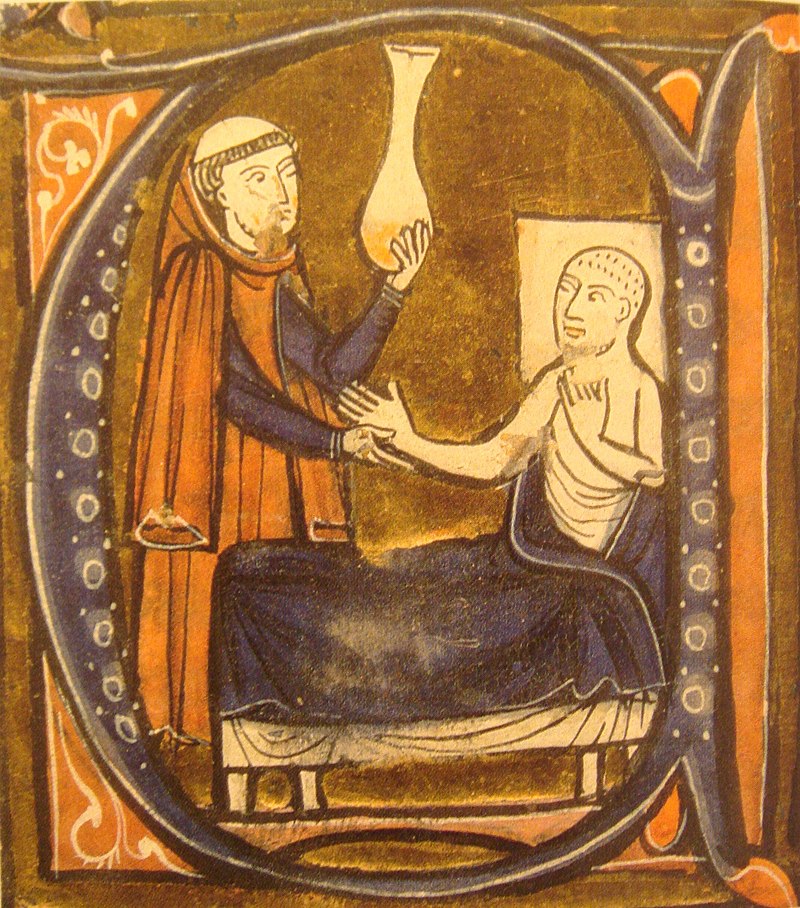
According to the basic view of alchemists on metals, the totality of metals can be arranged on a progressive bipolar scale; one pole of perfection corresponds to silver, the other to gold. In these two metals the two principles — the Principle of Sulfur and the Principle of Mercury — are most perfectly united, with silver realizing in the highest degree the manifestation of Mercurial qualities, and gold — of Sulphuric qualities. The other metals are considered compounds that have not reached silver in the negative direction or have not reached gold in the positive direction. In every metal (and even in every simple body) the union of Sulfur and Mercury is realized, but only in gold and silver is this union hermetically perfect. To transmute another metal into silver or gold one must first of all destroy the imperfect union established in that metal, i.e., separate the subtle (Sulfur, Fire) from the dense (Mercury, Water), and then establish a new, perfect union — of the type of predominating passivity or predominating activity, depending on which of the noble metals one wishes to transmute the base metal into. The Sulfur Principle and the Mercury Principle are joined in a common scale called the “Nitrogen of the Sages.” In practice we always deal with Salt as the basis of bodily manifestation, and with Nitrogen as the basis of the possibility of liberating the Planetary principles bound by Salt. The difference in qualitative and quantitative properties is determined only by the duration of the Work. The Philosopher’s Stone possesses powers hidden in nature not for destruction but for the elevation and rebirth of matter in the three divisions of Nature. The power of the Stone penetrates every solid thing.
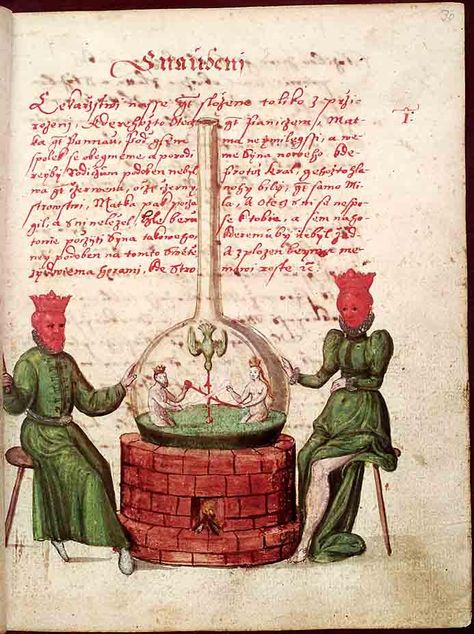
Mars posed certain difficulties to the people of antiquity, and the production of his metal — iron — despite the wide distribution of its ores, was for a long time very costly. The material cause was the refractory nature of iron. But the ancients viewed the world from somewhat different positions. The primitive concept of Creation is that it occurs only through an “original sacrifice.” What is created can be preserved only through sacrifice and war. The image of Mars is one of the symbols of the link between the higher unformed world and future forms. The notion of sacrifice characterizes the primordial order. Its strict law requires death for every life, sublimates criminal instinct into service to good, transforms hatred into love in the interest of renewal of life. “To preserve the existing order, the gods fought giants and monsters that from the beginning of creation sought to swallow the Sun” (Schneider). And Mars was regarded as the eternal embodiment of this necessity for bloodshed, manifest in all the laws of the Cosmos. Naturally, the gods long gave iron, the metal of blood, to humans only rarely — in the form of meteorites. Only with the attainment of a certain level of development — an awareness of their nature — did humans gain wider access to iron.
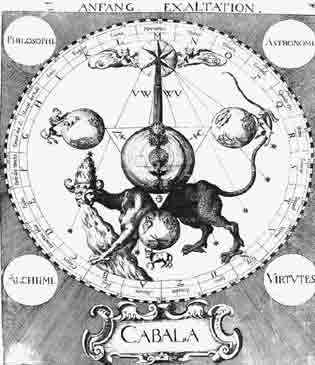
Contrary to popular belief, alchemists did not counterfeit jewelry with glass beads. As early as Ancient Egypt they knew how to enhance natural gemstones. The emerald on which Thoth’s tablet is inscribed and statues of gods carved from single gems testify to this. Indeed, Alchemy is the science of multiplication. It is based on natural phenomena of growth and development — processes of increasing and “improving” what already exists. One alchemical formula states: “all is in all.” What is true in the higher is true in the lower. If alchemy was a great spiritual fact, then it is also a great material fact. If it takes place in the retort, then it must take place in man; if it takes place in man, it must take place in plants and minerals. If anything in the Universe grows, then everything in the Universe grows. If one thing can be multiplied, then all things can be multiplied. Another axiom of alchemy says “in everything are the seeds of everything,” though in simple processes of nature they may remain concealed. Using these convictions as a theoretical basis, alchemists found a way to grow precious stones without resorting to colossal temperatures and pressures. From its inception the science developed in two worlds — East and West. Chemistry is no exception. Everything said so far pertains to Western science. The Eastern centers of civilization were China and India.
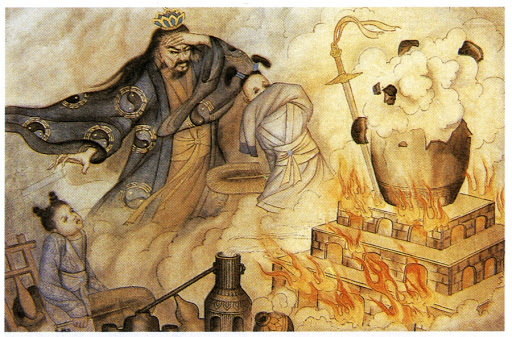
The birth of Chinese alchemy is dated to the middle of the first millennium BCE. It was an astonishing time: Laozi and Kǒngzǐ (Confucius), Socrates and Plato, the Buddha and Zoroaster all lived then. In China at that time the idea arose that holy hermits (shénxiān) possessed astonishing suprasensory knowledge and supranormal abilities. Such hermits were also called fánshī (“man knowing directions” or “man knowing methods”). They were versed in alchemy, astrology, methods of healing and so on. Fanshi advised those who wished to go to sea to search for magical islands — Penglai and others — where immortals live and where one might obtain means to achieve immortality. These islands (like the Promised Lands of other peoples) should apparently not be understood as material places; the unprepared, unpurified person cannot see them. Hence many expeditions in search of the Elixir of Immortality found nothing, and those who claimed to have seen something complained that the islands vanished as ships approached. Failing to wait for mercy from the gods, the “knower of methods” Li Shaojun proposed an integrated method for “smelting the Pill of Immortality.” Its essence is described symbolically as follows: “cinnabar sand must be turned into gold, from which a vessel should be made. Using it, you will live long and be able to see the saints of Penglai, which will secure immortality for you.” And a usual warning: “It would be a terrible sin to reveal the secrets of your art to soldiers. Be careful! Not even an insect should enter the room where you work!”…
A little later, at the end of the first millennium BCE, many tried to make an ingestible pill of immortality. Cinnabar — the poisonous sulfide of mercury — was listed as an invariable component. Those bold enough to take such a “pill” soon departed to the heavens. By smelting cinnabar with sulfur, lead and other metals and roasting it, they obtained “golden cinnabar” (jīndān), which served as a medicine and outwardly was indistinguishable from natural gold. Naturally, when reading ancient texts one must not forget that their authors wrote in a symbolic language, intending by words something quite other than their usual meanings. Each reader understands ancient writings according to the degree of his mastery of the subject.
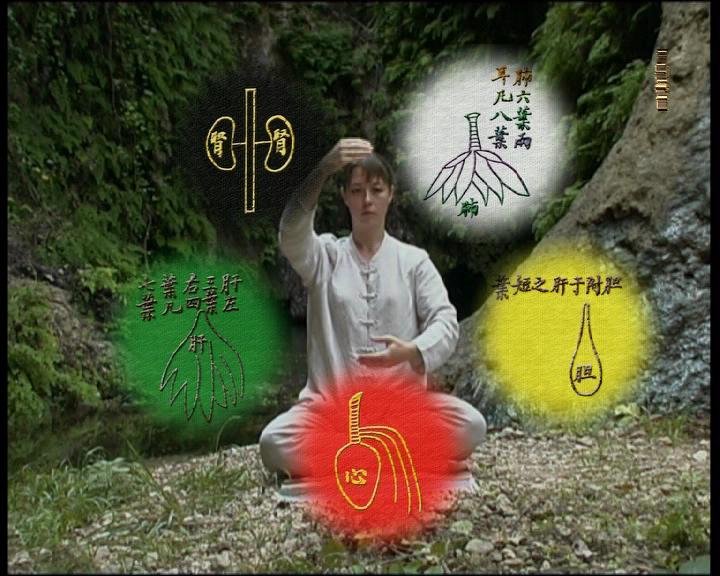
Work on creating pills of immortality continued until the 10th century, although lethality became the fate of many experimenters, among them rulers and high officials. However, from the beginning of the common era more active work was undertaken on the “inner pill,” by which was meant special energetic structures created in the body. The terminology remained the same, and the language stayed symbolic. “Smelting the inner pill of immortality” is a complex process of accumulating and transforming energies involving breath, bodily movement and awareness. The internal alchemy of the Daoists shows affinities with tantric practice (the transformation of the human senses not by renouncing them, but by “remelting” them), and with European and Arabic alchemy (the mystical marriage — the chemical wedding, and much else). The Daoists believe that ultimately the whole world will be transformed according to the same schema as the adept’s body. The Chinese described the world by means of trigrams and hexagrams, symbols familiar to the public primarily from the I Ching, and these symbols naturally appear in the characterization of alchemical transformation. Daoists likened the body of the ascetic to a crucible in which internal alchemical reactions occur, capable of nourishing the ascetic’s “spiritual child” and turning him into an immortal. Mercury was often identified with the energy of the lungs, lead denoted the energy of the kidneys, and so on. The embryo of the immortal body in the Daoist adept was called the golden elixir. It was conceived and grew thanks to the “internal Work,” which included many techniques and stages. Smelting (liàn) was understood as a symbol of energetic restructuring. But the character for “to smelt” is often written where a similar glyph meaning “to train” would be used, from which one may conclude the closeness of those meanings.
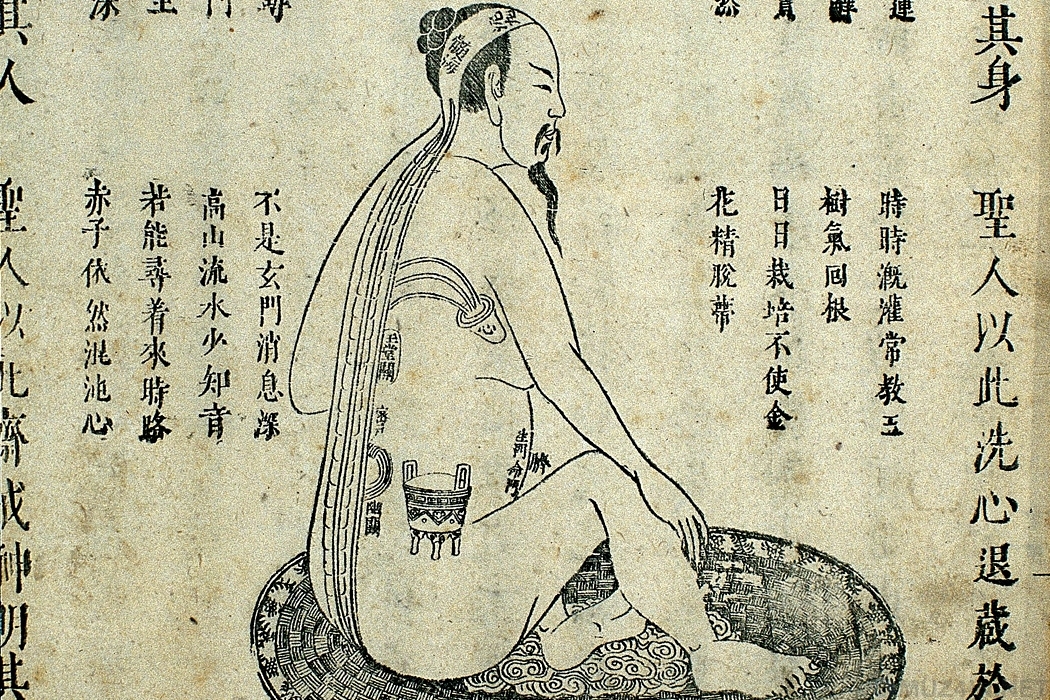
However, despite the similarity of Eastern and Western alchemical techniques, a profound ideological difference is traced from the most ancient times. In the tribal worldview of the ancient Chinese and Indians the identity of man and nature is very clearly evident. The I Ching and the Brihadaranyaka Upanishad insist on a substantial-genetic identity of man and nature. The essence of Eastern culture consists in a worldview that privileges the cosmos over man. Man assigns a certain direction to this style but does not change it in essence. Whether in Indian Vedanta, Mimamsa, or Chinese Daoism — everywhere the cosmos serves as the bearer of natural and human meanings of life. Moreover, they possess a degree of orderliness, permanence and influence on man comparable to the forces of natural cycles of matter. In such a situation the individual can only attend to nature, not “jump out” of the parallels of moving things, not step into another’s rank, and then he will fully realize his possibilities and essence. In the Western, technically organized cosmos relations are structured differently. If in Eastern models of the cosmos nature, kin and mind are bound together, generalized in images of prime ancestors who are substantially identified with nature and kin, then in the technical model nature becomes open to physical action by man: its dismemberment, fragmentation, mixing of substances, etc. If in the Western worldview “that which is below is LIKE that which is above,” in the Eastern tradition they are IDENTICAL (“You are That”).
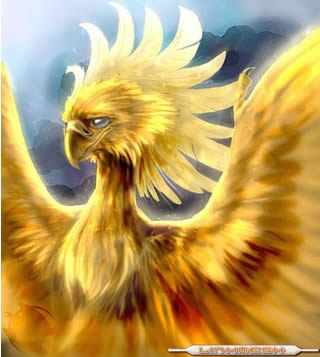
All alchemical processes occur simultaneously in the crucible and in the body of the alchemist.
Let us attempt to draw some parallels.
Usually twelve processes are counted in the course of the Great Work. We will consider them briefly.
Interpretation of these processes, chemical or psychological, can only be approximate, for the Work is not the same among different alchemists, and yet it is the same Work — the process of transmutation into the Stone.
1. Calcination. The starting material is heated in the air until it turns to ash. By destroying the external form of the starting material, calcination destroys all its superficial properties. In the alchemist’s body the superficial aspects of personality are burned away and only the ash of individuality remains.
2. Dissolution. The starting material is turned into a liquid state. Since, according to alchemical theory (originating with Plato and Aristotle), the original substance was liquid, turning metals “into water” means returning to prima materia and thereby freeing oneself from defects acquired on earth.
This recalls techniques of returning a patient to early childhood and even the womb (a thoroughly alchemical motif) in order to resolve the origins of psychological problems.
In alchemy mercury was often used for dissolution. Thus the ash of the indestructible basis is immersed in the waters of all-washing primordial femininity to dissolve hidden deep feelings and reactions. The difficulty lies in finding the true philosophical mercury, the true view of oneself — without excuse but also without accusation. The danger lies in the possibility of fear, despair and self-deception when one discovers beneath exalted ideals a base foundation, “vulgar egoism, infantile greed and complacency,” in Jung’s words.
3. Separation. Next “the water must be separated from the oil.”
Separation is not performed by the alchemist but by God Himself; the liquid material remains in the vessel until the primordial substances — Mercury and Sulfur — separate, of which the body consists. Analysis of the dark and turbid depths of one’s personality plunged the alchemist into a state of inner fragmentation. The alchemist discovers that he is “torn into pieces.”
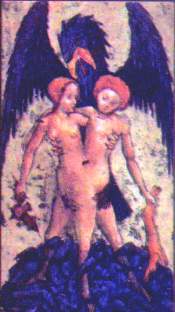
4. Conjunction. The pure Sulfur and Mercury of the philosophers thus obtained were united in incest (since they came from one material and are therefore brother and sister). This attempt to remedy unbearable separation was often depicted as a return into the womb.
The son crawls back into his mother’s womb. Thus a prenatal state of prima materia and the spark of life that fertilizes it is achieved. In a sense this is already death. The false, invented and externally imposed personality dies away. The next step is to kill the material and free the spark of life.
5. Putrefaction. The material was subjected to moist heat in a bain-marie or in fermenting manure until it blackened. Blackening is the sign of the loss of all properties (black — absence of color). Putrefaction was a necessary process because the Work imitated natural processes, and the seed that falls to the earth must rot, freeing new life (as the Gospel also says — Mt. 13:3–23; Mk. 4:3–20; Lk. 8:5–15).
The alchemist, interiorly “in the womb” and wholly withdrawn into himself, plunges into melancholia — a state of helpless dejection and spiritual decay during which the spark of life leaves body and soul (a process opposite to incarnation). If the alchemist finds within himself the strength to overcome putrefaction, an illuminating inspiration descends upon him. The vapors rising during putrefaction float in the vessel above the black mass like the Holy Spirit over the dark Waters in Genesis. These vapors condense into a liquid that impregnates prima materia during the warming of the vessel. Alchemists regarded this process as rebirth through “water and Spirit.”
Out of the depths of despair the alchemist brings forth life “without fear, without hope.” Action for the sake of action, for the sake of impeccability, without expectation of a particular result.
6. Congealing (crystallization). When spirit and matter reunite in the vessel, a white dense body crystallizes from the liquid material. White is the color of purity and innocence, the color of reborn life. The White Stone is the earth appearing from the waters on the third day of Creation. This is a new personality, still free of contradictions. The White Stone is capable of transmuting into silver — the lunar metal. The Moon — queen of the night and mistress of divination and other Perceptual Magic — lights up in the darkness of the alchemist’s soul. This is the first stage of Rebirth — the awakening of receptivity.
7. Nourishment. The material in the vessel is “moderately nourished with milk and meat.” New material is added to the vessel. This stage corresponds to feeding an infant. The alchemist must learn to use the resources of the material world again; he must live in the world while remaining separate from it. Not fleeing the world and not fighting it, but also not merging into it.
8. Purification. The alchemist imparts to the growing Stone the properties it must possess henceforth — perfect purity and strength. The material in the vessel was heated to evaporation, then slowly condensed, and this was repeated several times. The body is purified by being turned into spirit, residues are discarded, and spirit is again turned into body. The alchemist learns to “walk on water without leaving a trace,” to be light and imperceptible like a spirit while retaining his corporeality. This is the process of purifying the flesh from its primal filth, a process of spiritualizing the flesh, endowing it with perfect properties. Now the alchemist is open to the Games of Imagination.
9. Fermentation. The material in the vessel yellows and turns to gold. Often at this stage gold was added to the vessel to hasten the process. The Stone becomes a ferment capable of turning base metals into gold. The comparison with yeast shows that the Stone only incites the starting metals toward transmutation. In the process of fermentation the soul of the Stone joins its purified body.
The alchemist learns to govern his perception of the world. He learns to retain his individuality amid changing conditions. He ennobles the world by his presence, by his purity and integrity. The fiery principle of inner Sulfur changes the personality and turns it into “gold.” This is the feeling of intoxicating submission to an inner power, accompanied by excitement and agitation.
10. Exaltation. The Stone acquires a red color — a sign of its maturity. In the final stages the material becomes extremely unstable. The excitement of fermentation is often exhausted and the work fails. In the process of Exaltation the components of the Stone fuse into an unbreakable unity, achieving harmony.
Body and soul, united at fermentation, join with Spirit, and the Stone hardens, becoming steadfast.
The heat in the furnace is heated to the limit, and from the fire the Red Tincture is born. Only under the condition of the highest intensification of passions is exaltation achieved. The alchemist finally breaks beyond the bounds of his nature and enters into unity with the Universe.
11. Multiplication. The Stone acquires the ability to transmute quantities of metal far exceeding its own mass. The Stone becomes fruitful in the next conjunction, a union of opposites. This is the process of the alchemist’s accumulation of Power — the mastery of Awareness. The Work is cyclical, as cyclical as the life of the Universe. Alchemists must attain a balance of opposites. The perfect man is balanced, equally distant from asceticism and from the cult of the body. Suppressing one member of a pair of opposites only exacerbates the conflict. The alchemist does not flee from matter to spirit; he spiritualizes matter.
12. Projection (Creation). The Stone unites with a base metal, turning it into gold. The alchemist MUST teach someone his art. Without this the Work is not complete.
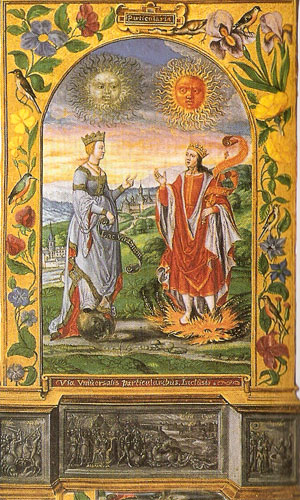
The Golden Age is the pinnacle of the evolution of the Alchemical group.
Can the erasure of personal history be attributed to the first point of the transformation process (baking)?
Ecologically, it would be correct to relate it to the first point. It is important to have a suitable instruction that fits the Alchemist for doing and a symbolic system for navigating and mapping the results of the work. As a rule, the material that has begun to heat up desires to change its properties. Here it is important to have purity of intention, as this stage of work largely relates to Microcosmic processes.
Thank you for the answer, a bit complicated :), but probably it’s time to look for a good textbook on alchemy :)…
Recently, I clearly realized that I am half in spirit, half in matter. An interesting feeling and the ensuing sense of Power.
At the moment, I consider myself at stage 6.
Thank you, Enmerkar.
I remember, the country of the Soviets released an excellent toy – a kaleidoscope. You turn the cylinder and look through the eyepiece, and there are beautiful and orderly patterns, and each time new. New patterns from old shards of colored glass.
When physicists talk about the structure of the atom – it becomes frightening. After all, the atom is 99% empty. What does our world of solid objects consist of if a substantial amount of solidity is merely emptiness?
The atom is an image, an attempt to describe the building material of the universe, and according to the assurances of the same physicists, the atom is a particle that can be divided into even smaller particles. The Hermes tablet speaks of the strength of the One penetrating everything and governing everything. In literature on alchemy, it is mentioned that EVERYTHING consists of the same particles, and taking lead as an example, one can, in its rarified state of primary particles, condense it into gold by introducing certain modifications in the process of transmutation.
All new patterns are generated by the movement of the Wheel, analogous to the cylinder of the kaleidoscope. All new images are constructed from all those same old blocks, the elementary particles of being.
And the human body, consisting of those same particles, can be transformed into… well, update it, for example, it would be good to rejuvenate it. The elixir of eternal youth, the recipe for which has been diligently sought by the same alchemists for centuries.
What is the essence of elementary particles when 99% of everything is merely emptiness?
Emptiness – Image – is the binary system. Is it possible to live in a world without images if life itself is merely one of the components of the binary life-death?
The primary binary Consciousness-Being, which we humans are originally conditioned by. Consciousness recognizes, penetrating being. Consciousness operates with images. Is Being without Images the absence of Consciousness?….and what are the images made of?
Like a newborn infant – a clean slate – tabula rasa – fills up with images.
Birth into the world of people is separation and suffering.
The separate part of the Great Spirit looking into the eyes of equally separate parts does not see that all eyes looking at each other are the eyes of the One looking into its own eyes.
The infinity of combinations of identical particles implies an infinite play of infinite emptiness within itself. 🙂
Many people probably felt that the time has come to break old ties and go off on their own. I had that desire too. The understanding that what holds you back must be left behind, otherwise there’s no way. Of course, you can endure and try to reconcile the old and the new, but I understand that it won’t work. Those who have gone through this, please share your wisdom about the transition.
I call it – Getting rid of the excess. From experience, I can say that it is not always worth taking what is easy to grab.
My transition ended in a psychiatric hospital. Now I am establishing new connections. Specifically, connections with patients and family. From experience, I can say that transitions should be made with an instructor or instruction. And one needs to know how to not cut off old connections and break away but to create anchor points in these connections. Then there will be a logical sequence in describing connections, and, consequently, there will be no harsh falls.
Somehow the cut-off turned out to be harsh for you, Roman.) Yes, I understand that such periods of rethinking and stabilization are inevitable. They are usually related to an enhancement of perception when you start to feel the world anew. You want to withdraw and reconstruct in solitude, rethink. Since it is problematic to do so in urban conditions, I tell my loved ones that they should not pay attention to my certain reclusiveness due to the restructuring. They understand). Wishing you success.