Ritual: Eight Steps of Realization
Magic is not merely a way of life; it is a mode of existence within Myth.
This means the Magus is aware of mythological plots being enacted both on the level of the macrocosm and within their own sphere.
We already know that every plot, as an elementary cycle, consists of eight stages. Repeated across three worlds, this cycle is expressed as a twenty-four-part system of enactment.
At the same time, the Magus’s enactment of an elementary mythological plot aimed at producing a certain result has traditionally been called a ritual.
Thus, we call a ritual any action that embodies some specific goal toward myth. With the broad understanding of myth we once discussed, it becomes clear that ritual is, in fact, a general method for achieving results. Human culture as a whole is founded on ritual.
Since a ritual is the symbolic embodiment of a myth, it must be performed according to certain rules — rules that are not arbitrary but dictated by the very nature of the myth being enacted. In a ritual, as in a myth, the primary concern is structure; the particular motives behind actions are secondary to the actions themselves. Any deed or text within a ritual acquires symbolic meaning. Even ordinary language used within a ritual does not carry the same meaning it would outside the ritual.
Consider the stages that form the skeleton of any ritual, correlated with the stages of a myth’s development.
1) Zero stage – the creation of the idea. A ritual must be preceded by an abstract understanding of the ritual as a whole — what it aims at, how it will accomplish that aim, and which Powers it will employ. Only by clearly imagining this integrated whole of the forthcoming action — that is, by generating the potency for its enactment — can one proceed to the next steps.
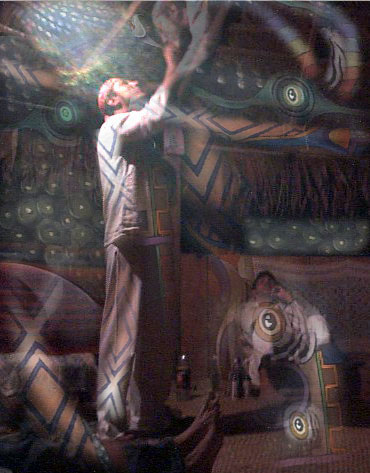
2) Specification of the unit. The first phase of actually carrying out the ritual is the preparation of the Operator. In other words, the one in whose name the ritual is performed must be prepared. To perform a mythological action one must first leave one myth and enter another. This preparation, traditionally called the Operator’s “purification,” may include various acts — fasting, washing, prayers, and other measures intended to transform the person into the creator of the myth, into the creator of their own universe.
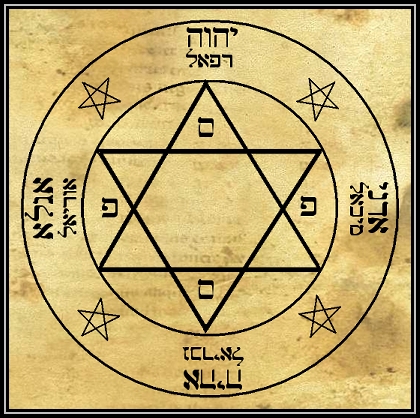
3) Division of unity. The next phase is the creation of the primary duality of the operation. The active pole of this binary is the prepared Operator, and the passive pole is the Ritual Space. This stage includes the formation of the space in which the ritual will take place — the creation of a universe in which the Operator will be god. Such a space may be a Magic Circle, a Temple, or similar symbolic structures. In any case, drawing the circle and “opening and consecrating” the Temple are intended to place the ritual space under the Operator’s full authority for the duration of the action.
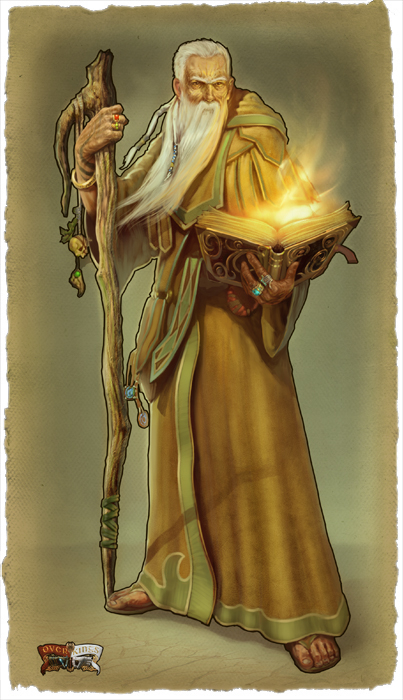
4) The Birth of the Logos of the Operation. At this stage the binary becomes a ternary. The laws that will operate within the ritual universe are formed. This stage is traditionally called the “Oath.” The Operator states the goal aloud and explicitly the goal of the ritual, its timing, and the direction of its enactment. Creative speech is the supreme stage of Creation (“And God said: Let there be…”). It is precisely the utterance of the goal that becomes the Principle of the Ritual’s form, its Logos.
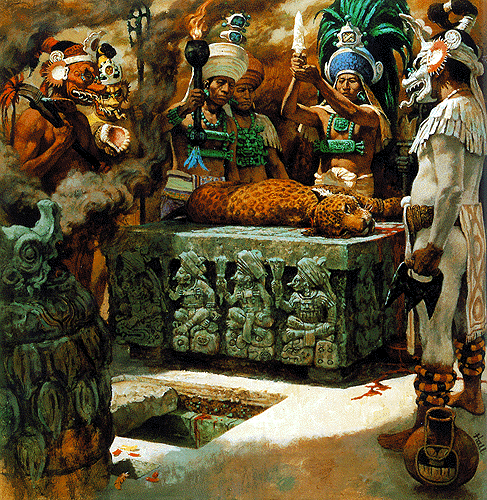
5) Creation of the Operation’s vortex. At the next stage the ternary becomes a quaternary — a necessary condition for realization. We know this transition is effected by creating the so-called “second passive pole” — a field in which the ternary’s activity takes place. Mythologically, this stage is symbolized by sacrifice: from the body of the primordial Ymir Asa the world was made — the field of its activity; Cain, who sacrificed Abel, inaugurated humanity; Dionysus, Osiris, Dazhdbog — these are other examples of such supreme sacrifices. Different rituals accomplish this task in different ways — sometimes wine is offered, sometimes the smoke of incense, sometimes animals or even humans are sacrificed. In any case, giving is indispensable to receiving.
6) Creation of the Volitional impulse. Any myth implies active agents who impart the force for its realization. The quaternary born at the previous stage remains inert without a thrust of will, without crossing the boundary of quaternity to a fivefold level. Since the Operator of the ritual is, in effect, its internal part and cannot supply such a thrust himself, an external force is required. Therefore, at the next stage the Operator invokes such forces in the form of gods, spirits, angels, the Names of the Most High, and so on. This stage is called the «Appeal», and it aims to “imparting vitality” to the ritual.
7) Creation of the Body of Realization. The most complex stage of the ritual is the merging of two ternaries: the ascending ternary created by the Operator himself and the descending one invoked at the previous stage. It is precisely this merging that creates the “middle part” — the body in which the power of the Ritual’s realization will reside and operate. Often, because of its complexity and vividness, this part is mistaken for the whole Ritual. This merging includes a set of symbolic words and actions intended to reconcile the macrocosmic and microcosmic components of the Myth. At this stage an accounting and harmonization of all forces involved in the realization must occur.
8) Release and closure. Once the forces have been brought into mutual alignment, it is necessary to separate the effect of the realization from the forces that acted — in other words, to return the activated forces to the cosmic order. In doing so, the vortex of realization is released (depending on the ritual’s goal it may be directed either inwardly or outwardly relative to the Operator’s consciousness), and the “forces disturbed” by the ritual return to their sources. This return of forces can occur in various ways and may or may not include “thanksgiving,” but the essence remains the same — the universe of the ritual returns to the realm of potentials, and only the result it has produced remains imprinted in the actual world.
One, two, three, four, five… I’m going to play, those who haven’t hidden… Beautiful) a proper game of adult children… The beauty lies in the awareness of what you are doing and responsibility. We are all playing out a myth called LIFE… every day))) I’m very happy about every entry, En!… and thankful))))))))
Thank you very much for the publication.
May I ask: if we are not talking about a ritual but about a ceremony, will the steps of implementation be the same, but the unit will not be an operator, but a group?
Perhaps in this case we need to add another step for forming a unit from a group. And, probably, that’s why synarchy is described as an ennead rather than an octad.
Thank you once again.
But doesn’t the preparation stage ( выделения единицы ) include the step of forming a unit both from a group and from a single operator (because even if he is alone, he carries within himself a collection of different aspirations)?
In a global sense, it certainly does include it. However, achieving a focused aspiration within one personality or within a group are different in complexity. In a personality, there is already an axis – an individuality; but in a group, such an axis needs to be created.
Yes, Oleg, the steps will be the same, whether you work alone or in a group, intertwining and weaving the vortices of all group members. In this case, remember the pyramid of magic, the myth as the only true one, correct to the extent that there is no other, and adhere to this myth unquestioningly until the result is achieved.
Yes, by the way, I hope all visitors of the blog understand that the concept of ‘myth’ exists in every type of magic without exception, be it Voodoo, ceremonial magic, etc., in witchcraft, and all the work is based on myth, each ‘school’ calls the concept ‘myth’ in their own words, but the essence remains the same: myth is the foundation! As for specific laws in magic, one can say they exist, and then say they don’t, some often use the phrase ‘laws are meant to be broken’; to some extent, that may be true, but magic does not forgive mistakes……
Is the release of the ritual vortex relevant after achieving the goal of the ritual? Otherwise, at the end, one might repeat, enhance, and eventually create a new ‘middle part’.
Can a curse be realized within the framework of a ritual? Or is a ritual a synonym for any realization, including a curse?
Release: The vortex of the ritual is relevant after achieving the goal of the ritual, the mythical continuation of which becomes absurd in the Creation stage of the vortex Operation. Otherwise, and ultimately, the next creation is the ‘middle part.’
Yes, dear mages, when you read you begin to lose your mind. And thank you for the algorithm! Some stages were completely unconscious. I will translate the information into plain language and try to use it.
There is no need to translate anything. One must converse with the teacher in a language he understands.
I apologize for writing the word TEACHER with a lowercase letter.
Theoretically it is possible at the fifth stage not to give back, but to take a debt. If I understood correctly. How will this affect the nature of the ritual?
Dear Enmerkar. Could you please shed light on some points? If work is planned based on personal power, then how to address point 6? And point 7, I don’t understand it at all. Could you provide an example? Thank you.
Magic is Power + Authority, so certain supports are necessary as long as we are linked to the material level of existence. Point 7 is, for example, pronouncing part of the Spell describing how the Ritual should act, where the energy will come from and how it will flow. Also, at this stage, a Symbol can be carved, an amulet created, or another support point.
Hello Master! Tell me, during the ritual of carving runes, is it necessary to call upon the gods relating specifically to this myth, or is it possible to read prayers and mantras of the faith one belongs to? Or can a magician not belong to a faith and must strictly adhere to the myth of the ritual?
Any Ritual is created within its system of representations and relies on these beliefs. Blending Traditions is a complex matter and requires a great deal of Strength and wisdom.
Dear Master. Thank you for your experience and wisdom. The article is amazing. I saved it to my bookmarks.