
Interspace: Islands and Spaces

When studying and mapping the spaces of the Interworld, it is important to remember that these spaces are, in fact, inseparable from the mind of the beings that stabilize them. In other words, while in the interspace, a being either dreams itself, or finds itself in others’ dreams of other beings.
That is precisely why it is impossible to speak of the “spaces of the Interworld” as such: they cannot be measured or described to measurement or description, presenting as an infinite fluctuation of probabilities. In other words, unlike worlds, the images of the interspace are not subject to active interaction; they do not carry their own energy (more precisely, their energies are fully balanced), and therefore cannot serve as a source of experience. In worlds where energies are not in equilibrium, a “productive collision” of the subject with the object of awareness is possible, and thus the creation of an image of this interaction — which is what the actualization of consciousness and the acquisition of experience means. At the same time, the Interworld is a hyperspace of processing and assimilation of experience accumulated in the worlds, but not a place to gain new experience.
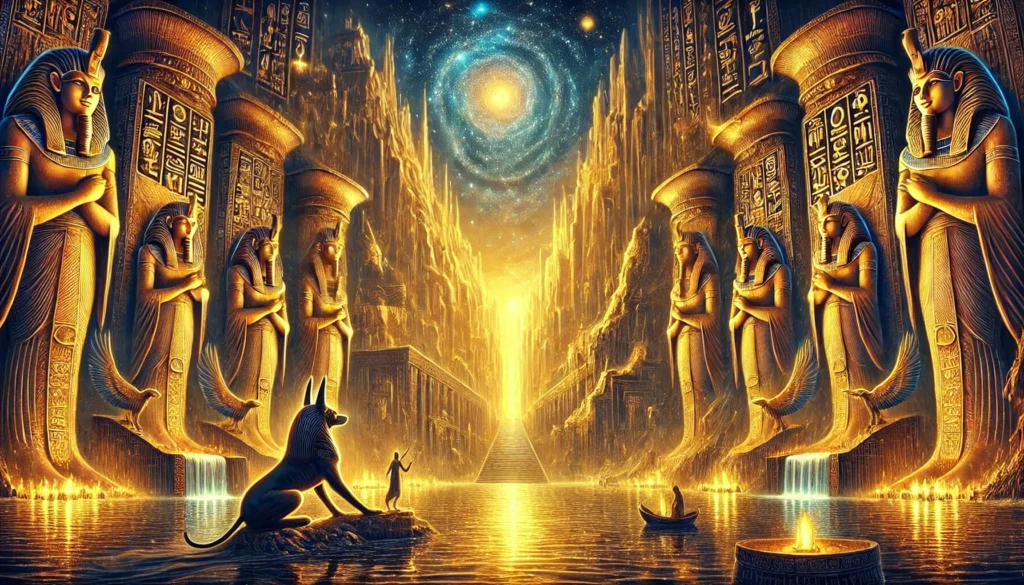
In this sense, the “Books of the Dead” speak of the fact that a sojourn in the interspace can be described with equal success as a journey or as wanderings, and as a succession of visions — a kaleidoscope of images appearing in the mind. We have already discussed that the same experience arising in the postmortem mind may be interpreted by one being as a long path through spaces and obstacles, and by another as a set of surfacing images.
Nevertheless, in this virtual hyperspace, devoid of its own properties and characteristics (or, more precisely, possessing every possible property), there are also “islands of stability,” built by the collective will of the beings inhabiting them. Although even these “islands” are, in fact, “collective dreams,” that is, they are devoid of an “objective” energy-generating component, they are, nevertheless, accessible to ‘external’ observers and can serve as shelters for wanderers of the interspace.

Among such “islands,” of course, the leading role belongs to the so-called “Elemental Cities” and their derivatives. It is the Cities that form the basis of the areas of the Interworld that are studyable and mappable, and it is in the Cities that the greater part of non-predatory beings of the Interworld dwell.
Also closely connected with the Cities, as relatively stable regions of the Interworld, are the “centers” or “axial structures” of its “layers” or ethers. In fact, each such “axis” is a summary projection of all (at least those known at the human level) Cities and is formed by their energy in exactly the same way as objects in the worlds are formed from the prima elements themselves.

Finally, the third type of comparatively stable subspaces of the interspace are cities and settlements built by beings who migrated there — Fairies and some Elementers (for example, from Ancient Egypt).
However, “beyond” these cities and structures, the space of probabilities prevails without restraint. That is, if, for example, two Fairies want to move from one settlement to another, and a portal has not been built, then it is in no way possible either to predict or to describe their wandering. Even if they set out together, their subjective experience will most likely be completely different, and even the time spent on the journey will differ: for one, the road may take a matter of minutes or hours, while for the companion it may last years. In exactly the same way, although, for example, from the Square of the TEX ether the Towers of all four Elemental Cities are visible, there is no way to determine the “distance” to them or to describe the route.
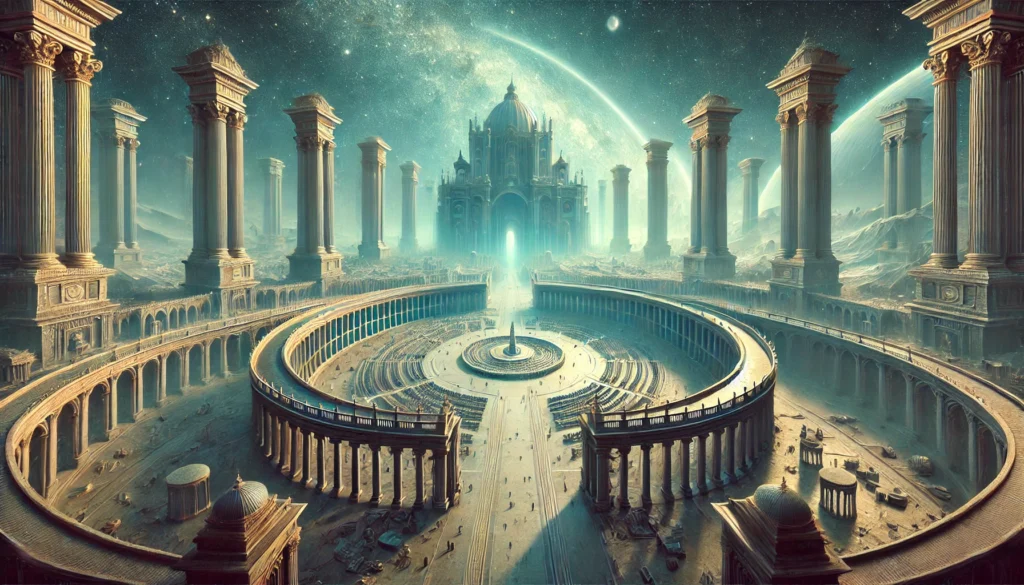
Accordingly, efforts to map the interspace should be focused precisely on describing its “stable” regions, and interacting with their inhabitants. At the same time, the experience of “ordinary” dreaming or poorly directed scrying usually transports the mind into arbitrary areas of the interspace, which are perceived and interpreted differently even by the same observer in different states or at different times. It is precisely due to poor direction of the mind that all those difficulties verifying and unifying experiences obtained by different visionaries arise, and varied accounts accumulate, from which it is very difficult to extract anything useful. In addition, it is important to remember that unstable regions of the Interworld (which make up the absolute majority) are inhabited exclusively by predators, and therefore most contacts with these regions end in more or less significant losses of energy.
Accordingly, the key task for successful study and mapping of the interspace is precisely compiling effective guiding vectors, relying on which the mind can direct minds into stable, safe subspaces, accessible for description and the compilation of verifiable unified maps. Such vectors can include runic bindings, graphical structures, and spells or calls. In any case, this area of Magic is not yet well developed, and therefore requires the accumulation of a large amount of experience, from which the essence — effective methods and strategies — will emerge.
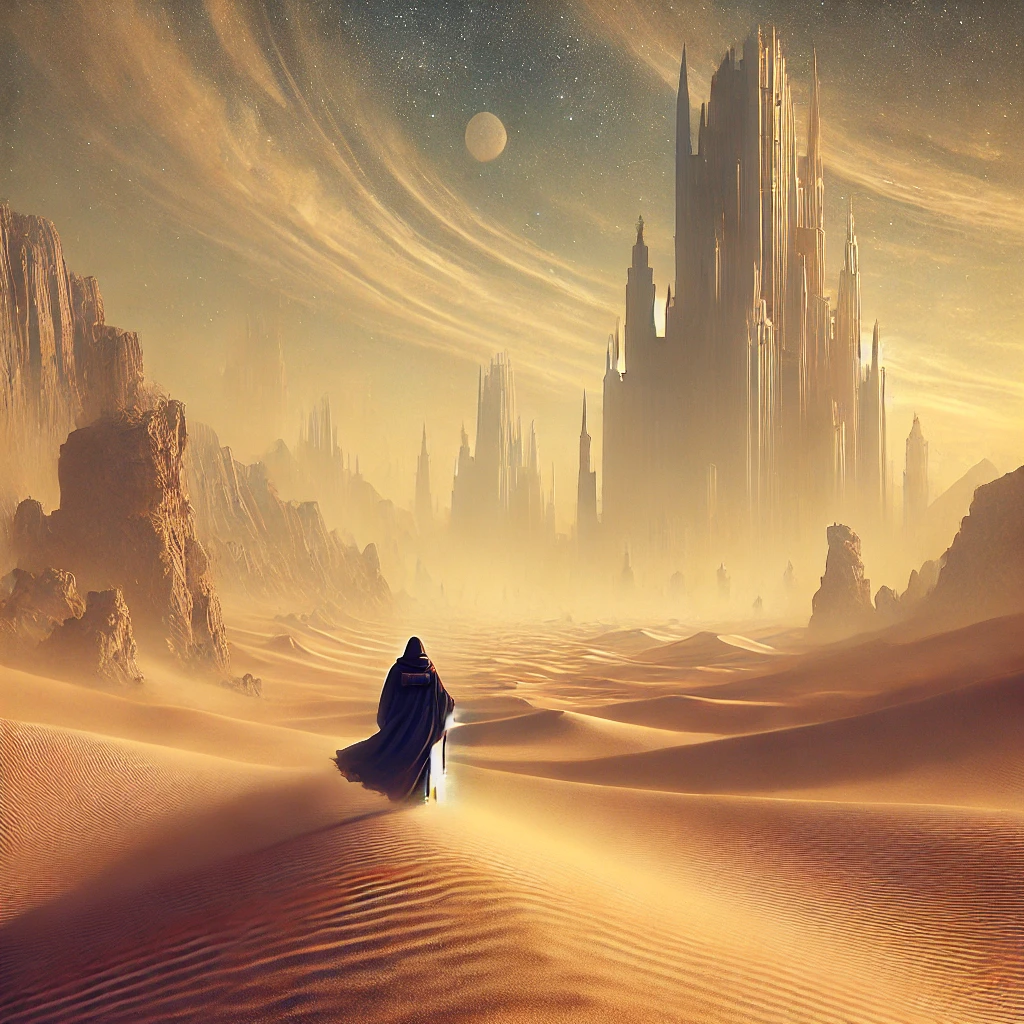
If the spaces of the Interim are, by nature, fluctuations of probabilities and lack their own energy, only stabilizing through the consciousnesses of beings, what is the true nature of these ‘islands of stability’ and Elemental cities? Are they merely collective dreams, dependent on the will of their inhabitants, or do they gain some intrinsic structural reality as they exist, transcending individual and collective perception? In other words, can the prolonged existence of such spaces lead to their ‘self-establishment’ within the structure of the Interim, transforming them from temporary formations into relatively independent points of being?
The Elemental cities of the Interim, despite their obvious dependence on the collective consciousness of their inhabitants, represent something far more than mere dreams of beings. The nature of the Interim is such that unstable spaces remain in a state of uncertain probability or superposition and are therefore devoid of their own energy and structure. However, if a group of aware beings maintains a focus on a specific image or idea over an extended period, feeding it with energy, this structure begins to acquire internal stability. This is how the stable zones of the Interim arise: initially, they are supported solely by consciousness or collective intention, but later they acquire internal inertia. Elemental cities are one well-known example of such a process. Their structure is supported not only by intention but also by the energetic principles corresponding to the four fundamental elements of the universe. This makes them far more stable than any other islands of stability in the Interim. They can be compared to powerful nodes in the network of the Interim that accumulate strength through cyclical interaction with the structure of worlds and their inhabitants. Each of these cities is not merely a mental construct, but a fixed point of intersection of probabilities, in which the potentials of the primary elements find their most stable manifestation. At the same time, most temporary shelters created by individual beings or their groups remain dependent on constant feeding by consciousnesses. When the structure of a city becomes stable enough, it ceases to depend on the presence and will of its creators and gains its own existence. This can be compared to an egregore, which is initially formed by the will of a group but then begins to act autonomously. Moreover, there is evidence that even if the majority of its inhabitants disappear from some city, the city itself will not vanish immediately – its framework will continue to exist until it suffers external destruction or is forgotten for so long that its energy dissipates. Thus, the longer an ‘island’ exists, the more beings inhabit it and the more knowledge is concentrated within it, the stronger its position in the Interim becomes. It can be said that such cities form the basis of navigation in the Interim, as they remain among the few predictable and stable points in the constantly changing chaos of probabilities. Mages and researchers striving to describe and map the Interim must take into account the dual nature of these subspaces: on one hand, they are born from the activity of creative consciousness, but on the other, they possess the potential to transcend subjectivity when nourished by the right energies and principles.