The Transformation of Avarice: The Radiant Unicorn
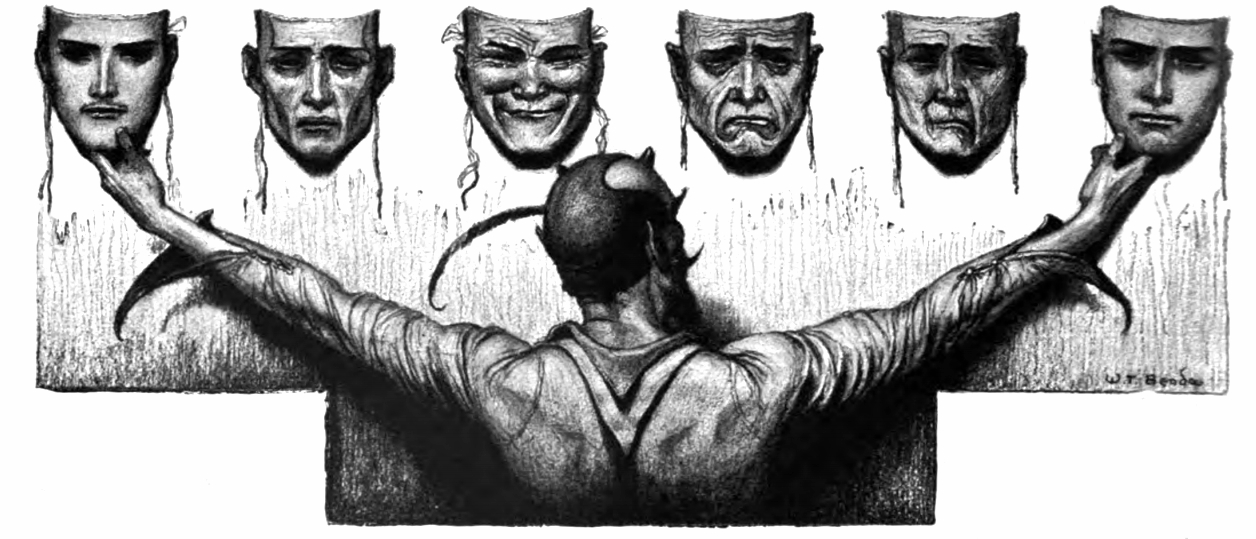
No matter how often teachers of every school and tradition repeat that the primary motive for any action is the action itself, the very necessity of performing it, in practice people most often act expecting to receive something for themselves.
At the same time, the usual “trigger” for performing such actions is, more or less, manifest envy or jealousy: a person either likes what he sees in another and thinks, “he is worse than me, so why does he have this and I do not? I am better, and therefore more deserving,” or he fears losing what he has, fearing that it will be taken from him, and so builds walls to protect his possessions. One way or another — whether in attack or defense — a person trains himself to take only those actions that he believes should multiply and preserve his possessions, whatever is meant by possessions — something material and tangible, or the possession of another person, or perhaps the possession of knowledge or skills. The drive to derive pleasure from the awareness of one’s ownership of what is valuable, of what seems important, is one of the key demonic distractors underpinning consumer society.
And, like any distractor, envy and jealousy are born of a distortion of the mind’s own striving, which in this case is the fundamental need for realization. The mind that strives to know itself through its actions, when caught in the trap of separateness and the urge to possess, begins to act not for the sake of the actions themselves but to maintain its separateness and to feed the demon of avarice.
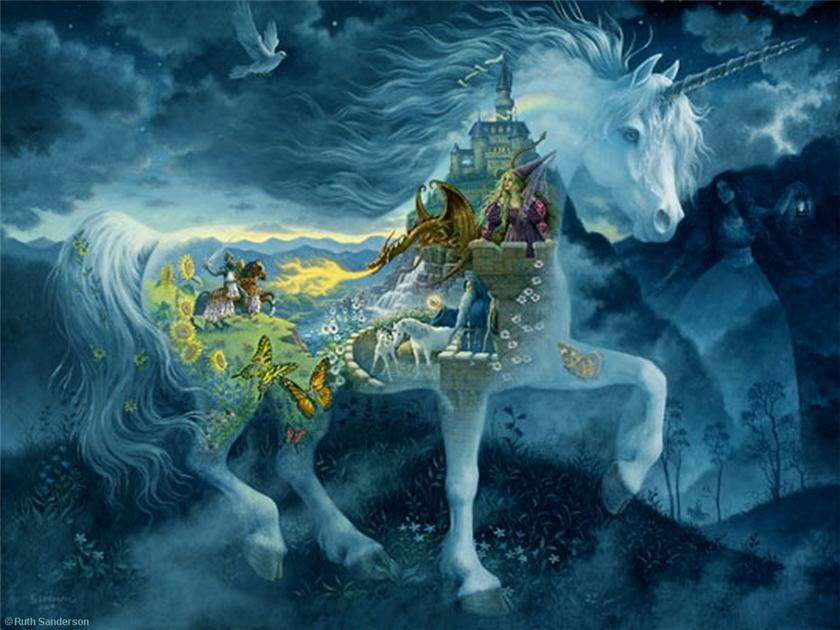
In its “original” manifestation this pure urge to act, to know, to realize simply because the need arose — not for the sake of the result, but for doing what must be done — is traditionally expressed by the image of the Unicorn.
The image of the One-Horned Steed, an animal with expansive, active energy, is known from deep antiquity: depictions of such creatures have been found on the walls of cave temples more than four thousand years old.
This force, expressing the “restless”, active nature of mind, its striving toward self-perfection, toward unimpeded self-manifestation, has been celebrated in countless myths and legends.
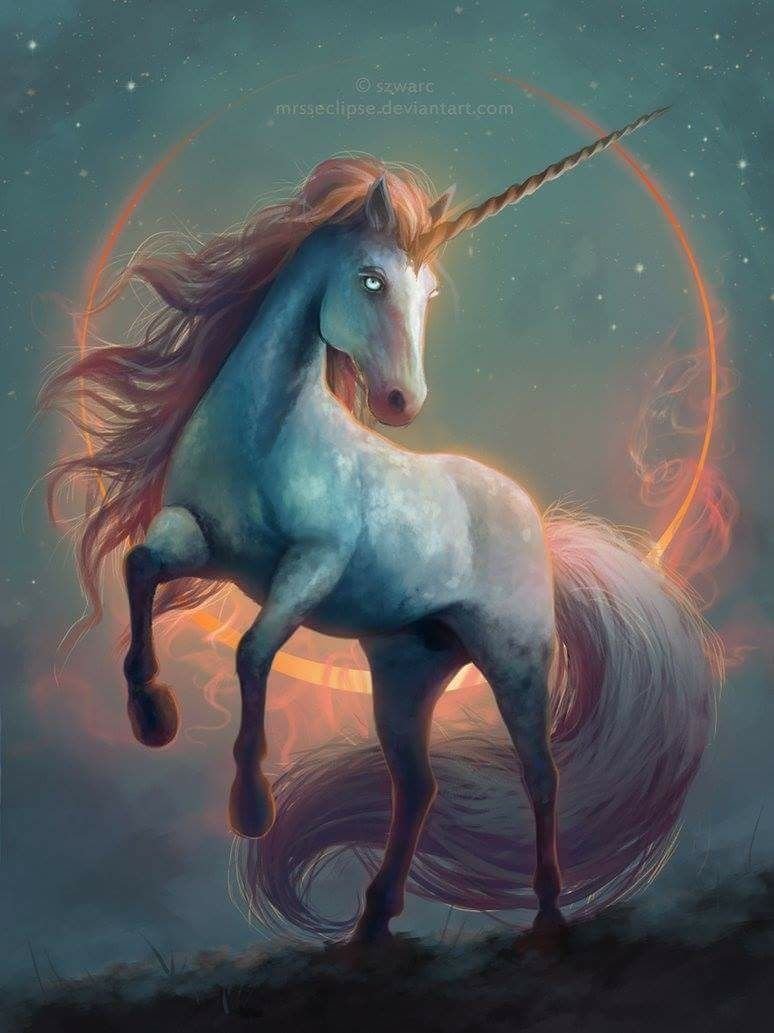
In Slavic myth this activity is associated with Dazhdbog, and for the Magus efforts to awaken and master it are one of the key tasks on his Way.
The Magus strives to act with emphasis on the actions themselves, and for that he accepts the challenges the world presents and responds to them, understanding that each such challenge, each new chance, every opened opportunity is another rung on his endless Way, another link in the infinite chain of self-knowledge and self-realization. It is precisely the awareness of the infinity of the Way, the awareness of the immeasurability of the stream of realizations, that awakens the Unicorn: once the Magus clearly understands that all efforts to master anything are finite and, frankly, absurd when viewed from the perspective of infinity — he ceases to strive for finite goals, perceiving any realization only as a link, a stage, a moment on his Way. The “chastity” so prized by the Unicorn is precisely the refusal to possess, the refusal to be an owner and a victim, a renunciation of market and consumerist modes of behavior. The element of the Unicorn is air, a mobile principle that disperses smoke and fog. Therefore, awakening the Unicorn’s force in the mind means not only the mind acquiring mobility, lightness, and non-attachment, but also the “dissolving” quality of its activity. In performing any action, the Magus “dissolves” the tension that served as the impulse for that action, dispersing that unresolved energy which led to the need to complete that realization. By doing what must be done, the Magus travels his Way with ease, and the Unicorn, carrying his mind through dark forests and swamps of material attachments, proves an invaluable aid in overcoming avarice, envy, and jealousy. Unicorn Stag
With our imagination, we create an image.
We endow it with qualities.
We direct our attention.
The more frequently we direct our attention, the more energy the image is filled with, and the brighter and more alive it becomes.
Tabitha, no. Imagination is useless. It’s not a property of pure presence. Imagine. Reject distorted shards, listen to Enna’s words purely. Forget everything and remember everything.
The unicorn is an Image, a Form. Do you agree?…………Words are also Images, Forms. Consciousness operates with Images, Forms. You attach and connect the Image of the Unicorn to the Process occurring in Consciousness – You shape the Process with the Image. You place the Process into the Image, that is, you visualize it…………………………………………………………………………… and Pure Presence is a State, to which you ascribe certain Properties. You describe the State with Words, that is, you also place the State into an Image.
Tabitha, you are right. Indeed, while imagining, we create a form and fill it with the power of consciousness, which, with certain skills, becomes material. This is how mages learn to create Worlds and understand the nature of forces based on them. But to be more precise: the impulse of the embedded idea, depending on the force applied to the beginning of the movement, acquires a form expressed in the structure of the vector passes through the consciousness matrix, imprinting in the world’s consciousness, and reflected receives realization in the form of filling this idea.
At this time, a unicorn is growing up in our world. It is being strictly guarded. It has the potential to turn the world towards the light and is a concentration of power, as well as restoring the balance of Light and Shadows.
“Beautiful image”
For me, a very important step towards the transformation of selfishness and greed has been the understanding of the concept of the mimetic double.
By nature, humans imitate other people. Very often wars and conflicts flare up not where there are any real contradictions, but where one side wants the same as another. Simply because the first unconsciously imitates the second. (From this angle, one might consider the murder of Abel by Cain.)
But at the same time, this mechanism provides the opportunity for learning as such. At least at that stage where the student must follow the teacher. On a purely physical level, if I correctly interpret the modern conception of neurophysiologists, mirror neurons are responsible for this.
Thus, it turns out that a useful mechanism of our life contains a distractor, forcing us to desire what others have (even if we do not need it).
Not that this is an important “practical conclusion”. Understanding how it works both conceptually and physiologically, shifting the problem from the shadow area into consciousness has helped me understand how this part of me should work properly.