
The ‘Playgrounds’ of the Archons
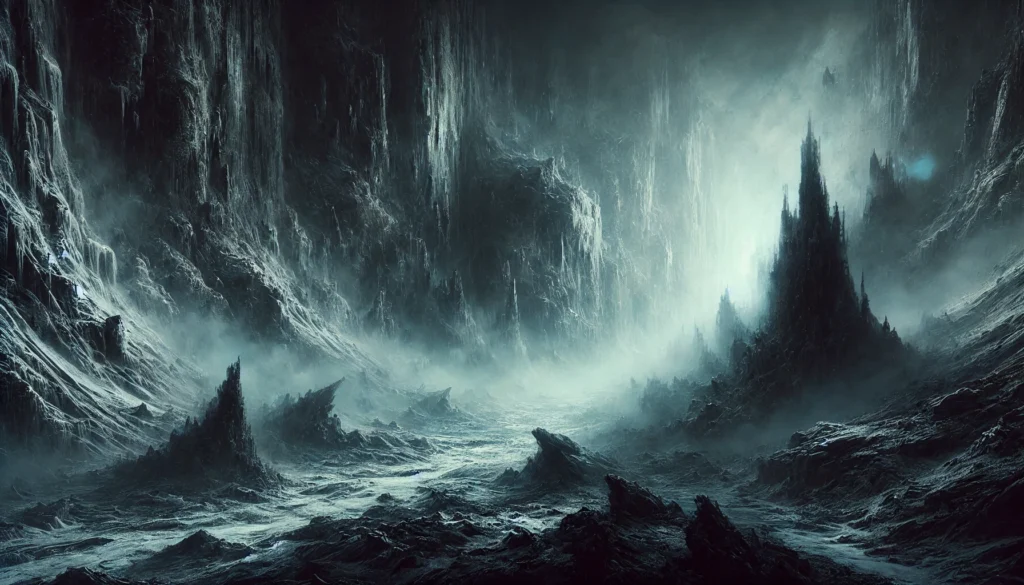
Among the most concealed, secret, and terrifying regions of the Interworld are the so-called “Formless Regions,” also known as “Playgrounds” (theatrum). Each of the spaces, subspaces, and regions of the Interval has an “other side,” usually unnoticed both by inhabitants and by the Interworld’s transitors, unmentioned and undescribed. Only some sources superstitiously refer to these spaces as the “Regions of Eternal Darkness,” immediately avoiding discussion of them. Norse myth speaks of them as the “abysses of Niflheim,” also distinguishing them from the “ordinary” otherworld — Hel. Nevertheless, understanding the nature and purpose of these regions is important both from a general worldview and from a practical point of view. Indeed, many ways of “losing” various “souls” during the journey after death have been described; however, they fall into two qualitatively different groups — those with “return” and those with “fall.” All failures in the path itself through Duat lead to the being that did not pass a particular lesson returning to the earthly (or another planetary) world in order to complete it. This is a “disruption” of the journey, but not its end. A completely different matter is the “devouring of the heart”: if the Judgment of Osiris deems the deceased unworthy of eternal life, his eb (heart) is devoured by Ammut (ꜥm -mwt, “Devourer of the Dead”), and the mind itself falls into that very “Eternal gloom.” Greek legends also speak of a similar state — the “Deep Tartarus,” into which even the gods never descend. And although calling this state “gloom” is not entirely correct, even from these descriptions it becomes clear that there exists a certain bleak region, distinct both from ordinary posthumous spaces and from worlds of retribution, characterized precisely by the notions of “emptiness” and “formlessness.”
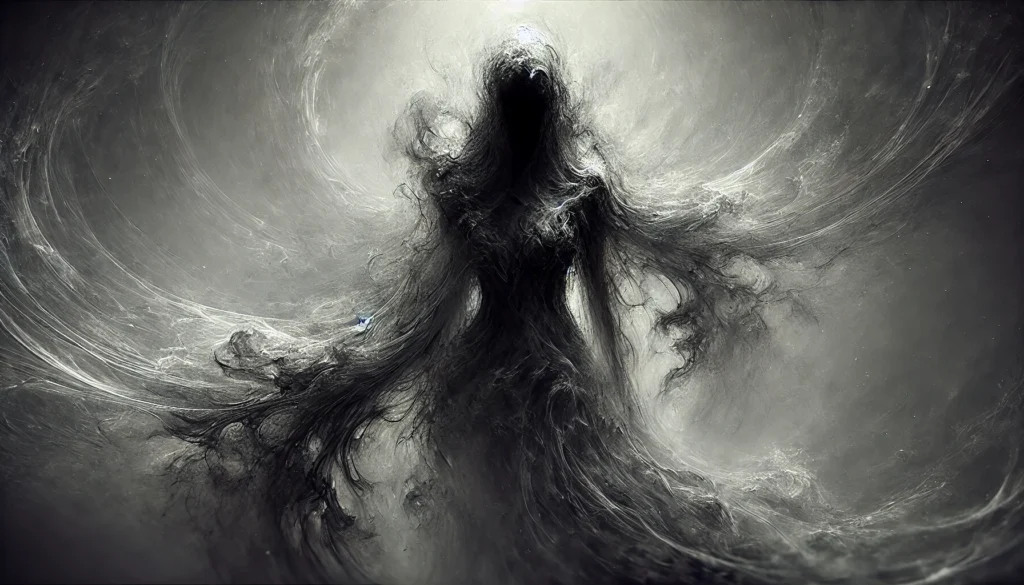
The Gnostic tradition describes these regions as belonging to the “sphere” of the Black Archontess — Ariuf — the force of “excluding” objects from the universe, and also speaks of the existence of special places for the “storage” of souls that are under the power of the Archons, differing from their usual paths and regions.
Thus, any of the spaces and subspaces of the Interval has two sides: one — the better known — “the active side.” All processes characteristic of the Interworld take place here; all its inhabitants dwell here, and its transitors pass through. A completely different, much smaller, hidden part is “the resting side,” where the “shadows of shadows” are located, i.e., structures that have no internal potential for movement or development, no glimmer of will or desire. In other words, as long as there exists even the slightest impulse toward movement or development in the stream of mind, it passes the Interval through “dynamic” spaces, not knowing and not coming into contact in any way with the regions of stasis; however, when these impulses for some reason are completely exhausted, the “emptied” stream of mind sinks into formlessness.
There may be several reasons for such exhaustion. It may be the consequence of excessive activity of predators “eating out” all the energy from the mind until it loses the will to live or resist; it may also be mistakes in spiritual practices (for example, the so-called “Dark (‘jada’) samadhi” — merging with emptiness without relying on luminosity); and simply a long habit of laziness building life to life, ultimately leading to its collapse.
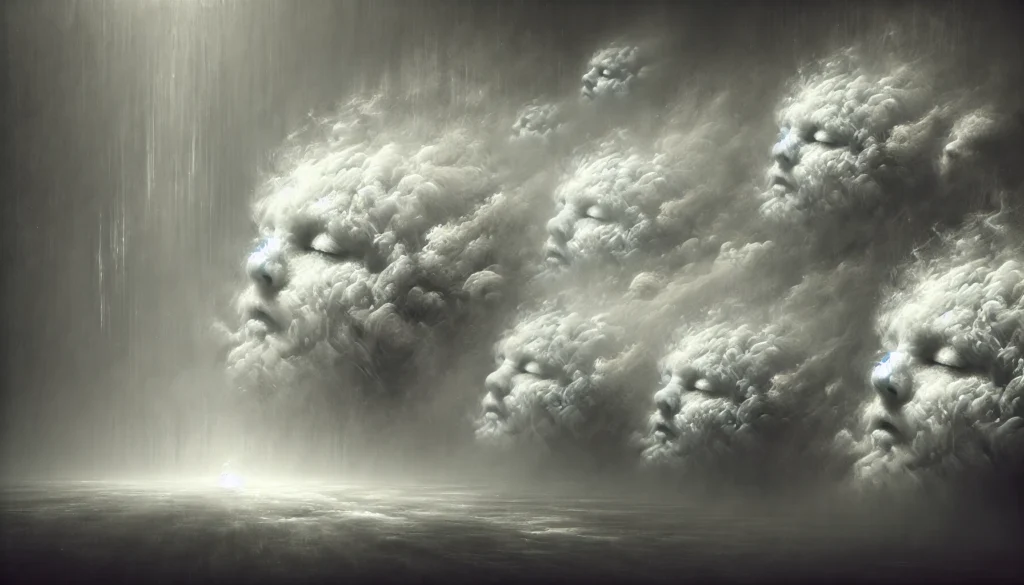
In any case, such streams of mind, lacking the quality of directed movement, end up in Theatrums, where their state can be compared to deep sleep. They are not motionless at all, since the nature of mind is movement, but their movement is without energy: they neither generate nor expend energy, although they may even interact with one another in some way, without really being aware of what is happening. They even have certain rare glimpses of visions, on which they do not fixate and of which they are not aware. This is a far more passive and less aware state than even that which is characteristic of the “Cities of lies,” and if in the latter the mind usually remains for a short time, then in Theatrums it “gets stuck” until the end of the world age.
And only when the manifested worlds perish in the Fire of Kalagni, and all the beings inhabiting them merge in the common Dream of pralaya, do the essences from Theatrums also enter the Unmanifest, so that with the coming of a new Age they may again try to realize themselves in a new world, having received at birth the impulse to move. At the same time, they constitute the “pure seed” of new worlds, since they are practically not burdened by any memories, karma, and the like, beginning the path “from zero.”
Thus, it is precisely falling into Theatrums that can be considered that “death of the soul” so often mentioned by various religions, and which usually serves only as a bogeyman, insufficiently described. However, understanding the nature of these spaces, as well as the states in which the mind abides there, makes it possible, without unnecessary emotions, to assess the importance of the mind’s tone, the inadmissibility of its weakening and laziness, since they can become truly irreversible.
If we consider the topology of the interval, is this the very bottom from where the roots of the world tree originate? And how to understand dark nirvana, entering into emptiness without relying on light? Nirvana translates from Sanskrit as Silence; this implies the silence of consciousness activity, namely, those desires that it generates? What is the consciousness state like that exists there? I would call it ‘eternity in a grave’. There is also eternity in paradise and eternity as a moment in time (stop a moment – you are wonderful).
Dear Enmerkar, what is the difference between theater spaces and formless worlds (arupalokas) in Buddhist cosmology? Or are these different perspectives of different belief systems on the same state?
I do not have enough competence to answer this question unequivocally, but I think they are simply different ways of description.