Magi and the Gates of Power
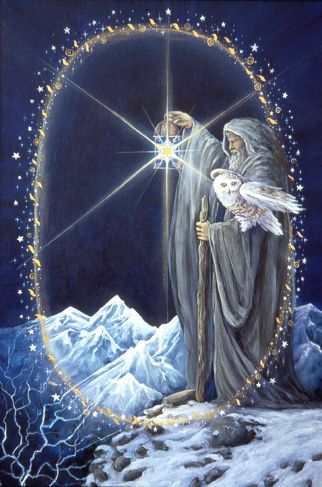
Perceiving the world as the manifestation of Unity in Multiplicity, Magic regards it as an aggregate of currents and energies engaged in complex interactions, generated by the two basic forces — the unifying and differentiating forces.
Individual currents, in order to be fully manifested, are held by the Threshold, the Gatekeeper, manifesting as Naxash (Phobos) — the force of repulsion. This force is balanced by the force of attraction — Ea (Eros). In the “ordinary” state of mind corresponding to the “human world”, “Midgard”, these two forces are balanced so that only a limited circle of energies, tightly bound to one another by causal chains, interact (indeed, this circle of energies is precisely what we usually call the “world“).

Being closed in on itself and separated from the world’s fullness by the Threshold (that is, effectively — a barrier of perception), each world is, on the one hand, stable and relatively well-defined, but on the other hand constrained and limited. Therefore, worlds must be separated for their stability, but on the other they must exchange energy to avoid stagnation and the cessation of development. For worlds to interact with one another, they communicate via controlled “points of descriptive instability”, traditionally called “Crossings of Worlds” or simply “Gates“. Each such Gate has free and ministering forces — “gatekeepers” that oversee the interaction.
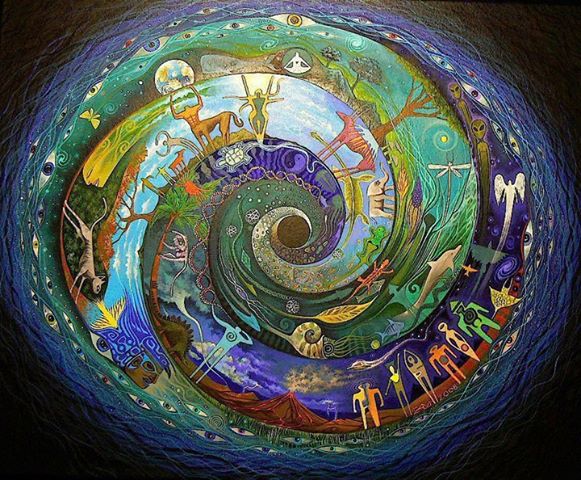
Since Magic is the Way of expanding awareness, any magical action always affects otherworldly energies — either by activating and attracting them, or by banishing and neutralizing them. From this perspective it turns out that, in addition to gods, angels and demons, ‘gatekeepers‘ include the Magi themselves. In any case, most Rituals of Magic either open or close particular Gates, acting as mechanisms regulating energy flows. By invoking the power of a given god in a theurgical operation, a Magus opens the gates to that power and thus shifts the balance of his “own” world toward an increased presence of that force; by evoking a demon in an evocation, a Magus likewise leaves the Gates ajar and risks opening them if something goes wrong, which again would disturb the original balance of powers and summon corresponding countervailing forces. Exactly the same applies to rituals of necromancy, “angelic magic“, as well as to Rites of Passage, Seit, even the Vision Quest, and so on — these are always Rituals of the Gates, in which the Magus assumes the Gatekeeper’s role, determining which forces he wishes to admit through the Gates he opens.
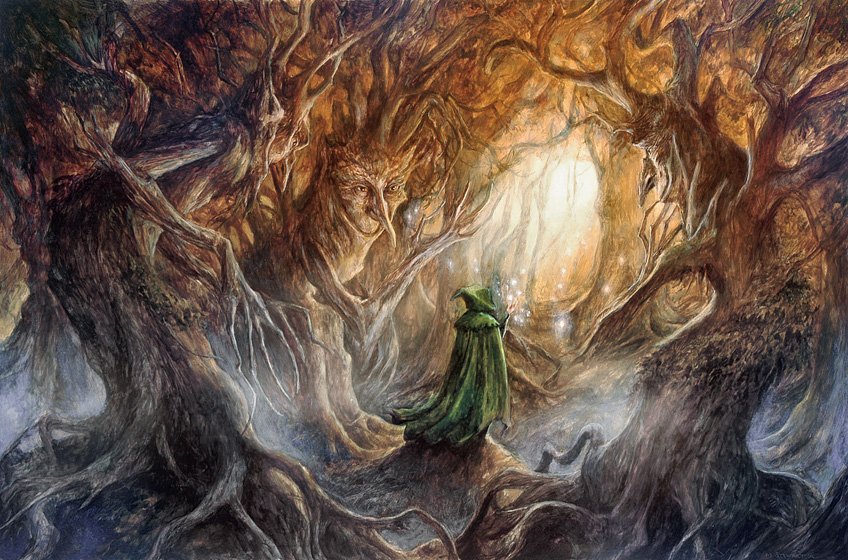
However, while “natural” Gatekeepers are always well-informed about the nature of the Gates and the consequences of opening them, many Magi lack such awareness. Seeing that any opening of Gates changes the overall balance of powers in a world by drawing into it something new and alien, the Magus must understand how great his responsibility is for such an act, how significant the consequences may be, and therefore strive for a clear awareness of the reasons, justification and meaning of his activity.
That is precisely why the teaching of Magic is both the study of Myth and Law — the study of Myth and of Law, is — the teaching of understanding with practice, and a break in this connection turns Magic either into philosophy (which is safe but powerless) or into sorcery (which is dangerous).
A clear vision of the Gates of Power that the Magus intends to open in his action, an understanding of the character of the forces passing through those Gates and their influence on the balance of the world, are paramount conditions for the effectiveness of Magic as a system of development, as a Way that leads not to destruction and breakdown but to harmonization and freedom.
Leave a Reply