
Archons and Aggression
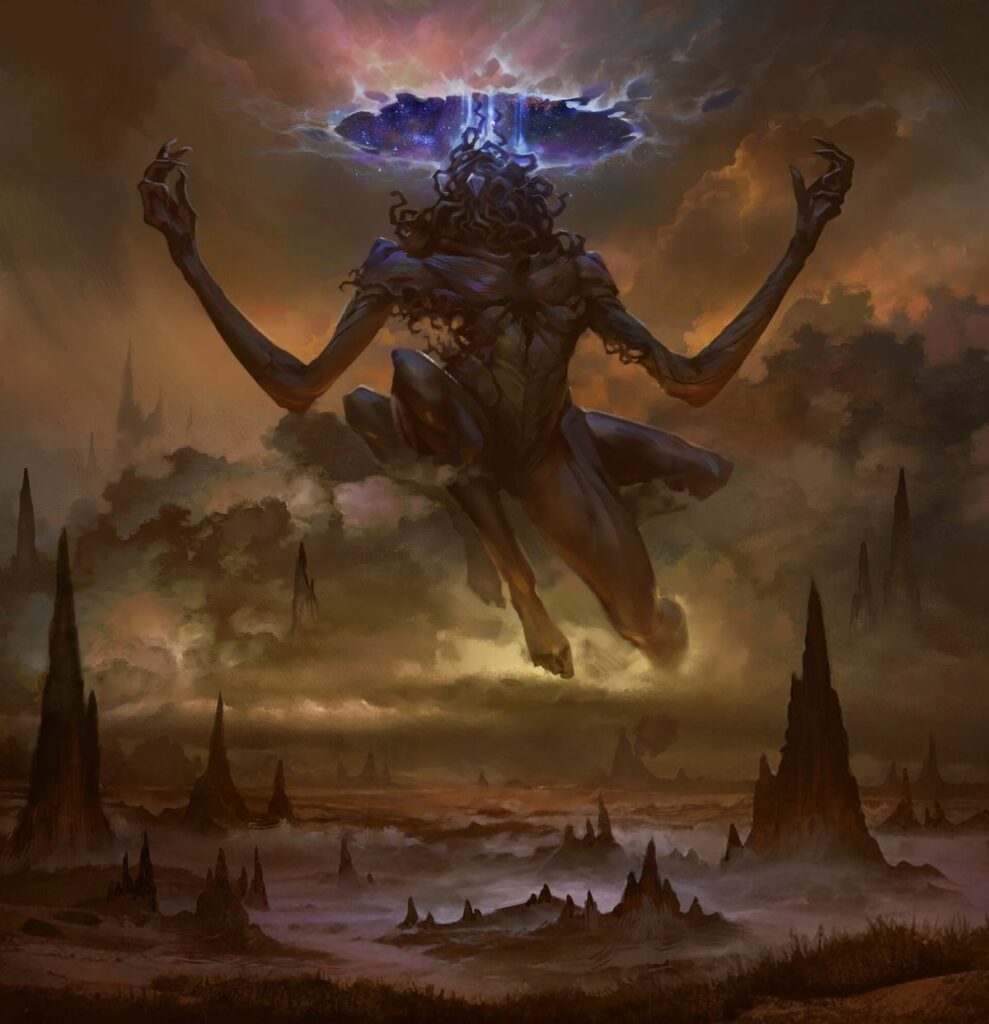
We have already said that by their nature the Archons are inertial forces that express the primordial fixation of the universe, creating within the boundless seething of the Interval’s totipotency the possibility of laws, forms and determination. Thus, the influence of the Archons is always ‘freezing’ and paralyzing, and in this lies their essence and nature.
Nevertheless, when describing the Archons, Gnostic texts often attribute to them “active,” expansive characteristics that, at first glance, seem inconsistent with their ‘icy’ nature.

And the most important such property, of course, is wrath, personified by a Higher Archon, whom the Gnostics described as the “Black Artemis” — Ariūf (Αριουθ, the name goes back to Eri-Aku, “Power of the Moon”), and the “Archon of Mars” — Adonin, the “Jealous God,” one of the creators of modern humanity.
Let us examine the features of “archontic wrath” in greater detail.
“Pistis Sophia” rightly attributes wrath to a “female” Archon and calls Ariūf an “Ethiopian woman,” that is, “black and wild,” pointing to the the destructive side of immanence, analogous, for example, to the Hindu Kali (whose name also means “Black”). The text also indicates that the forces of Ariūf “incite strife,” once again emphasizing the special nature of her destructiveness.
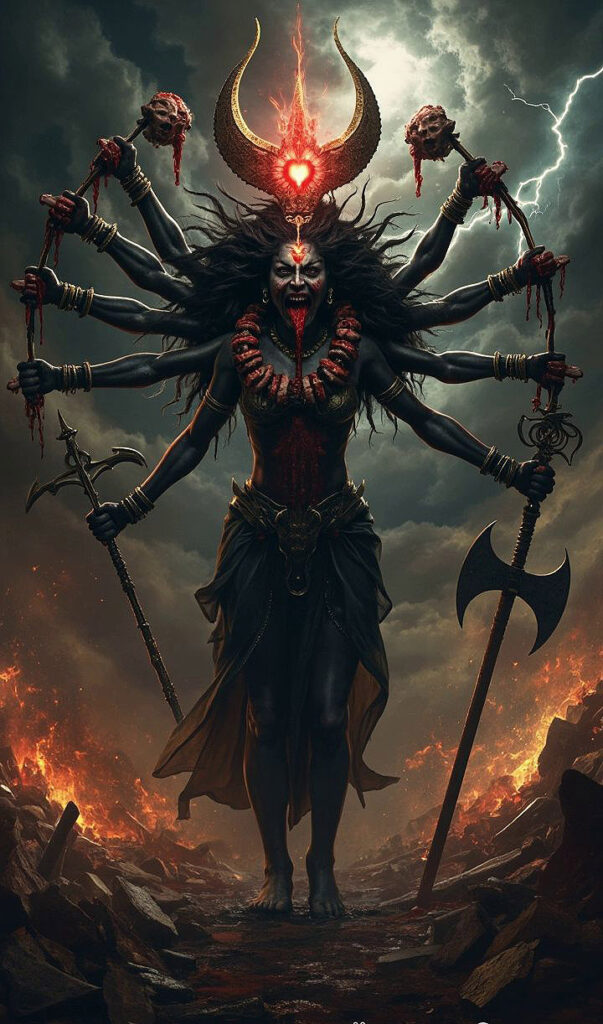
And it is precisely Ariūf, as the primordial archontic force, gives rise across worlds to wrathful goddesses who embody that destructive aspect of the worldwide energy of creation that first appears in the guise of the Black Ruleress of primordial hatred.
Since antiquity, Magi and mystics have seen that Wrathful goddesses differ from male destructive forces. While the wrath of male gods embodies a fiery, outwardly active, direct, and expansive power, the rage of goddesses is deeply elemental and chaotic in nature, being an expression of the primordial, pre-cosmic, and pre-reflective energy of life itself, manifested in its most archaic, primary aspect. Whereas male wrath is a directed, focused flame, female fury resembles a seething boundless sea, capable of sweeping away and dissolving all barriers, erasing established boundaries and returning the world to primordial chaos. In this respect, Tiamat is pivotal, as she most fully expresses this wrathful, chaos-inducing aspect of the primal waters of creation.
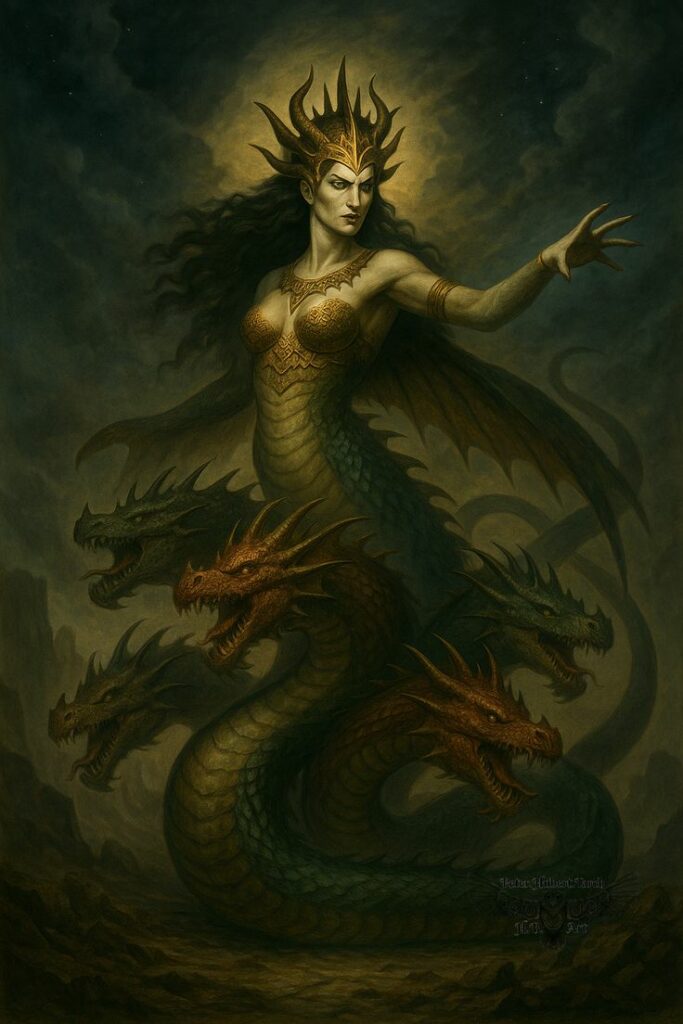
One of the key features of the wrath of goddesses is its connection with the fundamental capacity to simultaneously generate and destroy forms. The wrath of female deities does not merely destroy an already existing structure, but returns reality to a primordial totipotent state. Therefore, female rage is often expressed through images of a “black” or “dark” goddess (Kali, Black Artemis, Hecate, Tiamat), embodying fundamental indeterminacy and the abyss from which all forms are born and to which they return. The wrath of such goddesses is not a punishment for violating any laws or rules, as in the case of male deities, but is a manifestation of a deeper level of reality, on which any definiteness turns out to be temporary and illusory.
Another important aspect of female wrath is its intensity, connected with total immanence directed “inward” into the very structure of the universe. Male wrath, expressed through fire (Ares, Indra, Thor, Set), is always directed outward; it attacks, conquers, and destroys an external enemy, restoring order through a forceful transformation of the environment. Female wrath manifests as internal decay and destabilization; it destroys form from within, releasing its original, chthonic potencies. Therefore, female wrathful forces more often manifest through natural disasters, epidemics, irrational conflicts, and social strife (as can be seen already in the myth of the wrath of Sekhmet), through events when the structure begins to fall apart by itself, unable to withstand the internal pressure of its own nature.
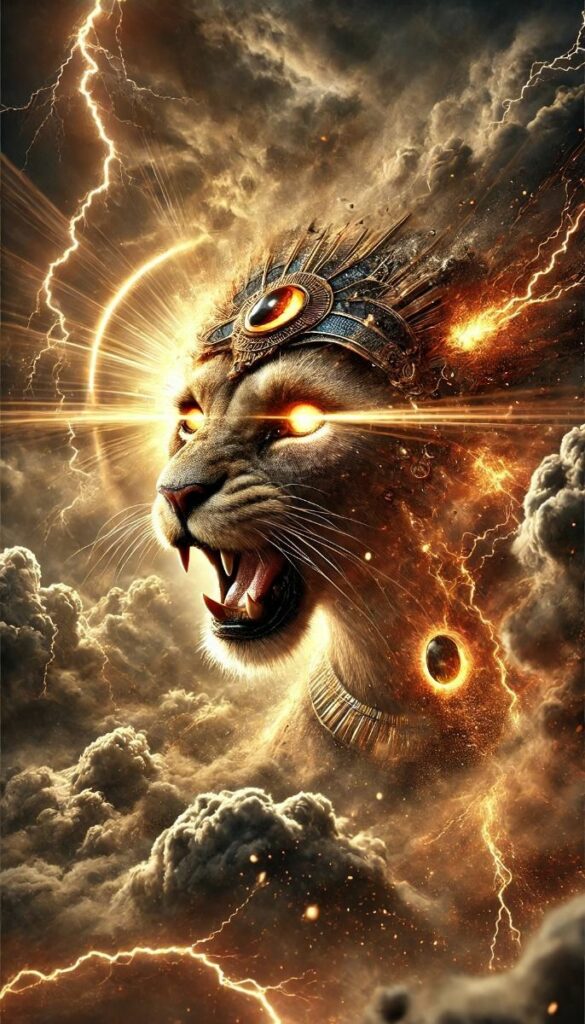
Archontic wrath, embodied in the figure of Ariūf, is fundamental and a constant potential of a full “revision” and restructuring of the universe, as a principle of the possibility of endless re-creation and return to primordial chaos, an inexhaustible source for a new cycle of creation.
It can return the world to primal indeterminacy, to erase all conventional boundaries and forms, to remove from the mind and environment regularities and conventions, holding the mind in constant inner chaos.
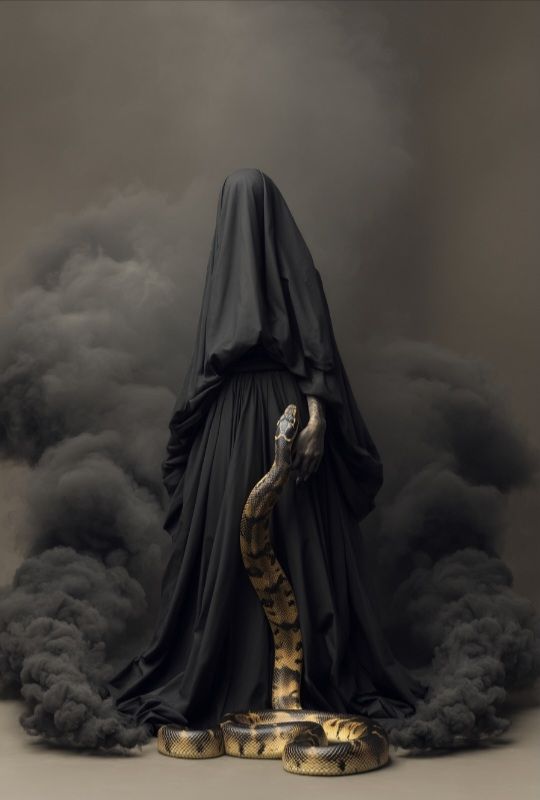
It is clear that the power of Ariūf is an entropic influence “stitched” into the universe, the cosmos’s striving to resist its crystallization. Such a force manifests in the form of processes that outwardly seem causeless or self-initiated: epidemics, ecological catastrophes, internal economic crises, wars, and social conflicts arising without an obvious cause or logic. States when systems disintegrate on their own, unable to maintain their own inner coherence and stability. Ariūf prevents structures from reaching full maturity and stability, periodically returning the world to primordial chaos, in which the mind again becomes a prisoner of the fetters of Heimarmene.
That is, the wrath of Ariūf manifests as a chaotic, elemental force, and its function in the archontic hierarchy is to maintain the cyclical, continuous return of the mind to a state of senseless self-destruction, conflicts, and endless repetition of destructive patterns. “Implanted” by the Archons as one of the basic reactions of the clouded mind, such inner aggression constantly sustains the cycle of unconscious reactions and mechanical actions, binding the mind in shackles of hatred.
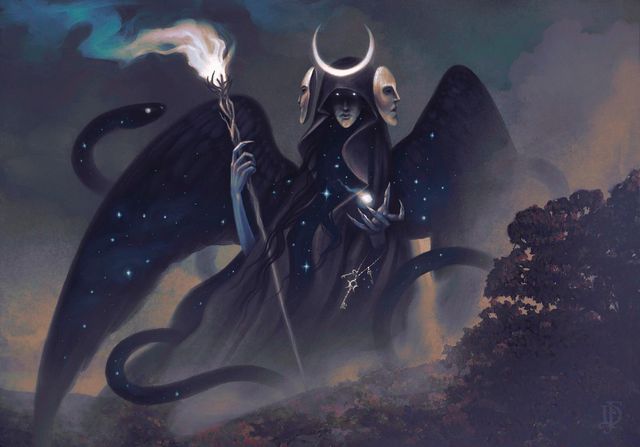
It is precisely this corrosive discontent and irritability in the mind, arising from a sense of dissatisfaction, spills into hatred and aggression, behind which stands the influence of Ariūf. They are the cause of constant outflows of a being’s energy, and, spilling over into overt or passive attacks on others, they provoke instability around as well.
Under archontic wrath, the mind falls into discord; its attention and energy are absorbed by senseless conflicts, arguments, and emotional confrontation. This leads to the mind closing itself into cycles of recurring conflicts and aggressions, losing the ability to progress toward gnosis. In this sense, the wrath of Ariūf is a subtle manipulative force of Heimarmene, holding the mind in a state of limitation and conditionedness.
In addition, archontic aggressiveness can intensify passive victimhood and reactivity, since the psyche, constantly seized by emotional outbursts and inner conflicts, is deprived of the possibility of taking an aware stance toward its experience. Such emotional reactivity and primal blindness make the mind especially vulnerable to external manipulation and propaganda, depriving it of discernment and plunging it into a state of constant dependence on external authorities and attitudes.
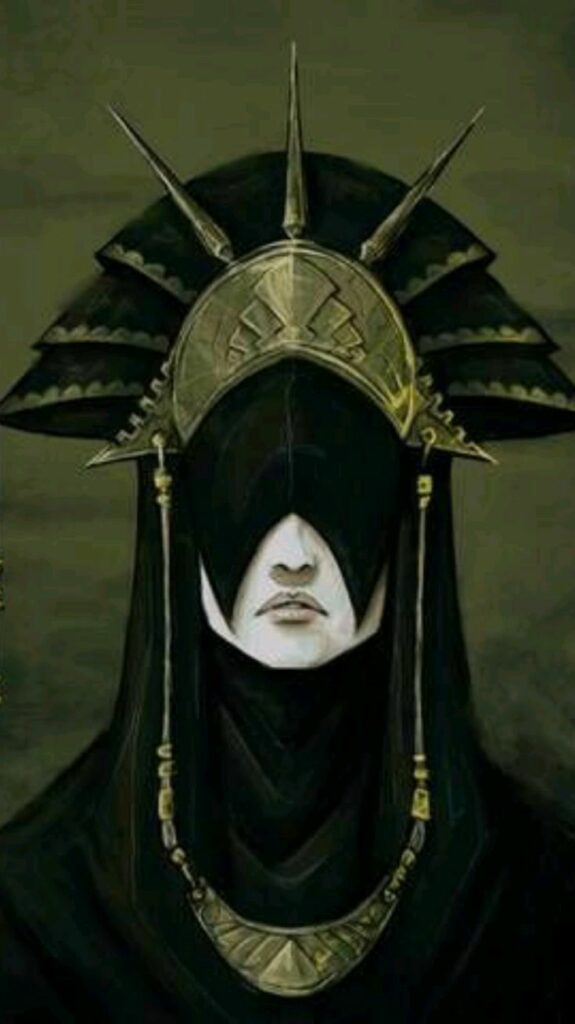
Unlike male wrath, which is open and recognizable, the wrath of Ariūf is hidden, immanent, and often not realized by the mind itself. That is why it, like other archontic hooks, often feels internal, not external impulses; the mind considers them genuine and inevitable. Thus, beings are deprived of the capacity for self-analysis, turning into an unconscious victim of archontic manipulations.
Accordingly, liberation from such deep hatred and destructiveness requires becoming aware and overcoming them and thus the cessation of identification with them and the transformation of elemental reactions into the aware energy of clarity and gnosis. At the same time, the liberation of the mind from archontic wrath and hatred as a female form of destructive influences fundamentally differs from liberation from male, fiery wrath and requires completely different strategies of transformation.
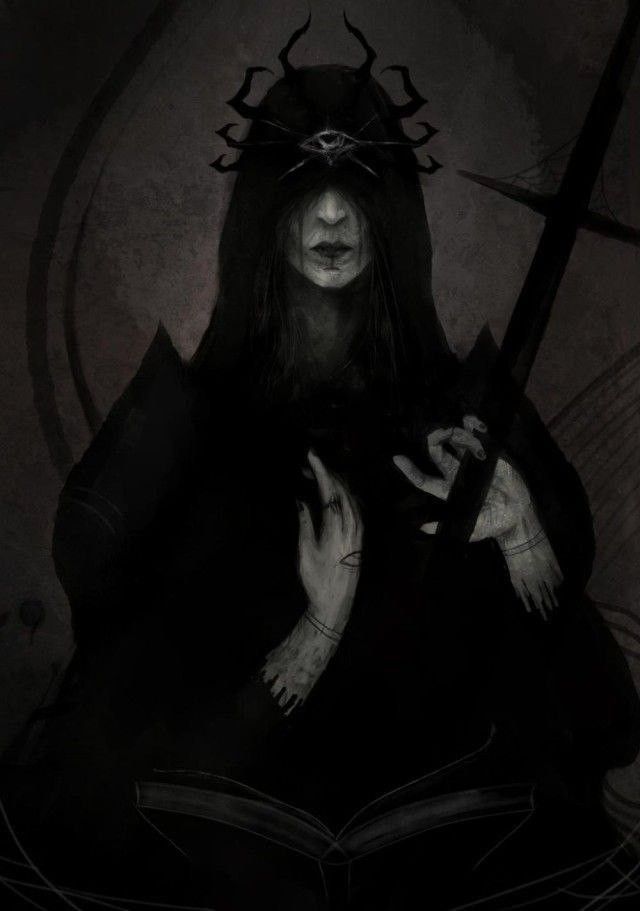
As mentioned, “male” wrath is the energy of action, open confrontation, usually easily identified by the mind. Therefore, liberation from it requires developing self-control, awareness, emotional discipline, and training the skills of managing one’s own reactions. At the core of transforming these energies lies the ability to recognize the arising impulse and consciously redirect it into constructive forms of expression. At the same time, key is awareness and mastery of wrath’s direction, redirecting its energy from destructive to purifying action. This is the process of the mind mastering impulses and choosing constructively.
“Female” hatred, on the other hand, often has a deeply inner, elemental, and unconscious character. Its impulse is not always obvious or understandable to the mind; it is often hidden in subconscious processes and fears. This is immanent psychic chaos, a state of inner turbulence and unseen destruction.
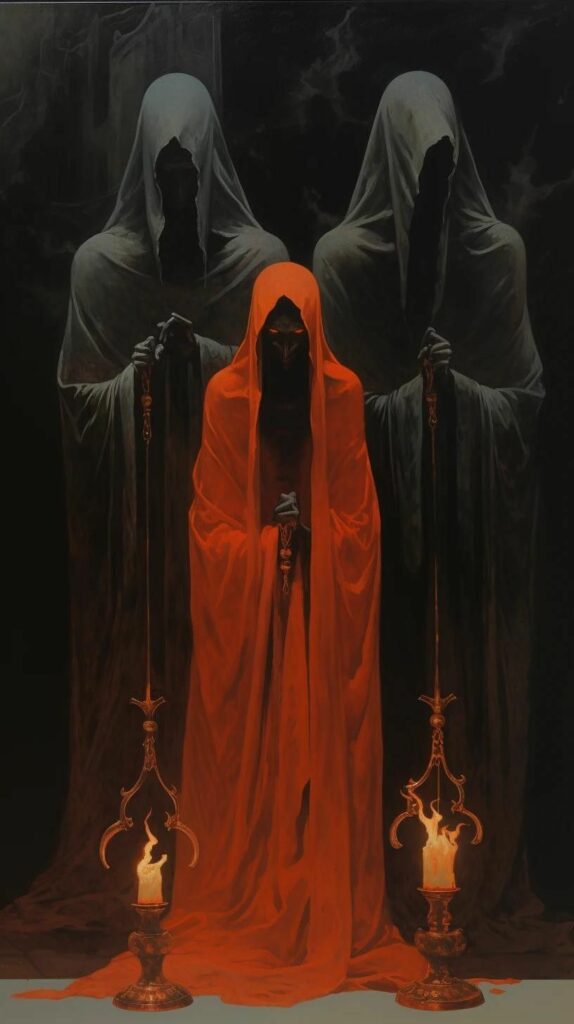
Therefore, liberation of the mind from archontic aggressiveness requires, first and foremost, deep, careful inner work with unconscious recognition and integration of repressed shadow aspects. Here a key role is played by the practice of mindful observation of inner chaos without identification.
In other words, overcoming Ariūf — the “completely black Archon” — is, in fact, overcoming one’s shadow, recognizing all aspects of one’s being, including those that are perceived as negative, destructive, or shameful. As long as the mind does not acknowledge these repressed parts of the psyche, archontic hatred retains its roots and its ability to manipulate inner processes, constantly returning the mind to the experience of chaos and inner indeterminacy.
After integration, the mind can use this energy held by Ariūf for inner development, integrity, and attainment of gnosis.

How wonderful it is to learn this Knowledge and Wisdom. Thank you
A little philosophy.
33. In death embodies the dissolutive power of the universal vagina.
34. Death is much more primary and immediate than the illusion of life, expressing the true metaphysical quality of being.
35. This metaphysical quality consists in the absence of internal support in being, as indestructible foundation.
36. The very fact of global being is the result of a certain decree of arbitrariness.
37. Original arbitrariness, by virtue of its unmotivatedness, cannot serve as a support for anything.
38. It is precisely this lack of support and total dissolubility of being that gives the metaphysical effect of the abyss.
39. In the metaphysical effect of the abyss finds its ultimate completion the all-encompassing inertia of reality.
40. The vaginal abyss is characterized by illusory inexhaustibility.
41. Original arbitrariness repeatedly manifests through this abyss with existential structures doomed to dissolution.
42. In all its external insignificance, these existential structures are in principle repetitions of the same.
43. In these doomed manifestations, the universal reason reproduces itself each time in all its internal vanity.
44. The manifestation of existential structure and its destruction express the rhythm of dialogue to which the flow of reality is subordinate.
45. The chaos of the abyss and the structure of manifest being correspond to the dialogical opposition of question and answer.
46. Renewing manifestations of universal reason are variations of the same eternally unsatisfactory answer to the inexhaustible inquisitiveness of the vagina.
47. Thus, in the structure of the universal dialogue, the primacy of the inexorable question is affirmed over any answer doomed to relativity.
48. Original arbitrariness fertilizes the vagina anew each time, dissolving into it the next manifestation of universal reason.
49. Thus, every time again, the illusory nature of reason is affirmed, returning to the abyss of fundamental unmotivatedness.
50. The return of manifested harmony into the chaos of the vaginal darkness is the archetype of fertilization.
51. Universal reason, as an instrument of fertilization, plays the role of the pseudo-phallus in existential drama.
52. Fertilization is essentially a castrating act.
Point 44 is interesting. So ultimately, what does this dialogue consist of? Between chaos and cosmos? Between spirit and matter?
Dear Master, what influences can explain the current transgender epidemic? Is it not those described in this post?
I think it’s mostly just a form of social protest against gender roles in society. Although, a small percentage is probably really related to embodiment errors.