Theurgy: Functions and States
For the Magus, theology, angelology, demonology and similar disciplines are not so much tools for creating a complete picture of the world, a way of describing and explaining reality, as they are the foundation for his practice, the justification for the actions and approaches he employs on his Way.
Accordingly, when reflecting on the nature of the gods, isolating and specifying their properties, qualities, predicates and attributes, the Magus is not merely exercising his intelligence but is developing a sound course of action.
The goal of Magic as a comprehensive Way of development, a Way of realization and liberation of the mind, is the discovery and manifestation of the maximum possible number of forces, establishing correspondences between the properties of the mind “in itself” and the manifested “reality,” that is — aligning the subject and object of knowledge.
From this perspective, theology for the Magus is, above all, the basis for theurgy: for correctly identifying and activating within himself and in the “surrounding world” those forces and currents that are the manifestations of the corresponding principles — gods. A proper identification of such a force can serve as the basis either for attempts to activate it in the “external world” (then, strictly speaking, a theurgical action occurs), or within the psychocosm (then we speak of the “assumption of divine forms” or the yoga of the gods). And even when a theurgical operation is aimed at achieving some “external” result, its success is largely determined by the Magus’s ability to find the corresponding divine force within himself, to enter the corresponding energetic or mental flow, and thus to direct it as required. Therefore, invoking a given deity and asking (or even demanding) it to perform a certain action, the Magus must understand that, in essence, this action is performed (or is not performed) by himself, depending on how successfully it is activated by a particular mental matrix. This, of course, in no way denies the objectivity of the gods themselves, their own wills and goals; on the contrary, the art of the theurgist lies in aligning his goals with those of macro‑currents.
Viewed thus, it becomes clear that when describing a particular deity (as well as an angel or demon), the Magus simultaneously and coherently attempts to describe two currents — the deity’s current and the corresponding mental matrix of the Magus’s own mind.
Traditionally, several methods have been developed for such a description.
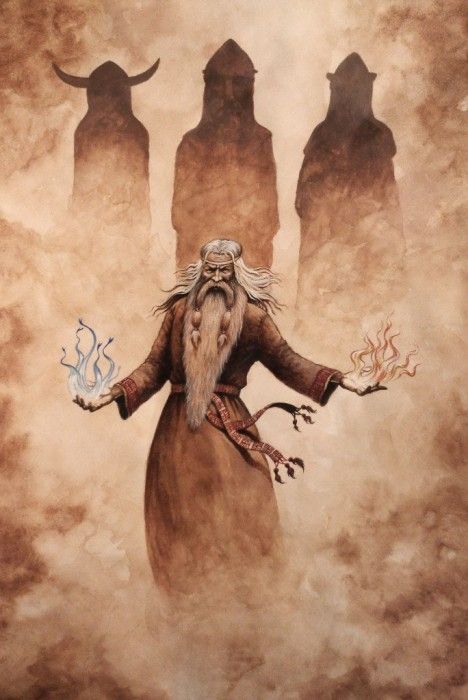
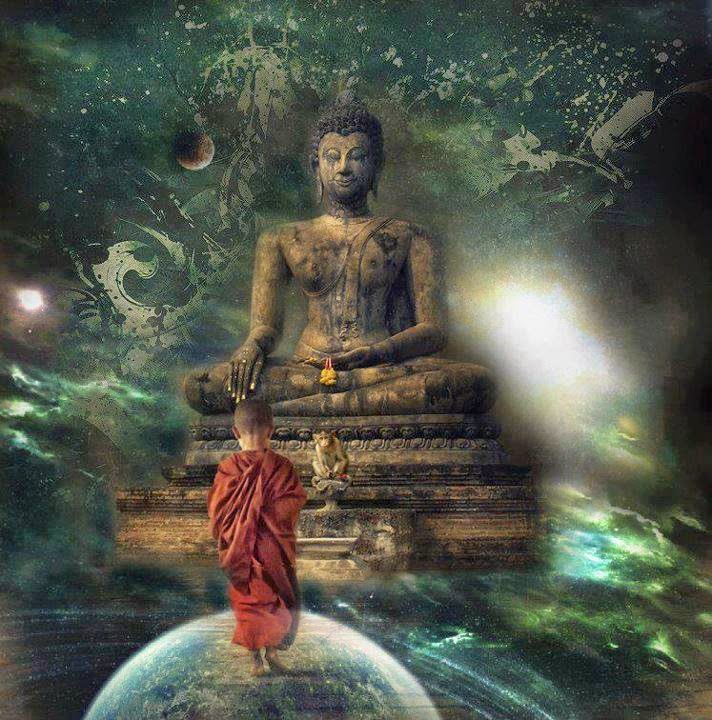
It is fundamentally important to divide the “supra‑forces” into “gods of being” and “gods of mind.” Most Western pantheons treat as gods of being, whereas, for example, Buddhist deities are primarily higher forms of the mind. At the same time, it is clear that even when emphasizing the active aspect of a given divine force one must not lose sight of the the corresponding state of mind, just as the transition of the mind into a particular higher form is accompanied by changes in its active functioning. In other words, calling on Perun, the theurg, on the one hand, activates a force that brings about certain changes in the “surrounding world” — a beneficial, protective influence — but, at the same time, he shifts his mind into the corresponding form to this function. Similarly, activating, for example, the state of Vajrapani, the theurgist, on the one hand, places his mind under a matrix that affirms his essential qualities and removes what is harmful, but, on the other hand, also alters the nature of his interaction with the “external world.” Both of these forces lie on the same axis of analogy; however, Perun is primarily a functionally oriented power of authority, whereas Vajrapani (although historically this image apparently also traces back to the cult of Indra the thunderer) is chiefly psychocosmic in nature.
Other important classification features we have already considered. For example, for effective activation of a divine force it is important to understand which “generation” the god belongs to, whether the deity is a creative or a formative one; it is also important to identify the place of this deity in the pantheon under consideration, its interconnection with other gods, and, of course, its own individual features. The more precisely defined the force to be activated, the greater the chances of success for the corresponding operation.
Note that such a precise definition of the divine current with which the theurg intends to interact does not necessarily have to take place at the level of the principle of intelligence. For many people more inclined to sensory‑emotional forms of apprehending the world, this “entering the current” can occur outside intellectual effort, intuitively. It is clear that both methods have their advantages and their dangers: relying on intelligence carries the risk of becoming mired in detail without grasping the essence of the current, while a sensorially oriented entry carries the danger of imposture and deception when a predatory stream masquerades under a plausible guise, and instead of activating a deity brings destructive/demonic forces into the world.
What remains decisive is the Magus’s self‑centered relation to the forces he activates. If for the priest/cleric the success of invocation rests entirely in the hands of the “higher powers,” for the Magus‑theurg that success is determined primarily by his own strength/authority/impeccability. If the gods “refuse” the theurg, for him this means he must work on himself, perfect himself; it means that he lacked the strength/authority to activate the corresponding force, not that the gods are “unfavourable” to him or “angry.” And we repeat: this approach in no way diminishes the autonomy of the gods themselves. The theurg does not learn to “command the gods”; he learns to govern himself, including his own divine forces. Only by mastering his own “heavens” and his own “underworlds” can the Magus discover that the “heavens” and “underworlds” of the Macrocosm are available to him.
Thus, theurgy as a distinct domain of Magic is aimed, above all, at the development of the Magus and the world, occurring interdependently and in mutual accord, and consists in the search for and activation of higher psycho‑ or macrocosmic forces that effect this transformation.
Leave a Reply