
“Sacred Magic” of Abramelin
“The repeated commission of the same mistakes is the cause of our present miseries and enslavement, which will last to the world’s end”
(“Sacred Magic, bk. 1, ch. 10)
Among the various examples of magical literature, one gained a new resonance when it came into contact with the Golden Dawn’s system. The greatest magical movement of the modern era rethought and reworked many classical texts and rituals, but “The Sacred Magic of Abramelin the Mage” enjoyed enormous popularity, attracting the attention not only of the Order’s founders but also of its brilliant protégé — Aleister Crowley. It was the latter who, inspired by the ideas of “Sacred Magic,” created a gem of the Thelemic system — the concept of “Knowledge and Conversation of the Holy Guardian Angel” and the famous “Bornless Ritual.”
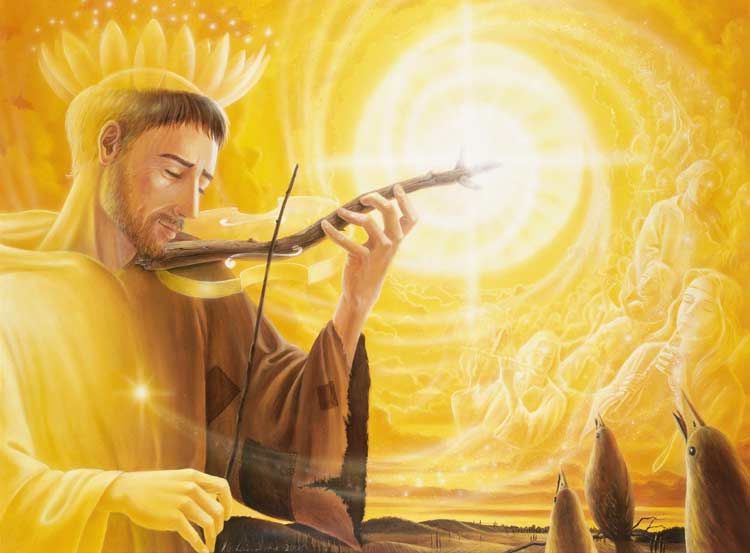
The idea of “Sacred Magic” is to attain, through purity and self-denial, the knowledge of and conversation with one’s Holy Guardian Angel, thereby earning the right to employ evil spirits as servants in material affairs. The term “Holy Guardian Angel” was first used in this sense precisely in “The Sacred Magic of Abramelin the Mage,” and later became entrenched as one of the cornerstones of modern magic.
According to Crowley,
“The only Supreme Ritual is the attainment of the Knowledge and Conversation of the Holy Guardian Angel. In this, the whole person rises and is stretched into a vertical line. Any deviation from that straight line threatens to turn into black magic. Any other operation is black magic.”
The manuscript of “Sacred Magic” is kept in the Arsenal Library in Paris and dates to the 18th century. It is said that an original written in Hebrew existed, dated to the 15th century. In the book itself, it is stated that it was begun in 1409 by Abraham, who learned “Sacred Magic” from the Egyptian sage Abramelin. The first English translation of this “Book of Sacred Magic” was published in 1898 by S. L. Mathers. The full title of the book is: “Book the First (Second or Third, as the case may be) of the Sacred Magic which God gave to Moses, Aaron, David, Solomon, and other holy patriarchs and prophets, which teaches the true divine knowledge, handed down by Abraham to his son Lamech, translated from Hebrew in 1458.”
The work is divided into three books, written by an elderly Magus and left as an inheritance to his son.
The first book sets out the author’s story: having studied Kabbalah, he began a search for higher wisdom. After ten years of wandering through Europe he finally found a worthy master in Abramelin, a hermit living in the Egyptian desert. Convinced of Abraham’s pure intentions, Abramelin accepted him as a pupil.
“Sacred Magic” proclaims that each of us is linked to a particular spiritual entity, which it calls the Holy Guardian Angel. According to this system of magic, after successfully calling the angel, a person gains authority over all spirits and demons. Until the Magus enters into a spiritual alliance with this entity, he has no way to truly command the inhabitants of the lower spheres of our nature or to advance on the path of spiritual development.
The author of the book holds that the good spirits and angelic powers of light surpass the fallen spirits of darkness in might, which, as punishment, are condemned to serve the initiated in the mysteries of the magic of light; and all ordinary material results are achieved by the efforts of evil spirits, who are usually subordinate to the good. Accordingly, the aim of the magical work in this treatise is to attain, through purity and self-denial, the knowledge of and conversation with one’s Holy Guardian Angel, and thereby to obtain the right to employ evil spirits as servants in material matters. Upon attaining the Conversation, the Holy Guardian Angel becomes the Magus’s counselor and directs all his subsequent magical activity from the perspective of higher wisdom.
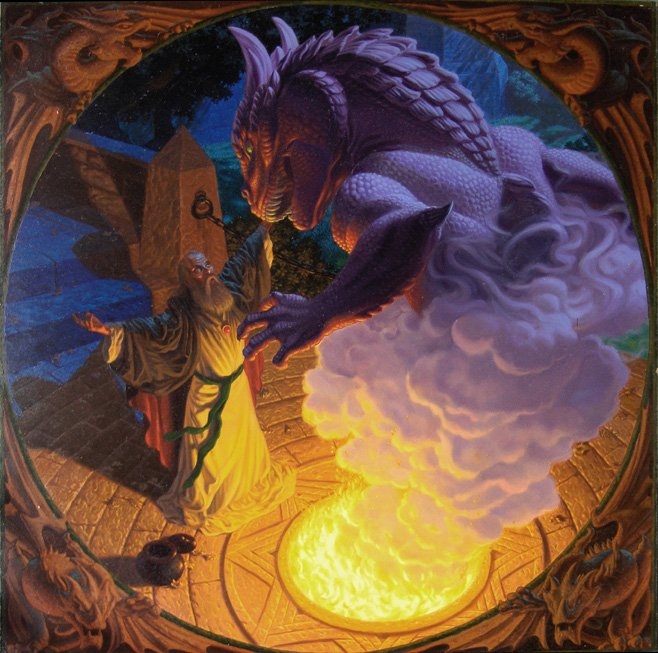
Having reached the Angel, the Magus receives instructions for evoking the “Four Great Princes of Evil” and subjugates them, obtaining their oaths of fealty. The next day the same is done with regard to the Eight subordinate Princes, and so on, until the entire population of the infernal realms has sworn allegiance and comes to obey the new Magus.
Several times throughout the text, the author points out that this system of sacred magic is based on Kabbalah. The ritual portion of “Sacred Magic” omits many familiar elements — the circle, the timing of rituals — and instead devotes great attention to the personal preparation of the Magus, discipline, and chastity. Proper arrangement of the ritual space is also given considerable importance. The book leaves a choice between two possibilities: to set up such a place in nature or in the city. Outside the city, it is better to do so in a wood, where an altar must be raised and sheltered from the rain by branches. At seven paces from the altar, a circle of flowers and shrubs is created. If, however, the ceremonies are to be held in a city, the Magus must choose a room with a balcony and build a small hut with windows there so that the balcony door is visible from inside.
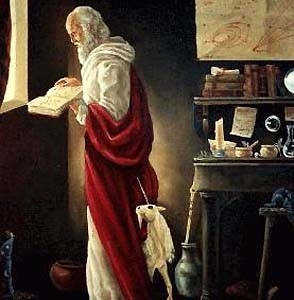
The entire ritual takes a very long time — according to different versions, from six months to two years — during which the Magus must lead a secluded, devout life. Israel Regardie said that, apart from Crowley, he did not know anyone who had successfully completed the Abramelin operation.
The second book of “Sacred Magic” contains information about those “Powers of Darkness,” by controlling which material results can be obtained.
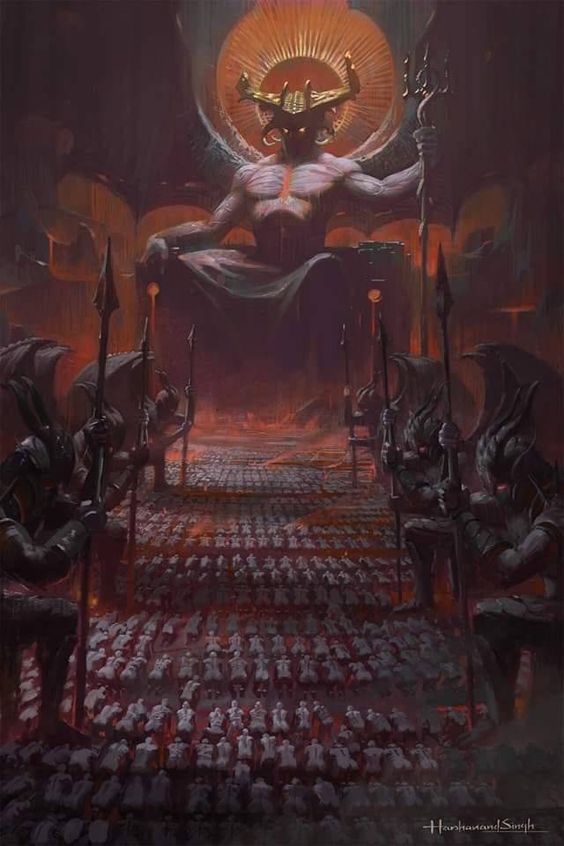
“The Four Greats” are Lucifer, Leviathan, Satan and Belial, and the “eight subordinate princes” are Astaroth, Magot, Asmodeus, Belzebuth, Oriens, Paimon, Ariton and Amaymon.
These spirits are well known from other Goetic sources. All the actions described in the book are performed by these very spirits, and the Ritual is aimed at gaining power over them. Spirits must be summoned and forced to swear subjection, so that their power can then be used. The book also gives a long list of spirits (316 in total) under the command of these chiefs. In other words, the cosmological part of “Sacred Magic” is entirely the same as in other sources. The distinctive feature of this book lies precisely in the approach: the Magus merges with the “good” spirit and thereby acquires power over the “evil” ones.
The third book of “Sacred Magic” is devoted to another interesting technical feature of the system — “Magic Squares.” Ideologically akin to the “Tablets” of John Dee’s Enochian system, these squares include a variant of the famous “Sator, Arepo, Tenet, Opera, Rotas” — one of the pentacles given in the Key of King Solomon. Many symbolic letter-squares have the character of a double acrostic; moreover, in those corresponding to large numbers the letters do not fill the square completely but are distributed in the shape of a gnomon, and so forth. There are also squares in which the central part is left empty. Each of the squares has its purposes, for example:
“[Helps] to know all things past and future, which, however, do not directly contradict God and His most holy will.
(1) To know all things past and future in principle.
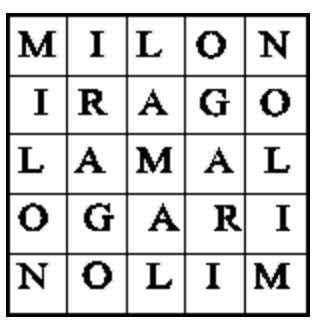
Each group of squares is accompanied by an indication of the power of which of the spirits described in the Second Book it works by. This means that the mechanism of these squares is ‘Enochian’ — they express the force of certain spirits, “redeeming” the phenomena corresponding to them according to the principle of the Sickle.
These symbols are considered valuable as a balanced and convenient basis for the reception of magical power; but if the operator is unable to attract that power to them, they remain mere lifeless diagrams. However, in the hands of a Magus who has subordinated the forces that feed them, they become a powerful protection and aid, sustaining and focusing the action of his will. These squares will help the Magus to master all knowledge and wisdom, to win anyone’s love, to find all treasures, including sculpture and ancient works of art. He can render himself invisible, evoke and subdue spirits, create zombies by enlivening corpses and compel them to function as living beings for seven years. He can fly through the air in the form of a cloud, an eagle, a raven, a crane, or a vulture. He can heal diseases, change his sex, age, and appearance, sow hatred, discord, quarrels, and cause other harm and trouble.
Nevertheless, work in the Abramelin system requires, of course, observance of all basic rules of magical safety. There are grounds to suppose that it was precisely neglect of these rules that led to the collapse of such a powerful magical organization as the Hermetic Order of the Golden Dawn.
Thus, in its original form “Sacred Magic” is far from the exclusively exalted, occult image that modern magi have given it. Despite its technical features, it does not stand out among the great Grimoires, and it is aimed not at ‘finding oneself’ — on the contrary, this “finding” is viewed only as a means to control the forces surrounding the Magus. The Abramelin system can be very effective for those for whom it is suitable, and that is its chief value — broadening the repertoire of ways to enact one’s power.
Will the ritual work if you extract (replace) Yahweh from it, accordingly redefining the reason for the subordinate position of the ‘demons,’ and manage without an assistant?
Every ritual works within the framework of the myth it relies on. This means that if you change the source of strength used in the ritual, the points of application of that strength inevitably change as well. Accordingly, if you want to subordinate demons, you must use the names of the Almighty, and if, for example, you want to chase trolls away, it is better to use the name of Thor (or Perun).
Regarding the article on the Magic of Abramelin – I would add the following, paraphrasing what Crowley said about the Lesser Banishing Ritual of the Pentagram: Whoever sees in the Magic of Abramelin merely a means to gain power over spirits is unworthy of its application, for it is the Medicine of Metals and the Philosopher’s Stone.
I don’t know how late I am with the answer, but I want to respond to the first message. In the new translation, which was translated into English directly from German (Mathers translated an already translated text), the assistant is absent, that is the first. Second, the book itself consists of four books. And third, the ritual lasts from 1.5 years.
Have you tried using these [tablets] to summon or obtain knowledge? There is a tablet that grants food, regular food on a plate, how realistic is this?
Apparently, this magic is more for men; as I understand, a woman cannot use it?
If you want to bring your ritual adjustments, you must take into account that two elder sons of Aaron (the brother of Moses) were killed right there where they were offering incense, at the very first arrival of the strongest heavenly inhabitant. From the magical gilded wooden box, where the guest was supposed to enter, a fireball flew out, and they collapsed dead. And their father Aaron and the two youngest of the remaining brothers could not even step beyond the place where the ritual was being held until the end of the designated actions. This is really serious. It’s hardly that in real life, if you somehow get the rarest opportunity, you would want to participate in something like that.
Astonishingly interesting information! Thank you very much.