Amaimon’s Trade in the Self
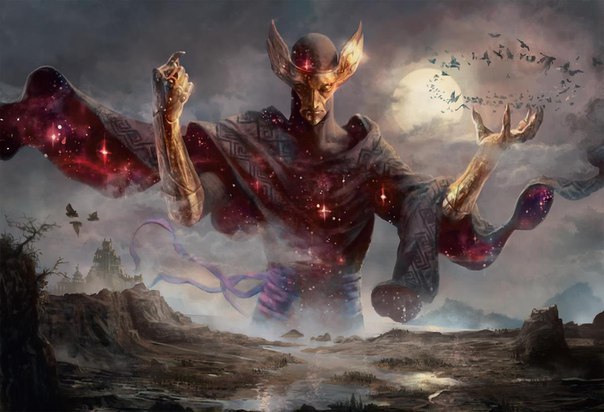
Among the demonic rulers significant enough to be named in the Bible, Amaimon (Mammon) appears several times in the New Testament — a demonic corruption of intelligence, a destructive manifestation of the great Law of Sacrifice and the principles of exchange.
The power expressed by Amaimon was known in the Near East from ancient times and was worshipped as a deity. The name “Mammon” means ‘belly’ or ‘womb’, implying accumulation, hoarding, and enrichment. Accordingly, this deity was venerated as the patron of “earthly goods,” and later the word “mammon” came to be used as a general term for wealth. The root of the name — אמן — indicates a combination of principles in which air — אוויר — rules over the waters (מים); that is, it denotes the dominance of intelligence over the emotional sphere. This is why the Lemegeton describes Amaimon as the “Emperor of the East” — ruler of the principle of intelligence, distorted by demonic influences, placing him second only to Lucifer. The Grimoire of Honorius names Amaimon King of the North and also calls him ‘hanged, wrathful, risen,’ sulphurous-smelling and punished,” thus linking him to the principle of Earth and materialization. Agrippa calls Amaimon “King of the South” and associates him with the principle of Earth, pointing to the “materializing” influence of this spirit.
In any case, Amaimon is firmly associated with trade, accumulation, cunning, and avarice.
Thus, Amaimon perverts the idea of hierarchy, substituting hierarchical standing (“natural value”) with artificial, commodity or monetary value. Intelligence, instead of seeking the natural relations of an object (or of oneself) within the system of the cosmos, assigns it a ‘price’ or ‘monetary equivalent’, and price becomes the object’s primary characteristic.
The urge to sell oneself, to adopt a ‘commodity appearance’, a ‘pretty packaging’, is a lamentable consequence of Amaimon’s dominance in the collective mind. Intelligence, transformed from an instrument of knowing into a mere mechanism for calculating advantage — determining value by mutual agreement for objects, processes, and beings — degrades into mere profit accounting.
It is evident that in such a condition inner uniqueness is devalued, because it cannot be equated to a market price; it lacks market preferences, and so effort is poured into outward display and superficial markers. The cult of the body, of “success,” of “practical knowledge,” of everything that is easily measurable and open to evaluation, nearly eclipses the search for and cultivation of spirit, substance, and meaning; it confines intelligence within the narrow bounds of market relations and trains it to expend vast energy on anxieties about one’s own value and marketability.
Unsurprisingly, the Lemegeton prescribes governing Amaimon by means of the Name אל — associated with the Sefira Hesed, the sphere of “true hierarchy,” which allows one to determine an object’s place in the system not by its “external price” but by its original nature. The Grimoire of Honorius invokes the “Head of John the Baptist” to subdue Amaimon, placing the authority of sacrificial intelligence above that of evaluative intelligence.
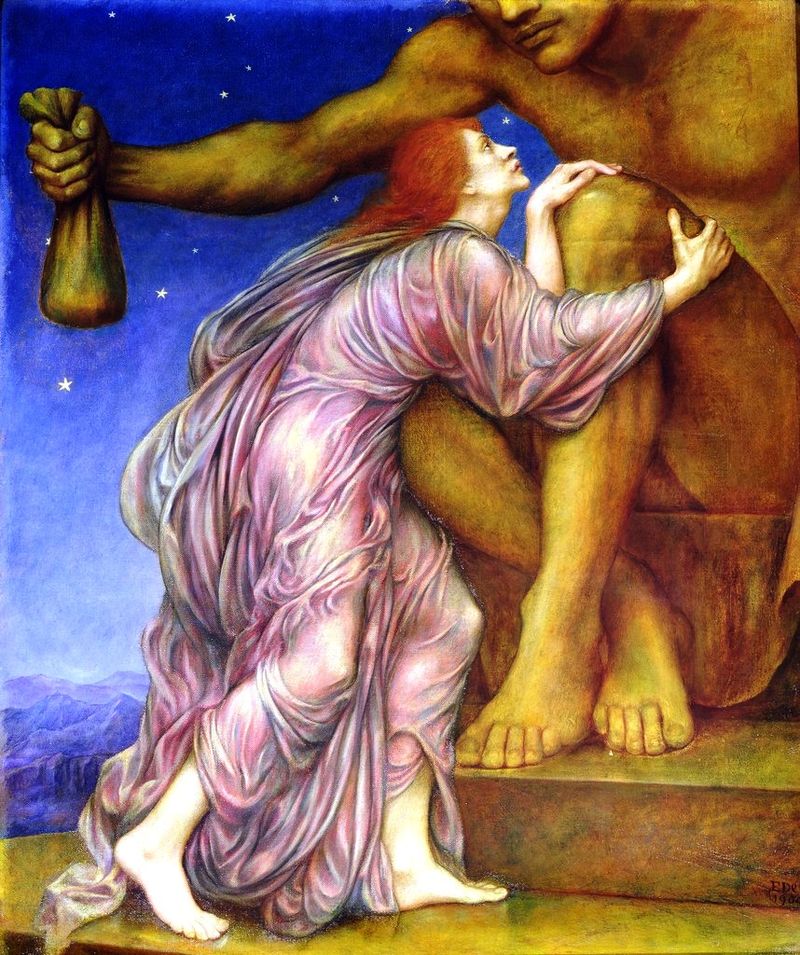
By shifting the emphasis from outward manifestations, from external packaging and ‘apparent value’, to inner substance, one takes the first step toward overcoming Amaimon’s power. Yet at this stage there remains the danger of conceiving oneself as a “commodity,” of determining one’s “price” — albeit now according to finer criteria. The next step, therefore, is an awareness of the absolute value and necessity of every single element of the cosmos for its functioning: a recognition that the price of objects cannot be determined because it is either infinitely great or negligibly small for all objects. It is crucial to discover that excluding any object, however insignificant it may seem, from the overall system of the cosmos would deprive that system of perfection; consequently, all objects are equally necessary. Accordingly, terms like “development,” “perfection,” and the like do not belong to the category of “increasing the value” of intelligence; they are meant only to express its perfection and individuality, which nevertheless makes it neither more nor less significant than any other object.
Returning to intelligence its differentiating, detail-revealing activity, and removing from it the evaluative tendency instilled by Amaimon, the Magus trains himself to perceive the world as a symphony in which every note and every overtone is necessary for a true, harmonious, and perfect sound.

Perhaps the name אל will allow us not to focus on the material side of things. Especially since economic consciousness itself, and expediency as a private manifestation, is unlikely to be destructive or dangerous, but the opposite situation (the absence of sober calculation) is a direct road to degradation. Indeed, spiritual matters should also be justly weighed and evaluated.
Attempts to manage by jumping into the sphere of feelings seem questionable – there are enough of their own demons.
There is a saying, “An awakened person continues to live in society, but society no longer lives in such a person.”
Society breeds demons in terms of mind and feelings in a specific person, as it is destructive in its separated unity and rules. Leave a person – a “hermit” – in the desert, and they will begin to gain insight and cleanse their nature.
alexsid, “Economic consciousness” is a product of society. And there is also “Pure consciousness,” which, for some reason, spiritual people strive for. Feel the difference between these two concepts, if you can.
Now there will be a lot of questions to figure out with what forks your answer was written, as there are suspicions that your demons:
First of all, ignore what was written about the name אל. For reflection: “what is the difference between ‘external value’ and true nature? [referring to Consciousness] What does true nature mean?
Secondly, are you so focused on the material side of things that you have spiritual matters? And is that the pinnacle for you?
By the way, “””Matter (from the Latin materia – substance) is physical in general, as opposed to the mental and spiritual.””” I will not delve into the substitution of concepts or someone’s fantasies. In the triad Body, Soul, Spirit – how will you weigh and evaluate Spirit? Or (I’ll help) what determines the frequency of consciousness that will help the Spirit manifest? Will it be “natural value” or “artificial value”?
Thirdly, which of your demons justifies themselves so well? And if you try to read the article again without inventing excuses and answer the question, “what harm does a demon bring to true nature?”. Reflect on the phrase “””in such consciousness instead of striving to maximize one’s uniqueness, express one’s individuality – appears the desire to ‘sell oneself profitably'”””, find an example from life… Analyze.
Also, think about the phrase “Sacrificial mind”, what does it mean? How does it differ from evaluative mind?
Is this about denial and escape into the underdeveloped element of feelings, the roots of which problems grow from the element of mind?
Your answers to the questions will clarify my understanding of your message, dear alexsid.
We all fight with our demons… And to understand it is enough to remember that demons are the offspring of Lilith – the beginning of the eternal (which is why I recommended the effort to tame the demon, not just oppose it), and that the vortex can be destroyed by a similar vortex equal in strength and opposite in direction (which is why switching to the plane of feelings is questionable).
Let’s take the human body as an example. It cannot function without fat cells or without nerve cells. Each type of cell performs a very necessary and unique function.
Perhaps my mind is closely acquainted with AmaiMon, but I can evaluate those two types and say that nerve cells are much more important and valuable. If desired, one can even find a quantitative assessment based on how much mass of fat tissue we can lose painlessly and how much nerve tissue.
Taking into account that “as above, so below,” I can quite easily trace this principle to other systems. For example, I don’t want to say anything bad about abstract managers in offices, but comparing them to surgeons who save a dozen lives every day, I can assess one as higher or lower than the other. Despite the fact that society needs both. Likewise, how to evaluate an “elephant” against an “ant,” etc., without trying to say that some kind of species is “unnecessary.”
I strongly suspect that the logic I am describing is exactly what you call the distortions of AmaiMon’s evaluations.
If you have the time, I would be interested to hear your opinion on what a “harmonious” evaluation should look like in this case. If, of course, you do not deny the very possibility of “evaluation,” seeing it as inherently flawed.
The definition of “relative” value can be constructive when its relativity is clearly understood. In your provided example – in the short-term forecast, indeed, the loss of equal mass of fat or nerve tissue can have different consequences, and therefore, if the question arises – which tissue is more correct to sacrifice when such a sacrifice is inevitable and necessary, the answer is clear. However, fat tissue has many other important functions besides simply storing fat, for example, it is an important endocrine organ where many biologically active regulators of life are produced, and therefore, in the long run, loss of fat tissue is also unfavorable for the body. Thus, such an assessment is only correct when the question truly arises – which piece of tissue to sacrifice for the salvation of the whole organism. By the way, in a real situation, it is difficult to imagine the necessity of such a choice, so it is largely speculative. The same situation applies to comparing the “value” of an office worker and a surgeon. It is clear that in the event of, say, a zombie apocalypse, if the question arises – who is safer to sacrifice for society – their comparison may be appropriate. But in other conditions, society needs all its components, as it consists not only of dying people who need a surgeon but also of healthy people who are buying something and need a sales manager. Moreover, even in such exotic conditions, not obvious factors may prove important, which shift values: for example, an office worker may have a very rare blood type and therefore could be a unique donor essential for the survival of society, while a surgeon may turn out to be a carrier of a dangerous virus, etc.
Destructive is not the evaluation itself; the destructive part is its absolutization, the spreading of private value, justifiable in narrow and not always realistically achievable conditions, across “life in general.” It would be harmonious to say not “A is more valuable than B,” but “In such specific conditions, it seems that the relative value of A is higher than the relative value of B.” Moreover, based on the second way of thinking, we must clearly understand that both the conditions and our knowledge and ability to evaluate are limited. However, it is precisely the substitution of the second conditional representation for the first absolute that underlies the destructive influences of AmaiMon.
But even more dangerous than the evaluation of others is the evaluation of oneself; the thought that “if I become a surgeon, I will be more valuable than if I become an office worker” leads consciousness away from constructive ways of thinking, because the effective way of thinking is: “It doesn’t matter whether I express myself as a surgeon or as an office worker; what matters is that I express myself according to my nature.”
Yes, I agree with you about the relativity of valuations, and that lower relative value does not mean the absence of value.
But I do not completely agree with you regarding the evaluation of my own potential value. In an ideal world of optimistic future with labor automation, I might agree with you. But at the moment, almost all people enter human civilization (except for rare hermits and monks): taking something from it and giving something back. I personally know dozens of examples of musicians, artists, and poets who have “found themselves” and follow their nature. And I have never heard of a surgeon, engineer, or janitor who suddenly left their office at 30 and jumped into a specialty.
As long as a person is part of civilization, they can always be evaluated in terms of civilization by the ratio of what they take and what they give. From my point of view, a significant portion of the “finding themselves” musicians are parasitic on society, taking from it like everyone else, but not giving back as much as others do, justifying it by rejecting consumption.
If you will, using any collective labor services instantly creates those specific conditions in which a person can be evaluated.
And until all the unpleasant work is taken on by machines, that will be the case.
It is quite possible that here one can indeed speak of the original vices of our society. But then one can talk about the symmetrical vices of multicellularity from the point of view of unicellular organisms. Our society is still far from a level of “totalitarianism” and lack of freedom of individual cells in the organism.
Try comparing an office worker who is successful in their field and a surgeon who got their job through connections and has not saved a single life. Or an engineer whose mistake led to the death of several thousand people (there are real examples). Which of these professions would be more valuable? In modern society, there is clearly more wealth produced than we can consume; we even have to artificially stimulate consumption, so I see nothing wrong with the fact that a farmer feeds a musician.
I greet you and allow myself to intervene. The key word in your comment, I believe, is “ideal,” but automation of labor is not an ideal in itself (let’s remember the Luddites, for example, with their inherent historical background; in modern reality – it is mass unemployment, a decrease in the value of human life and personality, people who are undervalued and do not believe in themselves en masse – and all against the backdrop of labor automation).
Automation of labor is not an ideal if it is not accompanied by compassion (that is, the intention to bring good to another being to the extent and form in which they consider their own good). “Wisdom without compassion is cruel, compassion without wisdom is foolish.” In this sense, one of the forms of optimal solutions in the context of labor automation is taxes on the labor of robots, for example, allowing the population to be transitioned from the status of dependents-“idlers” to consumers. But I digress, as there is another trigger word in your comment.
This word is “civilization.” Let’s assume we understand it the same way as “social environment.” But it is no secret that if we compare statistical data on cases of diagnoses and the course of such economically costly diseases as schizophrenia, we will find rather curious statistics: the frequency of cases and favorable forecasts per thousand population will give different indicators in different countries (and with different types of modern civilizations). Interestingly, in a technogenic society, the frequency of illnesses is higher, while the frequency of favorable forecasts / cases of healing is lower.
In conclusion, allow me to point out a small logical error in your reasoning: if society (civilization, = “social environment”) is perceived not as a collection of independent and valuable personalities, but precisely as a certain environment, then it is absurd to seriously argue about the “equality” of relations between an individual and the environment, since in that case the subject will either have to humanize the environment (the element) or recognize their own “materiality” (and, accordingly, refuse freedom of will).
The example with fat and nerve tissue seems absurd in itself, as there is no specific goal that can be matched. Let’s say the goal is to acquire a sporty body. Then the price is not “fat tissue” that we lose, but the willpower we spend in the gym and the nutrients that are consumed in the processes of transformation in the body.
Thank you for the article. It is very relevant for me right now.
When you come to seek a job from a person who looks at the world and people with a trader’s gaze, you must provide him with what he wants to take, show him that you are the product he wants to buy. As long as you are “fresh meat” without “authority” – you’re worth less and they will squeeze everything they can out of you. If during the “squeezing” process you can transform and become more, so to speak, build a “successful reputation”, your price will go up and they will be willing to pay more for you. And even (from personal experience) ten years after leaving a company where there is still a memory of your “successful reputation”, they will be ready to rent you a place and pay more than “fresh meat” because you can definitely provide what the trader wants to take.
AmaiMon lives in all “traders” – from market vendors to owners of large companies.
No system, which any community is, functions outside the laws of any magical mythology. You can choose any convenient one, and it will explain who the ‘predators’ are at work in society, and what to do with them. In the case where the goal of life is awareness, any situation ultimately becomes material for knowledge, and it is strange to expel, stigmatize, and flee from it. No system can be understood while being in opposition to it.
Many live in society, while some exist in it. Because for these some, the give-back from society does not bring pleasure and strength, while what does bring it – nature, for example, does not require large costs. You spend energy, but do not receive anything in return that would satisfy you.
“””The best things in life are free: hugs, smiles, friends, kisses, family, sleep, love, laughter, and good mood.”””
Society is a large Predator that fears Nature, which has gone against it, against its laws (for example, of natural selection), which fears to lose its protection, which created masks and fears to remove them. Predator which is Fear itself. Nature, with all its variability does not wear masks at all, on the contrary, it destroys them and returns a person to their true essence.
So, the Predator known as Society constantly consumes (it needs energy to exist), imposing various trends, all kinds of “needs” on a person, and the wider the comfort zones, the more this “needed” grows and the more people spend their energy on it, getting deeper trapped in Society, and not even trying to wake up from the opium dream.
For this Predator, all people are chicks in an incubator with which it can do anything it wants, kill at any moment for its needs. Such is the fate of domestic animals, in contrast to wild ones, which are given to themselves and their natural forces.
But in the incubator, there are also their own Predators and victims. Alas, the twisted law of nature says “either you or them.”
Let’s take, for example, two people working in the service sector. One works like a horse and if he achieves results, it is thanks to his own efforts – his will. The other makes no effort at all, but is promoted at work; people help, turn a blind eye to his flaws, he inexplicably succeeds, all because he is a good manipulator, rather naturally charming. Both have power, but each uses it differently, and the second is 100% a predator, even if he has psychical abilities.
So, if you are in society, who are you – a predator or prey?))
Where and who, then, is the magician?
I believe that society is a reflection of the consciousness of each of us. Our content and our realization, and that there are no separate clean us, no original purity, and separately predatory society. I think we are not born pure in the sense that we need to strive to return to. We are born blind. My way of thinking allows me to be effectively engaged in self-realization in society. I have not seen a single company that does not fit into the myth described here. And would be predatory in the pure sense. In my opinion, you seem to think that detractors may be in someone else, not in you. Or that there is a Predator in society. In the understanding of this myth, the Predator cannot manifest in flesh. Pure demons do not walk the streets. They live in everyone’s consciousness. And we are only responsible for ourselves and our consciousness. Although we can fight and chase external “Predators,” for as long as we want.
What I am saying, these thoughts – is being on the Path. At least, that’s where it begins. With the awareness of oneself – the world, with the awareness that detractors are within. Awareness, not articles, not poetry, not belonging to anything. Therefore, for example, I find Tavita’s description of magicians strange. The phrase that magicians do not work in social jobs. And so what?) Tavita thinks that the magicians she has in mind, are not in the society of which she thinks. This has no relation to who I am. Everything: my reaction, non-reaction, attitude, or conflict – in this case – is material for awareness. And another sign of the Path is the ability to at least sometimes remember that simultaneously – Tavita, with her definition – is not material for transformation. She is the cosmos as well. That I never planned, and will not try to manage it. That rejecting opposition to her definition of who she thinks magicians are – means beginning to care about it. What does working interfere with in this case? Not at all. Although I can very well reach out towards social goals. Yesterday, for instance, I was about to buy certificates for March 8 for employees and was wondering what I might gain from it) and this was the Predator. And this is me. Although these same certificates can be bought honorably and honestly within the Path. And be made the subject of awareness.
Maria, I have a favorite game – to ask others questions, and then honestly answer them myself, behind the scenes. Such refutations and different viewpoints arise that also exist; it makes you astonished by the duality of the world and all its possibilities. Guess where I am leading?
Society is too big to reflect us as a particle (even though we are in it, and it is in us), if taken as a whole. Moreover, you will not like this reflection of the whole, its quality. But you shape your surroundings, your specific boundaries and their quality with your right to choose, and they reflect you. Moreover, society is one of the foundations, a cradle in a cradle. You are taught what can and cannot be done, the rules of how it should be because someone did it that way. Society raises people like future bees; it has material interests largely. It forms an external base, but there is also an internal one – nature, instincts, the unconscious, archetypes, and other magic which people do not know, do not pay attention to, ignore. They see what they want to see. And it is good when the internal and external align and harmonize.
Initially, in its manifestation, a human (child) is nature, and later the society kicks in, trampling the defenseless nature under itself with its wants; thus predators, demons, and bugs in consciousness programs appear. Not to mention bugs in energy and unequal exchanges.
We are born defenseless, and we are “protected;” we are blinded for the sake of protection, put into a deep sleep. And we cannot live without this protection; we have no immunity, and some people live unaudited their entire lives, like ghosts. And nature is power, energy, which is both creative and destructive. It depends on the person how they use it (or rather, on who uses the person).
One should not act based on the principle of egoism and think that if it is good for me, it will be the same for others.
As for me, you do not know me. Detractors in someone else are detractors in someone else. For me, there is a predator in society, and there are predators within me, no other. The abilities to unite and divide are given not in vain.
Moreover, I have seen my predators inside using active imagination, my symbolic problems in my subconscious. I have also seen entities outside. In this world, there is nothing impossible; only frameworks limit.
You describe awareness so beautifully that I get the impression that your word awareness is the same as your path. It is loved to be written, talked about, walked around, but is it awareness?
Magicians can be both in society and outside it; why these rigid limits? They simply do not depend on it (but can depend if they want). “””No, a magician is only outside of society.””” Where is the freedom, where is the creativity? If they want to lead a secluded life in the mountains, they live in the mountains; if they want to play stalking and interact with ordinary people as a citizen, you will never know that this is a magician (of course, if you do not have sight). Sometimes it seems to me that magicians are as dry and petrified as terrifying. Only this is true and a point! Where are the changes and plasticity? Oh gods, take a deep breath of fresh air while it hasn’t been sold in special bottles yet. Although with our taxes, we already seem to be paying for air.
And for me, Tavita’s material is material for transformation. Have you thought about that, about others? If you didn’t find anything for yourself, it does not mean that others will not find anything for themselves. Well, I will consider that your answer concerned only you and not others.
Moreover, I really do not care about your life at all, whether you are a predator or not, but it is amusing to observe your reaction.
I also want to add to my previous response: Predators and victims are natural; they are not ugly, unlike parasites. Parasites do not know the sense of proportion. The predator is not as scary as the parasite.
*Before this, the predator meant precisely parasite to me.
By the way, your quote “I never planned to, and I will not try to manage it.” – I just noticed it now; before this, I read it many times and did not see it. It turns out that I read your response with blind spots, and when I want to switch on these spots, it starts to be a mental burden.
I seriously thought, either I have a block on perceiving your text and cannot see something in myself, or the text and meaning you have distort so much that they block my perception and I cannot see something in you.
Any external interaction is caused by consciousness. Any transfer of responsibility outside is not magic. And it is not magic. (Something there says Crowley, according to Will)
Of course, transferring responsibility externally is not magic, nor are people who talk about magic while being hired workers in some organization, voluntarily agreeing to obey someone else’s will, playing by someone else’s rules – they are not magicians.
The modern state, as a system of social roles and interactions, has its (not at all magical) myth.
And no matter how we (by “we” I mean all people who are full members of the state, subject to laws and fulfilling obligations imposed on them by the state and, naturally, having certain rights within the state system) tried to pretend that we are outside the myth of the state structure of social life – it isn’t true. We are all members of it to a greater or lesser extent. Therefore, within a normal human community, “choosing any myth” will not be possible. One can layer one myth onto another, describe situations of interactions between people with ancient Egyptian images or Scandinavian ones or utilize the rich intellectually-symbolic heritage of the Jewish people. – The question is, will the essence of what happens change depending on how it is described?
The Principle of Exchange, in my opinion, exists in any myth and thus it is necessary to assign a price to the good or service that is exchanged for another good or service, or a monetary equivalent. And it is not about transferring responsibility externally, but about transferring Models of Thinking, Evaluation Algorithms – applying the same algorithms when assessing consumer products (goods and services) and people.
I greet you. As for the evaluation algorithms equating the inanimate and devoid of free will (goods) with the living, possessing free will (human), such equalization contradicts even the postulates of Thelema.
As for whether hired workers are magicians or not, I believe the question lies in the ability to control the egregore (a quasi-living entity) and the volume of personal power.
Tavita, I agree with you about the Principle of Exchange – this is one of the laws of the Universe, the ability to give and receive implies a harmonious, equal energy exchange. However, it is important to distinguish equal exchange from Sale. In a sale, the cost may be inflated or deflated. A person may inflate their qualities, create an illusion, as may be the case with a product. Alternatively, a person may sell a product for a lower price due to a decrease in demand, undervalue it. The price is not constant for the same product at different times, in different places due to many economic and social factors. It often happens that Geniuses during their lifetimes, despite their contributions, languish in poverty, and only after death do their works become worth billions, but initially were not adequately valued by society. There is talk of inadequate evaluation. Money is a sacrifice, not an equal exchange.
Why should everyone sacrifice something to someone? What is the great meaning in this?
———-
Why did this thing called “sale” even appear?
Theo, because there were excesses of goods and originally there was nothing wrong with it. Markets appeared, a global market – competition, then a sly little uncle “Jew” by nature appeared, who decided to make money out of thin air. Thus, banks appeared, and many strange words like devaluation and, of course, inflation)) But there is no money from thin air; there is simply “a nasty word”. And this is what our economy, politics, and social life are built on. And it is based on parasitism.
I will summarize, as I like to complicate things; money is a tool for exchange when it is equal, a gift/sacrifice – when it is not equal (there’s Google if you need an economic definition). They can be called evil – because so many murders are committed due to them; one can relate to them as good. But money is just a tool. If you do not feed the System, it will not sustain you, with suitcases on the way out or homeless in the subway. And the great meaning – is to extract excess money energy (at least the example of banks). Convenient. And the State gets satiation, and you become a compliant puppet.
Thank you, exactly what I needed after forced interaction with one entity.
In this case, how do we distinguish between altruistic desire to bring good / gift to another being in the context that it understands and “pleasing AmaiMon” while suppressing one’s nature? Only by parity?
To realize everything mentioned above, it is important to understand the laws of existence in the world. In particular, understanding the generation of energy to sustain existence (let’s say of this myth).
We must not forget about the struggle of opposites and that any development is a consequence of the limitations imposed on the part that should be developed through the discovery of new ways of knowing the world by the Creator.
For example, having given understanding of freedom and the possibility of realization, as well as shown the probable path to obtain total knowledge, the Creator restricted this movement allowing it to develop new paths of self-awareness.
The entire existence of beings is ultimately directed toward the development of new knowledge, and by what means…
We value one thing and devalue another. We value the material and devalue the non-material. Or vice versa. I realized that I do not know how to value. Thank you all for your attention and help in finding the detective puzzle.
Come here now my god
Look at the world and at the threshold
What have you created and into what have you plunged
Your children, the children of your children
Let the demon of the abyss, knowing all
So hating power and pleasure
Let him also come here
To that earth where people live
Here even the devil cannot tell apart
To the extent that an angel cursed life
Go all into the fog into the filth
Only man has always suffered
And perished
Loved
Stood
And the cosmos blindly exchanged
For the contemplation of deception
A nightmare
Sold us and sold them
Into the magnetic-electron net.
The quote “It is important to discover that the exclusion of any, even the seemingly smallest object from the overall system of being will deprive this system of perfection, and therefore all objects are equally necessary.” For example, I swatted a mosquito, the cosmos didn’t even flinch, let alone lose perfection (if it ever existed). We seem to have stars exploding, and the universe is indifferent to it. Where did your conclusion from the above quote even originate?
I have no desire to argue with you, and quite the opposite. In my opinion, doubt is an important element of cognition. Your question led me to the answer: “death. In this Universe, along with the mosquito and the stars, there is death, and there is a place for it too.” And I think further, it is a rather hazy thought for now. I do not regard detractors in a wholly magical way. I seek awareness not in rituals but in life. It is important for me to discover the root and understand, and then in thousands of situations, I will recognize this energy. The thought is: the root of this commerce is connected with the awareness of death and mortality. The head of John the Baptist is not alive either. (I am now checking this thought for compatibility with everything I know. And are not all detractors linked with the fear of death?…)
Gaap 33 is a demon in his power. He is Amaiemon, Lord of the Black Kabbalah. He summons the head of John the Baptist to subdue Amaiemon. The fluidity of life and awareness is not harmonized in the body. Therefore, it is written that the lady who mastered Mammon, having seen one who was in asceticism, became interested in what an interesting man he was. John the Baptist simply could not resist and fell at Amaiemon’s feet as a wholeness, taking his honorary place in his orderly ranks. Ah, that’s what I actually want to say. Turn on your head – turn on your belly.
You should better read the grimoires of the new generation, from our modern strong dark Masters, so as not to continue slandering those who are truly helping humanity in development. For example, the cycle of books ‘9 Demonic Gatekeepers,’ and you will understand who is who. Darkness is not evil, and Light is not good—it is just the nature of consciousness. The universe has two paths of development. And Amaymon, like the other Demons, was demonized by the bright hierarchy of dictators wishing to monopolize all that is divine. Open your eyes already! And you will see who actually limits human development!