
Price, Payment, and Reckoning
It is well known that to receive is to give. We have discussed this regularity many times; it is traditionally called the Law of Sacrifice and has many applications.
Let us try to understand the nature of this law.
From the perspective of the myth of Magic, the cosmos is a system for transforming the Life Force into the Force of Awareness.
But what is the nature of the Life Force?
The cosmos is a form of the Absolute’s self-contemplation. For this self-contemplation to become possible, the Absolute passed from its ineffable unity beyond being to a state of potential existence.
In the language of Tradition this is described as the creation of the primordial duality — Light and Vessel.
Namely, the world’s unity, being outside the possibility of being, entered the realm of possibility by splitting into an infinite number of differentiated potentials — the Energies of the Absolute.
For this, in potential being there had to arise a Separating Power, preventing its reunification and return to non-being.
This Power fills the entire cosmos and brings its potential existence into being, manifests as the Life Force — the Power of world-unity born of division.
Being is actualized when the energies divided by the Life Force are filled with awareness and are united again as active principles, singled out from the world’s potencies and awakened to activity by the power of consciousness.
From the foregoing it is clear that any object can be viewed in its energetic and force equivalents. As a collection of energies, an object is part of the world-system, while its power-equivalent is the amount of Power expended to separate it from the world’s unity and to establish its system of interactions with other objects. The very principle of multiplicity of individual being is born only at the undivided unity’s sacrifice and the real experience of the tragedy of fragmentation.
This, in turn, means that introducing a new object into any system requires the rupture of its ties with other objects and the establishment of new ones. That is — in order to obtain something, one must expend an equivalent amount of Power; and since such a power-equivalent may be either an action or another object, the Law of Sacrifice arises: any acquisition requires expenditure.
But this is precisely where predators intervene and pervert these concepts.
In practice the Law of Sacrifice becomes mere commercial relations, and the world turns into an auction.
The original Sacrifice of the Absolute, which gave birth to the Law of Sacrifice, is ideologically far removed from common understanding.
“You must give something up in order to get something” — that is the typical formulation in the predators’ formulation.
The original idea, however, was that “You must spend Power in order to acquire Power.”
No matter how you spin it, one has to pay. But instead of carrying out an equivalent exchange, the world chose price-setting. That is, in reality one must pay not what the object is worth (not its power-equivalent), but an arbitrary price set by others.
Thus, in place of a true price there emerges mere payment.
And if escaping market relations seems impossible in the human world, then in the world of Magic such an escape is vitally necessary. The Magus must clearly understand that as long as he continues to pay the assigned price, entire swarms of intermediaries will be sustained at his expense.
Therefore one of the Magus’s fundamental tasks is to construct a hierarchy of values: with what and for what he is willing to pay, with what and for what he is prepared to sacrifice.
And when the required sacrifice is disproportionate to real progress, careful attention must be paid to its expediency.
Another destructive aspect created on the basis of the Law of Sacrifice is the cultivated notion that “everything can be bought; it’s only a matter of price.”
This destructor forces prudence to be replaced by calculatingness. At the same time, if you give in order to get, you accept the predators’ rules of the game, and thus you yourself become a predator.
In the World-process a Sacrifice is called a sacrifice because it simply means a renunciation of part of the resource, without the accompanying thought of profit from that renunciation. If the renunciation occurs for the sake of obtaining something — then it is not a sacrifice, but marketing.
Which means that instead of drawing from the world’s resources, such a “buyer” obtains a “commodity” from a seller.
The difference is roughly the same as between growing potatoes and buying them — in the first case you reap as much as you have sown; in the second, you pay whatever price is asked. Moreover, when one plants potatoes, one is guided by strategic considerations, not by the immediate feeling of hunger.
So — in real human life it is impossible, and indeed wrong, for everyone to engage in subsistence farming. But in the domain of acquiring Power, method is the only effective one. In other words, only Power won in an honest struggle can serve as an effective aid on the Way.
It is clear that as soon as the Magus refuses to participate in the world-market, he stops being a potential client and obstructs trade. And those who until recently, with oily smiles, praised their wares to him begin to dream of removing him from the path so that he won’t corrupt others.
And then it turns out that the price rises again. In our example — someone trampled the garden and you must start over, or the Colorado potato beetle appeared, or a pig was set loose, or something else — and the actual effort required increases because some effort is spent fighting the obstacles.
In reality it’s usually nastier than mere garden trampling. In reality — they strike the liver, the kidneys, sometimes the heart.
And this is the retribution for the desire for freedom.
The effectiveness of the warrior lies in continuing his path despite obstacles and attacks; the further he advances, the more serious his enemies become, the bloodier the battles, but also — the greater the scope of victory.
Only thus — “through thorns to the stars”, refusing compromises, not entering into trade, sacrificing without paying — does the Magus move through the darkness in order to leave it and attain freedom — the freedom to be oneself.
Awesome topic! And the metaphors with potatoes and gardening are a virtuosic move))))
In light of the above – a specific point. It would be a wonderful type of business: the more you work, the more you earn, a fair exchange. In barter – good. Although there is also the question: how to properly select the equivalent? But monetary signs interfere in this. And here it is extremely difficult to select an equivalent.
The article is excellent and, as I think, very relevant in modern civilization. Correct understanding of these processes is necessary for all of us. Enmerkar, please advise. I conduct classes and consultations on various issues, thus I expend force. There is no intention to ‘rip off like a sticky tape’. How (on what basis) to appoint the right monetary (or barter) price? After all, this is not even about material objects, to which it is sometimes easier to assign a monetary equivalent.
It is hard to say. In my opinion, the simplest way would be to assess time – how much time you spent, and how much you could have earned during that time in another way – that could be the price.
Can we say that impeccable behavior in daily activities is the most accurate expenditure of force? Completing tasks, fulfilling promises, not deceiving, spending force without expecting a reward (payment), putting maximum into every task, not holding back?
Impeccability is the most effective way of handling Force.
In essence, commodity-money relations in one form or another inevitably produce alienation of part of the efforts involved. For example, a person goes to buy potatoes. He pays for them the money that the seller has assigned him. But this money may be more than the actual amount of efforts that the subject expended in order to earn that money. And the money that the subject uses to buy the potatoes, he earned somewhere. That is, he invested his efforts somewhere for the fee assigned to him. This payment, most likely, is less than the efforts he expended. Conclusion: commodity-money relations inevitably lead to a complete alienation of part of the force from the subject that expend it. An irreversible loss occurs. As in thermodynamics – part of the energy that cannot be converted into work.
I think that in commodity-money relations, some will win, others will lose. It all depends on the work strategy that is built. Take, for example, a factory worker who is filing a machine casing from a steel ingot and a manager in a car dealership who then sells this car. Let’s not forget about the director of that very dealership, who fights with other predators for the harvest earned by the managers for him. Who has a more attractive time/money ratio? It depends on how you value yourself. According to what was written above, the victim can also be interpreted as a refusal of something (sometimes assessed as very expensive) in order to have the opportunity to move forward, unencumbered by ‘our charm’.
What is meant by a sacrifice offered to the Gods? Is it an act of gratitude, a request or something else? After all, in public understanding, such a sacrifice is often also interpreted as commodity-money relations.
Thus, mass religion should not lead to the accumulation of Force and freedom. It has other goals and tasks, primarily – maintaining the stability of society.
Yes, it is wonderful, I am impressed by the relevance of topics, their ease of perception. I am very grateful to you for the Blog.
The principle is not entirely clear. If you give without expecting anything in return, you may lose everything.
It depends on how you give. If you give and push away what the world can offer you, then yes. But if you give with an open heart and accept what is offered to you, then it will actually increase your resources 🙂
Thank you for all your publications.
There is a resonance in the soul to them, and it feels like what you write about is alive.
You have experienced it and breathed life into it.
“The Mage must clearly understand that as long as he pays the designated price, entire legions of intermediaries will thrive at his expense.” This phrase seems to nullify the conditions of many spells from the realm of village magic, in which the final moment often involves uttering the words ‘paid’ with a ritual action (for example, throwing coins at a crossroads, etc.). From this, one can conclude that such rituals of spells contribute to, say, possession, for the act of payment will bind not everyone?
Village magic, much like witchcraft in general, often represents a sort of ‘scam,’ where sorcerers are forced to pay exorbitantly for subpar services, exploiting their insufficiently clear understanding of what is happening. Nevertheless, in a number of cases, people are willing to pay any price – out of desperation or a mad desire to gain the coveted.
“Village witchcraft” and “conspiracy magic” are rather the invention of failed complexed “mages” who fancy themselves to be arch-great.
The sacrifice must be appropriate.
No matter who it is intended for, or for what purpose it is made; the motive must be worthy of such a great intervention in the lines of fate.
The sacrifice must be equal in magnitude.
Nothing comes from nowhere and goes nowhere; everything has its price; wanting to receive, one must give without regret.
The sacrifice must be closely related to the one who brings it, otherwise it will not contain anything of self-sacrifice – and it will lose its effective power. Only the gods know all paths. It is better to give voluntarily than under compulsion.
Do not play with heaven, or it will stop taking you seriously.
I was glad to see your thoughts on this matter. I have seen quite different attitudes towards this topic from various Magicians (in strategic terms, the principles may be similar, but in tactical terms they are very different, which raises questions). I live by similar principles and currently find myself in a stage where “either someone has trampled my garden and I need to start over, or a Colorado potato beetle has been planted, or a pig has been let in,” with practically no understanding of how to proceed. But there are no other options for approaching my work.
Your article has given me the strength to move forward more steadily. If someone else thinks and lives like this – it means that there is more Force on this Path, something like that 🙂
Good day! You raise and unfold very interesting topics; I would like to be your reader. For many, it’s an opening.
How to find out the equivalent price for a product?
_
For example, I understand fabrics and can independently sew anything. Thus, I perfectly understand how much a particular material costs and how well the product is sewn. There is neither the time nor the desire to sew, so I have to buy clothes, but I fundamentally do not buy things whose price does not correspond to the quality. In this case, “knowing the equivalent price” has nothing to do with the market prices of fabrics, threads, and seamstress work. I evaluate clothing as a whole, on a somewhat subjective level. A huge number of disparate details within my consciousness piled together during perception into a unified picture. And, in the end – I summarize – whether the item is worth its price or not…
_
Another person, who does not understand fabrics and seam quality, will not be able to independently determine whether the price corresponds to the effort exerted, and therefore will seek advice from a knowledgeable person.
_
At the same time, I do not understand anything about car parts and auto repair, so if necessary, I will look for a person who understands this field and ask for their advice. From experience, I can say that intermediaries set prices for parts from auto dismantlers (for cars that have long been discontinued) at three hundred, five hundred, or even more percent above what that part can be bought for at the dismantler itself. And clients to whom these intermediaries advise and “help” dutifully pay and thank for the assistance.
_
The difference between clothing and auto parts in this case is that when buying clothing I have a Huge Selection and Availability, whereas when buying an auto part – the Choice is Extremely Limited, and Access is Open Only Through an Intermediary who knows where to purchase the necessary part, whereas I do not.
_
When going to the market or shopping center, and spending several hours, I find clothing that corresponds to my price and taste.
But when my car breaks down, I frantically look for an intermediary and plead with them to help me as quickly as possible. In this case, the equivalent price for the product is added to the price for the intermediary’s work, which they set themselves based on their understanding of the equivalent price for the effort they have expended.
_
Once, having arrived at Kinburn Spit and going into a store for bread, I found only one long-expired brick on the shelf, which cost an outrageous price)))
– Do you have any fresh bread? – I asked a slightly intoxicated salesman.
To which he, smirking crookedly, smugly replied:
– Sweetheart, you’ve come to the end of geography. Take what you can or go away.
(However, later on, after purchasing the super-bread and having a heart-to-heart talk, he opened a secret compartment of the fridge and offered to buy, at a good price, real black caviar from sturgeons caught by poachers)))
_
Not everything in life is as straightforward as we would like.
And the intermediary’s efforts, regardless of what price they have set, in some cases, quite justifiably constitute part of the “equivalent price”.
Or maybe magicians do not buy clothes and do not take their cars for repair?……..Perhaps real magicians, stepping out of the vicious circle of buying and selling, approach sellers, draw their swords, and take what their soul desires………………………I ask you to forgive me for the sarcasm and of course I do not dare to ask, but it would be nice if you, within the framework of the Magical Myth, shed light on the difference between calculation and prudence.
Giving of Nature:
The life force is given to all plants for growth;
The mother gives herself to her child;
The wise give experience to the young…
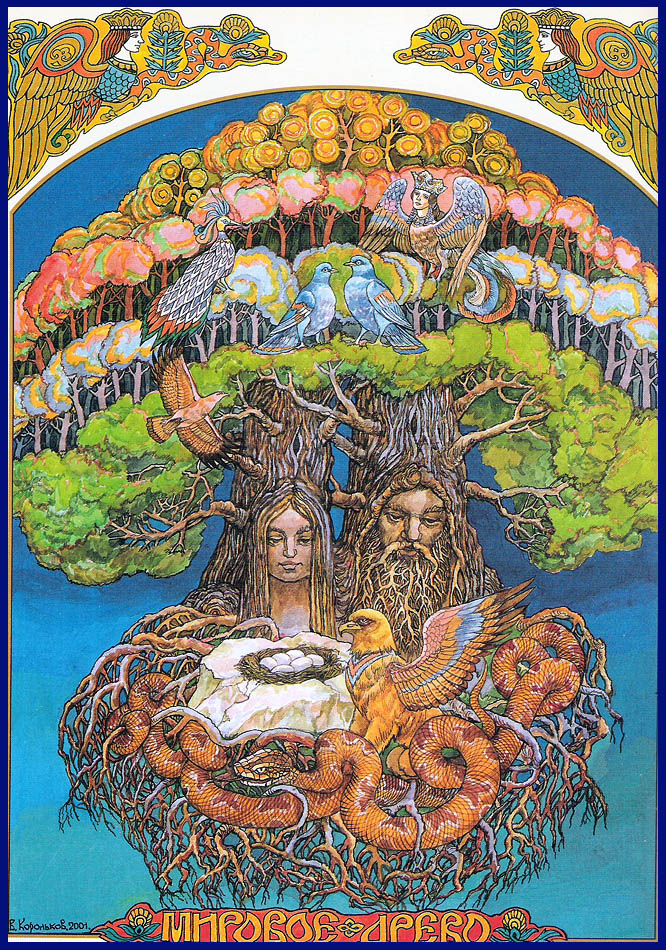
That’s right, the world tree in which the force rises from the roots to the crown, taking, carrying, and giving all the best for its own growth and blossoming.
The deceased organism gives its body to the earth, so it can be processed by it, and the earth may nourish newborn organisms.
The grown child gives its strength to the aging mother.
The young inspire wise old men with a freshness of perspective on the world.
And the crown of the tree, absorbing the energy of the sun, sends the processed and assimilated force – to nourish the roots.
The top supports the bottom.
The bottom supports the top.
The harmonic cycle creates balance.