Tor and Tursy
Although the “daytime”, practically oriented mind is a rather limited instrument, it is precisely that which sometimes turns out to be the main outpost preventing the mind from falling into chaotic states. The ancient Greeks distinguished “simple knowledge”, eidein (εἴδειν), symbolized by Hephaestus, and “higher knowledge”, gnosis (γνῶσις), personified by Apollo. (They also distinguished Higher Wisdom – Metis, and earthly Wisdom – Athena, expressing corresponding aspects of direct understanding.) Both gods were chaos-fighters: Hephaestus fought the giants; he killed Mimas by throwing molten iron at him and put another giant to flight, Aristeus (the only survivor of the Gigantomachy), while Apollo overthrew the Serpent of chaos — Typhon.
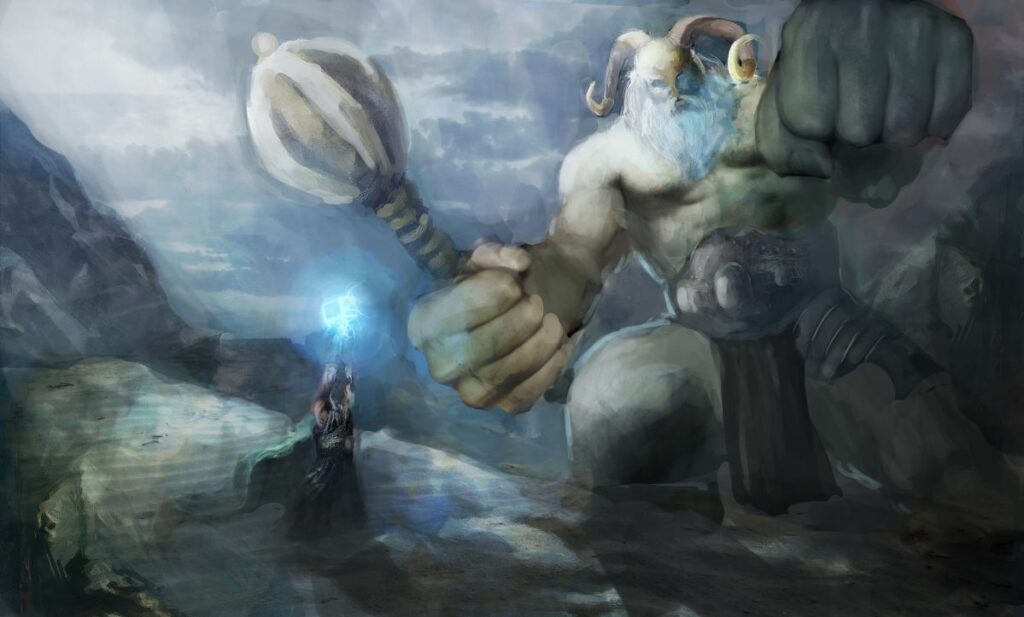
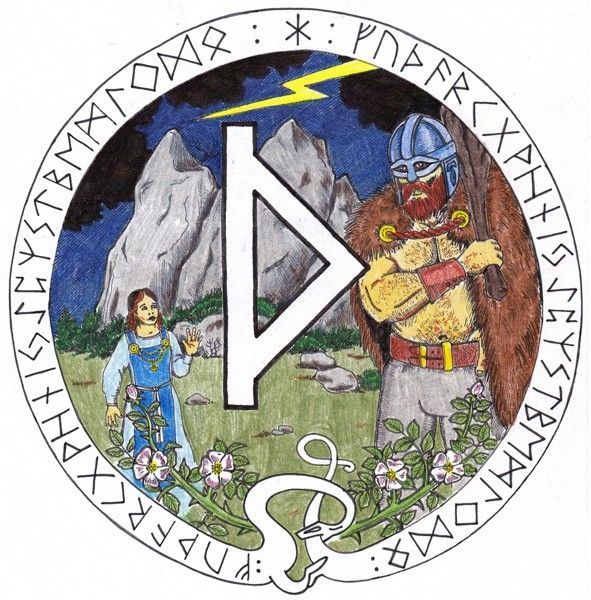
A similar story is a recurring theme in Scandinavian mythology as well, where the somewhat simple but powerful god Thor is the main opponent of the Thursar, protecting the worlds from the chaos they cause. It is noteworthy that here Thor alone performs both functions, shielding the world from the “anti-mind” Thursar and from the Serpent of Chaos (Jörmungandr).
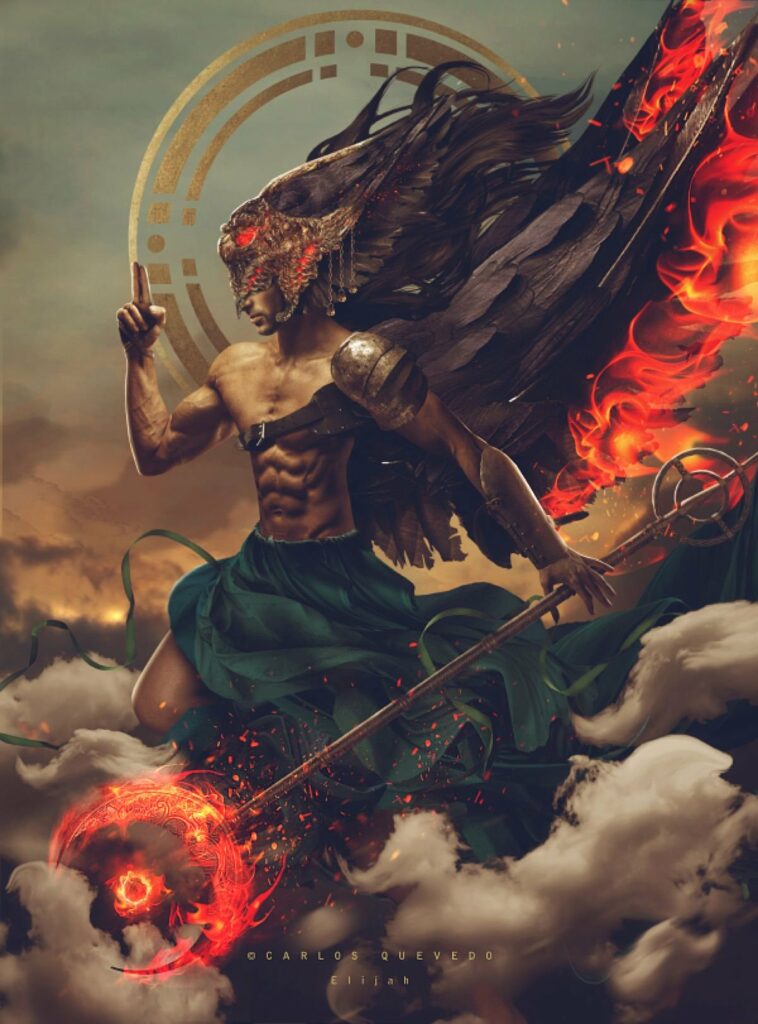
In Judeo-Christian mythology, the same role is played by the “earthly” Archangel Uriel, protecting the “lower worlds” from the “fallen” giants — the Nephilim.
All these descriptions point to the key role of the “simple”, “practical” mind — both as helping people survive in the world of physical phenomena and safeguarding their minds from chthonic depths and virtual spaces.
Despite the lofty aspects of philosophies and hermetic wisdom, Hephaestus is a key figure in the Gigantomachy, alongside seemingly more powerful figures such as Zeus, Athena, and Dionysus, who also destroy the forces of chaos. Likewise, Asgard would have fared poorly under the constant pressure of the Thursar if not for the might of invincible Thor.
The mind, lacking practical grounding, applied knowledge, solid grounding, loses balance and easily plunges into the “cold waters” of the unformed. Magi and esotericists, who are supposed to stand guard over the world, unfortunately often “get carried away into the empyrean”, forgetting about this practical component and thereby depriving their minds of firm support and defensive bastions.
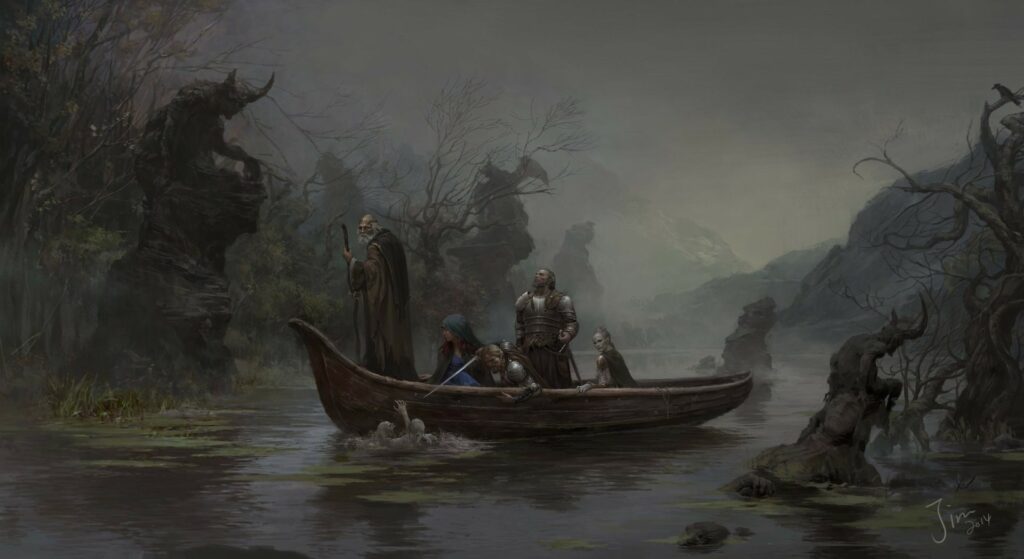
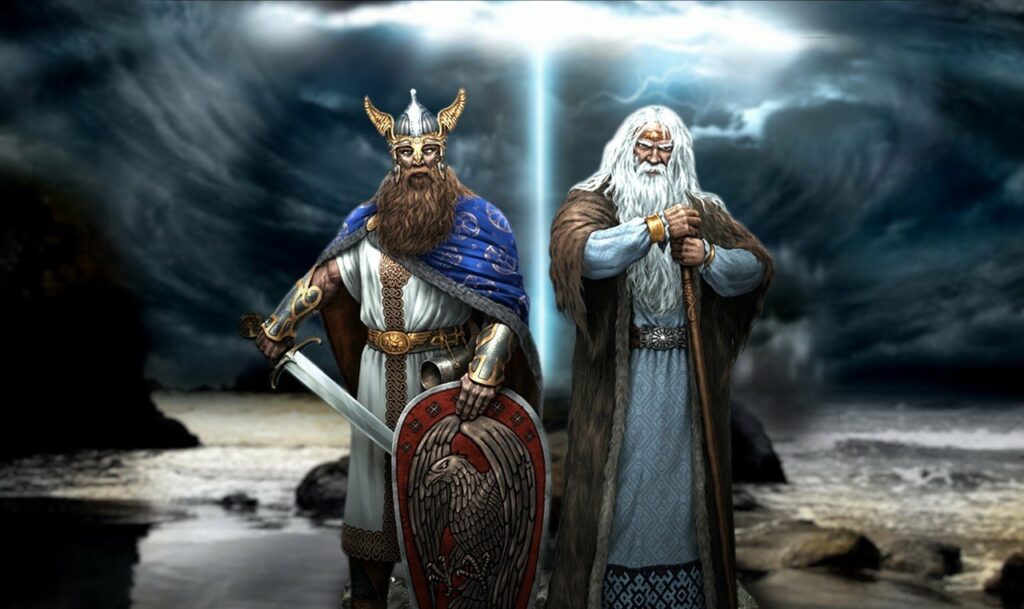
Of course, the gods of Magic — Odin, Veles, Hermes — look down on the “folk” defenders — Thor, Perun, Hephaestus; however, the role of the latter must by no means be underestimated, and the corresponding mental matrices must remain active. It is precisely such neglect of “pragmatics” that leads to various absurd, widespread theories in the “schizo-esoteric” milieu, and among “esotericists” it gives rise to many histrionic and otherwise unstable personalities.
For a Magus it is very important to remember the lesson of the Rune Thurisaz: the ‘fixing’, ‘grounding’, and ‘strengthening’ of the foundation of the mind can be both its enemy (if it leads to the breakdown of dynamic components) — and in this lies the danger of the Powers of Ice — and its protector, so long as it focuses on shielding the dynamic, living, flowing forces of the psychocosmos from chaos-inducing influences. And although Odin and Thor often engage in confrontation (as in the “Lay of Harbard”), and Veles and Perun are in outright conflict, these forces need each other both at the level of “reality” and in the plane of mind.
What distinguishes a Magus from a schizophrenic is precisely the capacity for adequate practical action — precisely their pragmatism — without which they easily “fly off the rails” and get lost in the drifting multireality of the Interworld.
Therefore, understanding the importance of “simple”, reality-anchoring, pragmatic activity, as well as the activation of the corresponding matrices in theurgic practice, is one of the most important outposts that save the mind from descent into chaos, virtualization, and emotional storms, which have become widespread recently.
Wow, this synchronicity. A couple of days ago, I was pondering that there are two types of wisdom. One is knowledge bent through life experience. The other is Metis – higher wisdom, something similar to gnosis among the Gnostics. As I understand it, this is synthetic knowledge – an instantaneous and one-time grasping of the logos (when you catch it all at once and in its entirety) or possibly even interaction with one of the Eons? Or what can it be compared to or described? Also, I read Alice Bailey back in the day, and there was the term ‘love-wisdom’, and as I understand it, without love, you will not achieve wisdom.
Yes, Metis, epignosis – is the vision of the logoi.
Please tell me, if there is an analogy between Odin and Thor, Veles and Perun, Hermes and Hephaestus, can we draw an analogy with the Ancient Egyptian Gods? And if so, with which ones in your opinion?
Well, since you do not answer the question, and probably never will, since you did not respond immediately… I will stick with the version that this is Hor. Hor Ur – Hor the Ancient and Hor Sopt – ready to fight for Osiris. There may be, of course, other variants.