
Others’ Mistakes
In the course of our discussions about the importance of fluidity and tolerance of the mind for a Magus’s success, we have often spoken about the importance of doubt alongside faith in oneself, of critical appraisal and the choice of support.
At the same time, we have also discussed the reasons why it is often those who have left the ordinary world who show the strongest departures from this flexibility of mind. These outbursts of intolerance, cloaked in slogans about striving for “purity” and “righteousness,” actually amount to an attempt to bring all wayfarers under one’s own banner, to impose one’s Way as the only correct one. On the one hand, it may seem that for the traveler, confident in their Way, such an inclination is natural.
At the same time, there has long been the notion of the ineffectiveness of imposing one’s view of things.
To clarify this issue, let us discuss possible attitudes toward the mistakes of others.

In fact, among those who have grasped the Way, two types of attitudes predominate: people of the first type trust no one, are accusatory and indignant, and find it hard to forgive others’ mistakes. In their view, everyone else is “wrong by definition,” because there are only two opinions — “mine and wrong.” This excessive criticism is most often a manifestation of insecurity about being right and shows a lack of confidence in one’s Way — such an approach stems from self-doubt.
People of the second type, by contrast, emphasize their support and indulgence toward others’ mistakes, while making it clear that they themselves never err. This attitude is also an attempt to conceal their insecurity, loudly proclaiming the opposite: “I, of course, know, and when you grow up you’ll see how right I was.” This notion coexists with the fear of “what if they don’t understand?!” — this approach is a consequence of social anxiety.
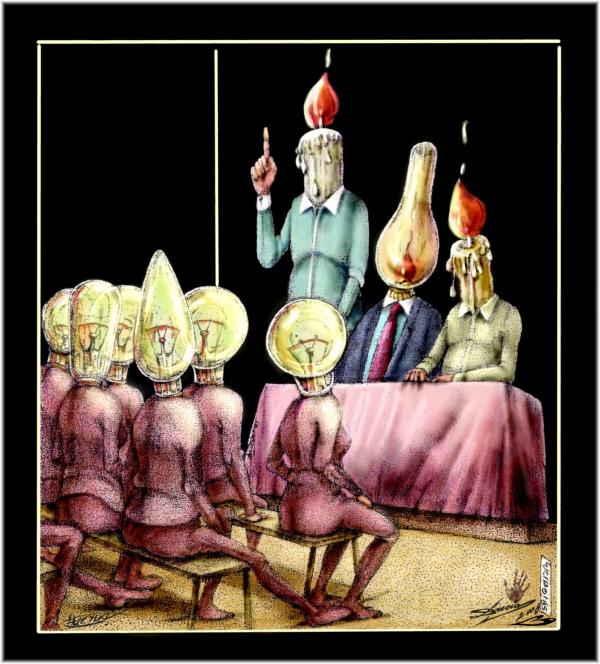
Both approaches harm their bearers and the people they affect. The “critics” undermine others, sowing doubt in others and depriving them of faith in themselves. It is precisely the “throwing others off the Way” that is the main danger of excessive criticism. At the same time, the sense of one’s own inferiority is projected onto those around them, and the idea arises that this inferiority can be overcome only through struggle with oneself and others.
The “indulgers,” by being overly sympathetic, also stop others from becoming independent. They impede their own progress on the Way, because they are convinced that when the other “becomes wiser,” they will inevitably acknowledge the exclusive correctness and wisdom of their Way, and follow it. What escapes their notice is that not all Ways are compatible, which in no way diminishes their individual value.
At the same time, as is usually the case, such approaches are natural impulses distorted by the Parasite of mind. In particular, instead of criticizing everyone indiscriminately, one can make one’s convictions known simply by expressing them firmly. Instead of trying to protect or teach others, one can gently help those in need find their own Way, expressing one’s viewpoint and giving each person the right to find their own solution and develop their own perspective.

Moreover, it’s important to understand that close attention to another’s mistakes is appropriate only when the one who errs and the one who seeks to correct it are united by a common Way. This may occur either in relationships of the “Master-student” type, or between very close people who lack the notion of “my” and “your” mistakes, and have only “our shared” mistakes, as well as “our shared” achievements.
In all other cases any active interference in another’s Way, whatever motives are claimed, risks becoming an obstacle, and the one who creates obstacles for another’s path is likely to lose power, since fighting the Way, the natural course of things, goes against the Flow.
Therefore for the Magus it is very important to understand that only those who do nothing never make mistakes, and to focus on one’s own Way, rather than on searching for others’ mistakes.

But how about the idea of “learning from others’ mistakes”? Learning from others’ mistakes happens when one observes the successes or losses of others who behaved one way or another. It is very important that another’s, even successful, mode of behavior is not copied, nor should mistakes be criticized. It is important to understand that one person’s loss in the same situation may be another’s gain, and that what is victory for one is defeat for another. Therefore the Magus must learn primarily from their own mistakes, although it’s not necessary to make them personally to do so. With sufficiently deep self-knowledge and a well-developed imagination, it is entirely possible to “model” the situation, to “play it out” mentally, in order to determine whether such a course of action is acceptable.
Thus, for the Magus it is very important to avoid both condemnation and indulgence, focusing on their own Way, and on those who share it.
“…Instead of protecting and teaching others…” you have a typo here =)
Interesting article. It’s a pity that it’s difficult to find a conversational partner who is on a different path and does not perceive discussions about the merits and drawbacks of my path and his as criticism.
Thank you, I corrected it 🙂
But there are no “merits” and “drawbacks” of a Path – if it is one’s own. There are limitations imposed by it or additional possibilities, but they are not “merits” or “drawbacks,” since you cannot get rid of them while on the Path, and thus – there is no need to approach them evaluatively, and the words “merits” and “drawbacks” indicate evaluative judgment. Rather, there can be a simple comparison of Paths, but without evaluations, and only with the statement of features.