The Summation of Vortices and Vectors

As we have said, Power (in the sense of the world’s field of realizational tension) has two forms of movement: vortical and vectorial.
Vortical movement occurs when there is a reorganization of interacting elements according to the Tetragrammatical law. This means that the volitional impulse arising in the creative mind sets in motion the potentials of the World Passive Medium, through which the required realization is achieved. In other words, the creative will draws on the element of feeling, the unifying component of the cosmos, drawing from it the energy for its realization. At the same time, new connections and types of interaction are established, overall cohesion of systems increases, while the total power remains unchanged. Thus, in a vortical influence on reality, the driving principle is desire, considered from the standpoint of the principle of feeling.
Vectorial movement takes place when new forces, new elements of activity, are introduced into an existing system, whose possibility of manifestation is implied by the system’s internal logic. This means that the volitional impulse arising in the creative mind sets in motion the potentials of the system itself, adding energy to it and thereby bringing it into a new state. In other words, the creative will in this case relies on the principle of intelligence, on its analytic activity, introducing new forces into the system from the system’s own potentials. In doing so, the system’s separateness increases, and the cosmos’ crystallization increases. Thus, in vectorial influence on reality, the driving principle is the principle of intelligence.
It follows that in vortical change realization is achieved by establishing new connections, whereas in vectorial change it is achieved by bringing new forces into actuality.
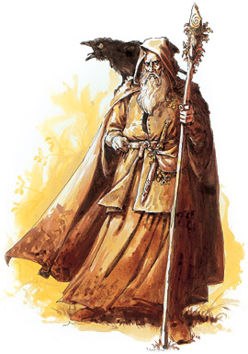
Put more practically, vortical operations — evocation, the magic of “astral” influences, theurgy — are based on reorganizing existing connections and establishing new ones. Vectorial operations — Galdr, druidic callings — are based on the introduction of new forces passing from the “unmanifest” world into the manifest.
In vortical influence, there is always a close interaction of two or more energetic vortices — the operator and the spirit, the operator and the deity, the operator and the larva, and so on.
In vectorial influence, the operator interacts only with the Great Stream of Power, altering its structure by the practitioner’s will, relying on Runic flows.
Note that in both cases all the principles of the Psychocosm are engaged, and neither an effective evocation nor a full-fledged Runic operation is possible without a clear understanding of what is happening, without a clear desire for that realization, or without a balancing principle in the will. Nevertheless, in vortical operations, the will rests, primarily, on desire, while in vectorial ones — on understanding the intended result.
That is why the goetic magus must be passionate, and the runic magus — wise. And in both cases inspiration is required to overcome the threshold.
What has been said has an important practical consequence, often overlooked.
Since in vortical influence the overall potential of the system does not change, any created vortex can be neutralized, and sometimes even annihilated, by an analogous but oppositely directed vortex. A demon is balanced by an angel; a malediction is removed by consecration, and a curse by blessing. Therefore, by calling an angel or a Genius, one can effectively protect oneself from demonic influence.
Vectorial influence cannot be cancelled by simply adding an “opposite” force. You cannot annul one rune by adding the action of another rune. For example, if fire is invoked by attracting the force of Kenaz, it cannot simply be “doused” with Laguz. The interaction of vectors has a far more complex character, and understanding this interaction is critically important for its effectiveness. A talisman containing Kenaz and Laguz will not be “neutral”; it will include the energies of both Runes, and its effect will vary depending on the order of inscription and the additional runes of the talisman and the will of Eril.
For a magus, it is very important to understand what kind of movement of Power is occurring in each particular ritual, and, when using multiple sources of Power, the kinds and ways of their interactions.
In goetic operations, it is important not to overdo protective spells, since they may simply block any manifestation of the spirit, and likewise not to do too little, since the operation itself establishes a connection between the operator and the demon, and this connection must be clearly controlled and severed in time.
In Galdr operations, one must understand that each word of the Vis, and the order of those words, as well as every Rune of the talisman, are firmly cut into the fabric of the cosmos, and they can no longer be removed “without scars”.
Without such understanding, a magus will not achieve the effectiveness required for success in their evolution and victory in the Last Battle.
Enmerk, what principle do you think lies behind the so-called ‘Chaos Sigil,’ vortexal, or vectorial? Regarding the mechanism itself, I expressed my opinion in this small essay: ‘It is obvious that the principle of the so-called ‘Chaos Sigil’ is quite simple. We should not reinvent the wheel to find an explanation. It is obvious that we are dealing with the birth of idea-entities in this case. Grigory Otonovich Mebes in the ‘Encyclopedia of Occultism’ wrote about the simplest way to create idea-entities. He wrote that one needs to formulate one’s intention, for example: ‘I want uncle N. to be softer in character.’ Then one needs to tense the leg muscles and let them go. Moreover, blood, milk, or honey (and, if we continue G.O.M.’s thoughts, of course, sexual fluids) amplify the effect of this method due to the life force contained in them. ‘Chaos Sigils’ are obviously an evolution of this method. We create an entity that has a Name (obtained by twisting the Sentence of Desire). We create a Signature of this entity by constructing a Sigil. Finally, we convey to this entity life force, for example, through orgasm and ejaculation. We can also activate a Sigil in the context of a planetary or elemental ritual. In this case, the created entity will have more specific properties. But if we apply a hierarchical charging scheme to a talisman with an image of a Sigil, we thereby connect the created entity, programmed for the fulfillment of a specific task, to a powerful reservoir. Since we are talking about an entity created by the operator themselves, one’s own mental setting becomes critical. If an operator has doubts about the positive outcome of the operation, etc., they will thereby create obstacles for the actions of their created entity. Therefore, there should be either absolute and unwavering confidence that the goal of the operation will be achieved, or, conversely, the absence of any thoughts on what has been done at all. Because the authors of relevant practical guides, such as Frater U.D. or Michael Donald Craig, who presents the Sigil Magic method in an exclusively sexually-magical context (see his book ‘Modern Sexual Magic’), recommend completely forgetting about the Sigil and the operation altogether. Because the memory of the conducted operation, its goal, and the Sigil of the operation activates an entire inventory list of thoughts associated with the operation, reducing to internal dialogue like: ‘Will it work or not? What if it doesn’t work?’ And thus, the generated entity breaks against such mindsets like a wave against stones. The energy spent on work is thus dissipated. In the end, especially regarding those who take the first steps in this method, the success of an operation may not fully fit into the mental picture of the world for the novice operator. On the one hand, they may want to verify the reality of magical phenomena. But on the other hand, their previous setups will say: ‘I know that nothing will work for me.’ Because the general social worldview taught in kindergarten, school, and university excludes all this. Ultimately, one should not forget the factor of Personal History. If the operator forms an Intention and creates an Entity that will embody this Intention, and as a result, they will take on a new position in the World, the World will resist this because it remembers them as they are now. Personal History is not just an intellectual abstraction. Personal history is, so to speak, a specific reality, an Astral Cliché (Resoluble), in which this subject resides. If the operator created an Entity whose result should be a change in the surrounding reality of the operator but, at the same time, they cling to their Personal History and by their thoughts in every way confirm it, they thereby destroy with one hand what they have created with the other. In this case, there will simply be a lack of space for the operation of the Intention. All of the operator’s thoughts associated with the Personal History will, in their Brownian movement, clog their Intention to change something, just like a crowd of cave people would for a mammoth. In this regard, it is clear that such experiments should begin not with external changes in the world (read – organizing events in the desired direction), but with things of an internal nature – for example, concerning character change in the desired direction or successes in certain spiritual practices. For instance, one could formulate the Intention as: ‘My Will is to achieve full control over the body as a result of practicing Asanas for three months.’ If, however, the Intention pertains to producing changes in the external World, then the object of that Intention should not initially be something entirely occupying one’s thoughts. In other words, it should be desirable, but not so much that one constantly thinks about it. Say you have a job that you, in principle, are satisfied with, but at the same time, you want a better job, so you can create and activate the corresponding Sigil and then forget about wanting something better and conducting an operation for corresponding improvement (‘My Will is to find myself a job with a payment of no less than a certain amount of currency per month within three months’). But if your current job is the subject of constant frustration due to its low pay or lack of prestige (like ‘Here I am, with higher education, doing what any fool can do :(…’), then after you conduct the corresponding operation, forgetting about it will be no easier for you than thinking about a white monkey. It is obvious that one of the best ways to stop thinking about a white monkey is to think about a black monkey. But that already requires a certain success in controlling thoughts. Because completely switching thoughts from a constantly occupying topic of dissatisfaction with one’s job to, for example, the successes of Kyiv ‘Dynamo’ in the current season, or the foreign policy of the Philippines, is not that easy. In this regard, it might be beneficial to lighten one’s attitude toward the current job before conducting the operation. Enough so that dissatisfaction does not occupy thoughts constantly. Well, and of course, one must first find an answer to the question of whether you actually need this change at all. And whether this desire is your own desire. Or do you just want to satisfy some social criteria for success, although you could very well manage without all of that.
In ‘Chaos Magic,’ there is a separate direction for ‘creating artificial entities’ – these are Servitors. But apparently, in reality, both of these techniques – servitors and sigils – are one and the same, just with different accentuations. That is, ultimately, they create larvas (vortices) that execute commands, provided the magician has managed to control them. It is unclear where to categorize such ‘artificial spirits’ – elementals, elementary beings…? What are their structure and functioning?
Perhaps there exists a third form of power manifestation – wave-like. It is initiated by any movement within the magician’s energy cocoon. A classic example is the ‘butterfly effect.’
Hello! Why is this pronouncement of the verse a vector operation? What makes it so?
Hello, Master! In your video lecture, you compare the use of runic symbols to shooting with a crossbow. What should be done with the image of the runes after they have been processed? It is advised to burn them, but as I sensed it, this does not pass without a trace, and you write about the scar of the universe.
Burning runes and talismans based on them rather activates, releases their energy than nullifies it. Runes and talismans should first be “scraped off” – this action is the opposite of “cutting out”, and only then can the carrier be burned (or better, buried in the ground or water).