
Galdr — The Word Endowed with Power
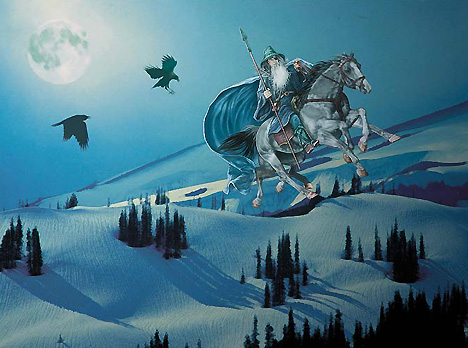
The masculine aspect of the Northern Way is Galdr.
The word “Galdr” or “Galdor” (Galdr, Galdor) in Old Norse originally meant “to cry” or “a cry”; i.e., a “spell” or “magical song.” Later it came to mean magic in general. Yet in its original sense, Galdr is precisely verbal magic. Only magical songs and spells uttered aloud may be called galdr. It is the very fact of utterance — the embodiment of thought and intention — that endows that thought with the power to bring it about.
Galdr spells are usually described by words meaning ‘to sing’, i.e., ‘to intone’. Technically, Galdr probably consisted of loud, often abrupt chanting of specially composed spells, usually reinforced by inscribing them in runes. The result of uttering such a spell is a change in the external world, an active transformation. The aim of Galdr is to bring the results into objective reality, to manifest them in the “real world.”
A Galdr spell contains magic in itself, and it is performed by the chief practitioner of magic — Galdr-crafter (the Eril). Galdr spells are supremely active, expansive, and warlike. The Galdr Magus must be strong and self-confident; otherwise his magic will not succeed. One neither flatters nor deceives the spirits; communication with them is imperative. When using Galdr, for example, for healing, the Eril rebukes the spirits afflicting the patient, declares his authority over them, and proclaims his magical weapons, spears and a knife. The ailment itself is ordered to leave and the patient to recover.
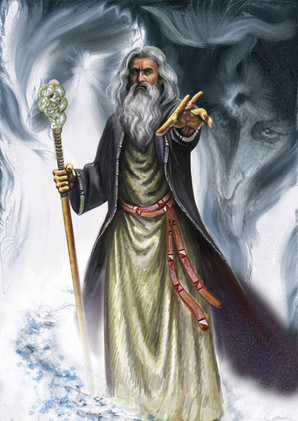
Moreover, a prerequisite for successful Galdr is the clarity of the magus’s mind. As he utters the spell, he tends to be “intoxicated” by Power, yet he remains in control over himself and the situation.
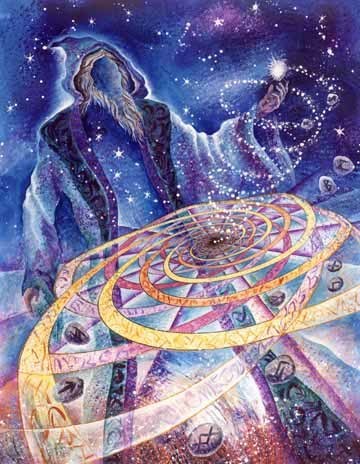
In one form or another, Runes are always used in Galdr. They are either carved into a special object (for example, a staff), or cast, or woven into a composite runic symbol (a galdrstav). Oral utterance and carving complement each other; together they ensure a greater effect of the spell — expressing the will of the Eril — into the fabric of reality, and thus its realization.
It is sometimes said that the first Galdr spell was whispered by Odin into the ear of his dead son Baldr when he lay upon the funeral pyre. The echo of that word, whispered “into Baldr’s ear,” resounds through the ages in the spells and songs of magic.
Galdr proved very resilient; in the late Middle Ages, runic inscriptions were still made in churches, and Icelandic bishops were famed for runic sorceries.
Galdr spells are most often known in three forms — Drapa, Nid, and Manseg.
Drapa — a song of praise, recited aloud and/or inscribed in runes. The name probably means “a song broken into parts” (from the verb “to break”). In composition, a drapa resembles a poetic list of names or records. Each of the vísur that make up a drapa is, as a rule, a closed unit, not only metrically but semantically. There is no plot in a drapa. Nor are there direct speeches, dialogues, monologues, etc. The only thing that allows one to establish the sequence of vísur in a drapa is the chronological order of the events described, which is always observed. Yet these events (battles, wars, etc.) in a drapa are usually not individualized but presented in general terms. Probably for that reason, many fragments of drapas have survived, but almost none complete. A drapa commonly opens with the skald’s request to hear the verses he has composed. Then follows a recitation of the military exploits of the praised one, extolling his bravery and generosity. The conclusion of a drapa may contain the skald’s petition for a reward for his composition.
Nid — a defamatory song aimed at harming its object. Few examples of such defaming verses have come down to us. Nid is characterized by a darkness of content unusual even in skaldic poetry. A nid is usually constructed according to the laws of name, association, and similarity. It appears that the capacity to cause harm was provided not by the content of the nid but by its very form, i.e., by being “bound speech,” verse. That was also the essence of the drapa: it, too, was effective by virtue not of its content but of its form. It is notable that the term nid referred not only to defamatory verses but also to a pole with a horse’s skull impaled on it, erected for the same purpose as such poems. In that case, it is even more evident that nid was considered something capable of exerting a magical effect upon its target.
The sagas often tell of nid and of the effects ascribed to it. It is well known that Egill Skallagrímsson carved a nid on a pole topped with a horse’s skull to drive King Eirik Blood-Axe out of Norway. Also famous is the story of the nid of the skald Þorleifr Rauðfeldarson. The Norwegian earl Hakon seized Þorleifr’s goods, burned his ship, and hanged his companions. Disguised as a beggar, Þorleifr gained access to the earl’s hall and was permitted to recite his verses. At first, the earl thought Þorleifr was praising him and his son Eirik. But suddenly a terrible itching seized the earl, and he realized that Þorleifr’s verses were a “hidden nid.” Darkness fell in the hall, all weapons came to life, many were killed, and the earl fell unconscious. His beard and hair rotted on one side of his hair part, and he lay ill for a long time thereafter.
Manseg — a coercive “love” spell, a form of binding or enchantment. Manseg, like Drapa and Nid, follows strict rules of rhyme formation and makes frequent use of kennings — “renamings.” In composing a manseg, the skald sought to win a person who in ordinary life would under no circumstances “give” him their heart. The “love-binding” power in this case was likewise ascribed to the poetic form itself, as is shown by the recorded prohibition in the “Grey Goose” against composing verses about a woman under penalty of a fine, since it was believed such verses could act as a love-binding — that is, as a magical means. According to the Younger Edda, this kind of love-binding is associated with the name of Freyja: “She delights in love-songs. And it is fitting to call upon her aid in matters of love.”
Thus, Galdr is magic directed at altering the “objective” reality, external to the magus. It is realized in the active embodiment of the magus’s will in verse and runes, thereby giving that will a special “body” intended to ensure it is carried out.
Yes, it’s interesting. I haven’t come across information about Garl’d before. In this regard, I have a request to post as examples several expressions or individual words from each variety of Garl’d for better understanding if possible.