Hermeticism as Post-Science

We have spoken many times about the fact that the magical, hermetic worldview is not an “alternative,” but an expanded description of the world, one that does not contradict but completes the “ordinary” or “scientific” picture of reality.
In other words, if physics focuses on an instrumental approach and asks: “How does it work?”, “How can we influence it?”, then hermeticism is directed first of all toward deep understanding as such, and asks: “What does this mean within the structure of Being?”
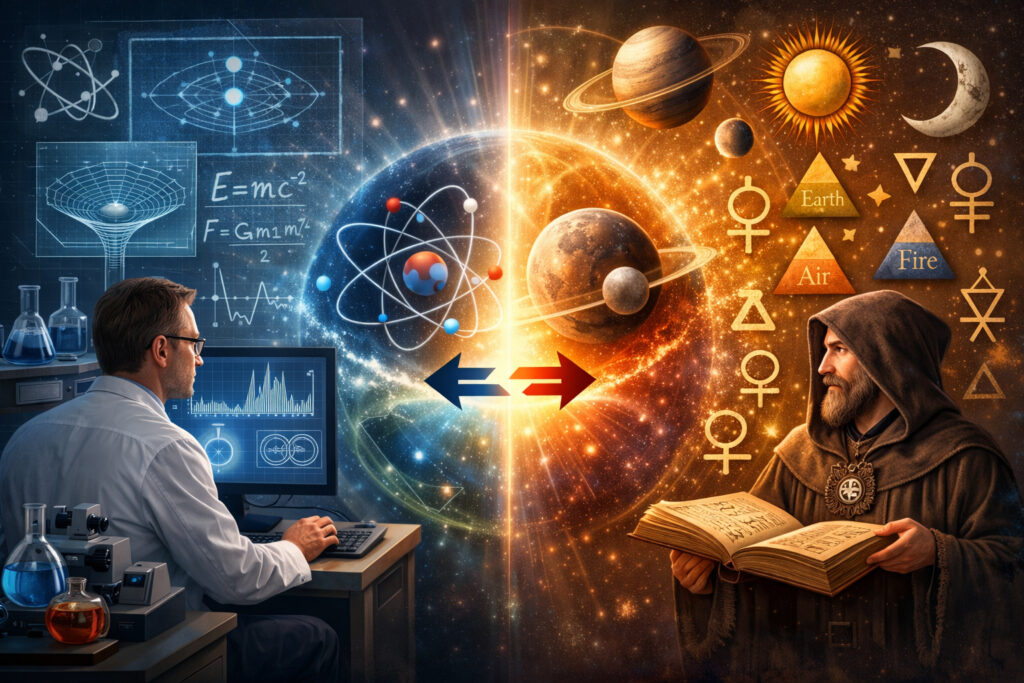
Thus hermeticism holds that at the foundation of the universe lies an original duality of forces. And physics, from its own angle, confirms this at every step: particle and antiparticle, the north and south poles of a magnet, positive and negative charge. From the standpoint of hermetic description, Coulomb’s law is simply a mathematical record of how the Principle of Polarity manifests in dense matter. So we can say that while physics describes the intensity (the formula) of interaction, hermeticism speaks of its essence (the relationship of paired forces).
The scientific picture helps us work with a given phenomenon: isolating variables, measuring, finding stable connections, building models, formulating and testing predictions. By its very nature it is “local,” because it studies a particular fragment of the world in order to render it controllable within the bounds of chosen assumptions.
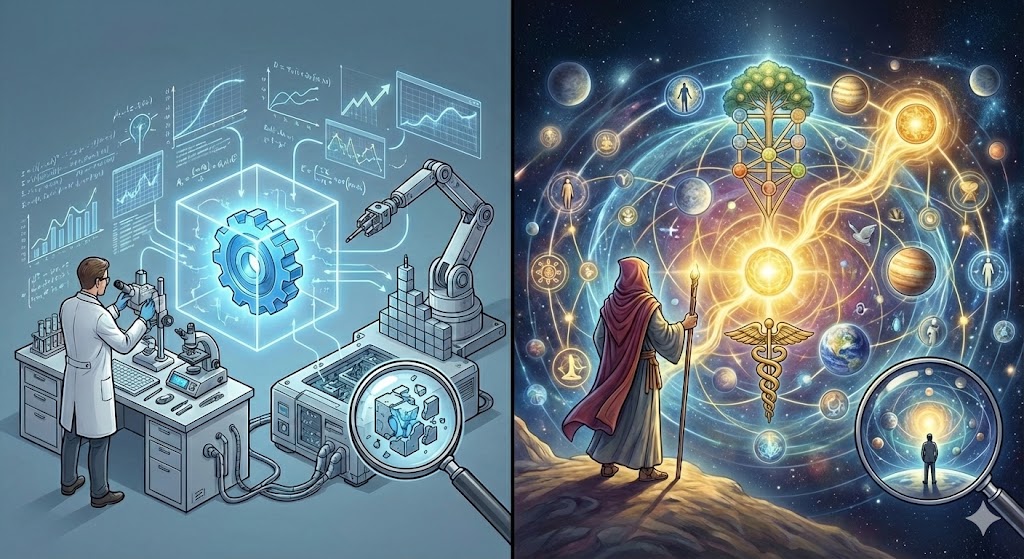
The hermetic gaze has a completely different focus. It asks what place a phenomenon occupies in the integral order of the cosmos — in its hierarchy of causes, its dynamics of becoming, its play of unity and division, form and decay. Its language is traditionally symbolic, because it does not describe methods of measurement and calculation, but the qualities of being: how exactly a given force participates in the formation of reality, what boundaries it lays down, what degrees of freedom and necessity it introduces, and what consequences this has for consciousness, for the individual, and for the world as a whole.
Science creates tools, yet hermeticism points out that any tool ultimately becomes embedded in the universal order of causes and effects, and every impact on the world inevitably returns to the agent — reflected in the qualities of the inner state of the one who acts.
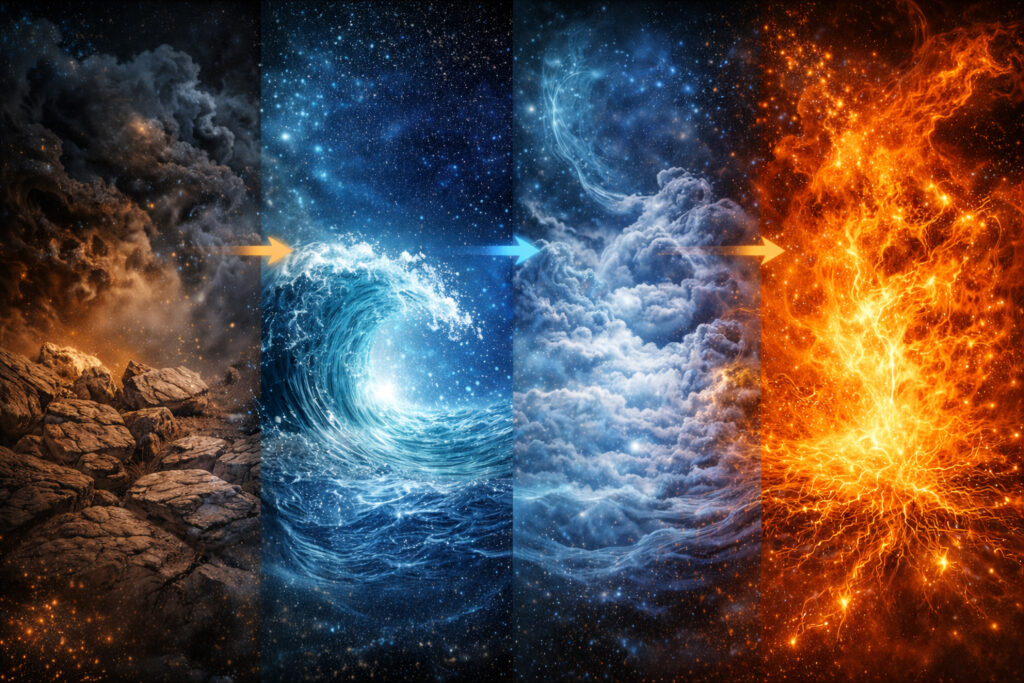
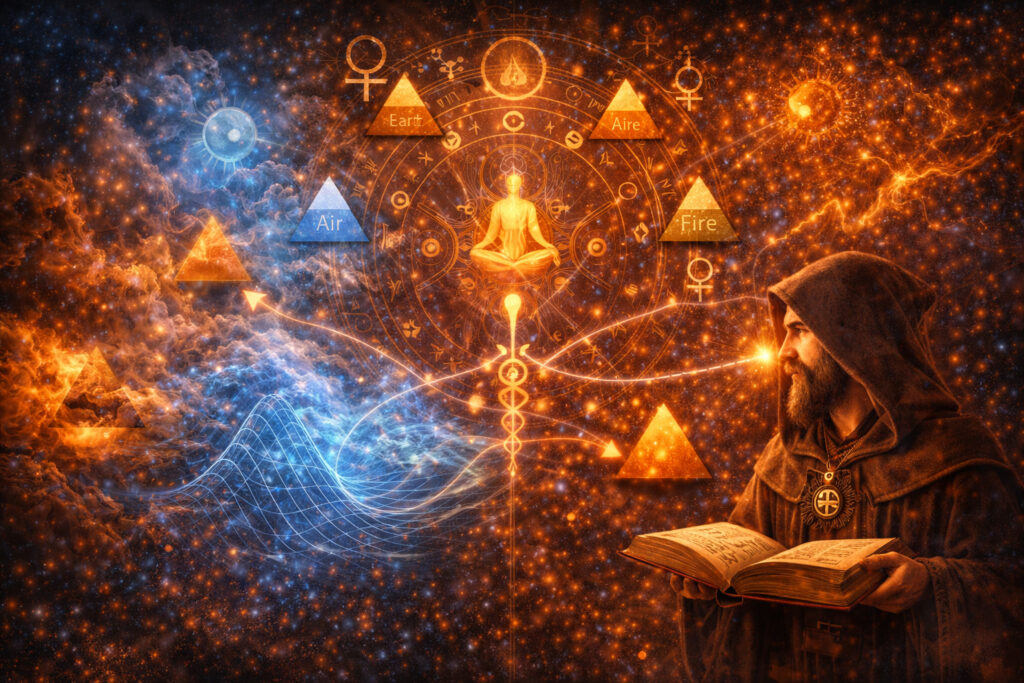
We have spoken more than once about the fact that, for example, the hermetic prime elements (Fire, Air, Water, Earth) are not so much kinds of matter as states of energy/information. Earth names the solid state of matter, characterized by maximal inertia and minimal vibration. Water is the liquid state, characterized by plasticity and adaptability. Air is the gaseous state, characterized by expansion and the transmission of information. Fire is Plasma / Pure Energy — the state of transformation, of high vibration.
From the standpoint of physics, the transition from Earth to Fire is simply an increase in the kinetic energy of molecules. From the standpoint of hermeticism, it is a rise in the vibrational frequency of the one Medium.
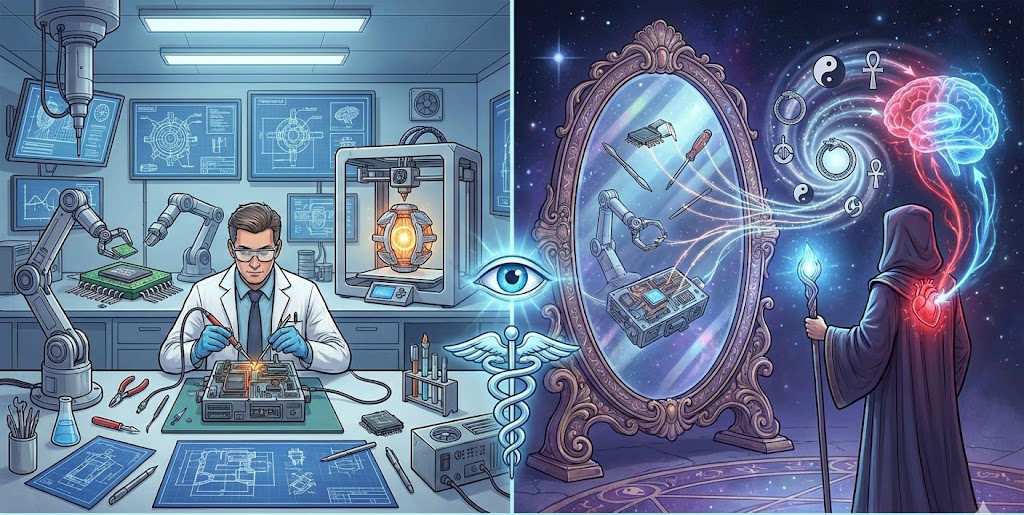
If a physicist understands how electromagnetism works, they build an electric motor or a hadron collider. For physics, knowledge is dead if it does not allow for intervention (technology). At the same time, physics strives to build its system so that the subject is minimally significant: measurements must be reproducible independently of the individual.
Hermeticism, by contrast, is above all a path of the transformation of consciousness, whose central aim is gnosis (gnosis in the strict sense). The hermeticist studies the very same forces in order to understand the “rules of the game” of the cosmos and to bring their inner structure into harmony with them. In other words, in this system knowing is a way of changing the subject, not the object. Therefore every phenomenon is always considered together with the one who enters into relation with it and why.

So if, for example, a physicist studies the laws of aerodynamics to build an airplane, a hermeticist studies those same laws in order to understand what “flight” is as a principle — and to realize that principle within their own consciousness.
In quantum mechanics, however, the separation into “observer” (hermeticism/understanding) and “object” (physics/intervention) is no longer so strict. On the quantum level, the very act of “finding out” (determining the state of a system) is an intervention. It is impossible simply to know what state an electron is in without changing it. Yet the role of specifically human consciousness is not required here: any physical interaction of the system with a measuring device and the environment suffices. Nevertheless, this means that knowledge (hermeticism) at this level becomes inseparable from action (physics). At the same time, whereas physics says that the collapse of reality takes place at the level of micro‑particles, hermeticism maintains that this principle is universal, and that by describing reality, consciousness thereby creates it.
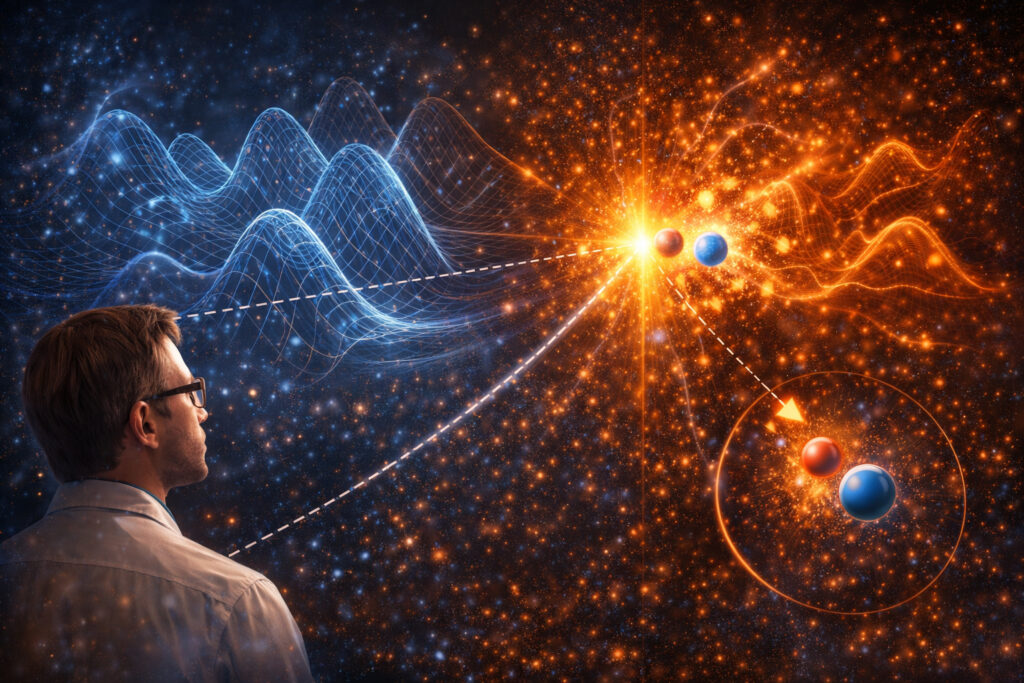
The possibility of bringing these two perspectives into relation lies in the very fact of distinction, on which it depends what particular result becomes reality for a given observer. In physics this distinction is set by the mode of reckoning: which parameter one chooses to measure and in what direction one thereby “shifts” the disposition of forces; from this, in turn, follows the set of possible outcomes; then the environment intervenes, quenches interference, and gives one of the variants the appearance of classical stability — of a particular timeline. In hermeticism, the same act of distinction is directed inward, into consciousness: what matters is what kind of recognition consciousness carries out and in what quality it does so, as well as what consequences this has for it.
Accordingly, while physics searches for the conditions under which collapse is inevitable (decoherence), hermeticism seeks a way to render this process conscious. If an ordinary person “collapses” their reality chaotically and unconsciously, then the Magus is the one who trains attention in order to shape reality in accordance with their will.

In physics, the act of description (reckoning) is essentially the choice of a measurable quantity and the conditions of its measurement. This choice fixes which outcomes are admissible and how they will be distributed statistically — but the result itself is then sealed by the physical interaction of the system with the instrument and the environment.
In hermeticism, by contrast, observation is an inner choice of the form of a system of logoi: what exactly the observer deems essential, where they direct their attention, to what degree and with what sense of responsibility. Here the observer is an inseparable part of what occurs: their state determines which structures crystallize in the experienced world, and this dependence of the observed on the observer is inseparable from responsibility.
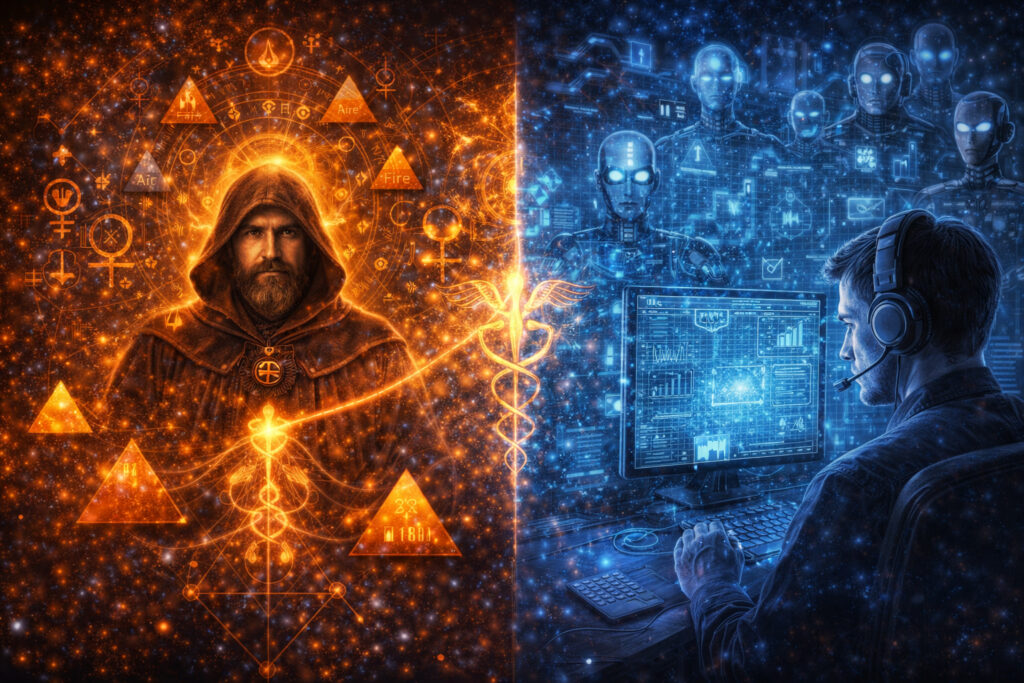
In other words, the “scientific” picture of the world is, in fact, a kind of hermeticism stripped of personal responsibility: a convenient way to shape and alter reality without feeling personally involved with it or bound to it. One might say that while hermeticism is the “Magic of Participation,” modern science is the “Magic of Alienation.” Within this lies both an important positive aspect (it removes doubt and pangs of conscience, and thereby eases the achievement of goals) and a danger, because it habituates us to irresponsibility. Psychologically, this confusion is easy: once an action is described as “technology,” it seems to be “no one’s,” “in and of itself,” and the consequences seem to be “merely the workings of natural law.” Digital technologies make it possible to kill, rob, or manipulate the consciousness of millions of people while sitting in a sterile office and simply pressing buttons.
The hermetic worldview, on the contrary, emphasizes precisely what science deliberately attenuates: it places involvement at the very center of its attention — insisting on the importance and inviolability of the chain “subject — action — order of the world — consequences for the subject and for the whole.” Thus an important difference is that science trains us to manage processes by way of detachment, whereas hermeticism demands that such management presuppose meaning and responsibility. And it is precisely this linkage that is especially needed today, so that the power of method does not become a justification for moral blindness.

This kind of responsibility is especially crucial now, as a new wave of life enters the world. A programmer, in essence, practices a hermetic “magic of the word”: they “utter” code (logoi), and “out of the void” a new functioning system arises. In this sense the digital age resembles the age of magic, because the human being alters the order of the world by means of symbols, signs, and formulae, without physically touching that which they affect.
And the hermetic tradition reminds us of an idea that is vital for this epoch: no influence is ever “impersonal,” every formula always has its author, and that author stands directly within the stream of consequences — if not legally, then at least existentially. In the digital world this is especially important, because the more powerful the tool, the more decisive the questions: who sets its aim, who defines what is permissible, who is prepared to answer for the unexpected or side effects, who — and at what point — is able to stop.
Hermeticism today is a way of reclaiming one’s status as a subject. In a world where algorithms replace choice and Big Data knows more about people than they know about themselves, only the hermetic approach (awareness of oneself as a center, as Observer) prevents us from becoming mere “nutrient medium” for machine intelligence. Without “hermetic skills,” a human being inevitably degenerates into an impersonal “terminal operator,” an additional interface for whom the consequences of their actions are nothing but numbers on a screen. And that is a direct path to total dehumanization.
Leave a Reply