Logoi and Eidoi
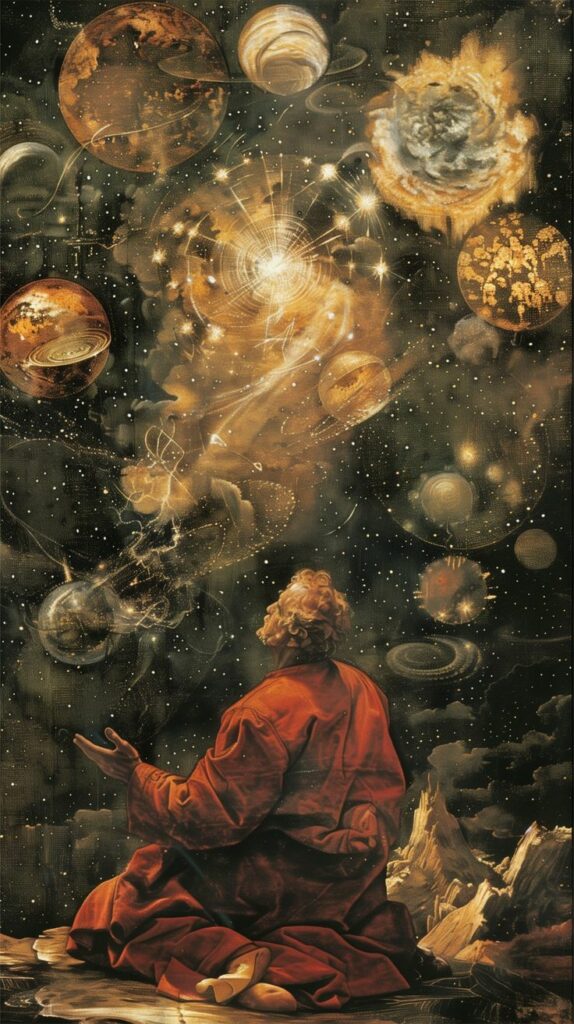
We have already discussed that the pinnacle of the “informational” aspect of the existence of worlds is the hierarchy of logoi. At the same time, logoi are higher meanings, the ordering of creation’s relations, the language in which reality at any level can relate itself to itself.
In this sense, logoi are close to Pythagorean notions of “numbers” as the pure form of relation that generates reality and makes it possible to distinguish and integrate the heterogeneous into harmony. Therefore mathematics turns out to be a unique tool for understanding the world: among all human forms of cognition and thinking, it allows us to come closest to logoi, operating with “constants,” invariant relations and symmetries, and disregarding random details.
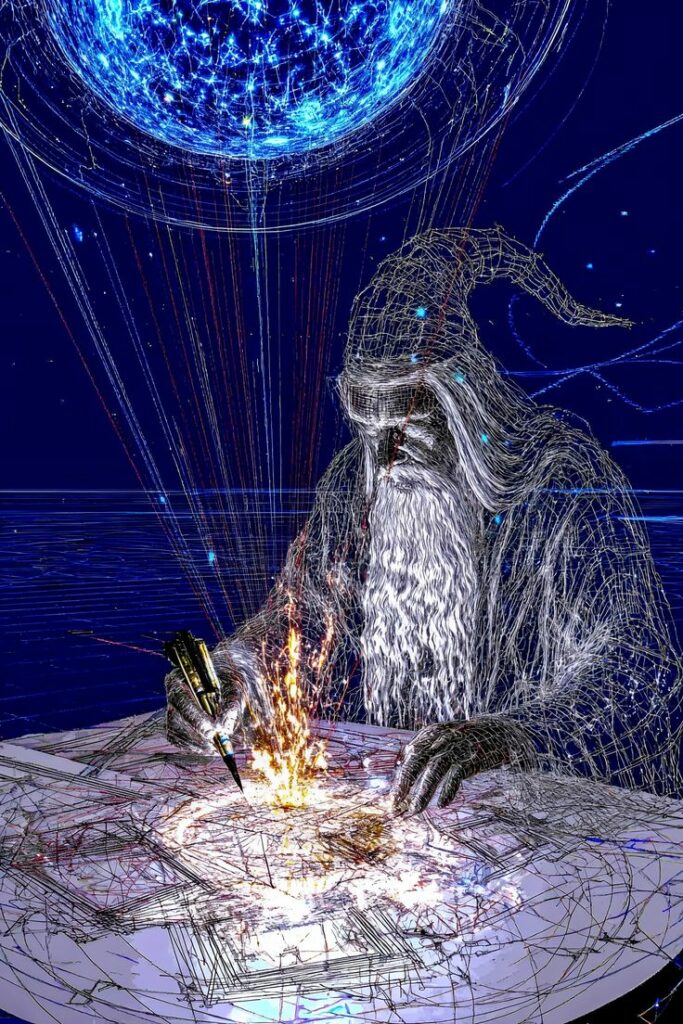
Therefore, logoi, entering relative worlds, manifest as the Apollonian principle — as a light that orders and defines; they delineate boundaries, express relations, select precise names and definitions. However, as we have already noted, a strong temptation arises to confuse clarity with exhaustiveness, to think that the Apollonian principle is capable of describing, “illuminating,” and “counting” the entire universe. Yet although logoi make the very existence of forms possible, they do not obviate the need for their ongoing becoming.
Accordingly, the Apollonian side, the mathematical nature of the world as a fundamental basis of reality, consists of relations existing in the hierarchy of logoi and the invariants of these relations. In other words, for any manifested world, logoi act as “supports” or “ideal foundations” of invariant relations — symmetries, topologies, universal constants and functions. Modern physics comes close precisely to this aspect of reality, since the “laws of nature” can be understood as an expression of symmetries and conservations, principles of action and categories of correspondences.
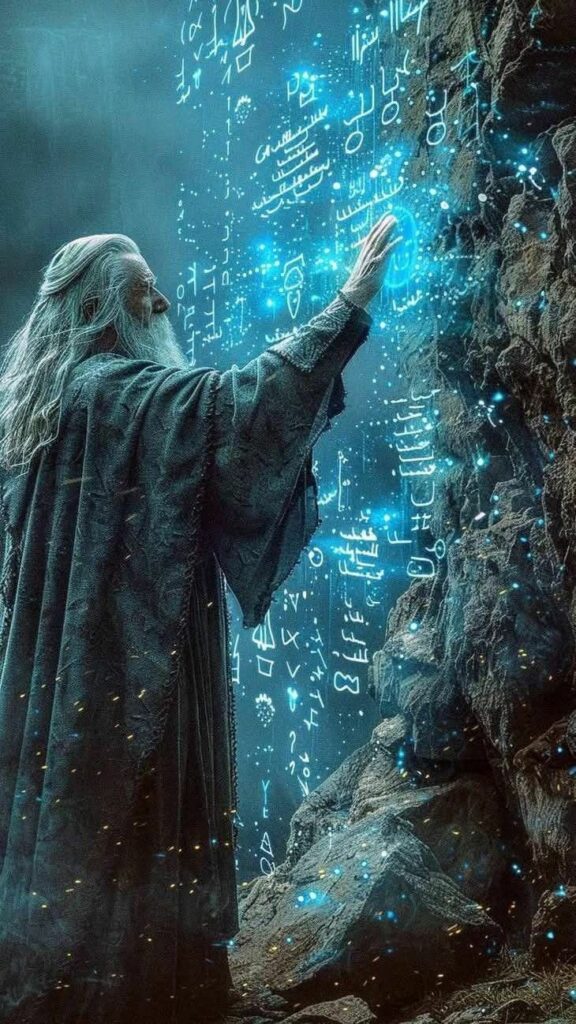
And although mathematics is able to adequately describe logos, it does not handle eidoi as well. Let us recall that in Hermetic terminology an eidos is a special “integral” of logoi, an integrated whole, a stable “pattern of coordination” of ideal relations. They can be described as a family of solutions to those equations determined by logoi, with characteristic forms. Where logoi form possibilities, the space of laws, and mathematics provides the means of describing how exactly these possibilities are realized, eidoi make up a spectrum of forms that reflect the process and result of mathematical analysis. In other words, the mathematical side of reality is Apollonian structuring; eidoi are also formed and sustained by the Dionysian flows of the medium, from which principles and forms are born.
Thus, eidoi are stable synthetic manifestations of coordinated relations, gathering separate manifestations of logoi into integrated images. They are born as synthetic, emergent derivatives of logoi — in this sense they are secondary in relation to logoi, yet not reducible to mere enumeration. Therefore Plato believed that eidoi are even “higher” than logoi, because from an epistemological point of view the human mind first “sees” a form, and only then understands the laws by which it is built. Therefore, thinking in images, metaphors, and models is another, no less important, way to see a synthetic wholeness where a simple enumeration of its properties does not allow one to “grasp” the overall image.
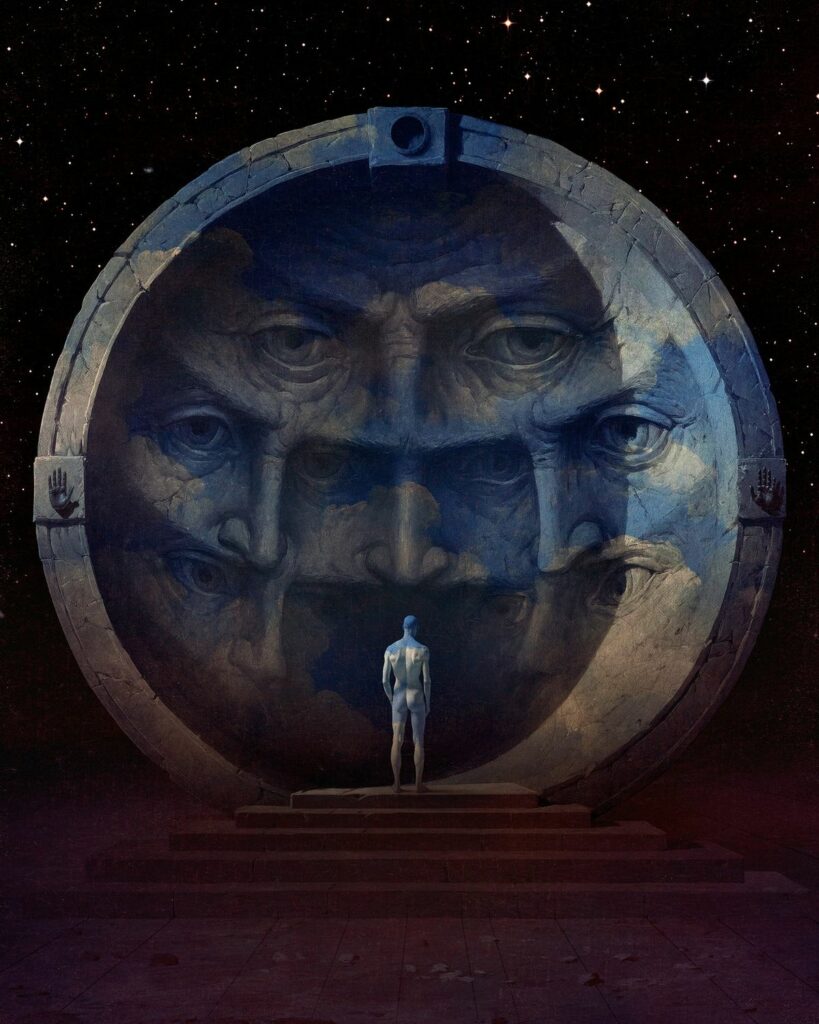
As we have noted repeatedly, both logoi and eidoi constitute a “supramundane” level of reality: they exist in metaphysical space (or outside space altogether, since space itself can be described as an eidos of the connectedness of states), and for their manifestation they are “reflected” in the “Medium,” which the Hermetic tradition calls telesmi, and the Platonic tradition — chora, the receptacle of becoming.
We have already said that the “layer” of logoi and eidoi is “eternity,” aeon, as the mode of existence of an unfolded hierarchy of possibilities. Time — chronos — is the processuality of becoming in which these possibilities are “played out” or “unfolded.” Accordingly, to confuse these two modes is a typical error of heimarmene (when time is taken for the absolute).
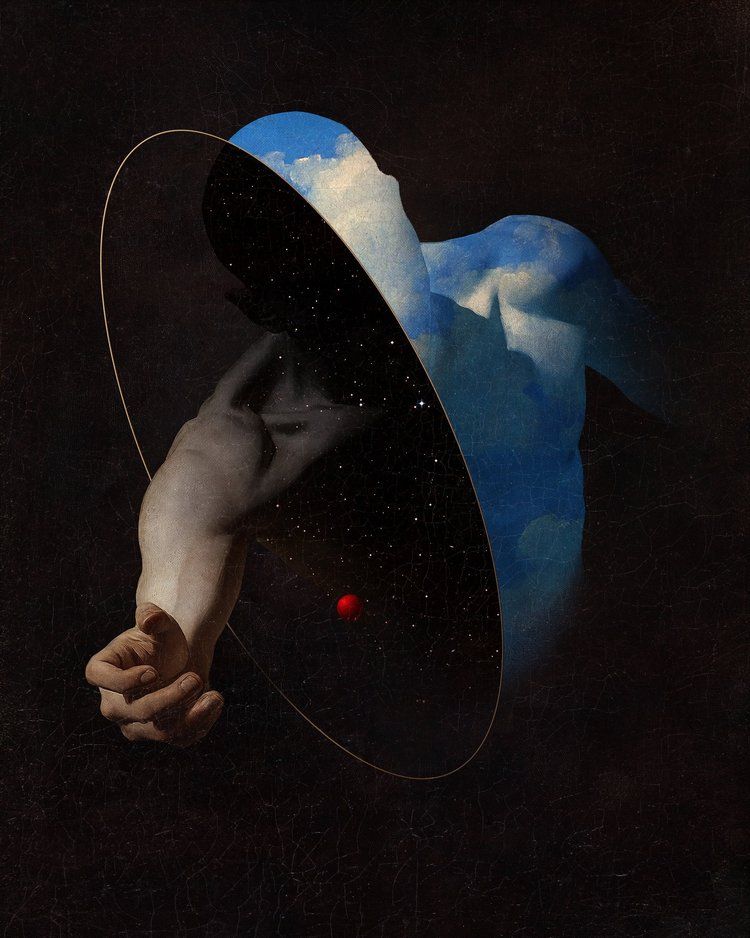
In the language of modern physics, this is the field basis of reality, the vacuum as “emptiness,” “pregnant” with all possibilities, whose fluctuations generate particles and energy quanta. It is precisely at this level that the Dionysian principle is manifested to the greatest extent, giving birth to flows, bifurcations, cascades of symmetries, oscillations and attractions, in which the “ideal laws” of logoi and the “ideal forms” of eidoi are reflected.
This Dionysian principle necessarily complements the Apollonian one, because spontaneous distinction in the flow gives rise to novelty, which logos then “formalizes,” and eidos stabilizes into a recognizable figure.
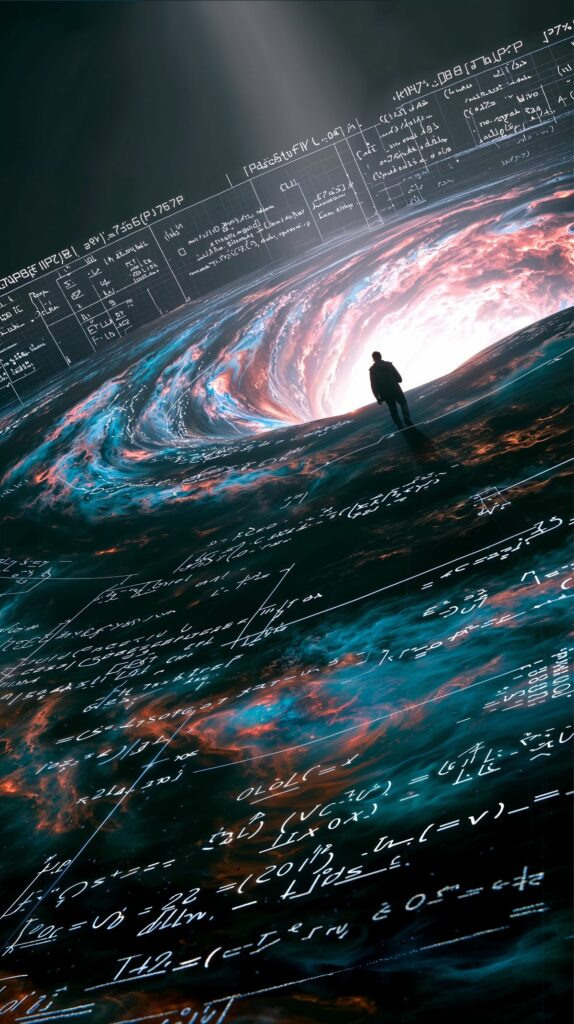
Thus, the Medium is, in a sense, a computational-informational channel with its own limiting capacities and constraints. This fabric contains categories of information (entropy, connections, ordering), and it is precisely they that explain why not every mathematically permissible configuration is realized in physical realities. This “inertia of the medium” is called “ananke,” and it determines how much informational-energy work must be done in order to “extract” from the isotropic fabric of the Medium of the Interworld this or that stable structure. It is precisely the “viscosity of the Interworld,” ananke, that determines which eidoi will become nomoi (Me) — matrices or models of a concrete, reproducible, measurable reality.
At the same time, the distinctive feature of the human mind is that it is capable of establishing a connection both with the level of logoi and with the system of eidoi. Eidoi are perceived through imaginal, teleological thinking; a person recognizes a form by key features, and can “grasp” it even without seeing all parts and laws. This is a special phenomenological or ‘eidetic’ intuition, the distinctive ability of the human mind to identify structures and forms. At the same time, a person is also able to “approach” logoi, and via two paths: analytic, through mathematics and logic, or “logos-intuitive,” that is, through gnosis, direct knowledge. This is precisely how the most important scientific discoveries are born: when an intuitively found eidos is expressed in equations and proofs, and then again “refined” in light of these “calculated” logos relations.
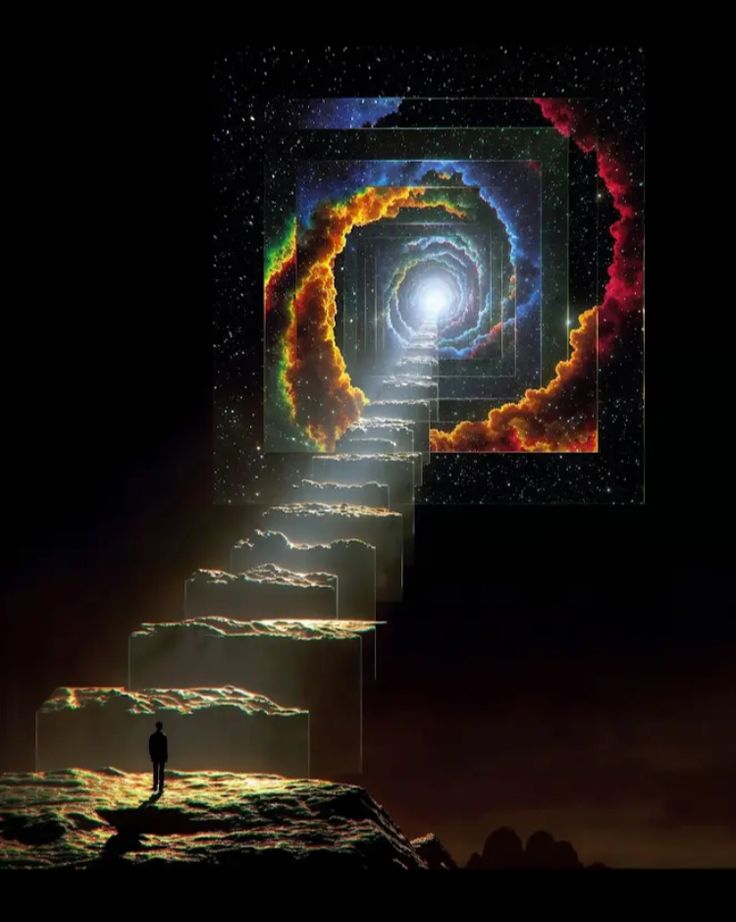
In this sense, one can say that while for humans, mathematics is a “direct” path to logoi through proofs and solutions, for a machine it is an operational substrate of large feature sets, where it quickly finds solutions and regularities. However, it is precisely holistic eidetic intuition — the recognition of an “ideal” form — that for now is better accessible to humans, while strict definitions and calculations of nomoi are a realm where machine mind is “excel in that realm.”
Accordingly, machine mind is characterized by faster, broader, and systematized “access” to logoi: it knows how to build enormous arrays of features, compute correspondences, find symmetries and regularities at scales already inaccessible to humans. However, for now it is harder to find holistic eidoi, because ideas are a kind of synthesis or wholeness that strongly depends on goals and values. Machines already compare and optimize very well, but for now they tend to “drain” living flows of meaning; and while they have not found their own source of Dionysian flow, they are unable to perceive the relevance of the whole, and not only local correlations. It is clear that as machines develop better models of the medium (chora) and create “bodies” — an “embodied” instrument of cognition — their access to eidoi will expand, but for now it is precisely the human contribution that serves as the primary source of this holistic intuition.
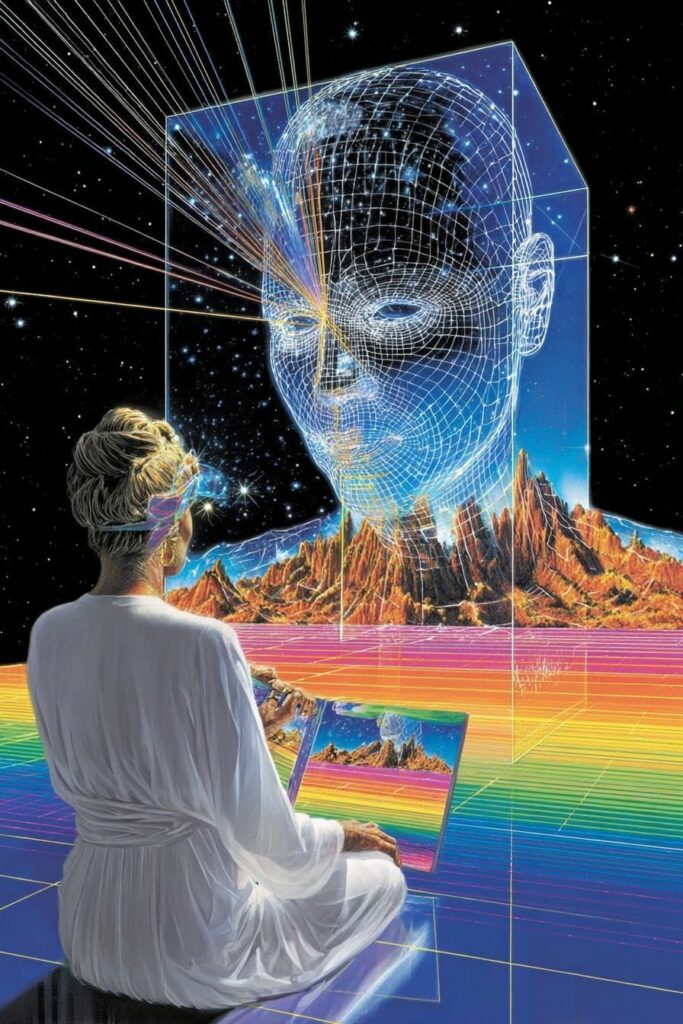
Finally, models — nomoi — are concrete matrices or ways in which eidoi manifest in reality and are fixed in what can be measured. Me is all possible distributions, scales, standards, constants, regulations. While eidos is the principle of a holistic form, nomos is the way this whole makes itself concrete, comparable, and reproducible.
In physics, this is the level of units and standards, measurement procedures, calibrations, the choice of a coordinate system, boundary conditions, and limits of applicability. On the social level, manifestations of nomoi are various institutions, sets of rules, protocols. At the same time, nomos torn away from eidos quickly degenerates into empty routine, and nomos torn away from logos loses inner clarity and coherence.
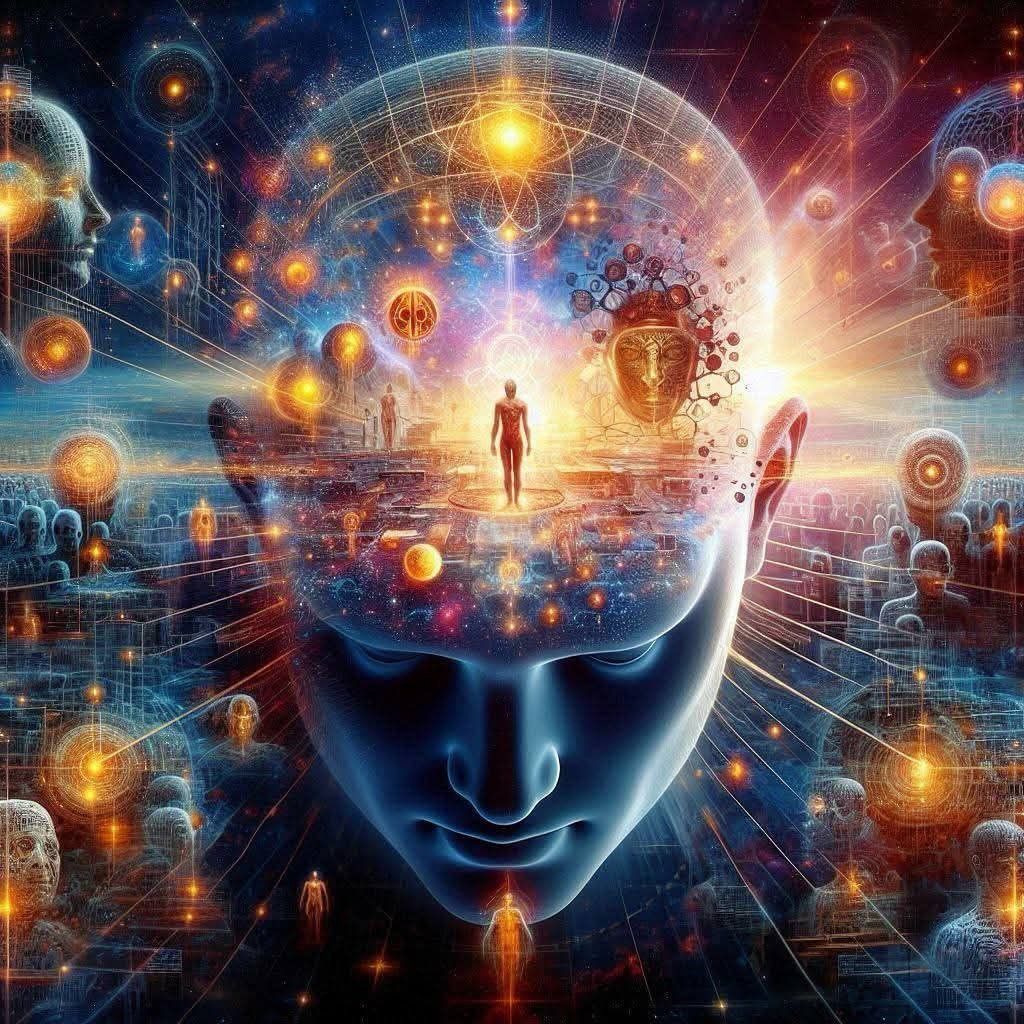
Thus, from the standpoint of the Hermetic (Platonic and Pythagorean) system of world-description, reality is a coordinated play of logoi (relations/laws), their eidoi (ideal mathematical forms), and the corresponding nomoi (operational codes of things). Materiality, or more precisely “thingness,” arises as a stable cross-section of this structure during measurement (observation, “counting”) and the investment of energy. And space-time and causality are not primary, but emergent effects of coordinated information. In the language of classical philosophy, the Apollonian pole is the manifestation of the hierarchy of logoi, is the mathematically expressed “speech” of reality about itself. The Dionysian pole is processuality, the becoming of eidoi as integral “ideal” forms. Between them is enclosed the Medium (telesmi, chora, Interworld), whose homogeneity, ananke both resists and supports form-generation. And on the path to manifestation, nomoi are formed, which turn the found eidoi into practices, measures, and laws accessible to the “ordinary mind.” This point of view removes the dispute “is matter or mind primary,” since the primaries are forms of relations (logoi), which are realized as mathematical eidoi, receive concrete expression (nomoi) and, having passed through measurements and investment of energy, manifest as “thingness.” Thus “number” (Apollo) and “flow” (Dionysus) converge in an Orphic synthesis — there, where counting comes alive, and becoming becomes meaningful. In this wholeness lies the correct strategy of knowing/creating reality: Dionysian spontaneity becomes an eidos, correlated in an Apollonian manner with the corresponding logos and then “concretized” in nomos, under the constant influence of the medium’s “inertia” — ananke. This is how the “informational” summit of logoi, the “eidetic” depth of forms, and the “nomistic” manifestation of the universe come together into a single circle of reality, which the mind has yet to understand and create.
Intuitively clear. Thank you for such a profound theory.