Localization of Mind
We have already said more than once that the universal mind, the subjective component of the Great Spirit, is in itself homogeneous, potential, and impersonal, and acquires tangible properties only when it is localized within flows and in contact with an object-field.
Put another way, any properties of mind — such as self-determination, individual or personal qualities, and so on — are epiphenomena of its activity, properties of its functioning rather than of its nature. Therefore one can assert that the manifested mind emerges interdependently and simultaneously with the objects it perceives. In acquiring determinacy, the mind becomes localized by relying on a particular carrier — the “body” of varying degrees of materiality.
Therefore, for the Magical Myth, the so-called “Great Arcana” is a central idea — the notion of the intimate interconnection and interdependence of the perceived and the perceiver: the mind, its object, and its carrier. From this perspective it is meaningless to speak of “pure mind” or “pure being”; both are potential, abstract, and acquire reality only through mutual contact.
Contemporary quasi-esoteric circles often fall prey to the fallacy of “pure reason,” a distorted chitta-matra — the idea that “everything depends on mind, is born from mind, and is governed by mind.” From this view the “external” supports for the mind, as well as formalized practices and Rituals, are commonly deemed unnecessary. That would be true if by “mind” one meant the absolute — the universal, undifferentiated, and featureless — but when such people speak of “mind” they usually mean a limited and relative specific flow to which they unreasonably ascribe governing properties.
At the same time, the Traditional view unequivocally affirms the interdependence noted above: mind, insofar as it is describable, arises only in contact with its object-field, a point summed up in the famous formulation of the Great Arcana: “Sumus creatores ambitus nostri simulque creationis,” “We are the creators of the environment we inhabit and, at the same time, its creation.” In this sense Magic denies the “reality” of the soul, speaking instead of the “energies” of mind, its Lights and flows.
In other words, everything we can call “self,” everything that can be described or defined, anything in which properties and qualities can be identified, is a product of relative existence — temporary and dependent on its environment. Therefore, neglecting the environment inevitably leads to a distortion of the flow of mind, however much we might wish otherwise.
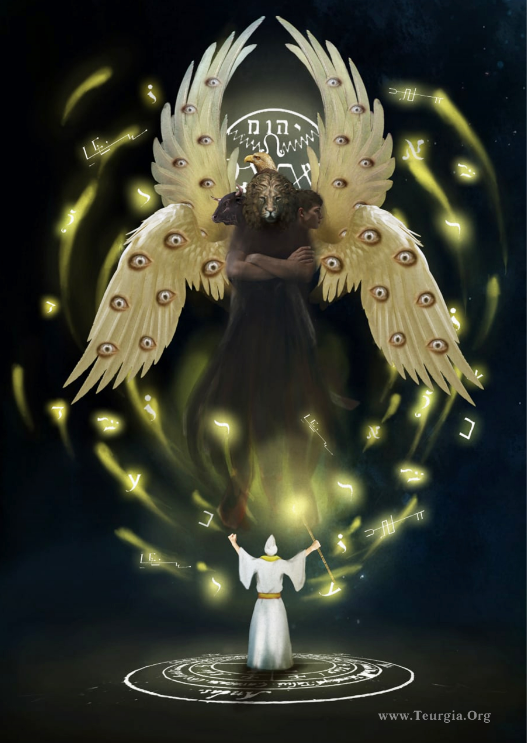
For this reason Magic is equally alien to both materialism and “pure spirituality,” denying the absoluteness of either pole and asserting their close interrelation. On the one hand, the magus understands that matter is merely temporary, relatively distinct properties of the world’s potentiality, perceived as “reality”; on the other hand, the personal characteristics of localized mind seem equally relative and temporary.
At the same time, understanding that he himself and the whole world around him are products of description — the interpenetration of being and mind — the magus learns to rely both on the qualities of mind and on the objects of the environment, shaping their evolutionary contours. The magus’s activity in the interdependent development of mind and environment — forming that environment, gathering and working with points of support, and so on — proceeds precisely from the conception of the Great Arcana. The magus understands that localized mind needs support, just as matter for its manifestation needs an “observer.” For realization — whether external or internal — a single “desire” or “will” is not enough; it also needs energy, a support, a field of manifestation. The complexity of ritual implements and the multi-stage nature of the Great Work are consequences of this understanding, a sober appraisal of one’s reality.

Neglecting “external” elements inevitably leads to a loss of concreteness in the flow of mind itself, and thus disrupts the natural course of the World Process, whose essence is the Great Spirit’s striving for self-knowledge and self-actualization; consequently such a flow of mind regresses and must later make a major effort of self-determination. By turning away from matter we do not draw closer to the Spirit; on the contrary, we lengthen its path, complicate its self-knowledge, and hinder its striving.
Leave a Reply