Aeons and Syzygies
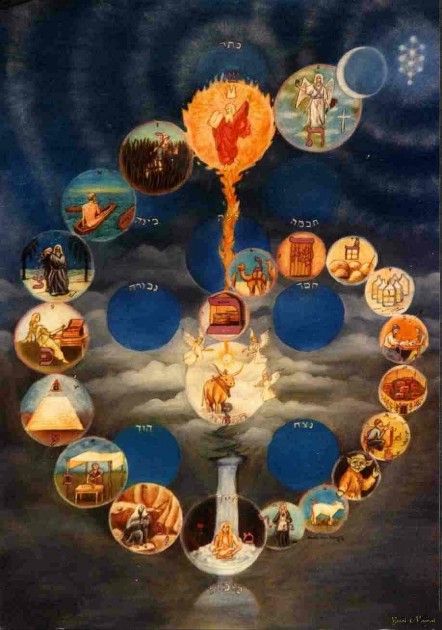
We have already discussed that, from the point of view of Gnostic teachings, the potential basis of all manifested worlds and spaces consists of special “quanta of divinity” called “Aeons” (αἰών).
Each Aeon is a “slice of potentialities” of the Absolute, capable of unfolding into an unlimited number of actual aspects of the phenomenal world, both in the aspect of being and in the aspect of mind. In other words, an Aeon is a potential for manifestation of certain properties and forms of being and mind.
As possibilities for manifesting the light of consciousness in the vessels of existence, Aeons are the basis of the Tree of Life; as possibilities for describing reality and giving it form, Aeons are the foundation of the hierarchy of Logoi; as the possibility of manifesting mind in separate currents and forms, Aeons are the basis for the emergence of individual beings.
They embody various attributes and qualities of the Divine, such as wisdom, love, light, and righteousness. Each Aeon is an expression of different aspects of divine reality and plays its unique role in the creation and maintenance of the cosmic order.
In other words, Aeons are, as it were, an “intermediate stage” between the Unity, which transcends all being and non-being, and Its manifested existence — worlds, spaces, and the beings inhabiting them. Thus, besides phenomena and the principles that determine them, the Gnostics also distinguished a level of potencies, possibilities from which principles and phenomena are manifested.
In the context of the Gnostic concept of Aeons, the birth of reality can be viewed as the manifestation of ideal forms and principles contained in the Aeons as possibility. The Gnostics taught that the highest Aeon, called the Proceeding (Proeon), is the highest aspect of the Divine source, inaccessible to human knowledge. The Proceeding generates other Aeons, which form a hierarchy of spiritual forces, arranged from the highest to lower levels.
Different Gnostic schools counted different numbers of Aeons, gave them different names, and described relationships between them; however, they all agreed that it is precisely these potential first principles (ἀρχή) that stand behind all manifested reality. At the same time, manifested reality itself was considered “corrupted,” since in the process of its emergence the actualizing forces (Archons) lost their connection with the divine primordial source and created a false, distorted image of Aeonic reality.
As the potential fundamental basis of manifestation, Aeonic forces are, in their basis, paired, since they contain both the possibility of “positive” — manifestation — and “negative” — destruction or non-being. Moreover, at the “Aeonic” level duality can also be described as the mutual complementarity of the “essential” and the “active” components, since “essence” means affirmation, constancy, and action means change, or the “destruction” of one state and its transition into another.
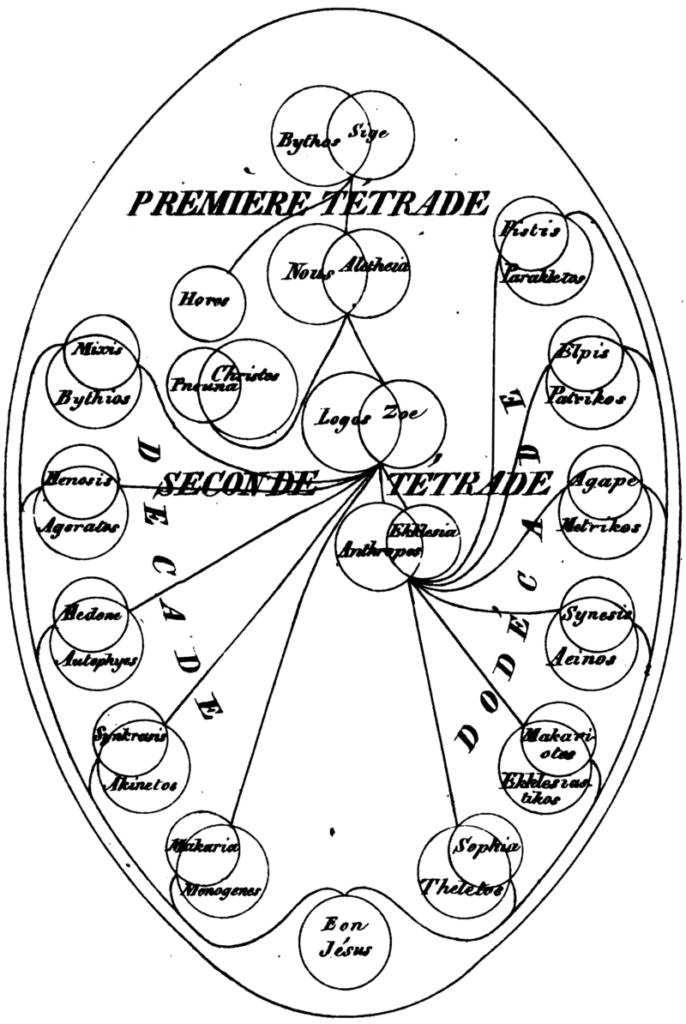
Such pairs, similar to the duality of matter–antimatter in the context of opposition and complementary qualities, were called by the Gnostics syzygies (Greek συζυγίαι, from σύζυγοι, literally “Yoking together”). These pairs of Aeons represent various aspects of the Divine, combining different qualities and attributes within themselves. In the Gnostic tradition, Aeonic syzygies are viewed as complementing one another, and each syzygy forms unity and harmony within itself.
Most often the Gnostics counted 30 Aeons, gathered into 15 syzygies belonging to different “generations.” This number is quite natural: it is the number ten (fullness) manifested in three spheres (an image of divine reality). Even those Gnostic schools that counted, for example, 32 Aeons, took the two highest “outside the brackets,” so that the potential basis of being-mind was still the same 15 syzygies.
As an example, let us give a list of Aeons accepted by the Valentinians, one of the most significant Gnostic schools:
- First generation
- Bythos (Βύθος, Depth, the One, the Primordial) and Sige (Σιγή, Silence, Grace (Charis), Ennoea, etc.)
- Second generation
- Nous (Νοΰς, Mind, also called the Only-Begotten) and Aletheia (Άλήθεια, Veritas, Truth)
- Third generation, proceeding from Nous and Aletheia.
- Sermo (Word; Logos Λόγος) and Vita (Life; Zoe Ζωή)
- Fourth generation, proceeding from Logos and Zoe
- Anthropos (Άνθρωπος, Homo, Human, a single being) and Ekklesia ( Έκκλησία, Church — in the sense of a harmonious union, an ideal society)
- Fifth generation
- From Logos and Zoe:
- Bythios (depth) and Mixis (mixing)
- Ageratos (Never-aging, existing outside time) and Enosis (Unity)
- Autophyes (self-generation, essential nature) and Hedone (Pleasure)
- Akinetos (Immobility) and Synkrasis (Co-dissolution, Interpenetration)
- Monogen (Only-Begotten) and Makaria (Bliss, Happiness)
- From Logos and Zoe:
- From Anthropos and Ekklesia
- Paraclete (Comforter, the Holy Spirit, who guides and supports) and Pistis (Faith)
- Patrikas (Father) and Elpis (Hope)
- Metrikos (Motherhood, procreation) and Agape (Love)
- Ainos (Praise, Glory, also “Eternal mind”) and Synezis (Intellect)
- Ekklesiastik (Son of the Church, a perfect member of the ideal community) and Makariot (Bliss)
- Teletus (Desired) and Sophia (Wisdom)
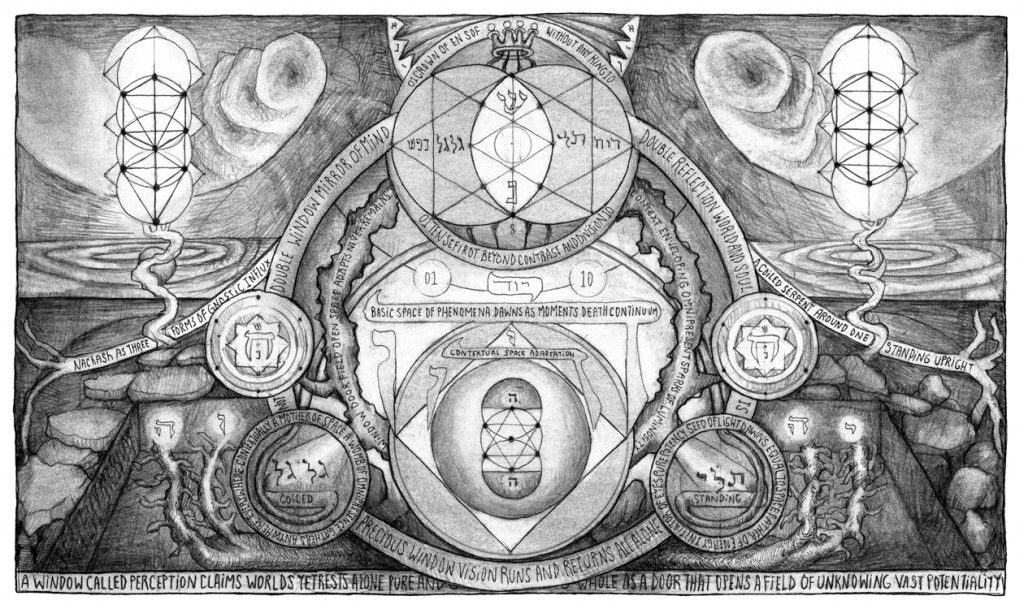
In this system, an extremely important and productive division of Aeonic forces into three aggregates proves to be: the creative Ogdoad, acting as the source for the rest of the unfolding of potential spaces; the Decad of “proto-sephirotic” Aeons, laying the foundations for the manifestation of the Divine Light — the Creative Presence; and the Dodecad of “worldly” (or, in the darkened reality, “Archontic”) spaces, in which possibilities arise for the creation and existence of manifested worlds.
Interpretations of the names of the Aeons are quite transparent; the reader can reflect on them independently. For now, we will note that in each syzygy the corresponding potency manifests in two poles, as can also be seen at the level of the Principles — the Sefirot. At the same time, reality is born as the fruit of the “darkening” of the last Aeon — Sophia — and the birth from her, first, of her own “shadow” analogue — Achamoth, and then also the “author” of materiality — the Protoarchon Ialdabaoth.
For a Magus, understanding the foundations of potential reality is important for two reasons.
First, it is necessary to be able to see the “roots” and causes of phenomena and processes in the “real” worlds. The concept of Aeons helps develop this perspective, and the description of each Aeon as a Deity, a Space, and a potential is useful for mapping the Intermediate reality — the beginning and end of all existence.
Second, just as Genii are the “ideal” forms of Goetic demons, Aeons in their “personal” aspect can be regarded as “ideal prototypes” of the Archons, and therefore the study of the hierarchy and internal logic of the Aeonic system can help in resisting the virtualizing predators.
How adequately does one compare personal aspects of aeons and yidams? Is the method of transforming archons into aeons suitable as a way to oppose, as in the case with the genius/kidemon?
Aeons are too general and potential forces to serve as ‘personal’ deities. As for ‘transformation’, for the same reason it is ‘not possible directly’, but searching for ‘aeonic’ sparks in Archons may be a way to diminish their power.
Yidam as a personal deity definitely does not fit, that’s true. Perhaps Dhyanis Buddhas are closer to the aeonic personal aspects. The strategies for opposing archons are indeed more complicated. It will not be possible to completely exorcise, seal, and transform them.
One could say that an Aeon is a yidam for the whole world in one of its aspects. And the opposition to Archons is primarily an evolutionary focus, or if one were to use Buddhist terminology – ‘Enlightened intent’ (Bodhicitta).
Thank you for the answer. It turns out that despite the fact that, conditionally, Vajrasattva does not represent a personal aspect of any of the aeons/ethers, performing the sadhana of Vajrasattva may serve as a counteraction to the influence of archons due to the fact that this practice specifically develops and maintains bodhicitta. Perhaps it is a mistake to draw such parallels; however, right now I would relate Vajrasattva to a certain aspect of the ether/aeon that serves as the basis of Yesod.
How are the aeons/ethers related to the correspondences from the Book 777: XCIII—’The Heavens of Assiah’, LXXXVII—’Palaces of Briah’, VI—’Spheres of Assiah’?
Conditionally, can Shemesh, Zebul, and Hekel Ratzon be called ethers/aeons that provide a field for the manifestation of Tiferet in the worlds?
If not, then what are Shemesh, Zebul, and Hekel Ratzon in this myth?
Aeonic forces cannot be directly detected in the manifested world, as they exist in the field of possibilities but not in reality, and manifest only through their actualizations. Regarding planetary forces – we have discussed them: https://en.enmerkar.com/myth/vtorichnye-prichinnosti. For example, the name Zebul (זבל) means ‘habitation, dwelling,’ and refers to the field of manifestation of planetary force, ‘Shemesh’ – this is the material expression of this force, and ‘hekekel ratzon’ (היכל רצון) – ‘Hall of Will’ – is the ‘outer vessel’ (‘kli hitzon’) for its manifestation.
Thank you for the answer! After writing the question, I realized that these are indeed different things. In my quest for the aeonic roots of secondary causality, I went very much the wrong way 🙂
If you think about it, what is the Being of the Aeons? The Aeons exist in eternity. In a sense, you could say, from a Christian perspective, that this eternity belongs to the hypostasis of the Father, who is referred to as “HE.” The Being of an Aeon consists of producing the next Aeon from itself, which in turn also reproduces from itself. And so it probably goes on indefinitely, though it’s usually limited to a couple of tens or hundreds.
That’s the first point. The second point is that the Aeons contemplate and glorify the highest Aeon, known as the Proeon? Although from other sources, I’ve heard that the highest Aeon is Bitus, Silence.
Proeon can be compared to a metaphysical or mathematical point, which is essentially zero, but despite that, this point has the primal potentiality. “The point, in essence, is infinite, because it has no limitations, dimensions, and so forth. It is not defined in itself. It is apophatic. Its FINITE nature only shows in relation to what is external to it. And WITHIN ITSELF, it is just as undefined and negative as that from which it was ‘born.’
The third point. I would compare the Pleroma as a whole to a crude metaphor: “a chocolate bar” that has been divided. That is, yes, it is divided into separate parts, but it still maintains a common unity—wholeness. The Pleromatic Whole is divided into parts (Aeons), but that’s only potential. Hence, unity—wholeness, without mixing.
The aeon coexists in pairs with another aeon. One aeon, as I understand it, is the essential aspect that embodies constancy, while the other is the active aspect, which brings in variability. However, when you read about it, it’s not all that obvious. For instance, Depth and Silence. Nuss and Truth. Who is who, huh?
Aeonic forces, at their core, are paired, as they encompass both the possibility of manifestation and non-manifestation.
In syzygy, the possibility of manifestation and the possibility of non-manifestation are astonishingly linked together. But one must understand that these are just potentialities! They are “virtual,” meaning they are not yet actualized (not fully manifested, not realized).
The possibility of manifestation is the unmanifested (not actualized) possibility of Being, which means it’s a possibility of manifestation that has not yet been “manifested” (not realized, not actualized); within it lies immeasurably more of the possibility of non-manifestation. So, the possibility of non-manifestation and the possibility of manifestation can be conceptually joined under the term “Being.” The essence of Being is about the “realization (actualization) of the possible.”