
Haborym’s “Closed Ears”
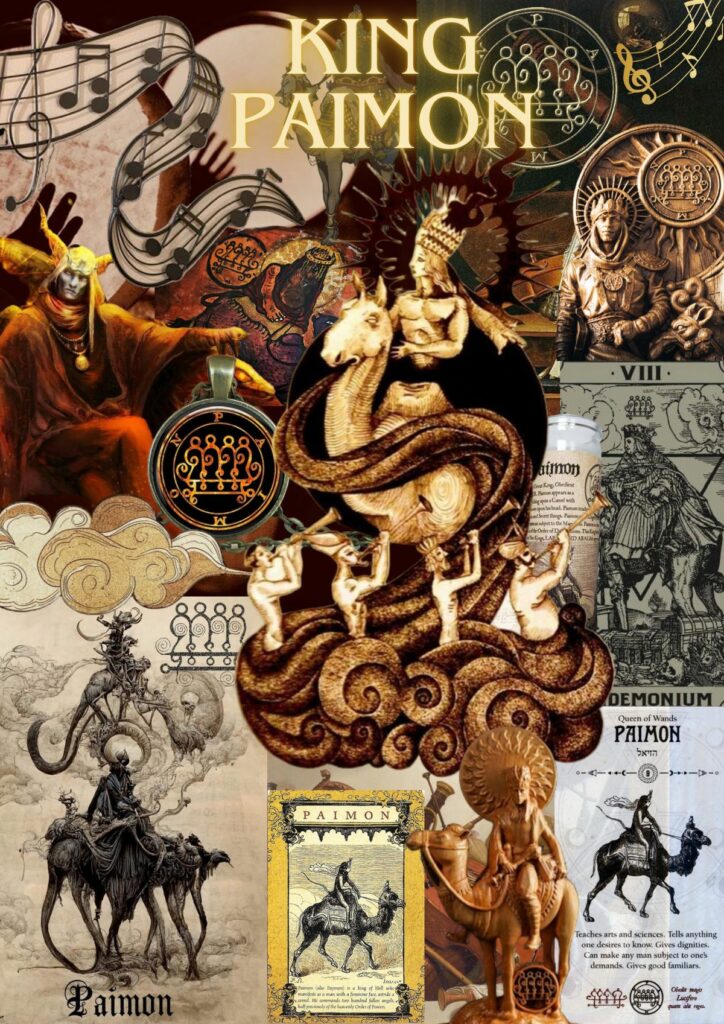
Undoubtedly, throughout the development of human society, one of the most active sources of drain of psychic energy has been the “King of Glamour” — Paimon — and his retinue. Despite the “secondary” nature of these destructors, they draw so much attention to themselves and prove to be such tenacious traps that the various forms of public displays they implant become among the foundational elements of social structures and processes. Indeed, societies are built on masks, pretense, and that very “glamour,” the ability to hide one’s nature behind bright facades.
And among the forms of this pretense, a considerable role belongs to various “demons of eloquence,” destructors of “verbal posturing,” from the elder Zagan (King of actors), Naberius (from Belial’s retinue), and Ipos, Valak, and Haborym from Paimon’s retinue.

At the same time, the influence of the latter is especially dangerous because of its subtlety and low visibility, yet it is no less effective in hindering the development of consciousness.
Just as Focalor often enslaves “spiritual teachers,” Haborym is a widespread master of the psyches of “qualified specialists,” especially in the humanities. It is by his efforts that the sphere of culture and spiritual life narrows, becoming a kind of exclusive domain of a chosen few, who monopolize the “only correct” understanding of history, cultural studies, and, more broadly, the realm of “subtle thinking and emotions.”

This destructor enters the mind under the mask of clarity, under the guise of “correct understanding,” through the urge to correct, instruct, explain — and by this it traps the psyche in hollow information, in experience that does not become true Authority.
Haborym replaces the key concept of the Path with the idea of a mere route, stripping it of depth, ambiguity, and paradox. At the same time, he does not deceive and does not “lead astray”; he simply discourages listening and looking deeper.

Haborym’s matrix is often activated in the mind when one’s understanding of oneself and the world begins to evoke not compassion or respect for otherness, but contempt and irritation. Then, where a person has already walked part of the Way, already achieved and overcome something, instead of sharing cautiously, he begins to judge. From that moment Haborym becomes his companion and adviser: he suggests whom to correct, whom to be angry with, in whose mistakes to urgently recognize “delusion.” He makes the mind deaf to the living, insensitive to the other, unwilling to look deeper and wider. It begins to seem to him that he already “understands everything,” including the movements of another soul, and because of this he fixates on only one layer of reality, on that stratum which is indeed understandable and known to him, but which nevertheless does not exhaust the whole complexity of the world and the psyche. He takes his successful, yet limited knowledge — a formed system that truly works well in one aspect or direction — and with its help judges everything else. Thus are born those who “understood everything” — and therefore no longer search or strive to understand more deeply. Haborym correctly points out the mistakes of others, but not to help, rather to subordinate them or simply to demonstrate his superiority. In the heart of such a person burns the fire of exclusive rightness, while subtly poisoning everything he touches.

The demon often takes hold of intellectuals, “gifted children,” those accustomed to being right, valued, the best. It strikes, first of all, those who genuinely understood much. In them it develops a mania of omniscience, intolerance toward the other, and a seething rage at “fools” or “profane people.” Haborym especially willingly settles in institutes — universities, spiritual schools, editorial offices — where he erects cults of “scientificness” or “orthodoxy” and produces a caste of “owners of truth,” guarding it from mere mortals.
Haborym’s influence convinces his bearer that it is precisely he who “knows better than everyone,” thereby making him deaf, closed, and blinded by his own light. He infiltrates the mind under the guise of “responsibility for others,” and turns this feeling into coercive instruction. That is why Haborym is often called the “demon of self-righteousness,” and is even sometimes confused with Raum — the demon of swindlers and manipulators. This matrix is active in the minds of those who consider their system of views universal, who create rigid scientific or spiritual doctrines and slap labels on dissent: “heretic,” “charlatan,” “half-educated.” He is not interested in life if it cannot be described; freedom irritates him when it is not structured. He despises doubt, he hates uncertainty, he denies space for error. Even a close person cannot argue with him without receiving a lengthy lecture in reply.

It is clear that Haborym infiltrates the mind gradually, and usually at the initial stages he is well disguised. When a person truly achieves success in some field, he begins to take pleasure in being able to explain to others, in seeing his experience bring results. Gradually he becomes an “expert,” a source of advice and instruction, often receiving gratitude. He is respected, he is listened to. And so in him grows an attachment to the role of the Knower. In any new situation he seeks confirmation of his model of the world. When it works, it reinforces the feeling of being right; when it does not, the guilty become “others,” “not ready,” “stupid.” Disagreement evokes in him irritation, an inner tremor, even rage. He increasingly wants to object, to prove, to expose.
Thus the mind becomes selectively deaf: it hears only what confirms what is already known; it cannot tolerate uncertainty, paradox, or another’s experience. In the one who disagrees, it hears not a person, but only errors in their words. Thus empathy gradually fades and gives way to structural analysis.

At this stage Haborym “seals the ears”: his bearer no longer hears others; he only speaks himself. Now for him it is already impossible not to be right: any mistake is perceived as a personal collapse, and any recognition of another’s rightness causes shame and anxiety.
Thus is born a way of thinking incapable of perception, spontaneity, miracle, or otherness — one that does not live, but only endlessly repeats what it already knows, applying the same templates to phenomena that are completely incommensurable with them.
But the essence of any demon is that it destroys, above all, the bearer himself. Although Haborym’s energy is fiery, it is a fire with no outlet, a flame that only scorches the psyche. He drains energy, undermines the nervous system, causes insomnia, anger, a feeling of internal constriction, and bouts of irritability. His bearer does not like to be alone, but he becomes difficult to be around in “ordinary” situations. He demands communication — but only with those who agree. He remains an excellent lecturer, but becomes an oppressive interlocutor. Therefore the one possessed by him becomes more and more isolated, lonely, poisoned from within.

He dazzles at the lectern, in the classroom, in a webinar. His speech is coherent, vivid, saturated. He knows how to place emphasis, commands irony, amazes with memory and logic. People listen — with respect, with interest, sometimes with envy. One feels strength in him. One feels knowledge. One wants to listen to him, but does not want to be near. Such people are often valued in the formal institutions, in education, in culture. They carry knowledge, but at the same time they lack warmth of soul. And therefore such people are often internally lonely; in their mind more and more cold accumulates, despite all the fiery nature of their knowledge and speech, because their (undoubted) rightness does not replace touch, participation, real presence.
Haborym’s “closed ears” are deafness not only to the other: they are, first and foremost, deafness to what comes from within the mind itself when it does not correspond to what is already known. It is a refusal to hear oneself if the voice of intuition does not fit into the scheme of the known, the verified, and the approved. An important sign of the presence of this destructor in the mind is the inability to listen without evaluating, to strive simply to understand; for Haborym there are no “different opinions,” only correct and erroneous ones.

It is not difficult to see that to oppose Haborym is to recognize the complexity and multi-layeredness of life, in the awareness that even truth can be murderous if presented without love, in the mind that being right does not yet mean being alive. And being alive means, first of all, being able to hear and to listen. For this it is important to understand that no knowledge alone makes one perfect, others have the right to be mistaken, and that holding a different opinion does not mean being stupid or wretched. A true victory is not the affirmation of one’s rightness, but the elimination of the very painful need to be right, a departure from the desire to impose, allowing the other to be mistaken, and oneself — not to know.

Thank you for the lesson.
Thank you, dear En.
Thank you, Master, as always – on time.
Hello Master! What do you think about the Mandela effect, which is currently being discussed by everyone?
Hello.
It’s not very clear how this relates to the topic of the article, but I will answer: in my opinion, most of these cases are just “memory glitches,” false memories that can be formed quite easily under the influence of both social and psychological factors. However, a smaller part is probably associated with the movement of consciousness between timelines – for example, as a result of the so-called ‘shift of consciousness,’ which can also have completely different causes and drivers:
https://enmerkar.com/en/observations/the-shift-of-the-mind
Hello, Enmerkar. I would like to understand how ‘contagious’ the presence of Haborym is in a creative collective. Can one subtly fall under its influence if someone from the community has long been enslaved and is almost completely destroyed but still has enough strength to exhibit this distractor?
Hello.
Strictly speaking, no demon or distractor can penetrate consciousness without its permission. However, the art of manipulation lies in making a person agree to something they actually do not want. So if we are as honest as possible with ourselves – it will protect against invasions, but if honesty ‘limps,’ then, of course, you may ‘not notice’ how unfriendly forces start to control you.
Thank you for your answer! When consciousness ‘creates worlds,’ it is hard to be honest and serious; the state of play is enticing. Well, I will try not to turn off the inner observer for even a minute.. For that environment can sometimes be very nourishing, even though you observe how snobbery and pseudo-elitariness draw people into a vortex, from which almost no one during my years in this community has emerged alive and healthy.