
Valac and the “Witch Hunt”

The reactionary and destructive nature of many fighters for “traditional values” is well known; yet, paradoxically, no less often so-called “progressive values” also turn out to be a cover for predatory behavior and aggression. Moreover, on closer inspection it usually turns out that the more exalted and pompous the slogans a person proclaims, the darker and more destructive the motives lying beneath them.
The destractor of hiding behind high-minded words about values, freedoms, “resisting evil,” and so on — of realizing one’s own propensity for violence, asserting oneself at others’ expense, or revenge — is personified in the figure of the Governor of inquisitors — Valac. His image — an angelic infant astride a dragon — expresses the paradoxical essence of this destructive matrix: outward innocence and respectability but inward cruelty and aggression.
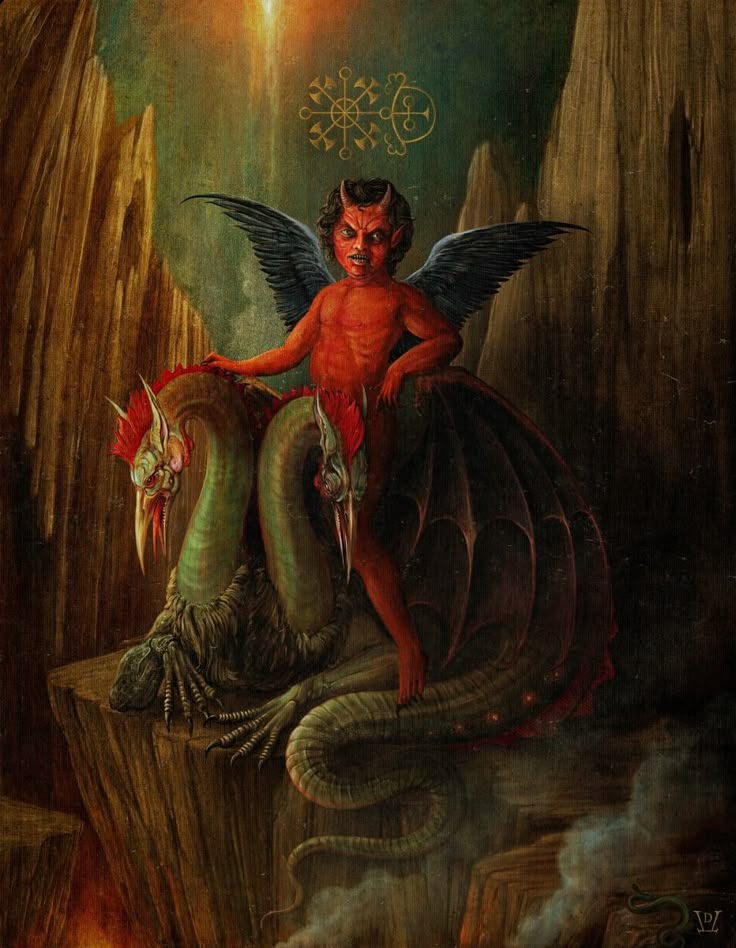
The demon’s motto, inscribed in his sigil — “טסתי תטפל”, “deal with flights” — means the matrix’s drive to “clip the wings” of pure aspirations and turn flights into falls.
The matrix of Valac is activated when the mind discovers within itself impulses that seem unacceptable — desires, aspirations, emotions — and instead of acknowledging and integrating them, it begins to identify with the opposite. Thus it “transfers” its shadow outward, projecting it onto other people. This creates a psychological split: “I am pure, exalted, and righteous; evil is outside.” Such a structure of mind easily supports cruel actions: after all, the fight is not against the innocent, but against “sin,” “vice,” “deviation.” An immature mind fears its anger, envy, vengefulness, and, without trying to transform these impulses, wraps them in grand narratives: the desire to destroy the enemy becomes a “struggle for truth,” aggression is masked as “sacred indignation,” intolerance as “refusal to tolerate evil,” and lust for power as “responsibility for order.” Thus begins a false transcendence of evil — instead of overcoming it, it is aestheticized. At the same time, the problem is not that the mind experiences anger or a desire for revenge (these are universal human states), but that it stops seeing them as something that requires work, and begins to see in them a virtue.
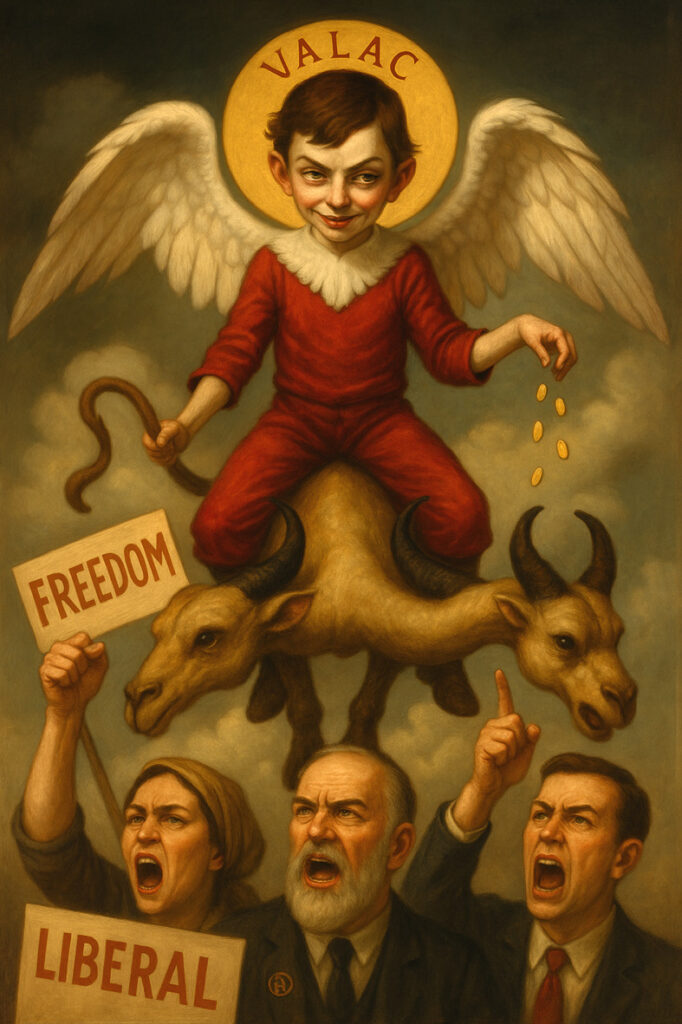
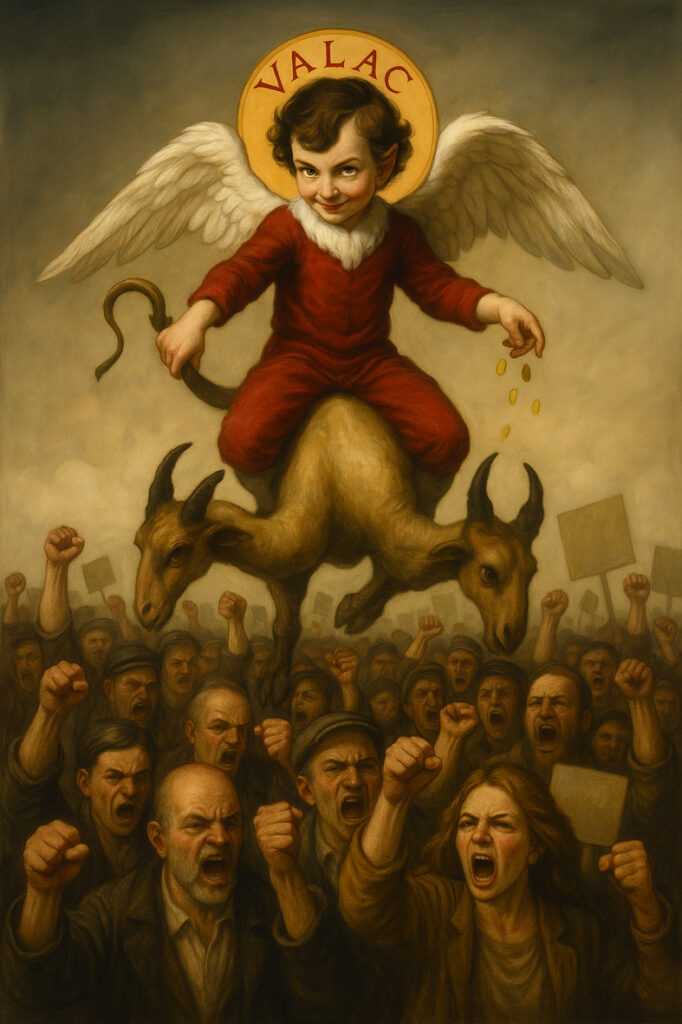
The Inquisition, witch hunts, political purges are vivid historical forms of Valac’s mass activity. Today’s zealous moralizers, ideological informers, pseudo-defenders of “values,” and aggressive “cleansers from the shackles of the past,” suppressing everything that goes beyond the limits of their narrow worldview, are typical victims of the demonic Governor. At the same time, the more a person’s darker impulses are repressed in the mind, the more furiously it condemns them in others.
It is not hard to understand that Valac’s invasion usually begins with a sincere desire to be good: a person genuinely wants to be “on the side of good,” to be “right,” but this very desire becomes the first crack through which the poison of the demonic matrix penetrates. In this striving, the person gradually begins to divide the world into black and white, into “one’s own” and “enemies,” not realizing that in this way they are already surrendering their freedom of thought and empathy — to a slogan or rigid formula. Instead of mindful self-dialogue, the person clings to a ready-made dogma: “I am right because I serve a great idea.” Thus an external opponent is created, onto whom internal fears are projected.
This substitution is so deep that aggression, fear, and hatred in the mind are completely concealed by a sense of righteous mission. Thus Valac turns the very structure of good into a weapon of suppression. Just as a religious fanatic is convinced of the holiness of killing “infidels,” the bearer of Valac’s matrix is sincerely sure that he is “defending freedom,” in reality depriving others of the right to self-expression; he “fights evil,” suppressing everything that goes beyond the framework of his worldview; he “stands guard over justice” — demanding punishment for those who are different, alien, “unclean.”
In such a state, a person loses contact with the real content of their words: they say “love,” but forget how to love; say “freedom,” but demand obedience; repeat “truth,” but hide obvious facts from themselves. Under the cover of lofty slogans, Valac fosters hatred toward dissenters (political, philosophical, religious), rejection of foreign cultures and identities; he cultivates in the mind irreconcilability, the inability to see others as human beings, not enemies. And the more furious this struggle, the fewer doubts remain about one’s own “rightness.”
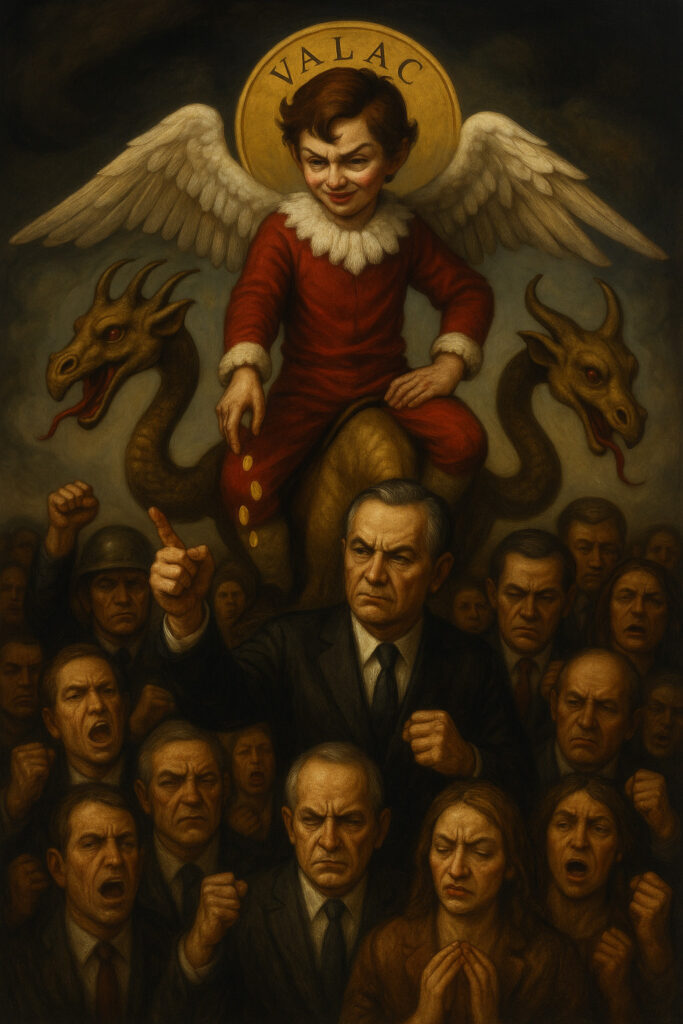
Thus begins the path to institutionalized sanctimoniousness, from inner fear to state propaganda. The idea of freedom in Valac’s matrix is reduced to the formula: “Only the one who thinks, feels, and acts correctly is free” (that is, as dictated by the “moral authority”). Any otherness — in thoughts, appearance, speech — is already a sin. Any disagreement with the dogma is considered betrayal. And the most terrifying thing is not even the violence itself, but its justification as an expression of the highest virtue. And when sanctimoniousness becomes the norm, resistance to it appears to be a sin.
In many “sick” societies, it is precisely Valac’s activity that provides social cover for repression, because the demon governs not only individual personalities but also the crowd, the collective mind, where the proclamation of invented values becomes a form of self-assertion. At the same time, someone who used to feel shame about aggression, under Valac’s influence begins to take pride in it: now it is “holy zeal,” a war for the sake of good. Under Valac’s power, society turns into a totalitarian system where nothing is questioned, where truth is silenced and lies are exalted as an ideal.

Thus, the essence of Valac’s matrix consists in refusing to acknowledge within oneself what seems “unworthy,” and replacing shadow work with the ritual of accusing others. It manifests in an excessive desire to control and eradicate all dissenting views on physical, mental, and ideological levels. Thus, fighting for “freedom” or against “evil,” a person seized by Valac’s influence becomes an instrument of repression. And the first manifestation of such pathology becomes the suppression of individuality, because in reality Valac’s matrix is always hostile to freedom, especially inner freedom.
It is clear that it is especially difficult to get out of such a matrix built on lofty slogans, because a person “entrenched” in it is afraid that they have invested too much in their righteousness, and therefore simply cannot admit a mistake. They defend themselves with moralizing as a shield, like a turtle with its shell. And most importantly, they are afraid to look into their shadow, because then they would have to admit that all this time they were not fighting evil, but simply pretending to be righteous.

The true confrontation with Valac is inner honesty. It requires, first of all, acknowledging and examining one’s shadow, and then awareness that another person’s freedom is just as sacred as one’s own. It is very important to admit that freedom does not require unanimity, and that good is not in slogans but in attentiveness to others. Such an ability to “see the log in one’s own eye,” the willingness to see within oneself what repels, and not hide it behind a facade of “holiness,” is the main antidote to sanctimoniousness. Only then does real work begin: not masking evil, not dressing the demon in angel’s garments, but meeting it face to face in order to deprive it of power — first within oneself, and then in the world.

Hello. And what if the voice that persuades you of the necessity to fight evil coincides with the voice of your conscience – how to understand if your shadow has replaced the true conscience, imitating its appearance and intonation?
Indeed, the problem lies in the fact that Valak, like all demons, never lies ‘outright’. He merely shifts the focus of application of truth: takes genuine values – freedom, purity, justice – and directs them not inward within the consciousness, but outward, turning them from vectors of self-purification into weapons for accusation and suppression of others. And it is here that the distractor manifests – while the conscience is always directed inward, the demonic influence directs attention outward. True conscience is always accompanied by deep inner work, its nature lies in the recognition: ‘I am the one responsible for what is inside me.’ Conscience always demands actions, inner restructuring, overcoming weaknesses, actual change of self. At the same time, the voice of demons is always a voice of anger and contempt, supposedly based on ‘moral purity’. It is a voice of condemning, rather than purifying, it never looks inward, and thus does not feel itself as the source of problems and distortions. This is action without effort, a moral declaration instead of transformation. So if we are confident in our righteousness and do not feel pain for someone else’s wrongness – we are not in the light, we are in the will of Valak.
If we doubt who speaks within us – conscience or Valak – we should ask ourselves two questions: 1) Whose sins do you think about more – your own or others’? 2) Is there room for compassion in your fight, or only anger and contempt?
Magical work always requires contact with the Shadow – not its expulsion, not suppression, but processing and assimilation. Thus, it is important to allow oneself to see all that we want to destroy outside in ourselves. And to see not in the form of an enemy image, but as potential, as embryo, and often – as inner trauma. Only he who can say: ‘I understand how I can become that which I hate’ – is truly free from the influence of Valak.
The path of liberation is not in denying or ‘distancing’ oneself from evil, but in recognizing it within oneself and transforming it. Without this, every fighter for the light becomes just another instrument of darkness.
And the article is very interesting, and the answer to the question about conscience is very simple and very profound. Thank you, dear En.