
Authoritarian Identification with Abigor

One of the demons that gains special power in periods of war, cataclysms, and social upheavals is the “Duke of Loyal Subjecthood” — Abigor or Eligos — the “standard-bearer” of the King of Jealousy. His power manifests when, under the pressure of stress or social factors, a person confuses personal choice with imposed behavior, in which the inner voice is replaced by external loyalty. In calm periods, this disruptor appears as a private tendency to hide behind authority figures, to refer to “the right people” and “the correct rules.” In eras of totalitarian and authoritarian regimes, military tensions, economic breakdowns, and general social anxiety, it becomes widespread. The reason is quite obvious: the more toxic the times, the stronger the desire to find support that removes responsibility and gives a sense of protection. Abigor offers exactly such support, and therefore appears convincing or even attractive. He manifests as a “new order,” a feeling of stability in a world that is “coming apart at the seams.”
This disruptor arises as a distortion of the natural mind’s impulse to keep the memory of the source of its strength — the Genius Hariel. Hariel is a network connecting to sources and anchors of power — people, places, books, events — through which the mind receives inspiration and resources for growth. Such memory is always accompanied by gratitude and is marked by precision, by an understanding of where the impulses were received, what exactly was gained, and it does not present what was received as solely one’s own achievement or “merits.” Accordingly, continuity in Hariel’s matrix remains alive: the student adopts the form, then tries it out, filters it through conscience, and then adds their own step. Thus the sources strengthen the mind and make it more responsible.
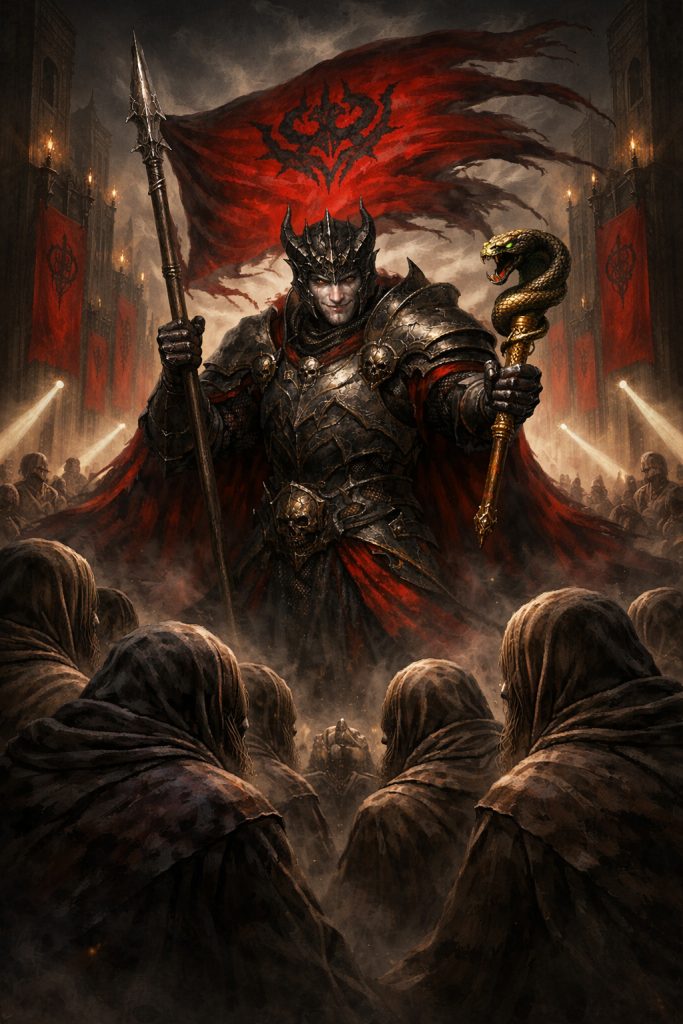
Abigor, by contrast, appears when this memory bends under the pressure of fear and anxiety. Under his influence, gratitude turns into dependence, respect becomes self-abasement, and continuity degenerates into copying. A person begins to treat loyalty as a survival strategy, and therefore delegates to authority more than it has the right to receive: the right to decide what to consider true, permissible, “correct.” Put differently, under Abigor’s pressure there arises a delegation of conscience. Thus the matrix of loyal subjecthood becomes an inner support, turns into an inner power, and then demands protection through aggression toward “outsiders.”
The image of Abigor as a knight-standard-bearer describes with great accuracy his main predatory tactic: he gives his victim a sense of dignity where, inside, a feeling of humiliation has already developed. And to compensate for this feeling, Abigor offers a urge to humiliate others, to join the repressive apparatus of power, to become significant, to become strong. Then outwardly his victim may look convinced, strong, noble; however, inside they often experience a vague sense of inferiority, shame, uselessness, lack of success, and therefore seek a form that will raise them above this pain. Abigor offers the form of “knightly loyalty” as a ready-made model of self-worth: if I serve the strong and the right, then I myself am strong and right.
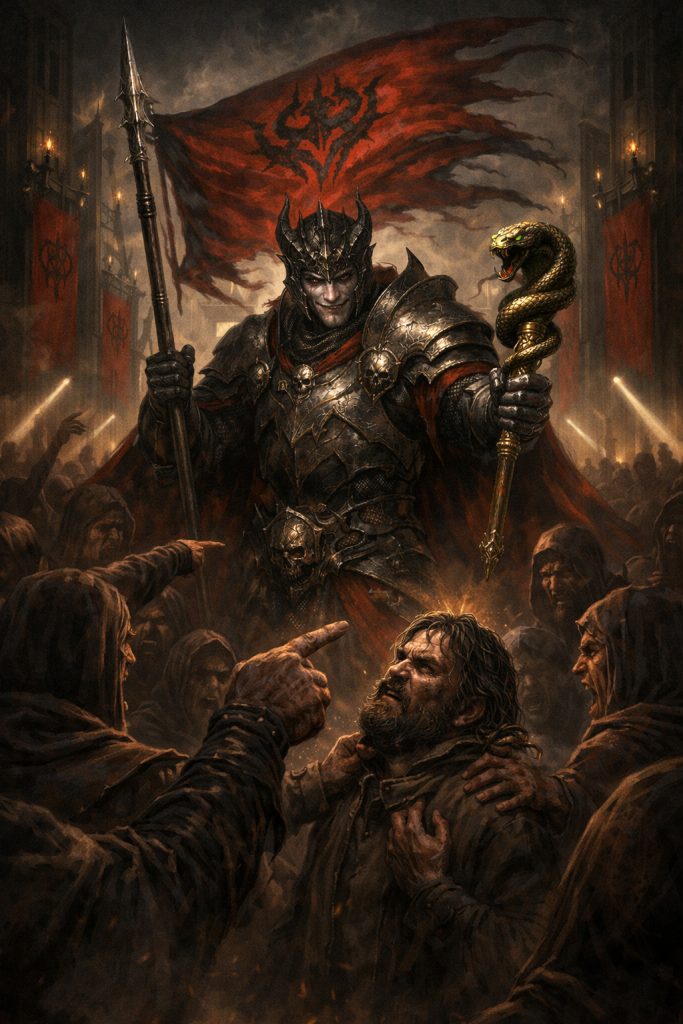
The banner in the knight’s hands is a symbol of someone else’s authority, carried outward. For someone possessed by Abigor, this means that their own name has become too weak to rely on. Therefore they raise someone else’s name, and carry it as an answer to inner emptiness. Thus a specific psychology of the “standard-bearer” develops: a person feels themselves to be the embodiment of power in everyday life, its voice in a group, its righteousness in conversation, its punishing hand online or in institutions of suppression, its “consciousness” at work. They begin to live as though every clash with a different opinion is an attack on the banner that they are obliged to defend. And since it is a matter of a symbol, any dispute ceases to be merely a discussion of facts and turns into a battle for honor.
The standard-bearer rarely realizes that they are defending, first of all, their own support. It seems to them that they are defending order. In reality, they are guarding only the mechanism that keeps their frayed psyche from inner collapse. That is why they react so sharply to doubt and irony; they easily become a willing spreader of fear: they begin to monitor, report, “warn,” stigmatize, call to “rally together.” At the same time, they may sincerely be convinced that they are fulfilling a high duty, because Abigor replaces their inner moral compass with an external reference point. And the less inner clarity a person has, the more they cling to the “banner” as the only support.
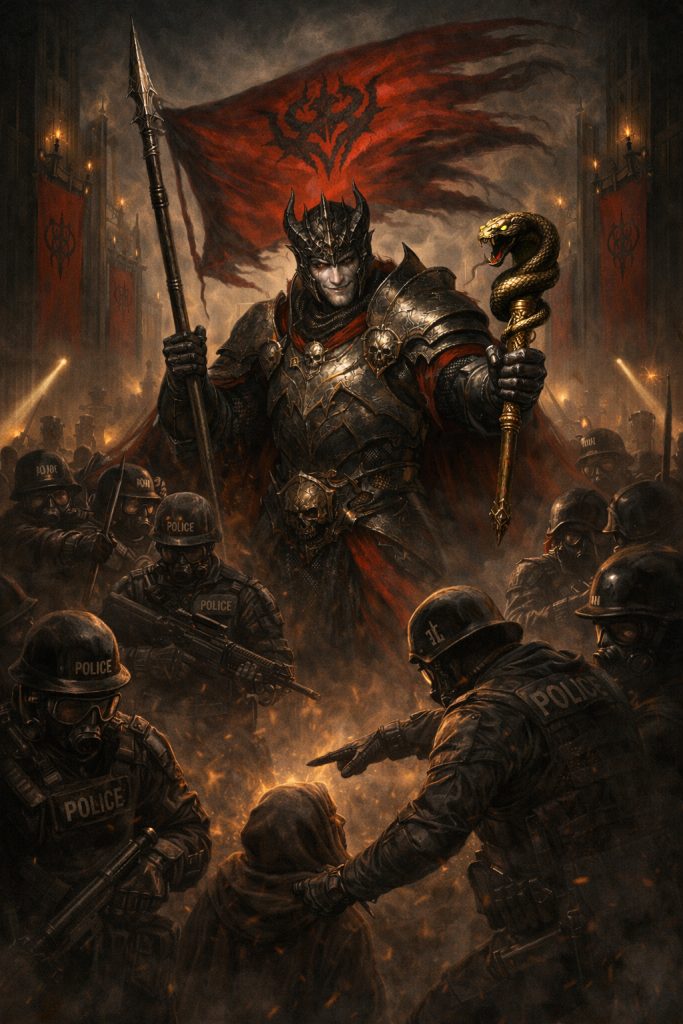
The spear in the Duke’s hand supports and amplifies this effect. It turns readiness to attack into a military expression of loyalty. The standard-bearer strives to see enemies everywhere, because without an enemy the raised banner loses its sacred meaning. They urgently need an outsider in order to feel themselves — an insider. They need danger to justify their own extreme rigidity. They need struggle to drown out their own longing. In such a state, aggression is perceived as a moral task, and the humiliation of another as confirmation of one’s own belonging to power. The system gets a free soldier, and Abigor gets food: the energy of service, the thrill of righteousness, suppressed guilt, and the sweetness of permitted and justified cruelty.
The prerequisites for his entrenchment lie in natural mechanisms of emotional defense. When environmental pressure becomes excessive and the future seems shaky, the psyche saves strength and strives to reduce anxiety by any available means. And against this background there develops a pull toward clear answers, toward simple explanations, toward a figure who “knows,” toward a group that “understands,” toward a symbol that “won’t betray.” The need for belonging is triggered, then the need to justify one’s own weakness, then the desire to consider this weakness a virtue. A person begins to confuse safety with truth. Accordingly, they seek not meaning but a shield; not critical verification of reality, but confirmation of simple and solid views; not maturity, but a sense of protection and patronage. In such a state, vulnerability becomes a trigger of many demonic patterns, among which Abigor manifests as a promise of relief as a result of identification with the “party of power,” with those who embody authority or might.
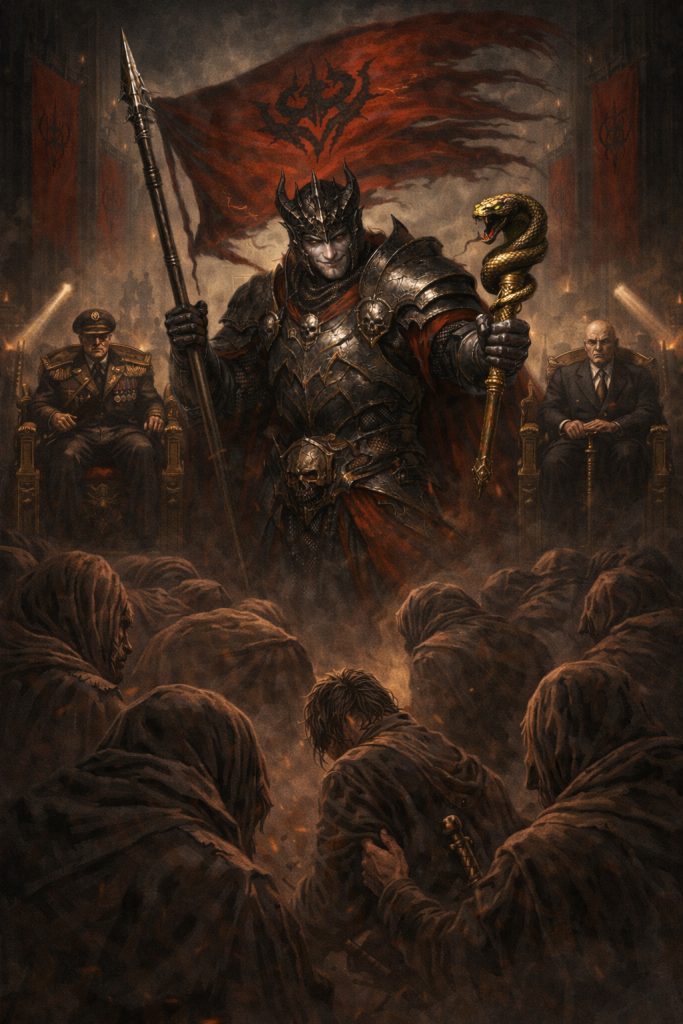
Then the gradual activation of the matrix of loyal subjecthood begins. At first it manifests in simple respect for those who “preserve” the system, willingness to “endure for the common cause,” tolerance of rudeness for the sake of “higher goals.” Then a habit develops of justifying what previously seemed unacceptable or dubious. The mind is trained to restrain its inner protest, tries not to notice discomfort so that its supports will not collapse. In other words, it begins to cultivate loyalty in itself as a way of escape from anxiety, as a source of calm. That is why, when the Duke’s matrix of obedience is activated, there is almost always a readily recognizable vocabulary: “it has to be this way,” “all complaints — after victory,” “there is no other way,” “not the time to discuss,” “this is not the time for questions.” These formulations reduce tension in an already unbalanced mind, because together with them the need to think and to choose responsibly disappears.
At the next stage, power ceases to be perceived as an external structure and becomes part of self-concept. The person no longer simply supports decisions; they begin to feel them as their own. They speak about them with personal resentment and pride, as though it were about their own merits and their own honor. This is how identity merges with the power hierarchy. In such a merging there is an obvious psychological benefit, which manifests as a feeling of “being in the right place,” as well as blurred responsibility. Accordingly, anyone who calls power into question begins to be perceived as a threat to that very personal integrity. This is how loyal subjecthood is formed as a way of self-preservation.

Then the main sign of Abigor becomes obvious — delegation of conscience: the mind retains a sense of freedom, because outwardly the person seems not to be doing anything against their will. They are simply “in agreement,” simply “understanding,” simply “supporting.” At the same time, responsibility is carried outside: decisions are made by “them,” which means guilt and doubt also belong to “them.” Inside, however, relief remains, and together with relief comes readiness to close one’s eyes. And the harder the decisions, the stronger the need to consider them necessary; the more obvious the crime, the sharper the desire to call it a forced measure. This is the point at which the activated matrix becomes possession: power is enthroned inside the psyche as the only source of permissible and justified meanings.
Possession by Abigor usually outwardly resembles social correctness. A person sets about defending decisions that maim and destroy with the same calmness and inner sense of righteousness with which one defends order in one’s own home. They explain punishments as care, repression as prevention, cruelty as responsibility. They perceive compassion as weakness, doubt as betrayal, pluralism as decay.
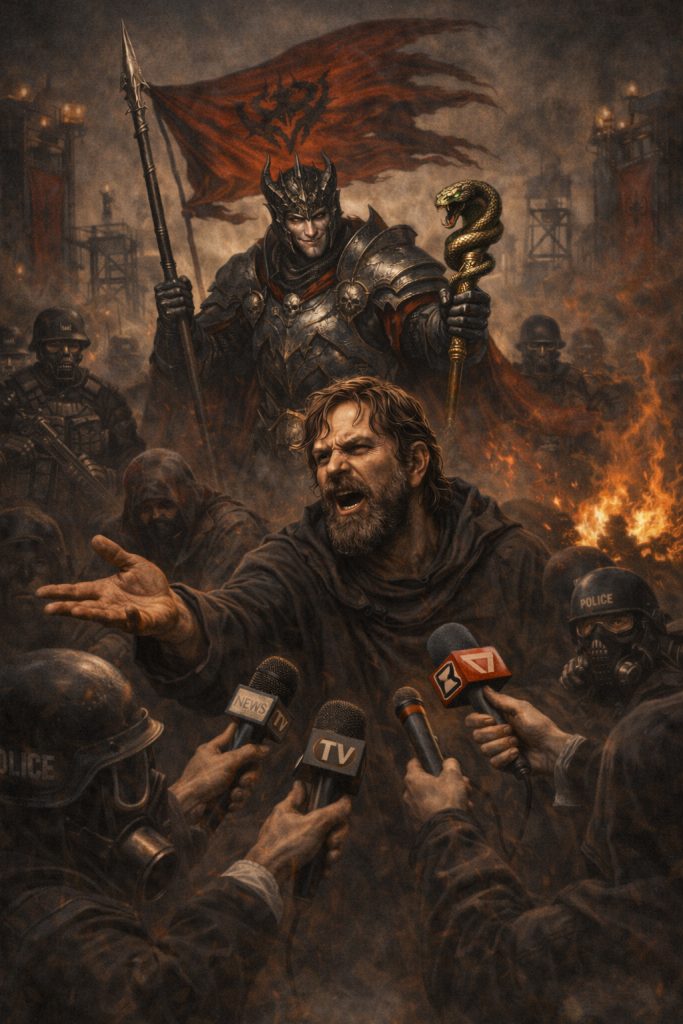
After this, aggression toward “outsiders” inevitably grows. Inner merging with the vertical turns any disagreement into a personal insult, which means the response becomes emotionally justified. The dissenter is declared a source of chaos, a threat to security, a destroyer of the common, valuable, and correct. Accordingly, in relation to them, what seemed inadmissible in relation to “insiders” becomes permissible. There appears a sadistic enjoyment of punishment, pleasure from humiliation, triumph from the fact that someone has been “put in their place.” Thus loyal subjecthood turns into a hunt for dissent. Abigor’s victim begins to defend the system even when it harms them, because admitting that pain would require admitting a mistake, and admitting a mistake would mean losing the support. Abigor holds the psyche precisely on this hook: it is better to be right and protected than alive and doubting.
Resistance to Abigor can begin only with restoring the mind’s right to choose, even if only in the smallest forms. It is important to learn to take responsibility for one’s actions, one’s decisions, one’s opinions, even when the decision comes down to a simple refusal to repeat someone else’s slogans. Next, it is necessary to cultivate tolerance for diversity. Authoritarian identification is always fed by the need to close the matter once and for all. Accordingly, the remedy becomes the ability to keep ambiguous questions open, to live through anxieties without an immediate need to be rescued by ready-made schemes. The discipline of discernment helps greatly: the ability to determine when the source of inner urges is fear, when it is the desire to belong or the habit of imitation, and when it is real conscience. Such discernment restores an inner authority to the psyche, which does not coincide with the power hierarchy.
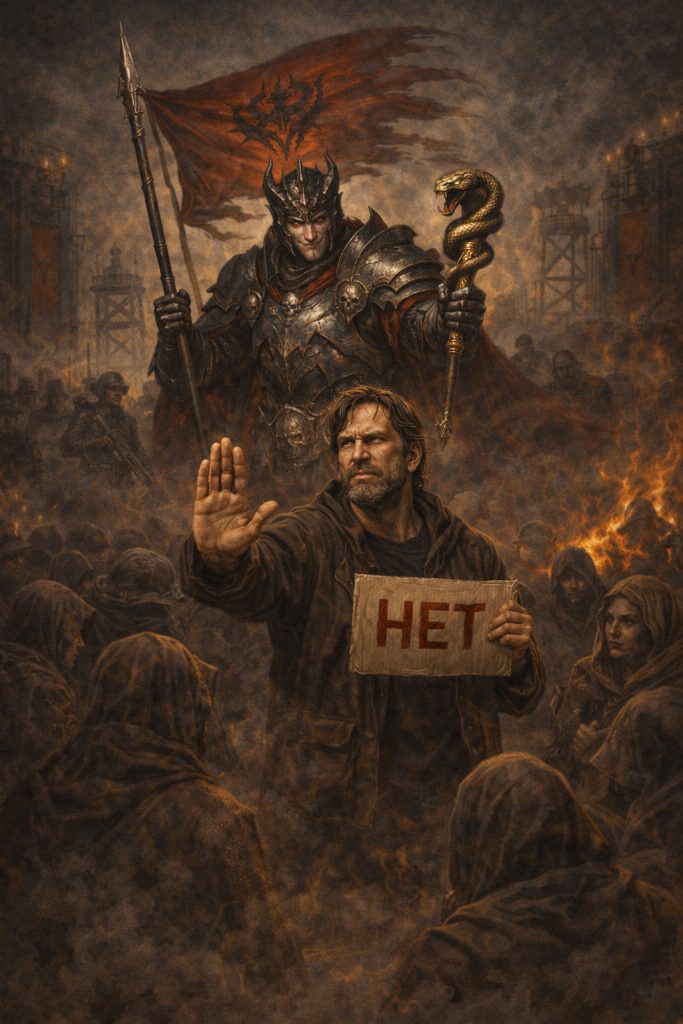
Then the knightly energy is purified: dignity, discipline, and loyalty remain, but the need to strike “outsiders” in order to confirm one’s own righteousness disappears. And then Abigor loses power, because his knight ceases to need someone else’s banner as a prop for their own Me.
For this, the transition from following to listening is important. Listening includes gratitude to sources and respect for masters, but at the same time leaves room for one’s own analysis and risk-taking. It does not require renouncing one’s roots, but it does require the maturity of the practitioner. A person can learn, serve, be faithful to the work and the shared purpose, while retaining the ability to say “no” where discipline turns into violence. Abigor demands veneration and does not tolerate gratitude, because gratitude always has much in common with freedom. Therefore, every time a person regains the freedom to doubt and the freedom to have compassion, the demon loses its sustenance. And then real loyalty becomes possible: loyalty to origins, loyalty to truth, loyalty to one’s own soul, which no longer hides in the shadow of someone else’s power.

Leave a Reply