The Principle of Desire

The force of universal gravitation, directed toward restoring the world to its primordial unity, manifests as the Principle of Desire. Let us summarize what we know about this principle.
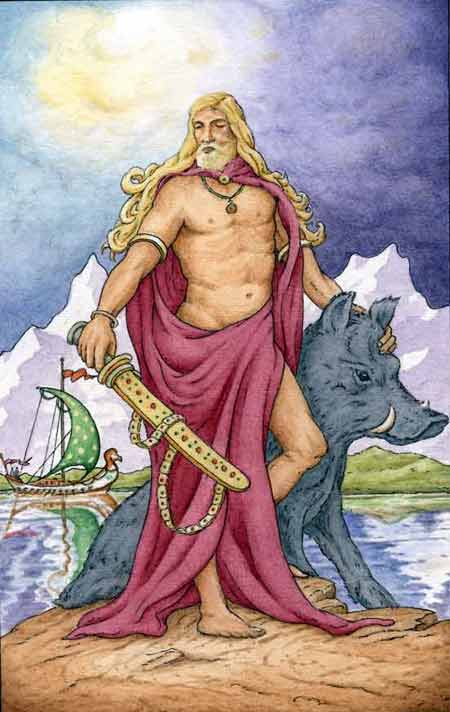
We have said that in the Magical myth desire denotes subject-object attraction, and the sum of these attractions — that is, effectively, the binary interaction of potential and actual being — constitutes the principle of Desire, personified in several mythological figures — Dionysus (and Eros, among the Greeks), Lel (among the Slavs), Aengus (among the Celts), Freyr (among the Scandinavians).
The first thing that strikes one is that the Principle of Desire has an androgynous nature. It contains signs of both activity and passivity, since, on the one hand, it is directed toward union (passivity, the feminine), but on the other it is inseparably bound to differentiation (because it implies subject-object relations — activity, the masculine).
Moreover, governed by this principle is the very creation of the world, since it is the result of the Absolute’s Desire for self-knowledge. This means that Desire constitutes the foundation of being, not only actual but also virtual existence.
Another important point is that Desire is precisely what appears in descriptions of the physical world as a force of attraction. From this perspective, to say “the Earth is attracted to the Sun” is the same as saying “the Sun wants the Earth.”
Understanding this last fact is very important for a correct description of the forces’ nature the magus encounters. Since like resonates with like, by cultivating Desire the magus acquires the ability to govern this force of attraction. It is worth noting in passing that to “cultivate” does not simply mean to “increase,” for if Desire grows uncontrollably it becomes a black hole, attracting far more than that which is kindred to the magus.
We said that the realization of desire leads to a change in the character of the system itself. However, we understand that the Principle of Desire as a whole is unordered, and the developmental change of a system effected by this principle is not necessarily a progressive change (that is, it is not necessarily accompanied by increased awareness). In other words, the system can be drawn toward elements that destroy it — that is, it can degenerate.
Such degeneration most often arises from a profound disruption of the system itself, creating continuation hopeless and the need for radical restructuring — and which may require destroying it first. In this case destruction itself is the way to power. An important manifestation of such an effect of Desire is the magus’s social destruction — his social death.
We also know that the realization of Desire must occur in an ordered way, and take the form of willful action. Disordered desire leads to chaos, to the disruption of force gradients, to erasing differences in potential — and thus to the impossibility of action.
Thus, understanding that it is through Desire that the world is created, the magus also sees that the world arises thanks to Desire guided by Will and ordered by Intelligence. None of these principles is capable of productivity on its own.
Well, alright, and any desire is fulfilled… What to do after a while??? Shoot?) I’m just fantasizing, of course.
Let me clarify. Not just a desire, but a desire for pleasure. Since pleasure and death lie at the basis of the origin of life. According to Z. Freud.
The topic is undoubtedly foundational and therefore contentious)) It is very nice to encounter thoughts on this matter. I can’t help but comment from my perspective.
Desire is associated with Masculine energy, not with Androgynous energy. Because Desire is indeed the basis of all Being, but of manifested Being. All manifested existence is Desire, which is the Word, the element of Earth, which is Karma and Form. Everything that exists does so thanks to this Masculine principle. Desire is the Logos, the Shivalingam, which gives and preserves the manifested existence of all that is, and this is the Law.
As for Androgynous energy, it is connected with the synthesizing element of Fire. This energy is related to Ecstasy and the Bliss of merging, rather than pure masculine Desire as such.
🙂 “Masculine desire” is rooted in the desire for union. And what is Shiva without Uma or Logos without Sophia?
“The desire for union” is already one of the branches of Desire, growing from the same trunk known as Being. Because, in essence, Being and Desire are one and the same. Being exists by itself without any reasons or consequences, without any meanings, purposes, or expectations. Because this masculine principle of the universe is self-supporting and inexhaustible.
At the same time, it is precisely on the back of this… immortal chthonic monster, floating in the world ocean, that the entire world with all its phenomena lies (like on a stage), which it feeds with its inexhaustible “I want”.
In other words, it is precisely from this pure Absolute Desire that all other desires flow – the desire for union, the desire for separation, the desire for freedom from desire, the desire for development, struggle, death, play, and so on.
Thus, Desire is a peculiar alchemical primary element that connects with other elements but by itself never ends or is lost.
As for the infinite and inexhaustible variety of our Being and all its desires, here we must express heartfelt gratitude to the Feminine principle of the universe, characterized by the word Mystery.
However, I’m in a hurry! After all, we recently had a men’s celebration, and March 8 is still ahead! 😉
The question, as usual, concerns terminology. You do not differentiate between the impulse of desire and the element of desire, I am trying to consider them separately. Desire as an impulse, creative activity – of course, is entirely masculine. This is the Yod Tetragrammaton, the Primary Fire. However, Desire as the Primordial Element, as the very act of creativity – is the result of the union of Yod and He, Father and Mother – the force of creating the Androgyne. The impulse of desire, just like pure Passivity – are only Principles that gain relevance specifically in the creation of androgynes. If we draw an alchemical analogy – Sulfur and Mercury find their embodiment, realization, actualization in Salt. It is precisely this emergence that this post is about. It is not about the Primary Principles, which we have already discussed multiple times in other articles, but about the dynamic process.
As for Eros (also known as the Winged Serpent, or Kundalini), the following can be said. The true power of Eros is born from the union of the Earth element and the Air element. Desire is a category of the Earth element, while the Air element represents freedom from it. The neutral energy of the Air element is Joy. The joy of pure awareness, the joy of movement and freedom. Thus, true Eros is the union of Desire and Joy. It is a state of euphoria in which we powerfully experience intense passion, while at the same time feeling the radiant joy of complete freedom from this passion… The properties of elemental energies described here are taken from the Fundamentals of Sexual Alchemy.