Walking on Water
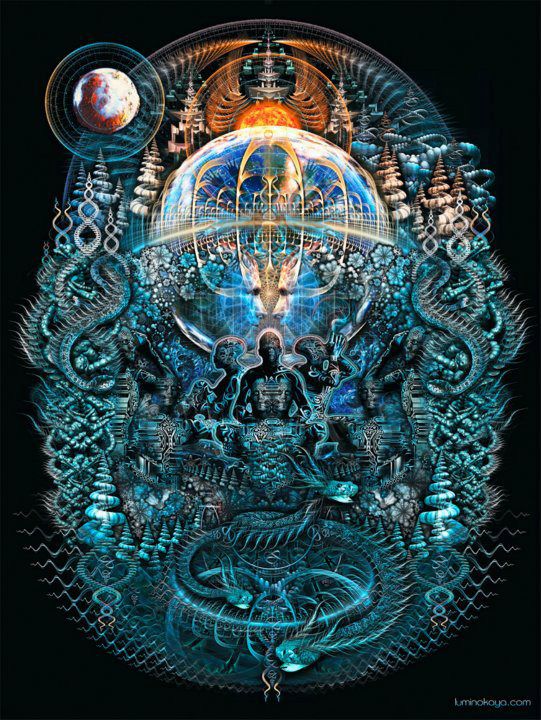
However heavy the burden of responsibility the Magus must bear, the wings of his freedom must be able to lift his mind above the storms of life.
The Magus is not a downcast pilgrim; he is a joyful, curious wanderer walking the Way of his destiny.
The Battles of the Magus do not rob him of his inner lightness; his victories and defeats do not add to his burden.
At the same time, the Magus does not lose his connection with the material plane, does not fly away into the heavens, and does not dissolve into the unmanifest.
Such a state of ultimate lightness that does not become detached is described as a “journey on water” — a fundamental metaphor in many mythologies.
That line, the Threshold, along which the Magus’s Way passes, is the balance between responsibility and freedom, interconnections and non-attachment; an excess toward either pole reduces the effectiveness of movement.
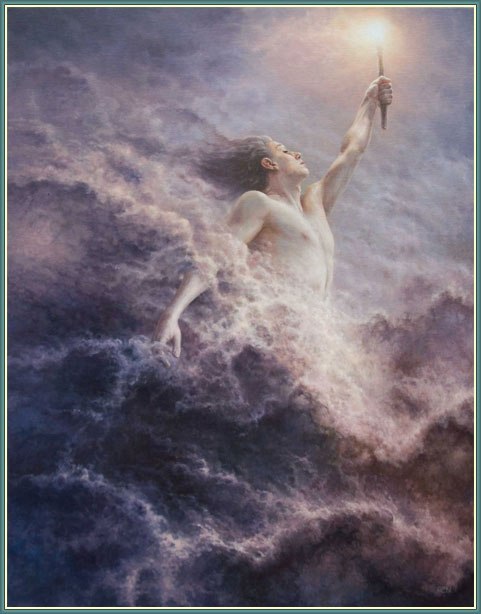
The Magus walks on water.
He neither sinks nor soars away.
This means that he neither plunges into the thick of manifested being, nor hides from it, nor ignores it, nor flees.
By generating within himself the power of Veles — the Threshold — he does not blend with the bustle; he remains distinct and unentangled. Yet by generating the energy of Semargl he actively uses the field of possibilities that the surrounding battlefield offers him for the development of his awareness. The Magus is not a monk, nor a community activist.
His Way is between immersion and dissolution, between air and water, between thoughts and feelings.
Whenever the Magus feels that he is sinking into the abyss of the unmanifest, dissolving into the world’s flow, he must take a step toward his individuality; and whenever the Magus risks becoming mired in activity, he must step back into his mind.
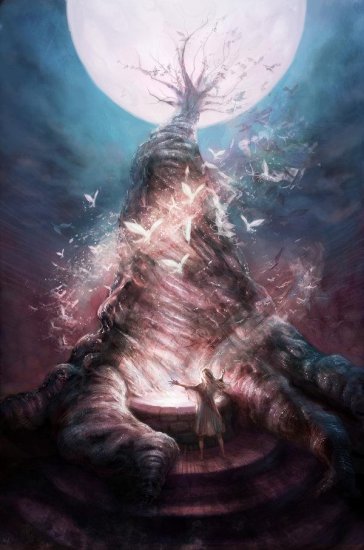
All the Magus’s battles occur simultaneously in the psyche and macrocosm, and his attention is turned in both directions — inward and outward.
A Magus absorbed only in inner battles may become a mystic, while a Magus who turns his attention outward may become a show-off or a sorcerer. It is not that the mystic’s Way is worse than the Magus’s Way — they are simply different Ways, and although every highly realized Magus is in some respects a mystic, and every true mystic is also a Magus, mixing these ways at the beginning of the journey is not particularly effective.
Understanding that the world is at once infinitely full and utterly empty, the Magus acquires the ability to walk on water, neither sinking nor leaving any trace, free like the Great Spirit itself — the unified, indivisible identity that is the goal of the Magus’s development.
Good day! An interesting article, but the moment of differentiation between the mystic and the mage is a bit unclear, for example, according to the analogies of the Scandinavian Three Great Branches of Power – Galdr, Sait, Trot. As I understand it, you refer to mages specifically as followers of Galdr (The Path of Realizations), while mystics can be related to Sait (The Path of the Unconscious, Pure Spirit), and Trot to theurgy (understanding the will of the gods)?
To walk on the edge and not cut your feet,
To strive upwards but not to melt away in the height,
To go through darkness yet faithfully follow the road,
To fly to a dream on the wings of inspiration.
Thank you for the article. Recently I was roughly thinking about this, and I recalled lines from Nautilus mentioned in the audio ‘Parable of the Pythons and Rabbits’ by Kurginyan.