Flows of Zhiva
The embodied state of mind, which is the Way and the method for realizing its potentials, requires support in the form of a conduit — the body, which, in turn, needs resources from the environment to exist.
Some of these resources are obvious; others often escape close attention. People are used to noticing only those factors that guarantee their survival and existence at a “basic” level, whereas the “advanced”, i.e. a more fully realised existence — requires accounting for a greater number of factors.
Although, of course, a highly developed mind is capable and ought to form and transform its environment when its tone is high, in periods of decline it is more effective to take external influences into account and to use them for support.
Both extremes — complete reliance on the “power of mind”, and an infatuation with “energy” — limit development: the first — technically, the second — ideologically. The golden mean of the Magus, of course, must take both factors into account.
A Magus on the rise, steadily moving upward, can ignore energetic tensions, dietary or sexual limitations, larvae (subtle entities) and vortices — while his mind is powerful and intact, he will easily overcome all of these. However, in phases of formation, restructuring, moulting, reassessment, when the tone of his mind falls or becomes destabilised, all these factors begin to play a noticeable role.
An important factor influencing the development of mind in its quasi-stationary state is the flow of Life force, which is available, helpful, or, conversely, obstructive to the accumulation and toning of pneuma.
As mentioned, Life force, although homogeneous in its nature, is at the same time passive, and becomes organised into flows and vortices when interacting with various active objects.
In doing so, by acquiring mobility it also separates a potential difference, a binary, the active component of which — the reflection of the impulse that gave rise to this mobility — is called Yar (Greek — Fohat, Chinese — Yang), while the passive component — the reflection of the primordial unity of the Medium — is Zhiva (Chinese — Yin). If a flow moves swiftly, or a vortex winds sunwise, Yar predominates; if it flows smoothly or the vortex is wound counterclockwise, Zhiva predominates. Note that this pair of properties — the intensity of motion and the direction of the vortex — can also be considered separately, since each can exert its own influence on a person’s body and the objects around him.
Flows of Yar can be useful when activity needs to be added, but destructive if the system is not strong enough to accept that activity, because Yar is difficult to control. Similarly, flows of Zhiva can add health and vitality, but can also suppress or “dissolve” manifestations of mind. In other words, effective development requires a dynamic balance between these components, and the temporary predominance of one pole should be compensated, when necessary, by the predominance of the other.
It is useful for the Magus to activate Yar around themselves when they lack activity, and to moderate it when movement is excessive; the Magus should seek and initiate Zhiva when he needs depth, but not indulge in it when he risks losing his activity.
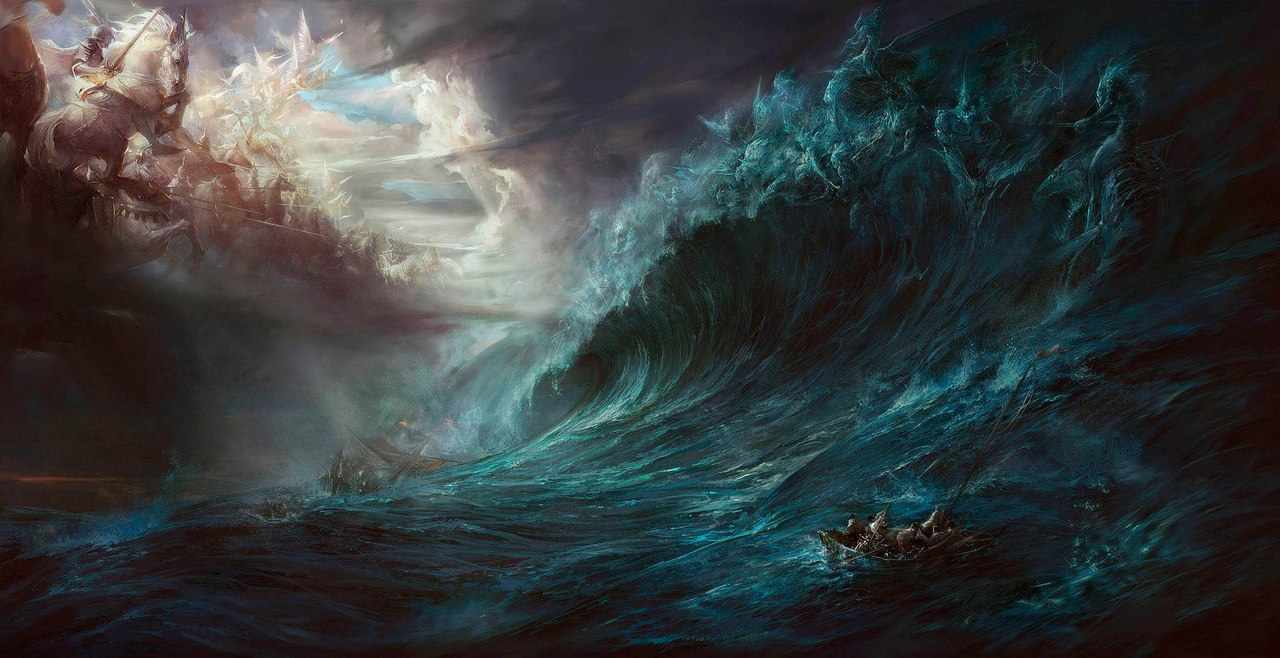
The art of using flows of Life force, as well as their transformation and restructuring, has always been one of the principal factors in forming a harmonious living environment among all peoples and cultures.
Similar forms of support for the development of mind include the induction of Power by places or objects, and by beings with developed Baraka.
Thus, the Magus actively forms their surroundings so that it is as favourable as possible for his development, especially in times of decline and instability. He must have sufficient breadth of outlook and attentiveness; he must notice and assess the conditions in which his activity takes place and, when necessary, change, supplement, cleanse or restructure it.
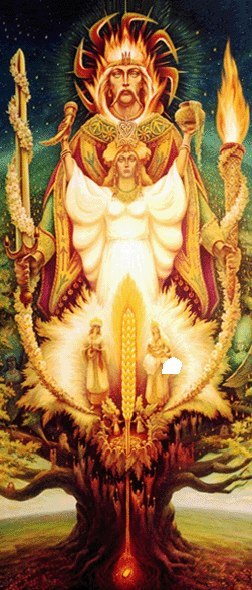
‘Similarly, the streams of Ziva can add health and vitality, but can also suppress, ‘dissolve’ manifestations of consciousness’ – a practical example can be observed in everyday life in the case of ordinary individuals. The simpler the level of awareness, the more they feel a sense of ‘joy’. Energy overflows. They rejoice at everything. They laugh at any reason.
Is it so? The streams of Yar and Ziva in the matrix of elements: Yar – intensive whirlwinds of sunward-fire energy, summer, and smooth whirlwinds of sunward-air, spring; Ziva – smooth whirlwinds against sunward-earth, intensive whirlwinds against sunward-water energy. Uncontrolled energy of fire can be destructive. Water flows of emotions can ‘dissolve’ consciousness. Is it so that sunward is more like an ascending direction, correspondingly – against sunward is descending?
Here’s the translation to English:
“For me, these are very complex questions. I will express what I know and what I have noticed.
First, the question: why is Yar oriented towards the Sun, while Zhyva is against the Sun?… The Sun moves clockwise across the sky. The Earth moves counterclockwise. When you rotate in the same direction as the Earth, you’re kind of catching up with it; when you rotate following the Sun, you’re kind of accelerating and running away from the Earth… like in one song, ‘And you run after the sun…’ or ‘Run, run after the sun…’. Moreover, this can be easily verified in practice. You can simply spin in place or run in circles… and notice your feelings. We have tested this in the gym many times and observed how it affects people with knowledge and understanding. And everything corresponds. I should also note that there is a Tibetan practice called ‘Eye of Awakening,’ where awakening begins precisely with the bright rotation towards the Sun.
Regarding whether Yar is ascending or Zhyva is descending? In my understanding, this is undefined. For the experiment, you can do the following: you enter an elevator on the ground floor. You press the button for the top floor. While the elevator moves up, you rotate in place toward the Sun—this is the ascending Yar. 🙂 Then you go down and rotate toward the Sun—this is the descending Yar. The same applies to Zhyva.
As for how it is in nature… in my opinion, it varies depending on many factors… I recently read that natural crystals, for example, are alive and when they grow, some twist toward the Sun while others twist against it. Thus, one could say that crystals can also be male and female. :)”
Theo, interesting comment. If we take the Sun and the Earth as sources of Yar and Zhivi respectively, we can envision the bidirectionality of each flow. After all, both the Sun and the Earth emit something and absorb something. So, both flows can be ascending and descending, even simultaneously.
This analogy of Yar with the Sun and Zhivi with the Earth helps to realize that they always act on a person. The question is to what extent one is aware of them and resonates with them.
Regarding the perception of directions—clockwise and counterclockwise. For me, clockwise feels like an upward direction, while counterclockwise feels downward. I wanted to know if these lines are perceived this way by me or if it is common. Like right—towards truth, left—“towards another truth :)”, as a circle feels dynamic, a square feels stable.
Greek, there seems to be some contradiction in your comment for me. Rough manifestations of emotions can be linked to a low level of awareness. Those who ‘laugh at every occasion’ can start a fight over nothing, just to fight. For me, this is linked to the person’s very energy – low and rough, not with the flow of Ziva. On the other hand, I agree – the higher the level of awareness, the fewer reasons there are for a smile. For example, people who live in a survival situation. For example, firefighters, rescuers, or surgeons usually do not have time for smiles. The faces of the inhabitants of tribes or places where hostilities are ongoing and where vigilance needs to be maintained are also not Hollywood. I admit, I have noticed that during my time on this site, I have become much less smiling. However, ‘the feeling of joy’ is something else.
Thank you for the article! Just in time, I intuitively approached this: there is constantly a process of oscillation between activity and depth. If you linger too long in some state, effectiveness decreases. Enmerkar, tell me, can manifestations of slash occur without aggression? And in general, how are these concepts related? Can destruction happen without aggression, but always imply activity/anger? How is it best to control this energy of activity? Or just add Ziva?
I think that the primary fire ‘Yar’ cannot be described with such words as ‘aggressive’, as ‘Yar’ is an unformed, unordered fire. https://enmerkar.com/en/myth/yar-primary-fire https://enmerkar.com/en/myth/fire-the-activity-of-ascent Destruction, like any other action, implies activity, but not fury.
“I think that the primary fire ‘Yar’ cannot be described with words like ‘aggressive.'”
Why can’t it? If you are using Slavic myths, please use Russian words. ‘Aggression’ in Russian is ‘нападение’ (attack). Can’t one attack with primary fire? What about the rage that is in action?
…Destruction can be very different. Including cold, calculated destruction. And ‘act’ in Russian means ‘действие’ (action). To destroy, is action needed?… Naturally. You can’t catch a fish without effort.
How to control Yar?
“There is strength, no need for mind,” says the saying… But what if there is both strength and mind? … Strength here is Yar, mind is the structure… Yar is fire… mind is the valves for the fire… and together what are they? … A FIRE-MASTER! 🙂 Therefore, Yar is controlled by the mind.
Look at this article; it’s very close.
https://enmerkar.com/en/way/the-awakening-of-the-dragon
Svetoyar, I apologize… another article.
https://en.enmerkar.com/myth/on-the-wings-of-your-dragon
What is said in it about riding the Dragon is quite applicable to managing the streams of Yar. (And maybe here Yar and the Dragon are the same thing, just from different myths?… Perhaps, the Dragon is the source of Yar? The fire-breathing Dragon… hmmm…)
But with some additions… In my understanding, not every yar-whirlwind is connected to its own Dragon. Accordingly, in order to manage each yar-whirlwind, it is not at all necessary to venture into the Psychocosmos in search of the Virgin. Sometimes it’s enough to find the nearest suitable structure.
In simpler terms: one can outline the boundaries of “allowed” and “forbidden” themselves and establish the paths for the fire to follow, setting rules for rage. Therefore, there is a resemblance to a flamethrower.
It’s unlikely that anything can be controlled with the mind 🙂
I doubt that in this myth, Yar and the dragon are the same; rather, the dragon is born from Yar, meaning that, on the contrary, Yar is the original source.
And I’ll repeat my thought once more: Yar is unformed energy, so Yar, who is already attacking (formed), is no longer Yar, something like that 🙂
And why is Yar considered unformed energy? The question of unformedness may be relative. After all, Yar itself, as the Primary Fire, is already a form that the Creative impulse takes as it penetrates the World environment – this is from the link you provided.
And the paragraph “The Primary Fire, still unformed and unordered – is not only the primary substance of creation but also a source of destruction and rebirth.” I interpreted it as: “the unformed, unordered Primary Fire can be a source of destruction.” That is, aggression. This part of Yar—unformed in my depiction—represents the Fire Dragon.
I’m not entirely satisfied with the fact that I’m writing a lot here by myself because I love playing together and in games where everyone wins, but there’s nothing to be done.
Thoughts emerged from here, so they must mean something in the end.
As always, this is a sketch on a social and domestic theme.
Magic, streams, it’s all good, but we ourselves are walking embodiments of a part of energies, and in my opinion, that is the greatest magic.
I have some observations on this matter:
As a 100% woman, I’ve noticed this – I can manifest desires brilliantly, right down to getting an apartment in a week or winning the lottery instantly, if I like them and truly want them. Moreover, I can create and structure space. This is also completely obvious, especially in places where I work infrequently but where I’m known – when I come to work at an event, the last time I heard a rather amusing phrase: “Well, thank God, everything will be fine now.” Although my part of the work there was minimal. I just can come in and make the environment pleasant.
At the same time, I can’t create a vector, a goal. I can only pull it out of space if it exists or join in and realize one that I like.
These observations are backed by years of monitoring a large number of people – women who can set goals usually do not do it alone.
Besides mushrooms, there are many ways to delve into the subconscious, and it’s clear that the clear vector born of a woman is the goal referred to by psychologists as the “inner man” – that part of the subconscious that reflects the parent or the person who has replaced them.
I might even be willing to say that according to my data, women create curved vectors separately while men create distorted spaces.
And there might be a theme of “overcoming one’s nature,” but I’ll say something amusing – I know it, and I enjoy it. Perhaps that is the overcoming itself?
The only thing is that, as always, all this is not easy. Try to find, for example, a director (at work) who is sane and whose goals are pleasant to realize, a director who will know your needs and generally understand what’s happening.
My colleagues are great guys, and we’ve done great things together, but the maximum understanding in the moment is bewilderment, especially when I’m leaving – it’s a funny kind of “Shovel, where are you going?”
I keep thinking about why we talk so much about magic and don’t live it, don’t extract what is in it… “We all run around, knowing not what we seek…”
An hour ago, I heard that the attention and goals of a Man are precise, like those of a Hunter. And the attention and goals of a Woman are a domain, a field like that of a Gatherer.
I also studied tunnel and panoramic perceptions of the world and checked it many times. This can be seen even in something as small as navigating the environment, reflected in the simple question “How do I get to the library?” A man will most often describe directions in terms of orientation—right, left—while a woman will refer to objects that have emotional significance for her, such as “over there behind the store,” “next to the pink house,” etc.
Maria, you’re sharing interesting things. Thank you.
I would like to slightly disagree.
“The data is supported by many years of observations of a large number of people—women who can set goals—ultimately do not do this on their own.
Aside from mushrooms, there are many ways to look into the subconscious, and it’s evident that a clear vector, born of woman, is the goal of what’s referred to by psychologists as the ‘inner man’—that part of the subconscious that is the imprint of a parent or a person who has replaced them.”
Probably, in 95% of cases, that’s how it is, based on my observations. It seems I’ve been lucky with those 5%. I have known women who could indeed set a vector and did it better than many men. And this was not an echo of past interactions with men; it was their own vector. But, of course, that is a rarity.
————–
“I would even say that according to my data—women, separately, create curved vectors while men create distorted spaces.”
Well said. But! I have known men who can create harmonious spaces perfectly, and not deliberately; it comes naturally to them, by their nature, and their sexual orientation is just fine. And I’ve already mentioned the women’s vectors.
———————
“Most often, a man will speak in terms of direction—right-left, while a woman will relate to objects that have sensory significance for her—’over there behind the store,’ ‘next to the little pink house,’ etc.”
That’s right 🙂 This suggests that if the task of locating something is complicated, and a man explains it to another man, then it’s fine, but if to a woman, there’s a high probability she won’t understand.
That’s why I play a kind of quest: to tune into the person and explain in a language they understand.
By the way, we played an encounter game. (If you’re not aware, these are urban games for finding objects and such.) (And not just from here.) Men generally don’t like solving riddles and making suggestions about where something is, especially if they aren’t sure, even if they have good ideas. But if they’re confident, they speak with enormous pleasure. If they’re wrong, they either get frustrated or fall silent—it’s a loss. Women, on the other hand, prefer to express ideas, even if they have doubts, and if they make a mistake, they take it much more calmly.
Men enjoy getting someone to a specific place. Finding a known object is also enjoyable. Guessing and rummaging through a map to locate that object—not so much.
——————
“Try to find, for example, a director (at work) who is reasonable and whose goals are pleasant to implement, a director who will know about your needs and generally understand what’s going on.”
The question is: if a director doesn’t understand the goals and needs of their subordinates, then what do they even need to be there for? And why would they care at all if the vectors are different? It would then be slavery. Here, in the main articles by Ena, there are notes about “calling and calling approaches.” That’s exactly it.
———–
“I keep thinking about why we talk so much about magic and don’t live it, don’t extract what it has…”
“Everyone runs around, all clueless about what we’re searching for…”
I extract, but it enters the human world with difficulty. The acceptance rate is minimal. The question is, what do they need? I constantly ask myself: do they themselves need Power, individuality, Love? And the answer usually comes back like this: Power is needed, but only for oneself, free power, to dominate others, and to could be hidden away, so they wouldn’t have to show individuality. Love is needed, but people are afraid to admit it to themselves. They see love as a weakness. What are they looking for? Usually, nothing at all. They wander. They wait for something to come on its own. And they’re content with that. Is that why they need: Power, individuality, Love?
I see here careful reading and dialogue, with no objections 🙂
And perhaps this is exactly what was missing for the full picture – indeed, men can create spaces and women can create vectors.
Maybe this is one of the lessons to avoid falling into absence? For instance, if all ears are on the front.
I can create them, but I don’t like it. Personally, I enjoy being the space and making sure the vector wins – this is one of the never-ending pleasures for me – to see a man get what he wants.
My directors are good guys and have taught me a lot. But they are certainly not magicians. And one proof of their wisdom as people is that they allowed me to leave. Although, of course, I didn’t want to 🙂 I consider this a learning interaction and a very good experience, not slavery. In fact, they are a rare example of a truly possible symbiosis in business for me. And we saw what can come of it and how everyone can benefit when doing business in accordance with their nature.
Here’s the translation to English:
“I had less luck with partners. And the overall benefit interested them the least.
When it comes to utilizing the natural strengths of employees, it’s generally the same everywhere; they are seen as just a mass. In one place, for example, a girl was given a male job, and then she was just rudely suppressed, publicly humiliated, and eliminated. Afterwards, they decided that women weren’t needed at all.))) And then, the company started going downhill, and employee turnover increased. My explanations of the situation for them were, ‘of course, just empty words.'”
The practice of non-violence expands perception, as they say, and that certain special effects occur. And I don’t think we should focus on them or grab at them. They really just happen.
I don’t know what the simple development of the “second sight” leads to. What vision and of what quality. In essence, all filters in consciousness remain, and the mental and energetic plan becomes visible. But along with it, all one’s own filters as overlays. I think there is also a plane of causes, but I have a rather vague vision on it for now. I have seen it a few times and in dreams. The mental – these are thoughts. In my format, they are read as waves, probably similar to radio waves. And they are felt as pressure and as movement. I feel it pretty physically. And when focusing attention and deepening into the sensation – it becomes clear what this is and from whom. After a year of having this option – I have already slightly figured out the localization and shades of sensations. I need to learn to read further. Seeing energy and flows – this is the second part. Probably reminiscent of electricity and warmth. This is also quite tangible. And I think there is also, by analogy with physics – the field of other particles. I have only seen this third level a few times. So the practice of non-violence immediately and quite noticeably expands the perception of the mental. Words and images.
I have also contemplated the reasons and sources of vision. For example, if it results from the development of consciousness, or from developing the “sight” itself, then the vision can vary. I think that there is egregorial and streaming vision. For instance, being a part of some stream, you see everything in the symbols of that stream. Here I am most interested in what happens when you see the opposing stream in the form of danger and enemies.
Wonderful thoughts. Thank you very much.